
Two runners accumulate the same kilometres or training time in a week yet experience their programmes differently. One has almost identical days; the other alternates shorter and longer, easier and harder tasks. The weekly total cannot fully describe this difference.
Training monotony is a measure attempting to quantify variation in daily loads. It asks a useful question, but it is easy to expect too much. It is not a boredom meter, medical diagnosis or automatic prediction of who will become injured.
First separate two kinds of monotony
In everyday language, running the same park loop every Tuesday can be monotonous. Monotony of load distribution refers instead to similarity between daily numbers. Varied routes can still involve nearly identical loads, and the same route can support different days.
This matters because the solutions differ too. For boredom, company or a new environment learnt safely may help. An unfavourable distribution of daily load calls for reviewing weekly structure. A new route alone does not necessarily reduce similarity between tasks.
The questions can intersect, but should not replace each other. Running experience and load interpretation both matter. Neither automatically establishes the state of the other.
Where does the load measure come from?
An early study based on observations of twenty-five experienced athletes examined relationships between load, daily variation and illness. It described monotony as mean daily load divided by its standard deviation. This was a research and practical monitoring tool, not a risk threshold valid for everyone.
The logic is simple: closely grouped daily values produce a smaller standard deviation, so the ratio can be higher. More varied values produce a lower ratio. The number alone cannot establish whether the total chosen load is appropriate.
This limitation matters. A very easy week with similar days and an excessively hard week can both produce higher monotony. Daily similarity is not the same as certainty that the task is too large.
What represents daily load?
One usable approach connects the full session’s duration with its overall perceived effort. The study of the session-RPE method examined this quantification under several loading situations. The resulting unit supports planning; it is not directly measured tissue load.
For a simple illustration, a forty-minute complete session rated four can yield one hundred and sixty arbitrary units when the chosen scale is used consistently. The number summarises your entry. Equal values from two people do not mean identical loads in every respect.
Clarify the scale and recording method beforehand. Do not rate the hardest repetition one time and the whole run another. An interpretable diary needs a consistent method, not necessarily a more complicated formula.
 Enlarge diagram
Text version of the illustration
- Week A
- 0 · 300 · 200 · 400 · 0 · 200 · 300; mean: 200.
- Week B
- 150 · 250 · 150 · 250 · 150 · 250 · 200; mean: 200.
- Different variation
- Daily values have different spreads, so monotony differs too.
A mathematical example with equal weekly totals
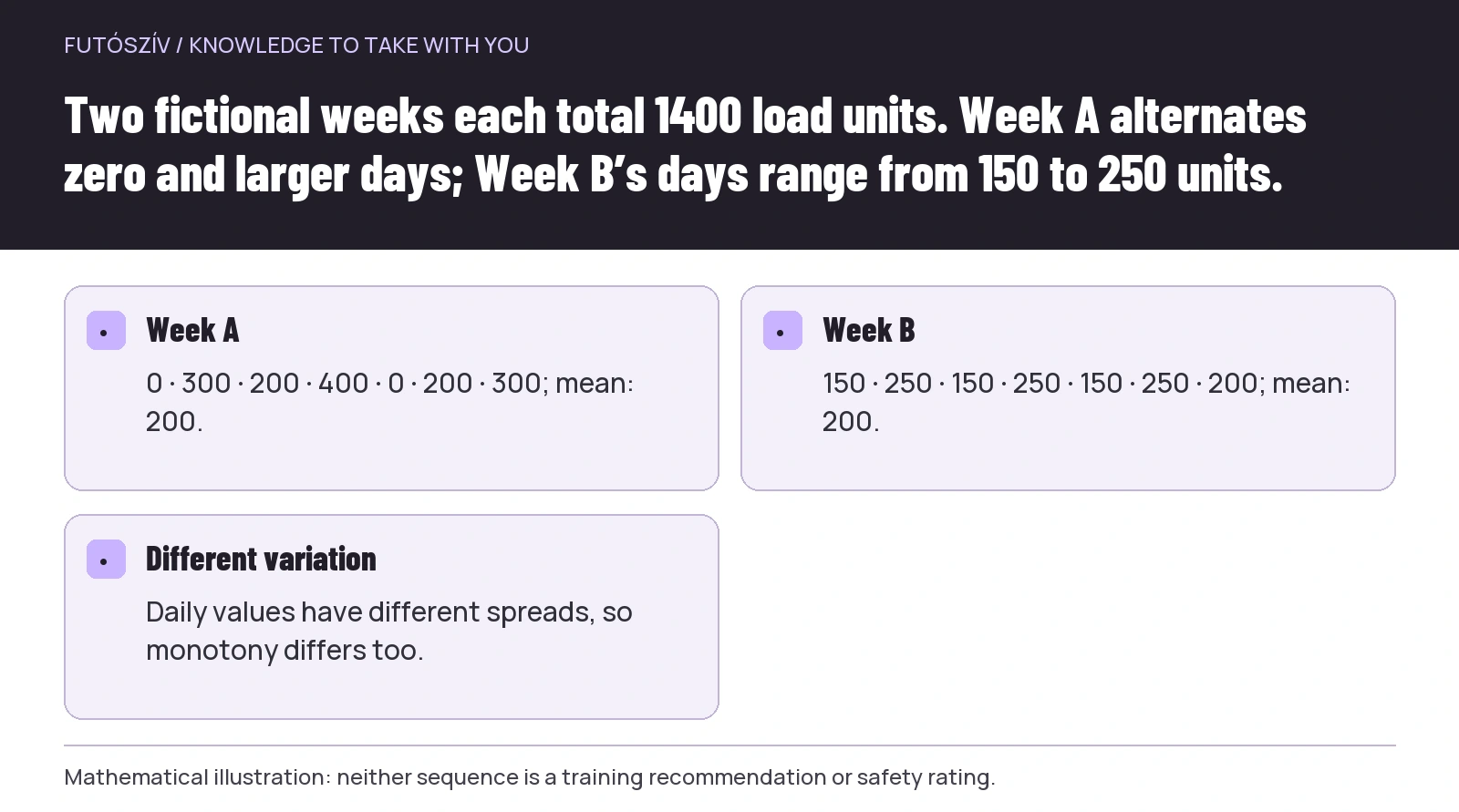
Imagine two fictional weeks. Week A has daily values of zero, three hundred, two hundred, four hundred, zero, two hundred and three hundred. Week B has one hundred and fifty, two hundred and fifty, one hundred and fifty, two hundred and fifty, one hundred and fifty, two hundred and fifty and two hundred. Both total fourteen hundred; both daily means are two hundred.
Treating all seven days as the full dataset when calculating standard deviation gives approximately one hundred and forty-one units for A and forty-six for B. Dividing the mean by standard deviation therefore gives roughly 1.41 and 4.32 respectively. The difference comes from distribution.
These are calculation examples, not recommended training plans. The four-hundred-unit day in the lower-scoring week could still be excessive for a particular runner. Higher monotony alone does not prove the other week dangerous. Consider total, distribution and personal background together.
Do not confuse a rest day with missing data
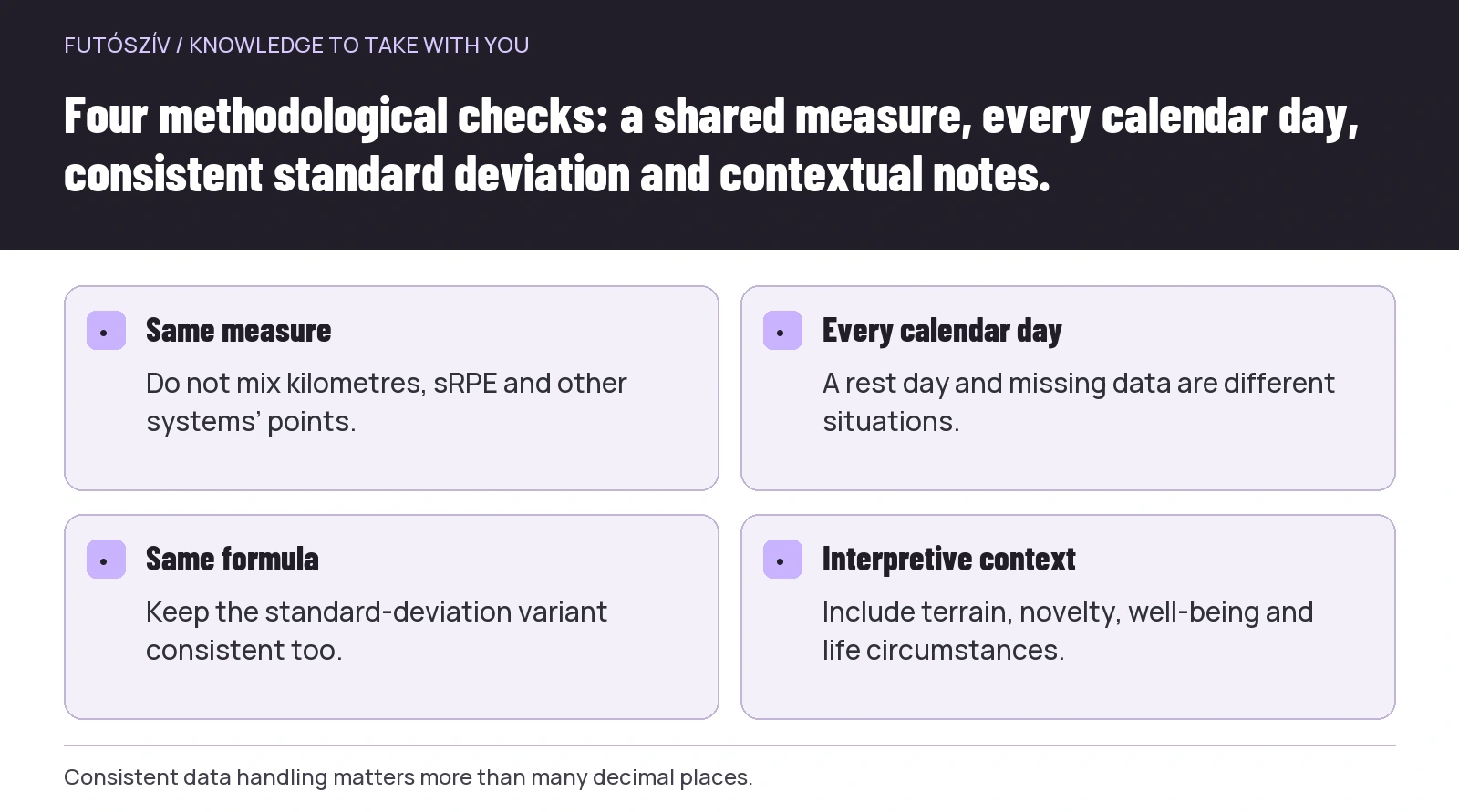
If your method counts every calendar day, a genuinely training-free day can have zero sporting load. Keeping only training days in the table instead produces a different mean and standard deviation. These numbers are not comparable without explanation.
A missing entry is different. You do not know whether load was zero or simply unrecorded. Do not automatically turn it into a rest day, artificially altering the week’s pattern.
Likewise, decide how to handle multiple sessions in a day and other sports. Use a consistent rule for the daily total. If you start adding strength work in one month, comparison with earlier periods involves a methodological change.
Identical days expose a limit of the formula
If every daily value is exactly identical, standard deviation is zero. You cannot divide the mean by it in the usual way. A spreadsheet may show an error; an app may show an extreme value under its own handling rules. This is mathematics, not a sudden medical alert.
Even with a very small standard deviation, a few units’ difference can substantially change the ratio. Do not treat decimal-place differences as independent training instructions. Look at the actual daily sequence too.
Apps may calculate differently: which days they include, which standard deviation they use and how they handle missing values. Without knowing the formula, comparing two platforms can create an apparent difference.
Do not increase variation for the measure’s sake
You can lower the monotony ratio by making one day unjustifiably large. The week then becomes more varied mathematically without necessarily being better planned. Producing a prettier number is not the goal.
For the same reason, do not add a new hard task solely because days look too similar. An appropriate change can also be a shorter or easier session, a different order or rest. Begin with the programme’s purpose, not improving a ratio.
Variation has several dimensions. Equal load numbers can conceal different terrain, downhill running, accelerations or strength work. The formula cannot see these in detail, so written comments remain valuable.
What does running-injury research say?
A study following twenty-five male trail runners for a year analysed changes in several load measures, including monotony, during weeks preceding injury. The small sample, participant characteristics and substantial individual variation limit generalisation.
Retrospectively comparing weeks before injuries is not the same as proving that a predetermined number reliably predicts the next injury for every runner. Further evidence is needed between an association and a usable personal alert rule.
Treat the measure as a question-generating tool. If it changes, examine programme and well-being. Do not diagnose from it or treat a favourable value as a guarantee that any load is appropriate.
 Enlarge diagram
Text version of the illustration
- Same measure
- Do not mix kilometres, sRPE and other systems’ points.
- Every calendar day
- A rest day and missing data are different situations.
- Same formula
- Keep the standard-deviation variant consistent too.
- Interpretive context
- Include terrain, novelty, well-being and life circumstances.
Make daily differences functional
Differences between easier and harder days are meaningful when they serve a role. A manageable task after a key session, shorter running on a busy workday or orderly spacing around new strength work can fulfil concrete purposes.
Every day need not be entirely different. Consistent routine and a familiar easy route can provide a good foundation. The question is whether important tasks fit and the week remains sustainable after harder days.
If every run is similarly moderately hard, check whether task purposes have blurred. More fast training is not necessarily the answer. Easy days may need to become easier, with the main task more precisely defined.
The formula does not measure life circumstances for you
Work demands, sleep, travel and family tasks may not appear in daily sport points. A day with zero training can be very tiring. The mathematical entry can remain correct within the chosen sport measure while failing to describe the whole day.
Do not arbitrarily convert every life factor into the same unit. A separate short comment or consistent well-being diary may be more useful. This gives the sequence meaningful context without manufacturing an apparently precise overall risk score.
Share that background with your coach too. A changed weekly measure may reflect a new sport, missing data or harder sensations alongside worse sleep. Clarifying the concrete cause matters more than a red spreadsheet cell.
How to review your own week
First check entries and calculation rules. Second, examine the sequence: where were long or intense sessions, rest and other sports? Third, add well-being and life circumstances.
Only then decide adjustments. Choose a concrete change, such as a shorter easy run on a busy day or better spacing between two demanding tasks. In the following period, observe whether it helped the system work.
You need not introduce a new scoring system every week. A consistent simple diary often provides more usable information than frequently changing scores. Monotony is one possible supplement, not the plan’s main character.
When recognising the pattern is enough without numbers
If weeks contain no genuinely easier day, every run becomes competition and the next session grows harder, you need not wait for a complicated calculation to review the situation. Simplifying the programme can already be considered from concrete experience.
For persistent symptoms or concerning illness, a load measure cannot replace appropriate healthcare help. Neither a high nor low value can determine a symptom’s cause at home.
Training monotony’s best role is reminding you of the days behind the weekly total. Examine the work, how tasks alternate and what remains afterwards. The goal is not a perfect ratio, but manageable preparation suited to your situation.
Primary sources
- Monitoring training in athletes with reference to overtraining syndrome – an early monitoring framework for monotony and load.
- A new approach to monitoring exercise training – examination of a method based on whole-session perceived effort.
- Variations of Workload Indices Prior to Injuries: A Study in Trail Runners – small-sample trail-runner follow-up with substantial individual differences.
How Futószív articles are prepared: our editorial guidelines.