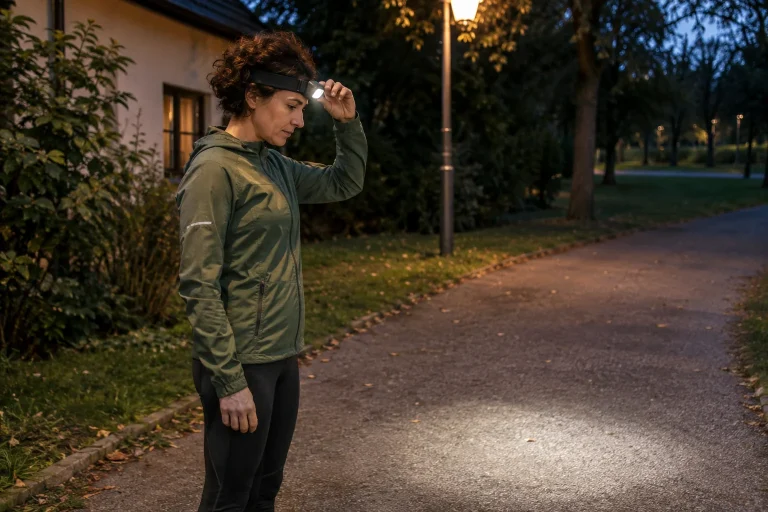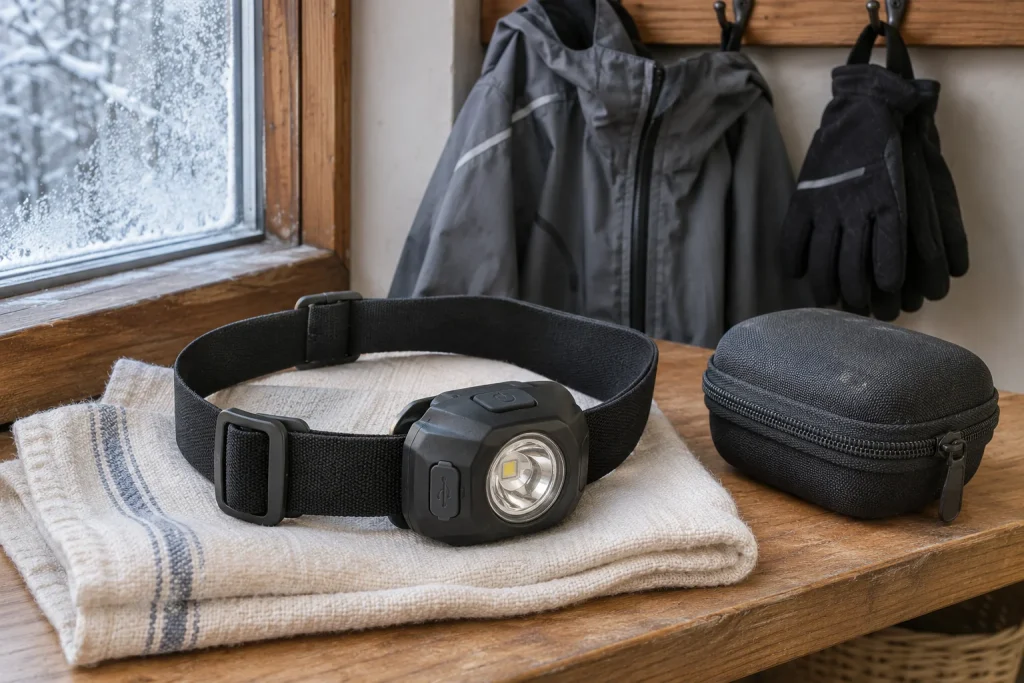
A running light may be an everyday winter tool or spend weeks waiting in a drawer. These situations need different storage routines. A damp strap, switch that can be pressed accidentally and power-source condition need separate attention, while some lights come apart and others use built-in batteries. A good solution therefore begins with your model’s manual. This article helps organise equipment between uses and prepare it for a longer break; it offers no general battery-repair instructions or charging recipe for every product.
Winter is not one storage condition
A light resting indoors between evening runs differs from one left in an infrequently used bag for a month. A car boot, unheated store and heated home are different environments, so look beyond the season’s name. Find your manual’s storage and charging conditions and compare them with the device’s actual location. A light’s operating temperature range may differ from permitted charging or long-term storage conditions. Record these separately.
Write down how long you intend to put it away and when you need it again. This need not become a complicated equipment diary: the point is to prevent an extended break happening accidentally in a soaked sports bag. If the light serves as an emergency backup, accessibility and working condition are separate tasks. You may know where a device charged long ago is, but that does not guarantee suitable operation in the intended mode. Make room in storage arrangements for a check before the next use.
Identify the light and power source
Find the exact model name, manual and power-source designation. Replaceable non-rechargeable batteries, a manufacturer rechargeable unit and a built-in battery do not offer identical handling options. Do not mix similar-looking units when their part numbers or permitted uses differ. A physically fitting connector alone does not prove complete compatibility. Choose backup power and charger for the manufacturer-specified system, and store matching parts so you can identify them.
The Petzl headlamp selection page , for example, describes a design that supports several permitted power sources through its own solution. This is not permission to insert arbitrary batteries into any light. Exact compatibility belongs to the product’s own description. Charging follows the same principle: not every power source you can insert can be charged through the light, and a non-rechargeable battery does not become rechargeable because the device has a port.
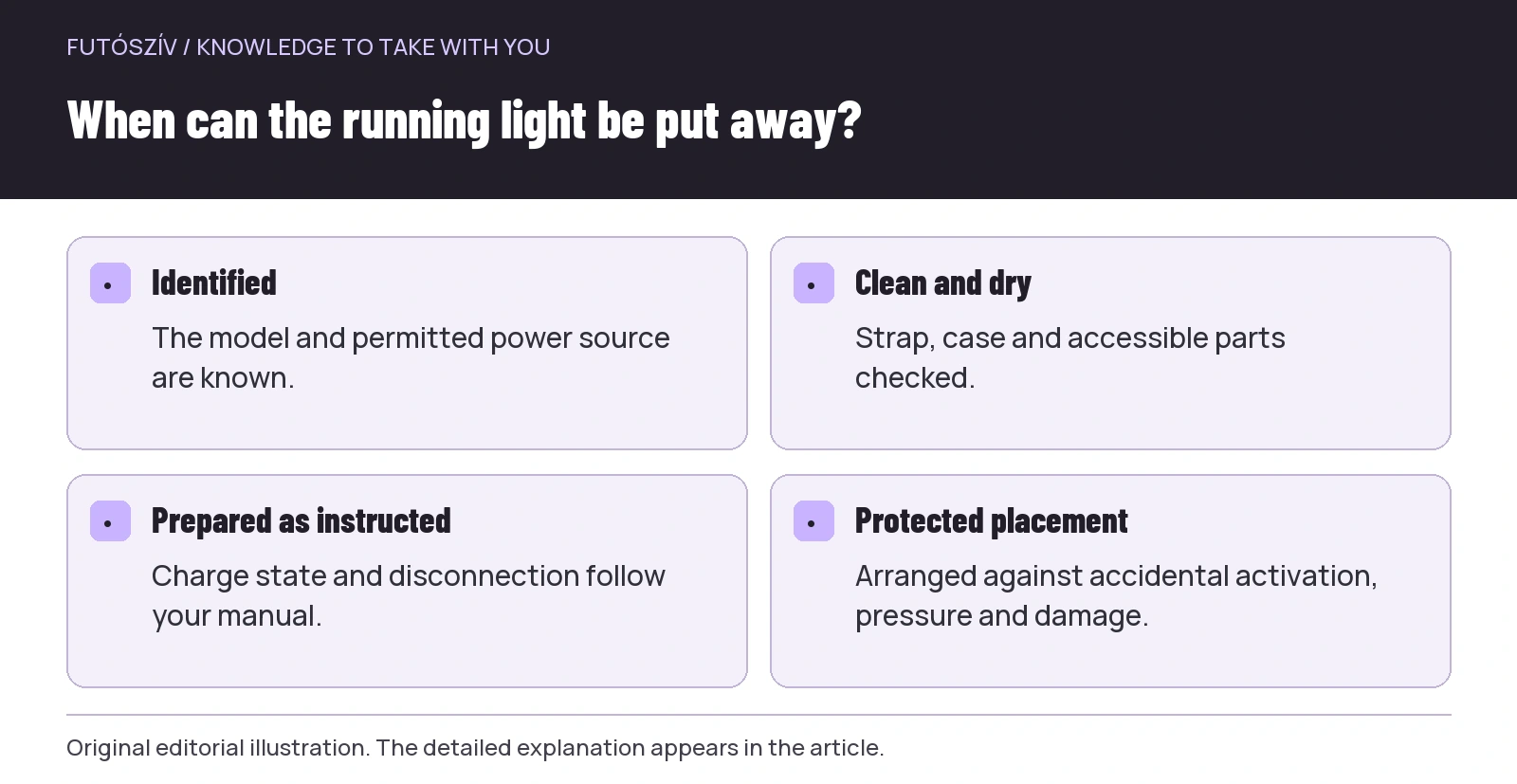 Enlarge diagram
Text version of the illustration
- Identified
- The model and permitted power source are known.
- Clean and dry
- Strap, case and accessible parts checked.
- Prepared as instructed
- Charge state and disconnection follow your manual.
- Protected placement
- Arranged against accidental activation, pressure and damage.
Separate care from repair
After use, inspect the housing, lens, switch, strap and accessible connections. Removing dirt according to your instructions is care; a cracked case, damaged wire or abnormal battery is another kind of problem. Do not treat these simply with more drying or stronger cleaner. Do not open or modify a damaged power source at home. The manufacturer’s fault-handling process and appropriate disposal information provide further guidance, not a general online DIY recipe.
If you notice unusual heating, leakage, deformation or another abnormality, do not start experimentally discharging the device or forcing it to charge. Follow the specific product’s safety instructions and contact the manufacturer if necessary. Everyday storage procedures concern undamaged equipment that can be handled normally. This is an important boundary: caring for a light is not battery repair, and a replaceable strap does not mean electronics or housing can be freely dismantled. Work only with parts accessible in the prescribed way.
Let every accessible part dry after cleaning
Clean the light body and strap according to their own care instructions. A removable textile strap may require a different process from the electronic unit, so do not automatically wash them with running clothes. A photograph can record how to remove and rethread the strap. If it is not designed to detach, do not cut stitching for cleaning. The aim is removing dirt while preserving the original attachment and light-body operation. Coating, seal and switch care instructions matter as much as those for the main housing.
After drying, inspect strap folds, around the buckle and around connector covers that instructions allow you to open. Textile can remain damp beside a case that is dry outside. Do not accelerate drying with high heat unless permitted for the product. A water-resistance rating during use does not imply machine washability or permission to charge when wet. Prepare charging according to the manual’s separate conditions, using an approved charger in an appropriate environment.
Do not guess the charge state for longer storage
The general battery type cannot replace the specific product’s storage instructions. A manufacturer may specify charge state, top-up intervals, permitted surroundings or a disconnection step. The official Petzl R1 technical information , for example, discusses longer storage, charging and battery disconnection separately. Apply such instructions to the named product rather than copying them to every running light. Record your own manual’s requirements together.
If instructions call for regular checks or recharging, set yourself a reminder you can follow. The aim is not to leave the device permanently on charge, but to fulfil its prescribed storage process. Do not assume a percentage rule learnt for another model is appropriate. With a built-in battery, disconnection is a different question too: do not open something the construction does not make user-removable. Replaceability and serviceability are not identical concepts for every product.
| Question | Where should you look? | What should you record? |
|---|---|---|
| Which power source can be used? | Your model’s compatibility section. | Exact type and part number. |
| How can it be stored for longer? | Storage and transport section. | Charge state, disconnection, checks. |
| When can it be charged? | Charging and safety instructions. | Permitted environment and charger. |
| Which part can be removed? | Care and maintenance guidance. | Operations the user may perform. |
Prevent accidental activation separately
Another object in a bag can press a switched-off light’s button. Your model may have a switch lock, physical protection or instructions to disconnect the power source. These are not automatically interchangeable, so read storage and transport guidance precisely. The cited Petzl information also discusses heating from accidental activation. Choose the appropriate preventive step for the specific construction. Assuming a tight pouch protects the switch is insufficient.
Even when putting it away briefly, make its stored state apparent. If using a switch lock, learn to release it too rather than first searching in darkness. If disconnecting the power source as directed, protect the connection according to the instructions and clearly identify matching parts. Do not store loose metal objects beside the power source in a way that could bridge contacts. Physical organisation belongs to storage: the electronic switch alone does not establish the appropriate state.
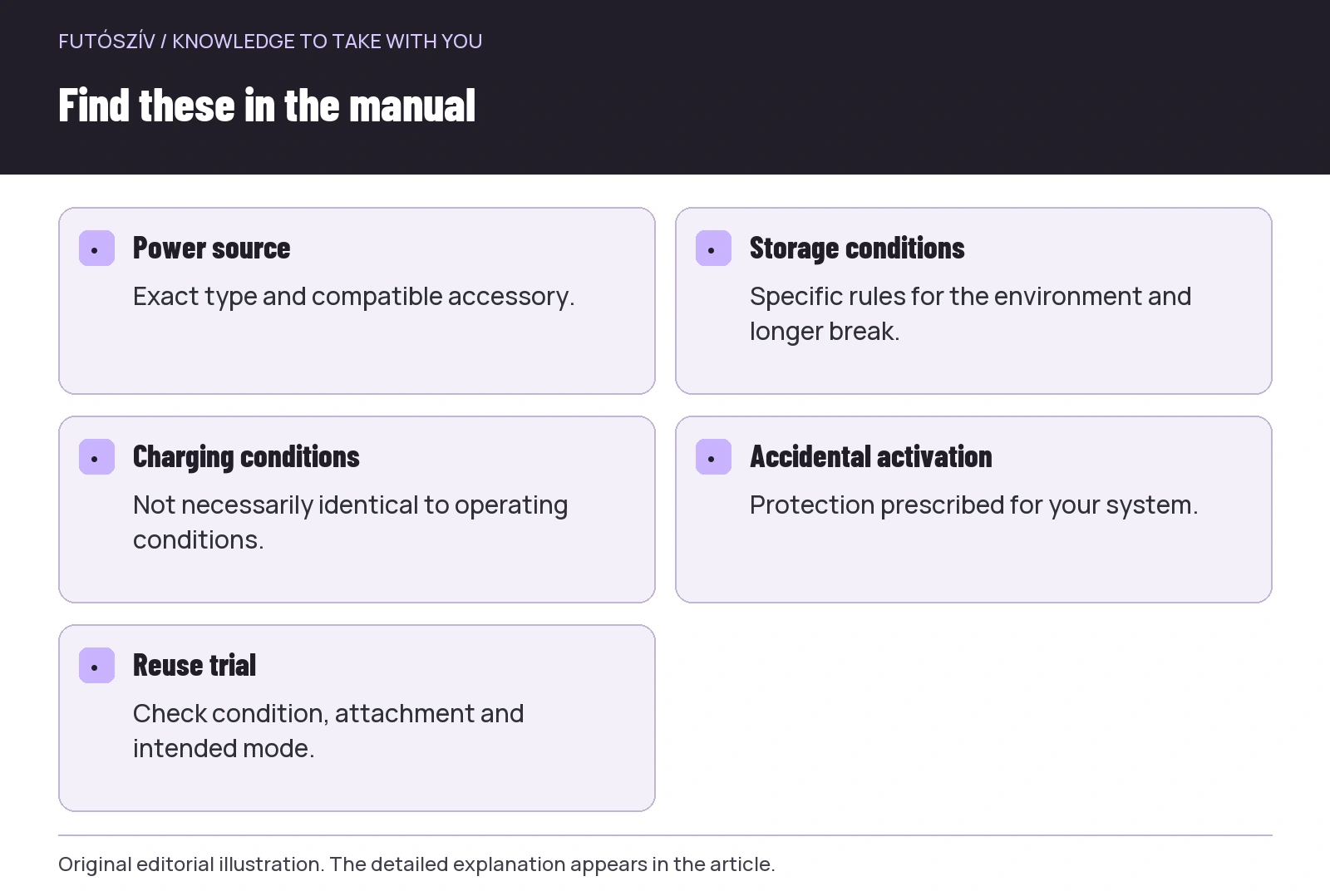 Enlarge diagram
Text version of the illustration
- Power source
- Exact type and compatible accessory.
- Storage conditions
- Specific rules for the environment and longer break.
- Charging conditions
- Not necessarily identical to operating conditions.
- Accidental activation
- Protection prescribed for your system.
- Reuse trial
- Check condition, attachment and intended mode.
Do not wait until the next start to inspect the strap
On a dry strap, inspect textile edges, stitching, slider and buckle. The part holding the light’s weight matters even when electronics work perfectly. A worn strap may be separately replaceable, but find the accessory appropriate to the model. An elastic band of similar width may not route or attach identically. Restore threading from manufacturer guidance and consider the light ready only after checking the complete assembly.
Do not stretch the strap around a larger object unnecessarily in storage, or compress the buckle between light head and cable. Some designs include an external battery holder and wire: arrange these according to the manufacturer. Avoid sharp cable bends and weight pressing on it. If an attachment fails, random glue at hand is not an appropriate repair. Strap and hardware may seem inexpensive, but they are real elements of the light’s usability.
A storage case supports organisation, not drying
A suitable case protects against scratching objects and keeps accessories together. The manufacturer page for the Silva storage case , for example, shows a separate compartment for small parts. This does not mean wet equipment can go into a closed case or that every power source can be stored inside in any state. A case is an organised place for prepared equipment. First make the system clean, dry and in the instructed condition, then choose physical protection.
Inside the case, a charger or cable should not press the switch, nor should a spare accessory scratch the lens. A brief product-identification note or manual location may be more useful than collecting several unknown cables. If you own several lights, clearly match spare batteries and accessories to them. Do not keep an obsolete or damaged part among working equipment as a ready backup. Confusing faulty and usable equipment can become apparent later in the wrong place at the wrong time, so separate their states when tidying.
The check before next use
When taking the light from storage, inspect visible condition, attachment and the power-source indicator. Prepare it according to manufacturer guidance, then check switching and the intended mode in bright, calm conditions. A momentary flash does not prove sufficient runtime for the entire next run. Runtime planning requires the manufacturer’s figures for the specific mode and your own use conditions. Checking storage and planning route illumination connect, but are different tasks.
Check strap adjustment with your hat or other headwear too. If the light is needed on an important route, do not discover a missing accessory or forgotten switch lock at departure. A good storage routine ends with every part findable, known device condition and time left for preparation. In winter darkness, a light prepared for use can then fulfil its role, rather than hope invested in an object left untouched for a long time.
Sources and further reading
- Petzl: headlamp power sources and constructions
- Petzl R1: official technical information and storage instructions
- Silva: Headlamp Storage Case
How Futószív articles are prepared: our editorial guidelines.