Trail experience is not a single pace figure
You are preparing for a shared forest run and everyone reports similar road ten-kilometre results. Yet people may differ in following waymarks, familiar terrain and map use. If you form the group on pace alone, these differences may appear only at the first complex junction or narrow section.
Planning a shared trail loop therefore begins by comparing its tasks with participants’ experience. You need not rank your friends. Choose an outing whose framework everyone understands and for which the group actually possesses the necessary knowledge. This guide offers considerations for organising small, prearranged shared runs; it does not replace leadership training or personal professional preparation.
Ask about specific situations rather than a general level
“Have you run on trails?” can produce many kinds of yes. A gravel loop on a city’s edge differs from a longer forest route involving several waymark changes. Ask instead what kinds of routes the person has used, how well they know the area and which tasks they still want to learn.
Independent navigation is a separate topic. Someone may be a fast, experienced runner while hiking maps are new to them. Another participant may move more slowly yet know the route and sources of local restrictions well. These are different strengths. Do not automatically assign group tasks according to the best race time.
A few short, factual answers are enough for the discussion. Every participant need not provide a public health or performance dossier. Clarify personal questions affecting suitability appropriately and confidentially. If a basic requirement remains uncertain, choose a simpler route or another occasion.
Four separate areas of experience
| Area | Example question | Why does it matter to the shared plan? |
|---|---|---|
| Movement on trails | What kinds of surface and route do you usually run on? | It must fit the chosen loop’s task |
| Navigation | Have you independently followed waymarks or a mapped route? | It reveals where explanation and practice are needed |
| Equipment use | Can you open the saved map and route? | Technical backup helps only when usable |
| Local knowledge | Do you know the start, key points and return? | The same task is not new to the entire group |
The table is not a grading test. It makes differences visible during planning. Being new in every column does not exclude someone from every shared outing, but may call for a different route and support from a group able to navigate independently.
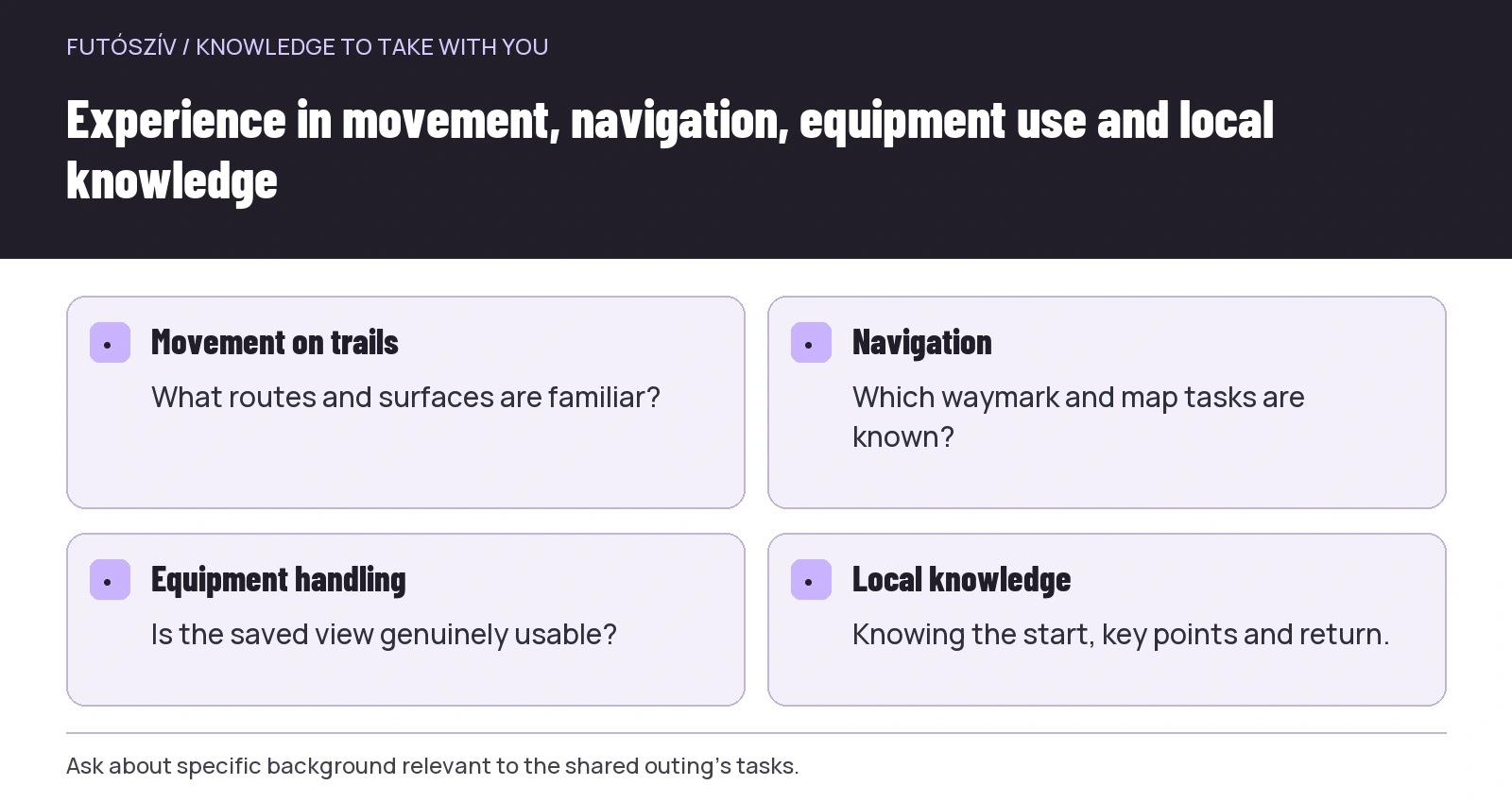 Enlarge diagram
Text version of the illustration
- Movement on trails
- What routes and surfaces are familiar?
- Navigation
- Which waymark and map tasks are known?
- Equipment handling
- Is the saved view genuinely usable?
- Local knowledge
- Knowing the start, key points and return.
Name the outing’s purpose before leaving
An introductory group loop, navigation practice and individual workouts alongside each other require different organisation. Without stating this, one person may expect a social outing that stays together while another expects training at their own pace. Resolve the difference before, rather than during, the run.
Write one sentence about the occasion: today the aim is learning the loop; we stay together and check at waymark changes. Or: there will be two prearranged groups with different outings, each with its own leadership and finishing arrangements. Participants’ knowledge and the location determine the specific organisation.
The British Mountaineering Council guide for beginner hillwalkers includes group members’ progress and breaks in planning. It offers an example from walking in mountain environments, not a trail-running training plan. The shared principle is useful here too: the route’s time frame should fit the actual group, not one person’s ideal pace.
A shorter route is not automatically simpler
If seeking an easier outing because experience differs, do not merely remove kilometres. A shortcut might lead through a hard-to-follow or more complex section. Look at the full task: elevation, surface, waymark changes, access and return options.
A loop with few decision points and a clear finish may be a good first shared outing. This is a selection consideration, not a recipe for every location. Keep unknown factors manageable, particularly if group members are learning equipment use too.
Check the MTSZ hiking-trail warnings and land manager’s information for both the main route and any shorter option. A backup version needs current access information just as the original loop does.
Do not leave all knowledge with one person
Leadership and navigation roles should be clear, but others should know the outing’s outline too. Everyone should know the starting place, planned finish, main junctions and communication arrangements. One flat device battery or brief communication problem then does not erase the entire shared plan.
Tasks within the group should be accepted voluntarily and genuinely. Anyone going ahead to examine the route should understand their responsibility and how to stay in contact. Someone helping keep track of the group’s rear should not acquire that role retrospectively merely because they happen to be slowest.
Even an experienced participant need not instantly give a confident answer to every question. “We still need to check that connection” or “Today we will choose another route” can be useful statements. The appearance of leadership confidence does not replace real knowledge of the place and outing.
Make meeting arrangements at junctions clear
A group can stretch out on the trails. Agree beforehand how you will handle junctions and what happens when someone cannot see the others. The specific solution should fit the terrain and group; one distance or time rule will not suit every forest path.
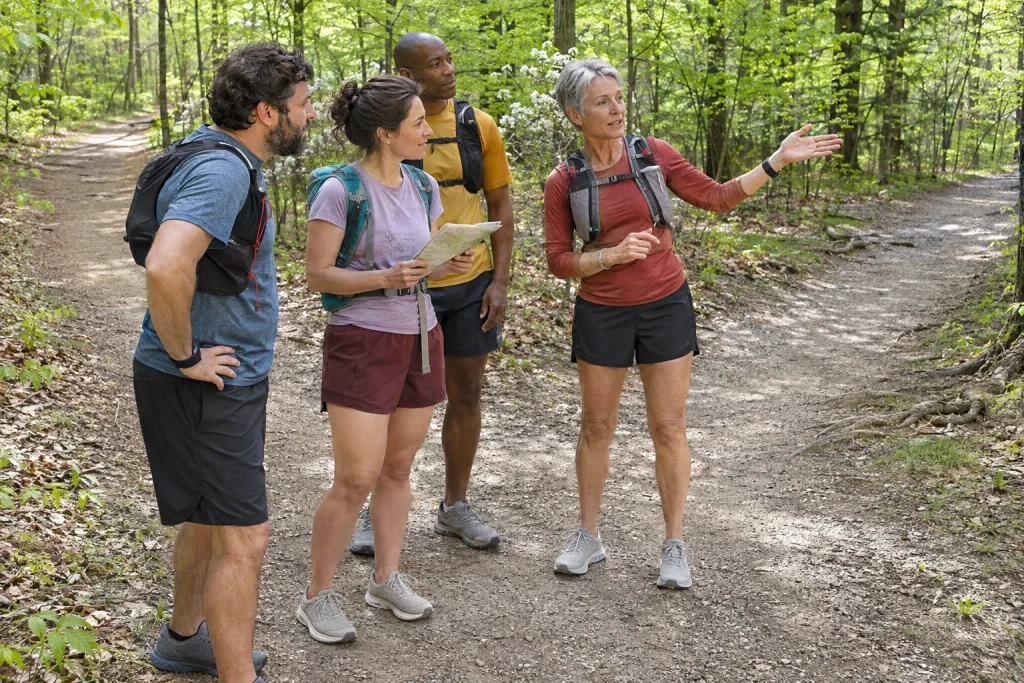
On an introductory outing, jointly recognising a junction is also a learning opportunity. Participants can name the arriving and next waymarks, then compare the choice with the map. Do not turn this into a humiliating exam. If someone does not know, clarify rather than challenge them in front of everyone.
Leave room for other countryside users when regrouping. Instead of gathering across an entire intersection, choose a point where checking does not obstruct others. Shared attention extends to how you use the environment too.
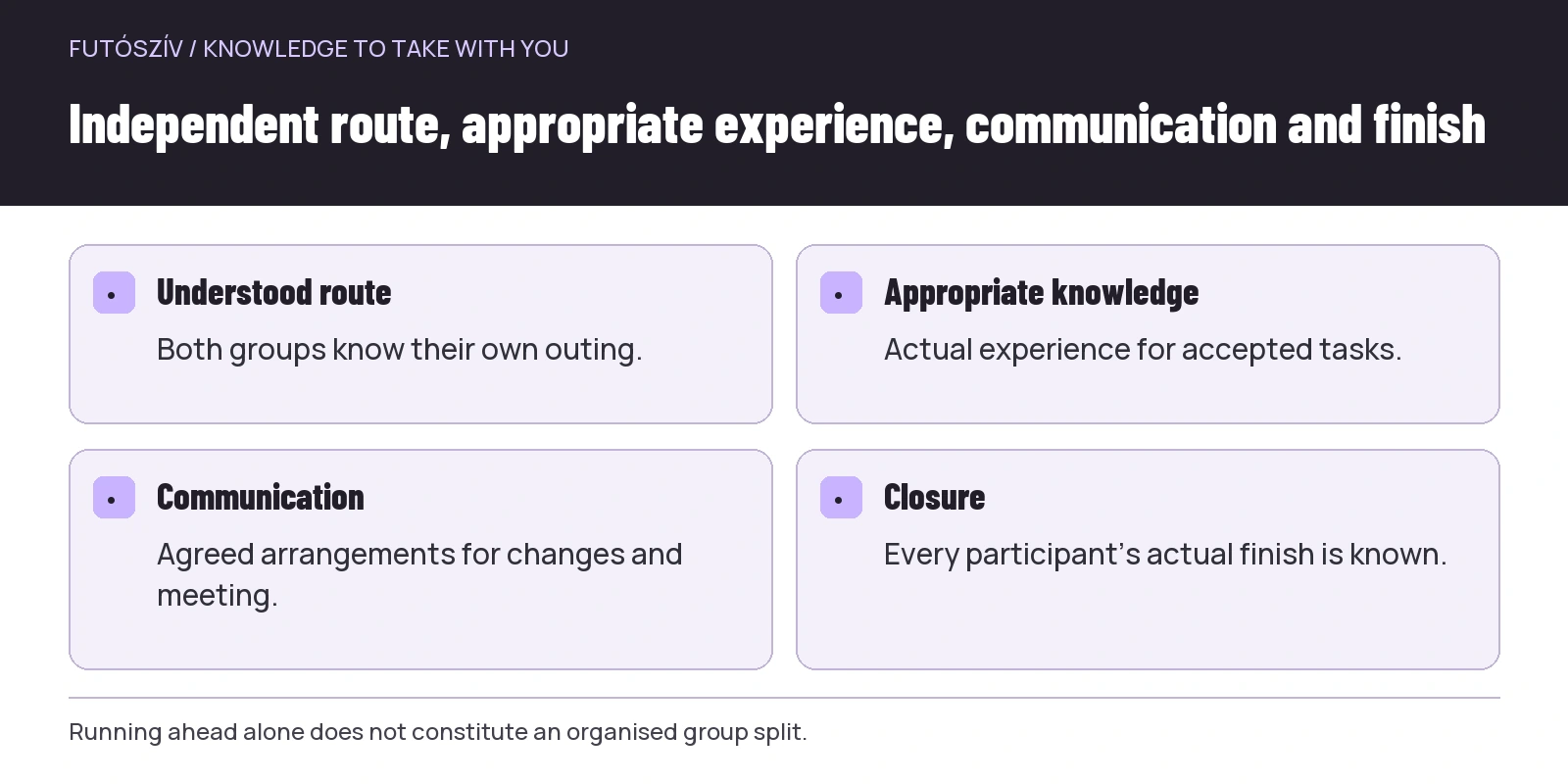 Enlarge diagram
Text version of the illustration
- Understood route
- Both groups know their own outing.
- Appropriate knowledge
- Actual experience for accepted tasks.
- Communication
- Agreed arrangements for changes and meeting.
- Closure
- Every participant’s actual finish is known.
After waiting, give everyone a genuine opportunity to restart
A common organisational mistake is for those in front to stop for longer, then leave the instant the last person arrives. The group has formally reunited, but members are not continuing from the same situation. Clarify the checkpoint’s purpose in advance.
You need not assign identical rest minutes to everyone from an article. Instead, consider what is needed at that point: clarifying the route, arranging equipment, communicating or changing the outing. If you agreed to stay together, actually restarting should be a shared decision.
If the gap is repeatedly too large, do not describe the person behind as the loop’s problem. The route, outing format or group composition may be poorly chosen for that day’s aim. Discuss this before the next occasion rather than recreating the same tension at every junction.
Split a group only with a complete plan
Two smaller groups may sometimes work better, but only if both have an independently understood outing. Each needs a clear route, appropriate experience, communication and finish. One group should not form accidentally as some run ahead while others remain at an uncertain intersection.
Agree the meeting point and any different time frames too. If one group chooses another version, it should report this as agreed where possible. On returning, participants’ actual finishes matter, not merely someone having seen them near the car park.
If experience or organisational conditions are insufficient for two independent plans, choose a simpler shared outing. Different individual training goals can wait for another occasion. Splitting the group is not compulsory for resolving every pace difference.
An illustrative example involving four friends
Four runners plan a shared trail loop. Two regularly run in forests, one is experienced on roads and the fourth is learning route following. The initial idea is a long loop with many waymark changes. Discussion reveals that their real shared purpose is introducing the area to the newer participants.
They therefore choose a version with fewer junctions. They identify waymarks and meeting arrangements in advance, open the map on the actual devices and clarify a shorter finishing option. The two experienced runners move their own faster workout to another occasion because that is not today’s shared commitment.
After the outing, average pace is not their only outcome. They review which junctions were understandable, where more explanation was needed and how well the outing suited the group. They build the next loop’s complexity from this actual experience, rather than their initial road results.
Group photographs and activity sharing are separate decisions
Social rules matter in a new group too. Participation should not require public performance sharing or appearing in every photograph. Separate communication needed for the run from social content. Joining does not require making all personal information visible.
Do not automatically turn learning situations into supposedly funny public stories either. A missed waymark change or difficult section is not content manufactured for others. A group can discuss uncertainty honestly when doing so does not bring later humiliation.
Using the area also requires shared rules. The Duna–Ipoly National Park guide emphasises following designated paths and protecting the natural environment. A group photograph, overtaking or maintaining pace must not justify leaving the designated route where this is prohibited.
Ask for specific feedback for the next outing
At the end, discuss four simple topics: route, communication, equipment use and purpose. Everyone can name one element that worked and one question needing clarification. You need not rank participants or score them.
The next step may be repeating the same loop, choosing another simple route or practising navigation separately. More kilometres are not an automatic reward for a successful shared outing. First consider which knowledge has become more reliable and what remains new.
The group is then shaped neither by the fastest participant’s vision nor by constant improvisation blamed on the least confident person. A jointly chosen task and clarified roles provide its framework. Different experience becomes a manageable planning question that you can discuss before departure.
How Futószív articles are prepared: our editorial guidelines.