
A negative split means completing the second half of a run in less time than the first. It sounds like an appealing race idea: control early, accelerate later. In practice, however, the term names a time pattern, not a guaranteed performance-improvement recipe.
A faster second half can result from deliberate pacing, but also from a downhill course, tailwind or excessively slow start. To make it a useful strategy, interpret it alongside your goal, current fitness and race conditions.
First, make the calculation clear
Compare halves of equal distance. In a ten-kilometre run, for example, the times for the first and second five kilometres form the two halves. Twenty-six minutes followed by twenty-four is a negative split; the reverse is a positive split.
Both total fifty minutes. Twenty-five plus twenty-five minutes gives the same total too. The time pattern alone therefore cannot tell you which was the best achievable result, or how sensible the execution was.
Another important distinction is that a faster second half does not necessarily mean accelerating continuously every kilometre. It can contain steady sections, brief slowdowns and livelier running towards the end. The two half totals are only a broad summary of the whole run.
A restrained start is not aimless slowness
At the start, crowds, music and fresh legs can easily draw you into a faster pace than you planned for the full distance. A controlled start aims to keep you within your own task. It does not mean deliberately running a first half so slow that recovering the time later requires major risk.
If executing your plan would require a second-half pace beyond your current ability, calling it a negative split does not make it realistic. Add the two half targets together beforehand and consider their associated speeds too.
For the opening section, choose a manageable range and a focus task. Examples include avoiding rushing, finding your own rhythm and moving predictably among others. Exact pace depends on the race task, not one universal number of seconds.
Why do large results lists not prove everything?
A study analysing almost seventy-nine thousand Boston Marathon finishes described different split patterns and their relationship with results. The better average performance of more evenly paced groups is an important observation, but this was not a comparison of randomly assigned race strategies.
Better preparation may itself support more even running. An overambitious start, weather, course profile or difficulties during the race can influence both splits and the final result. An association therefore does not mean that merely copying the time pattern causes the same improvement for everyone.
Other race data, such as the analysis of the Ljubljana half marathon and marathon , also allow examination of pacing differences between groups and performance levels. These provide sensible context but cannot replace your own starting plan.
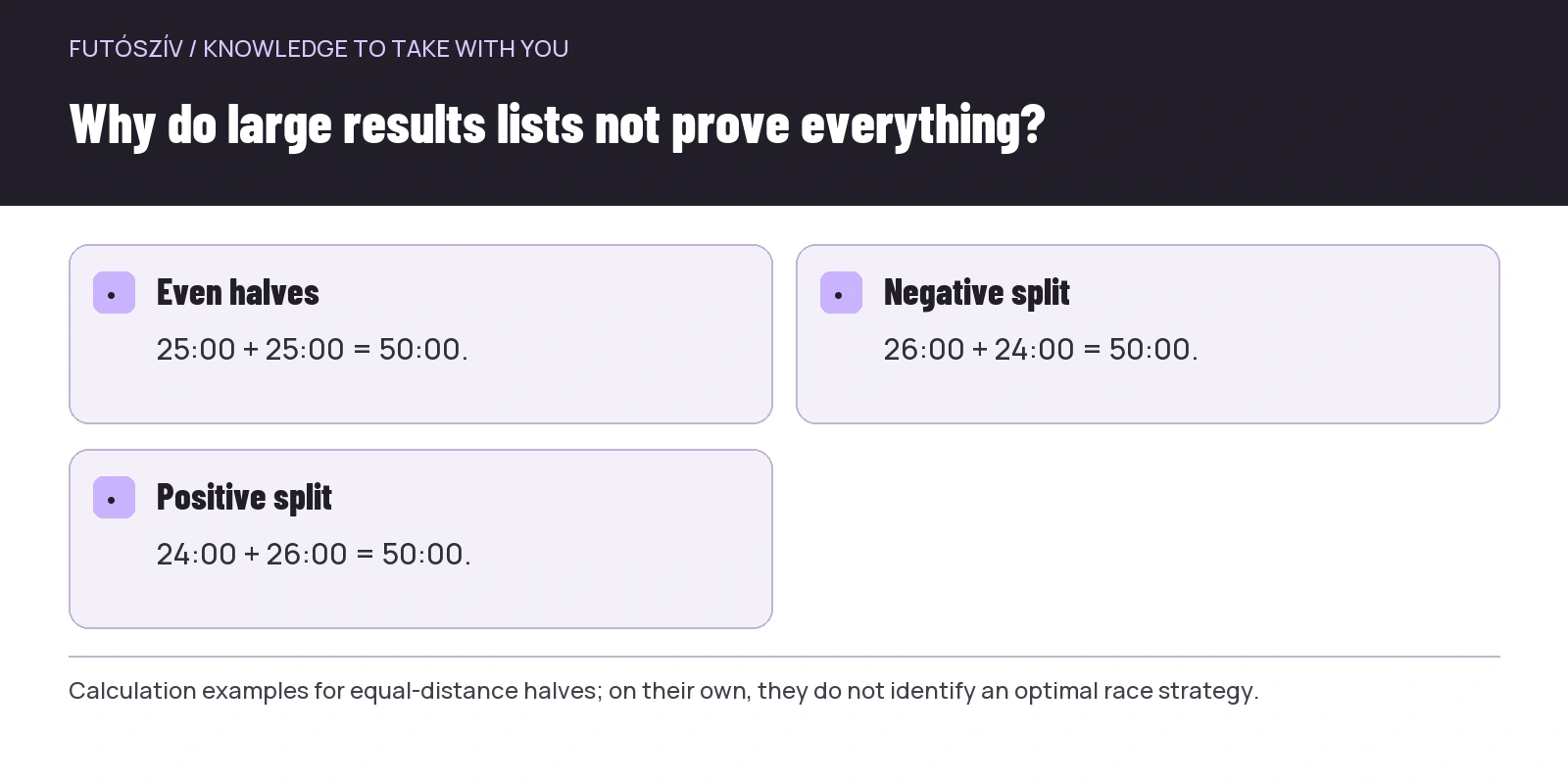 Enlarge diagram
Text version of the illustration
- Even halves
- 25:00 + 25:00 = 50:00.
- Negative split
- 26:00 + 24:00 = 50:00.
- Positive split
- 24:00 + 26:00 = 50:00.
Short and long races pose different questions
Do not apply an idea about marathon pacing unchanged to every distance. A five-kilometre run involves a different duration and task from a race lasting several hours. Excessive caution can particularly easily cost result-relevant time over a shorter distance.
A treadmill study involving eleven young female runners tried several starting paces over five kilometres. No clear statistical difference was found in total times, while individual best trials were also associated with faster starts. The experiment used a small sample in a specific setting; it is neither a general call for a fast start nor support for compulsory negative splits at every distance.
Your own distance requires its own experience. The goal may be even pacing, a slight later acceleration or tactics aimed at placing. Choose the task first and only then give it a time pattern.
The course’s two halves may not be comparable
If the second half is predominantly downhill, a shorter split does not necessarily mean you worked harder later. If hills and a headwind await, a slower second half can also reflect deliberately well-managed running. Without terrain and conditions, the number can mislead.
Look at the official route and available elevation profile, but do not assume every kilometre is perfectly identical. Bends, narrow sections, bridges and aid stations can shape progress too. Adapt the split plan to these.
The aim is not to make the difference between halves negative at all costs. Rather, seek pacing that distributes effort appropriately across the whole task. If conditions change, revising the plan may be a sign of good execution.
The key decision after starting: do not chase someone else’s plan
The first kilometre of those around you is not evidence of your ability. They may be running another distance, pursuing a different goal or simply starting too fast. You need not immediately follow. Concentrate on your own task after the start.
If you plan to follow a pacer, learn the group’s goal and pacing approach beforehand. The group may help with rhythm, but it cannot replace attention to your own well-being and conditions. If that day’s pace does not suit you, letting the group go can be reasonable too.
Do not try to regain time lost in a start bottleneck through sudden weaving or sprints. Safe, orderly movement into the flow matters more than seconds in a predicted target time. Large early fluctuations are not the same as deliberate acceleration later.
Make halfway a review point
Identify beforehand what you will evaluate later in the race: how controlled your movement is, your attention, whether the fuelling and hydration plan is working, and current effort. These can guide a decision to hold, adjust slightly or ease back.
This review is not a medical fitness test. If you feel unwell, have chest symptoms, feel faint or experience another concerning symptom, safely stopping and obtaining appropriate help matter more than the race plan. A negative split is no reason to make further acceleration compulsory in the second half.
If everything is in order, a moderate adjustment may be the next step. You need not make a large change at one point. Gradual decisions are easier to follow and leave room to reassess the situation.
Keep acceleration optional
A poorly phrased plan says: “I must run the second half faster whatever happens.” A more useful version is conditional: “If the situation is appropriate, I will cautiously pick up later; otherwise, I will maintain or adjust effort.” This sounds less impressive but fits an actual race better.
Steadily maintaining pace in the second half can also be a good result if you previously slowed substantially. Every improvement need not appear as a strictly negative difference between half times. Performance, execution and experience can be evaluated from several perspectives.
Having strength left at the finish does not necessarily mean you got the race wrong either. It can be learning information for the next start. Do not, however, automatically raise every future target pace based on one run.
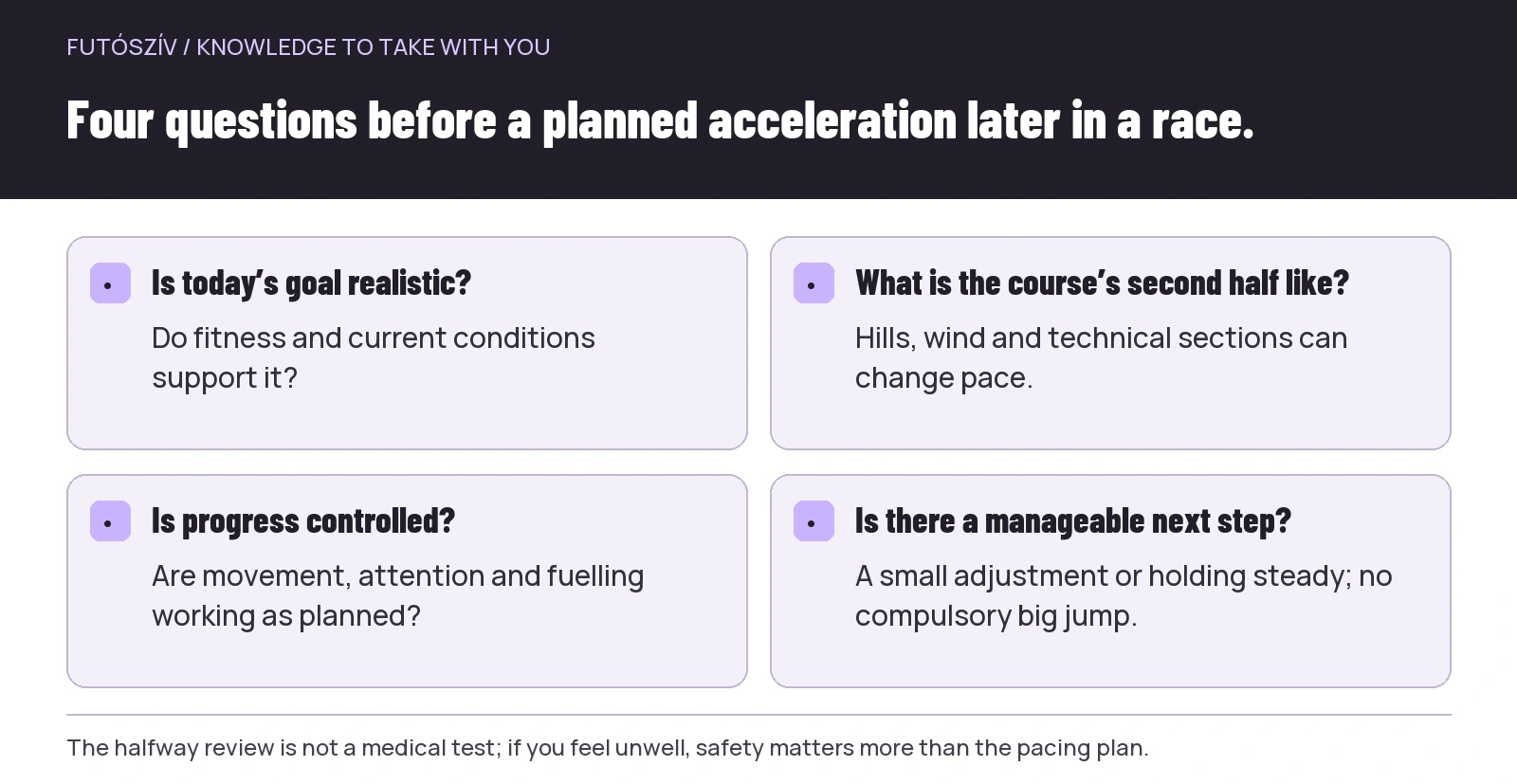 Enlarge diagram
Text version of the illustration
- Is today’s goal realistic?
- Do fitness and current conditions support it?
- What is the course’s second half like?
- Hills, wind and technical sections can change pace.
- Is progress controlled?
- Are movement, attention and fuelling working as planned?
- Is there a manageable next step?
- A small adjustment or holding steady; no compulsory big jump.
Do not copy the entire race in every training session
Pacing can be practised through a smaller, appropriately planned task too. The aim might be a calmer start or a manageable rhythm change later. You need not turn the end of every long run into a hard finishing effort, or make every session a trial of the whole race distance.
Fit the specific task into your weekly workload. If intense training and other substantial work are already present, another hard run added under the label “practising negative splits” changes the programme. Targeted practice should have a place rather than being added unnoticed to everything else.
Take forward how you recognised the opening effort, how controlled the change remained and how you felt afterwards. A successful shorter progression run does not automatically prove the same pattern is sustainable in a long race.
Be precise with watch data too
Compare halves over equal distances, using reliable splits where possible. Chip time in official results, time from the starting gun and your own watch may be different data. A stopped or automatically paused watch may not show the race’s entire elapsed time.
If the measured course distance differs from the display, do not insist that the device’s halfway alert marks the official course midpoint. State which data you use in later analysis. Precise definitions matter more than a more flattering graph.
Look beyond the difference between halves. Smaller splits may reveal substantial early fluctuation or one long stop. The same ratio of half times can conceal entirely different races.
Three interpretation examples
A controlled race on a flat course: the runner starts with a realistic goal, chooses a small acceleration in the second half and finishes under control. Here, the negative split may have matched the plan. Recording the experience precisely is the next task, not necessarily seeking an even larger acceleration.
A downhill second half: the time is faster while effort stays similar. This may reflect good course management, but the same half-time ratio should not become a requirement for another flat race.
An excessively slow first half: the runner leaves considerable time unused relative to the original goal, then accelerates strongly towards the finish. There is a negative split, yet the finishing time may not be the best achievable. The lesson for the next start may be a more realistic opening, not intensifying the pattern further.
What should you record for the next race?
Record the original goal, actual opening, important course and weather features, and later decision points. If you accelerated, explain what guided it. If you eased back, evaluate that factually too.
A useful conclusion may be one concrete change: a calmer opening section, a more accurate target time, less frequent watch checking or better preparation for an aid station. “Next time I will run a negative split” alone gives little information for execution.
Pacing is a useful tool when it helps turn your abilities and the day’s conditions into a sensible performance. A faster second half is one possible pattern. The real aim is a well-managed whole race, rather than an appealing label afterwards.
Primary research
- The impact of different pacing strategies on five-kilometer running time trial performance – a small treadmill experiment involving young female runners.
- Pacing strategy patterns and performance outcomes in marathon running: A large-scale analysis of split time data – observational analysis of race data.
- Performance and Pacing of Age Groups in Half-Marathon and Marathon – descriptive comparison of splits and groups.
How Futószív articles are prepared: our editorial guidelines.