
After an important race, continuing can seem to offer only two extremes: carry on exactly as before or disappear from running completely. A break between seasons can take many more forms. Some people need distance from regular training, others want to move without race paces and calendar pressure, while others need a genuine stop for health or life reasons.
A useful plan does not begin with how many days it takes to lose fitness. First clarify what you want to bring to a close, what you need now, and the circumstances in which you want to return later. A transition period can have a purpose of its own, even if it produces fewer impressive figures in your running app.
What has ended: the race, the training block or your running year?
Completing one race does not necessarily mean the season is over. It may have been a preparation milestone, your main goal or the last event in an overcrowded series. Decisions about the length and content of a break should reflect which of these it was.
Review the last few months. How much continuous preparation was involved, how many important starts did you have, and how much freedom remained outside running? If every week carried a performance requirement, a break from structure may be valuable even without particular physical symptoms.
Do not let your last finishing time alone guide the review. After a disappointing race, it is easy to seek an immediate correction; after a successful one, to chase another personal best. In either situation, reviewing the whole period before the next decision helps.
Define the kind of break precisely
Stopping training completely, reducing training and moving more freely are three different situations. Confusing them also makes later expectations inaccurate. A “two-week break” can mean no running, or a few comfortable sessions without a performance goal.
Your statement of purpose might be: “For a while, there will be no race pace or compulsory weekly mileage, but I am happy to run briefly when it feels enjoyable.” In another situation, the appropriate statement is: “I am stopping targeted sporting load for now and will discuss my return according to the professional plan.” These statements are not interchangeable.
Discuss what the change means with your coach or running companions too. If social sessions automatically turn into hard runs, explain in advance that you are choosing a different rhythm for now. A break need not involve explaining yourself afresh every week.
What does detraining research actually say?
In a classic study following seven endurance athletes, changes in adaptations were measured at several points after training stopped completely. Maximal oxygen uptake declined, while not all previous adaptations disappeared at the same rate. The research used a small sample, examined complete cessation and does not provide an individual daily fitness-loss curve.
The lesson is not that you should never take a break. Rather, current race fitness is not an unchanging possession, and different capacities may develop differently. A later plan should therefore fit your current condition, not only an old personal best.
Do not use data from complete training cessation as though the same thing happens after a few shorter, comfortable weeks. Remaining activity, previous fitness and duration all form part of the situation. A percentage on the internet does not describe your next run.
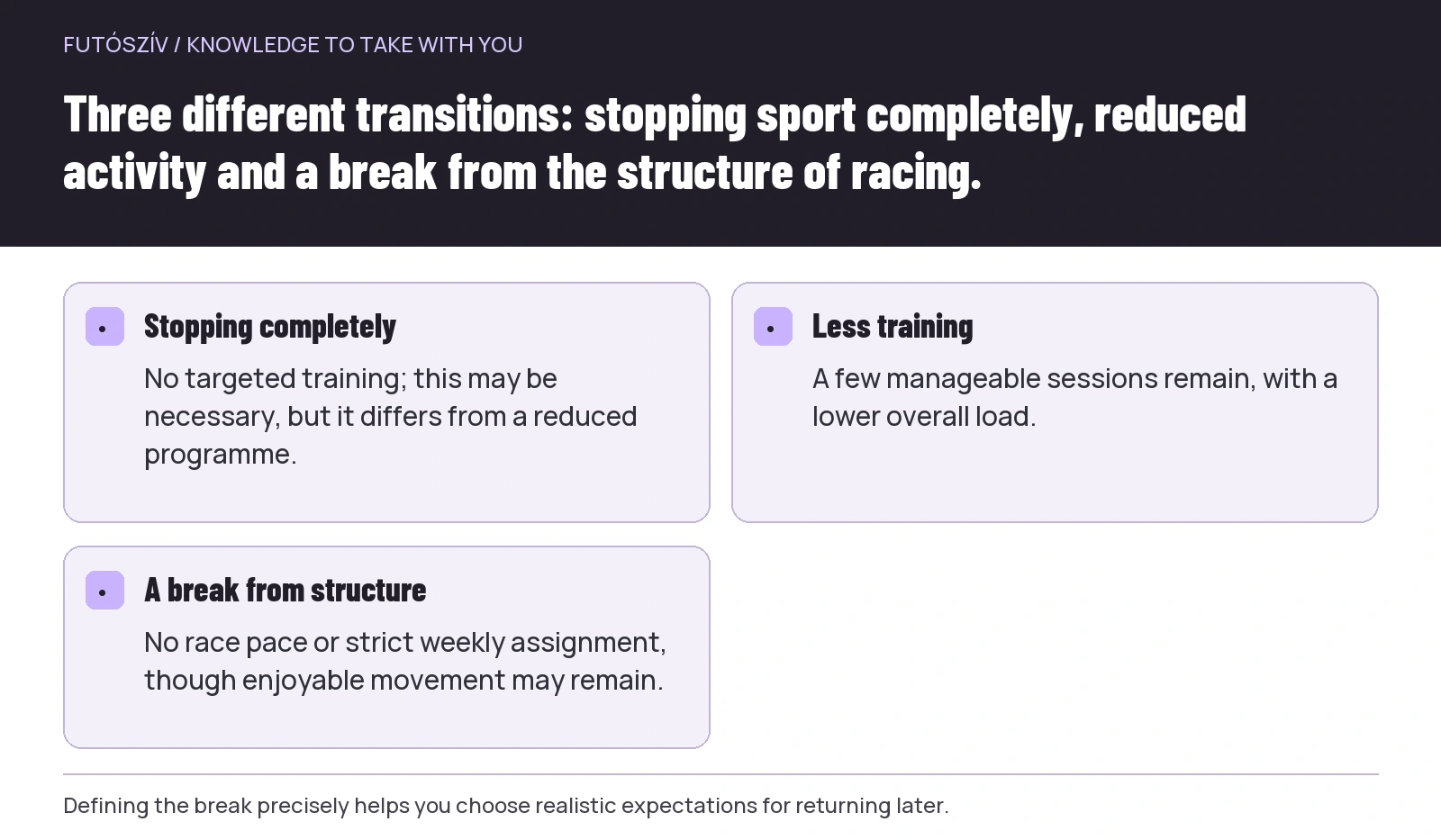 Enlarge diagram
Text version of the illustration
- Stopping completely
- No targeted training; this may be necessary, but it differs from a reduced programme.
- Less training
- A few manageable sessions remain, with a lower overall load.
- A break from structure
- No race pace or strict weekly assignment, though enjoyable movement may remain.
A reduced programme is not the same as zero
In a study involving twelve male cyclists, several physiological and performance measures were maintained during twenty-one days of reduced training. An important detail is that participants still trained regularly and for a substantial total time. The study does not demonstrate that complete rest preserves every capacity unchanged, or that all runners’ abilities remain unchanged.
This does not imply a compulsory maintenance protocol for recreational runners. You need not turn a period intended for rest into another performance obligation to make sure every measure stays intact. The purpose of the break comes first; only then consider the training elements you wish to retain.
If activity remains, choose manageable, enjoyable tasks. Easy running, walking or another familiar sport is appropriate not because it offsets some theoretical percentage of fitness loss, but because it fits your current situation without immediately restoring the same burden from which you wanted a break.
Make room for a mental change too
During race season, running organises many decisions: when you get up, where you travel and what you commit to at weekends. The transition can bring back activities that previously struggled to fit. You need not rank them by their usefulness for your next training cycle.
A study of young endurance athletes found different levels of sport-related stress among female runners in pre-season and off-season periods. The observation applies to a specific group and does not prove that every runner experiences a break in the same way. Alongside physical load, however, commitments and expectations deserve attention.
If a freer period instead brings emptiness or uncertainty, give your day a few simple anchors: shared activities, a familiar routine, or something that does not end with a results list. Seek appropriate help for persistently low mood or strong anxiety; entering the next race is not an answer to every situation.
Do not package symptoms as end-of-season tiredness
A break can be a good opportunity to review recurring discomfort, but it does not replace necessary assessment. If something has hurt for a long time, is getting worse or interferes with everyday movement, do not rely only on it disappearing by itself before the new season.
The same applies to unusual, prolonged exhaustion or other concerning symptoms. Reducing training volume may be an important adjustment, but several different causes can produce similar problems. Appropriate healthcare help is precisely about avoiding guesswork when planning what comes next.
If you receive a treatment or rehabilitation plan, do not override it with a general idea for off-season activity. In this situation, the reason for the break determines what is permissible. “I am just doing relaxed sport now” is not precise enough to judge the load on an injured area.
Do not turn the break into a competitive season in other sports
Wanting to try new movement is natural. The problem begins when several demanding, unfamiliar activities immediately replace running. A long bike ride, a major hike or a new strength session creates real load too, even if your running watch shows fewer kilometres.
Keep first attempts genuinely introductory. You need not search for the limit of your endurance in every new sport. Technique, equipment and environment must be learnt separately; running results cannot replace this.
If another sport ultimately becomes your main goal, that is a valid decision too. Just rename the plan accordingly. A clear purpose helps prevent you from comparing your eventual return to running with the freshness you would expect after an imaginary period of complete rest.
What should remain in your routine?
Even in a freer period, predictable sleep and eating rhythms, social connections and everyday movement can be valuable. You need not measure everything, but a basic routine may help prevent the break becoming a series of entirely disorganised days.
If running previously provided an important time frame, you need not fill the freed-up slot identically every day. A prearranged walk together works well for some people; for others, freedom means an afternoon without a fixed appointment. Choose according to your needs, rather than another optimisation checklist.
Do not turn eating into punishment for running less. If you are unsure about nutrition alongside changing loads, discussing it with a sports dietitian may be worthwhile. A break between seasons does not automatically justify extreme restriction or compensatory exercise.
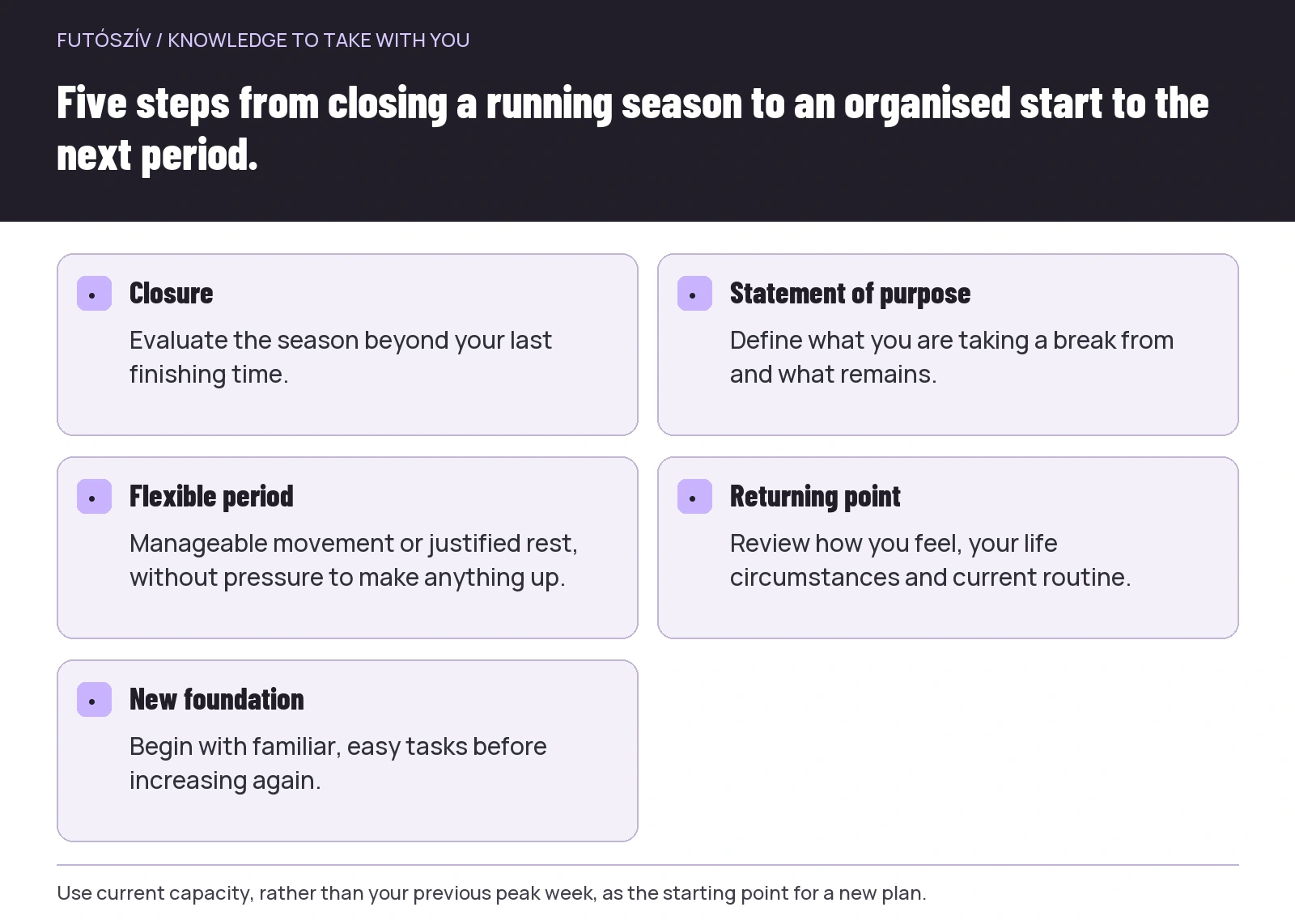 Enlarge diagram
Text version of the illustration
- Closure
- Evaluate the season beyond your last finishing time.
- Statement of purpose
- Define what you are taking a break from and what remains.
- Flexible period
- Manageable movement or justified rest, without pressure to make anything up.
- Returning point
- Review how you feel, your life circumstances and current routine.
- New foundation
- Begin with familiar, easy tasks before increasing again.
Review in a way that supports later decisions
When closing the season, write down three separate things: what worked, what was difficult to sustain, and what you do not want to repeat unchanged. Alongside finishing times, include weekend time demands, travel, sleep or the community experience.
Avoid broad judgements such as “I was not disciplined enough”. A specific observation is more precise: “After Thursday’s late session, I was regularly tired on Friday.” This gives you something concrete to change in the order or timing of the next plan.
You need not immediately create a detailed annual calendar during the break. Setting a later date to replan may be enough, when the race’s immediate emotional impact no longer guides the decision. Choosing the next goal can also be a calm process.
Do not make the first run an exam in your past performance
When returning, choose a familiar route that is easy to shorten, and fit the task to your current effort. You need not prove on the first outing that your old easy pace is still there. One average on the watch does not evaluate the entire transition period.
Review your experience during and after the run, and how you feel the following day. If it follows a longer complete stop or symptoms, returning particularly does not mean immediately restarting your old peak week. Plan a gradual approach suited to your background, with professional help if needed.
Your sense of pace and routine may need practice again too. This does not mean that all previous learning has disappeared. The aim is to establish a foundation sustainable now, from which you can later work towards specific tasks again.
Do not restore everything at once
Duration, session frequency, intensity and terrain difficulty are separate variables. Restoring all of them to their previous levels at once makes it difficult to identify what prompted an unfavourable response. Restarting becomes interpretable when you decide from the experience of successive weeks.
An upcoming race should fit this too. Choosing an important result target too soon can easily bring back the hurry you wanted to escape. If you do start a race, experience and assessing your current position can be its main purpose; clarify this with yourself beforehand.
If you work with a coach, explain how much activity actually remained during the break, and what kind. Do not send only its calendar length. Two periods of identical length can provide entirely different starting points for a new plan.
When should you extend the transition?
If the previous system still would not fit your life, you need not step back into it for the sake of a planned date. Work, family circumstances, how you feel and the experience of movement all matter. The next training cycle is sustainable when it fits your current life.
Persistent symptoms or health uncertainty may require appropriate help with the decision to return. With mental difficulties, you need not wait until they also show up in running results. Support aims at the person’s well-being, not solely at enabling the next personal best.
A well-planned break between seasons is not a secret competition to retain fitness. It gives you time to finish, observe and choose again. What makes continuation valuable is returning to a system you still want and are able to follow now.
Primary sources
- Time course of loss of adaptations after stopping prolonged intense endurance training – complete training cessation examined in a small sample.
- A reduction in training volume and intensity for 21 days does not impair performance in cyclists – reduced but continuing training in cyclists.
- Interrelationships between stress, eating attitudes, and metabolism in endurance athletes across a competitive season – season-related observations in young athletes.
How Futószív articles are prepared: our editorial guidelines.