Two weeks ago the same pace felt easier on the same loop; now the average is slower. The log quickly offers a story about fitness, while one run happened on a cool, cloudy morning and the other on a warm, windy afternoon. Weather is not a certain explanation for every difference, but cannot be left out. This article develops a method for reading your runs with their conditions understood. It offers no universal temperature-based pace correction and does not calculate precise physiological change from two recordings. The aim is better questions and more traceable observations.
Name the comparison’s purpose first
Understanding a route’s total duration needs different data from examining a particular workout task. If one run was an easy informal loop and another a timed trial, their pace difference is not a simple weather experiment. First check whether task, route and recorded section matched. Review conditions afterwards. A good comparison acknowledges from its question that everyday runs are not laboratory studies changing one variable.
Name the variable you are considering: total time, a section’s pace, experienced difficulty or another appropriately interpreted value. Do not use a whole weekly average to evaluate one short section. Do not read heart rate alone without understanding task and quality either. A precise question reduces the comparisons needed. If you only want to know how much time to allow for the next outing, total elapsed time and the story of stops may matter more than the fastest kilometre.
What does research using race data show?
The data from several marathons analysed by Ely and colleagues examined associations between warmer conditions grouped by WBGT and slower results. This provides important empirical background for weather’s role, not a personal correction formula for every runner. Participants, distance, comparison and environment define interpretation. The research does not mean adding or subtracting identical seconds for every degree on your short loop. Do not turn a group association into false individual precision.
Another study examining Boston Marathon data from 1972–2018 analysed results alongside several weather factors, including wind direction and precipitation. It concerns that event’s data and model. It usefully reminds us that air temperature is not the only environmental variable, but does not prove one cause for your two runs’ difference. For practical data reading, research broadens the question: which other circumstances were missing beside the log’s big number?
Temperature is only one row
Record temperature information for the run’s time and place, naming its source. A nearby station, an app weather card and a watch sensor may be separate sources. Do not automatically call a wrist-worn device’s temperature a flawless measurement of ambient air; check manufacturer guidance. Data for another part of town or time may only approximate your route. Lacking precise local measurement does not invalidate a note if you claim no more than is known.
Shade, sunshine, humidity, airflow and duration are additional circumstances. The US National Weather Service explanation distinguishes heat index from WBGT, describing sunlight and wind among the latter’s components. An everyday app’s “feels like” number is not automatically the same measure as a study’s WBGT. Do not interchange them in the log. If you only know you ran in direct sun throughout or mostly in shade, write that simply.
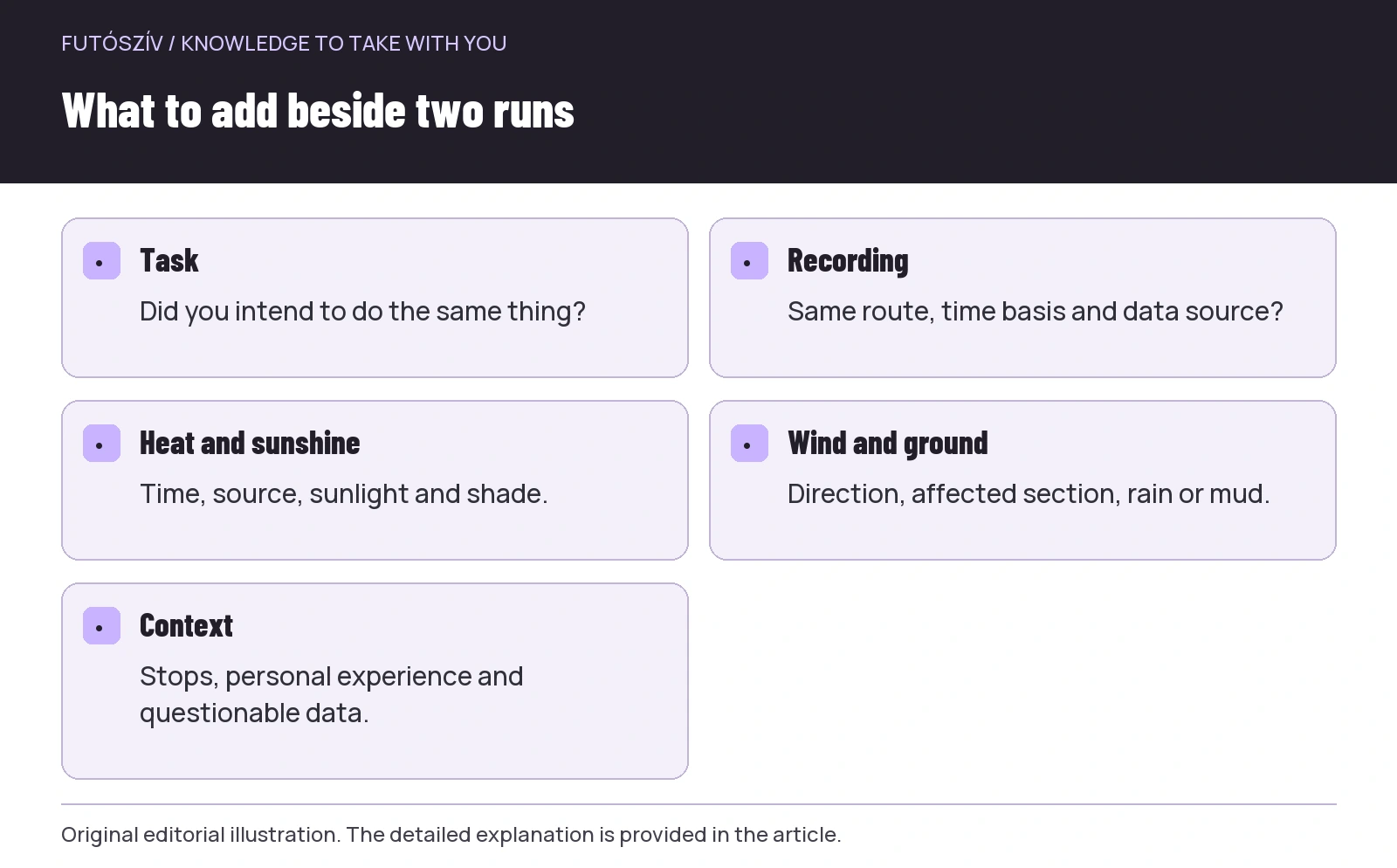 Enlarge diagram
Text version of the illustration
- Task
- Did you intend to do the same thing?
- Recording
- Same route, time basis and data source?
- Heat and sunshine
- Time, source, sunlight and shade.
- Wind and ground
- Direction, affected section, rain or mud.
- Context
- Stops, personal experience and questionable data.
Wind also needs the route direction
Headwind and tailwind on an exposed straight can create a different situation from a sheltered twisting forest loop that day. Wind speed alone does not say how it affected your run. Note the route’s main direction and where wind felt stronger. On an out-and-back, separate directional data may be interesting, but the turnaround, terrain and time matter too. Do not assume favourable and unfavourable sections simply cancel every effect. The overall average can conceal detail.
If the run used several loops, examine whether wind or section patterns changed, avoiding overly precise retrospective stories. The relationship between a nearby station’s gust and your route is not known at every point. An observation can be cautious and specific: “strong headwind on the embankment return, more shelter in the forest”. This is more useful context than correcting the whole run with one number. The aim is improving comparability, not removing actual conditions through a formula.
Rain and ground: the same line may be a different task
The ground can differ despite an identical GPS track: dry trail, mud, wet pavement or another obstacle can require different attention and route choices. Note important conditions, particularly with stops, detours or more cautious progress. You need not map every puddle. A short route-condition description may prevent reading the recordings as identical later. Kilometres and a mapped line do not contain the complete ground-surface story.
Rain may have affected clothing and device handling too. Adjusting a jacket, stopping to pack a phone or using different equipment can appear in total time. The actual task and recording method change together. Do not automatically explain these as physiological differences. Separate moving time, total time and stops help compare dry and wet days. A brief post-run note preserves events more accurately than guessing from the graph months later.
| Condition | What should you record? | What should you not assume? |
|---|---|---|
| Temperature | Value, time and source | That a distant station represents your microclimate everywhere |
| Sunshine | Exposed or mostly shaded route | That equal air temperature means equal conditions |
| Wind | Main direction and affected section | That one average speed describes everything |
| Precipitation and ground | Mud, wet pavement, detour and stops | That an identical track means an identical task |
| Timing | Time of day and changes during the run | That the daily maximum surrounded you throughout |
Keep recording foundations consistent
Before analysing weather, align time definition, sport profile, distance source and automations. If auto pause was enabled for one recording but not the other, a technical component may affect average differences. The same applies to a new foot pod, another watch or corrected distance. Select data with matching meanings. This may not require another run: opening detailed fields often clarifies it. Weather is important context, not a substitute for all other data checks.
Flag questionable sensor data too. Cold, rain or another situation may coincide with different wear or device handling, but do not claim a certain cause without investigation. If heart rate is incomplete or the track jumps, that part has limited usability. Do not apply a retrospective weather percentage in hopes of repairing it. An apparently precise new number derived from poorly understood data can merely conceal uncertainty. Clarify recording quality and origin first.
Choose a comparable section
If one complete loop included a detour, a shared, identifiable section may make more sense for some questions. Do not retrospectively select the most favourable detail for a desired story; name what to compare beforehand. Matching start, finish, direction and time basis help. Junction, traffic-light and stop notes still matter. Present the section’s result in its role, not as the entire run but as information about a defined part. Make the selection transparent and justifiable.
An illustrative example: on one of two supposedly identical five-kilometre loops, you spent twice as long stopped at lights. Total-time differences include that stop. If interested in a shared uninterrupted section, select it separately under suitable conditions. This does not mean every weather effect has been removed; you clarified one known confounding circumstance. Comparisons become more precise step by step. They need not be called perfect to be useful.
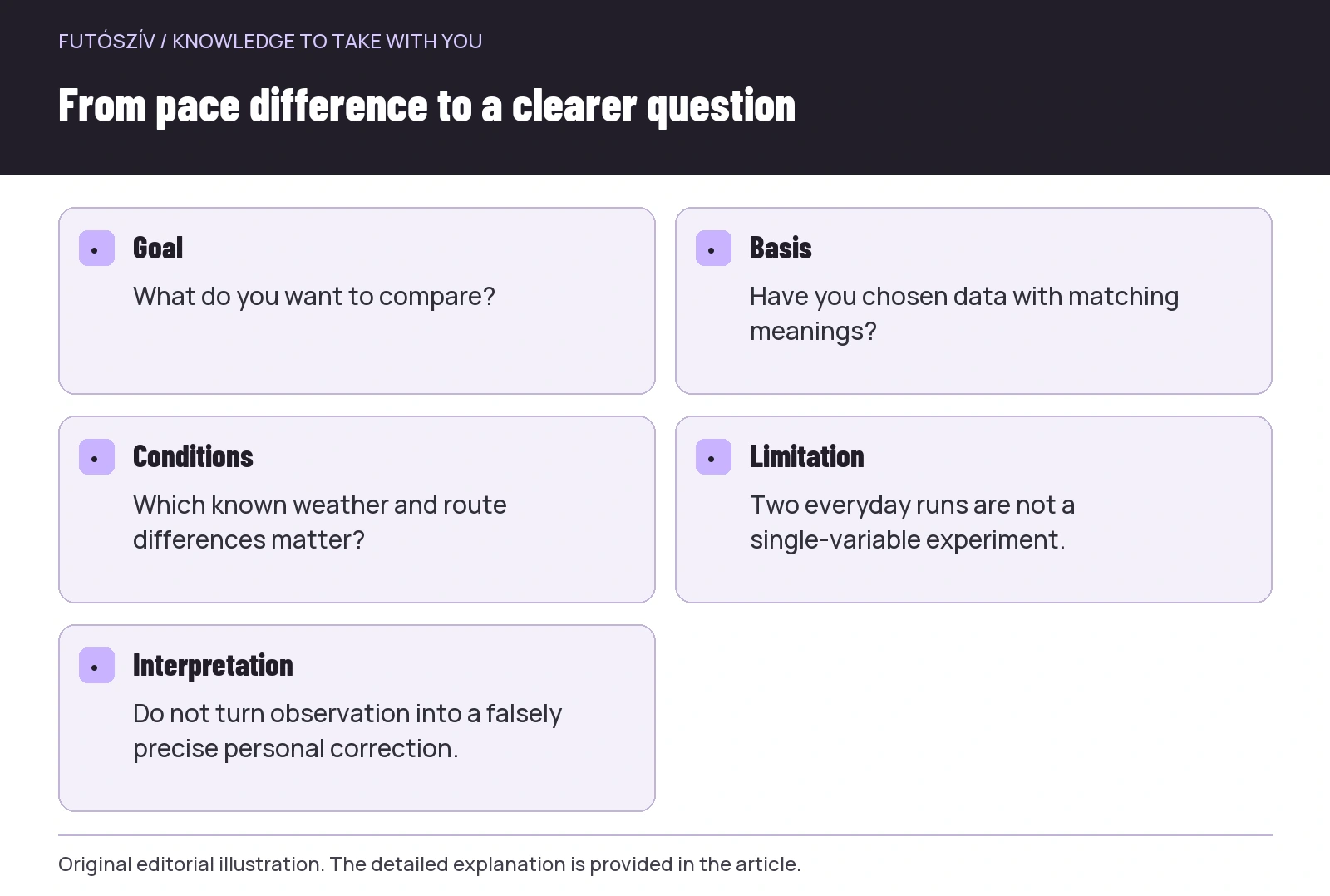 Enlarge diagram
Text version of the illustration
- Goal
- What do you want to compare?
- Basis
- Have you chosen data with matching meanings?
- Conditions
- Which known weather and route differences matter?
- Limitation
- Two everyday runs are not a single-variable experiment.
- Interpretation
- Do not turn observation into a falsely precise personal correction.
Give personal experience its own line
Briefly describe experienced difficulty across the run or selected part using your consistent approach. Add to recorded data rather than trying to override it. “Similar perceived difficulty at a slower pace”, for example, is interpretable, but does not independently prove an exact weather effect. Many factors shape wellbeing, not all measured in the log. Record known events without inventing confident explanations for unknown ones. Factual notes remain more useful later.
If symptoms or a markedly unusual condition arise, do not automatically dismiss them as definitely heat or wind. Clarify health questions with an appropriate professional. This article interprets training data rather than explains symptoms. A good score or corrected pace provides no medical reassurance. Equally, a slower run need not immediately establish a problem. Personal condition and technical comparison are separate questions even when side by side in the log.
Why is one correction for everyone misleading?
A formula is developed from specified data under defined conditions. Applying an association from a marathon group average to your short interrupted run skips several steps. Individual background, route, sunlight and recording may not match the model situation. Treat a weather calculator’s result as a model estimate, not the original run’s true “cleaned” time. Output calculated to a tenth of a second does not resolve uncertainty in inputs and applicability.
If using such a tool, note its source, inputs and limits, keeping it separate from the actually recorded result. Do not rewrite the whole log with unlabelled corrected numbers. The original run happened under real conditions and its story has value. A corrected estimate can at most offer a separate view for a particular question. Without knowing a calculator’s data basis, do not rely on it for significant personal training decisions. Your observations and appropriate professional interpretation may provide more guidance.
Two runs support few conclusions
One faster day and another slower one may reflect many factors together. Several outings recorded under similar conditions may reveal your patterns better, but still do not constitute a controlled experiment. Do not select only extreme or memorable examples. Examine all comparable runs within a defined period and retain condition labels. The story then relies less on one good or bad experience. Consistent collection aims for a clearer question, not complete removal of every source of noise.
Separate current safety from retrospective comparison. In severe heat, stormy weather or other adverse conditions, base decisions on fresh official information, local conditions and your situation rather than an old pace graph. Do not seek dangerous conditions to construct a better data pair. Let the log interpret activities actually undertaken appropriately. A skipped or modified run can also be recorded clearly without treating it as statistical loss.
A one-page comparison sheet
In two columns, write date, task, route, time basis and the value compared. Below, add temperature with source, sunlight or shade, wind direction, ground and stops. Finish with personal experience and known quality limitations. The sheet aims to clarify a disputed comparison, not create another administrative burden. If many important rows differ, accept that as part of the outcome. You need not force one clean percentage of progress from it.
A precise conclusion is often more modest but useful: “the conditions differed, so average pace alone does not assess fitness change”. Then identify what to record more consistently or discuss professionally next time. Noting weather is neither making excuses nor explaining every discrepancy. It is part of the actual environment that a good log places beside distance and time. Data then serves understanding your running rather than forcing a falsely precise judgement of two different days.
Sources and further reading
- Ely et al. – Impact of Weather on Marathon-running Performance
- Knechtle et al. – Weather Conditions and Boston Marathon Performance, 1972–2018
- National Weather Service – Heat Index and WBGT
How Futószív articles are prepared: our editorial guidelines.