
The fastest group is not necessarily the right one for a new race distance
When preparing for ten kilometres, a half-marathon or another new distance for the first time, seeking social support can be natural. A group’s name, shared photographs and results do not yet tell you whether its sessions suit you. A useful choice rests on specific questions: what is the session’s purpose, who is it for, how is it led and how does it fit your preparation?
This article concerns choosing a training group, not a race-day pacer. A group involves recurring weekly sessions, companions and organisational habits. For a new distance, you seek more than a few shared kilometres: you need an environment where your current situation and intended task can be discussed.
Do not introduce yourself with your target time first
The planned race is useful information, but the leader needs to know about your current running too. Somebody already running similar durations regularly arrives from a different position from somebody whose new distance is a future wish while a routine is still developing. The same target race does not automatically mean the same next session.
In a brief introduction, describe your current running pattern, the session types you know and what you want from the group. You need not upload your whole sporting history to a public chat. Clarify personal questions affecting suitability with the appropriate leader through a suitable channel.
A useful opening message might say: I am preparing for a new distance, my current runs generally take this form, and I would like to know which session you suggest as a first trial. This is easier to answer than “am I good enough for you?”. Clarify the fit between task and organisation rather than a runner’s worth as a person.
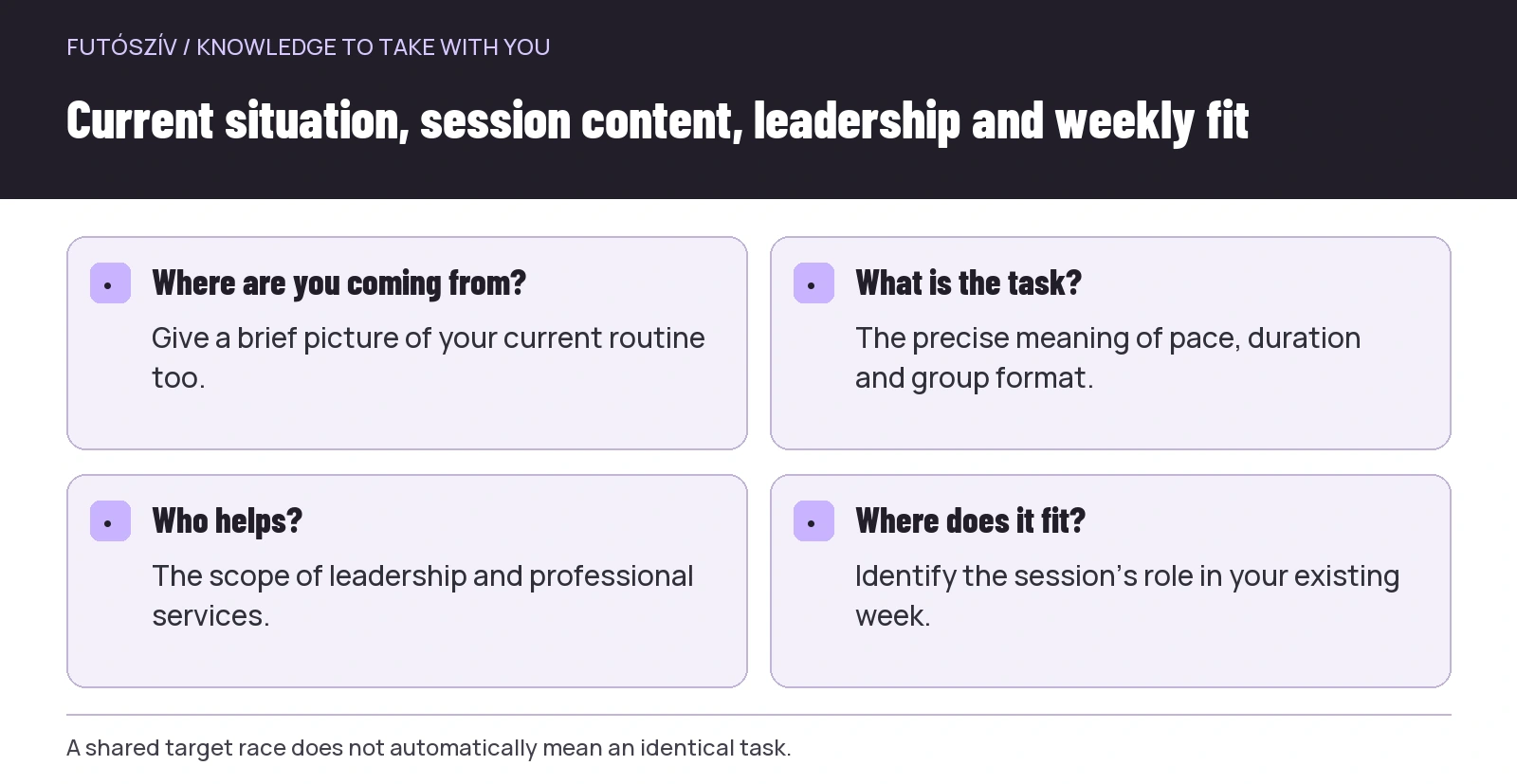 Enlarge diagram
Text version of the illustration
- Where are you coming from?
- Give a brief picture of your current routine too.
- What is the task?
- The precise meaning of pace, duration and group format.
- Who helps?
- The scope of leadership and professional services.
- Where does it fit?
- Identify the session’s role in your existing week.
Find what a level means in that group
“Basic”, “intermediate” and “half-marathon” are not international units. One place may refer to pace, another experience, another a particular training purpose. The RunTogether questions for runners distinguish session types by pace, distance and experience, for example. This is that English system’s own classification, not a rule transferable to every Hungarian club.
The example’s main lesson is the need for a description. Ask whether a listed pace concerns the whole outing’s average, an easy section or one task. It also matters whether the group follows one route together or performs different tasks at a common venue.
| Information in the group description | Clarifying question |
|---|---|
| Listed kilometre pace | Does this concern the whole outing or a particular part? |
| Longer group run | What are the planned duration and route? |
| All levels | How are actual differences handled? |
| Programme for a new distance | What background is expected and who helps integrate it? |
| Flexible grouping | When and with whom can you arrange another group? |
Do not infer the whole session’s workload from one average. The detailed task and your situation matter together. If no public description exists, request information before the trial.
Leadership, coaching and social running: clarify the service
A community run and individual coaching are different commitments. A volunteer route leader can help organise the group without overseeing your whole preparation. Conversely, even a coach-led session does not necessarily include a personal weekly plan for every participant.
The England Athletics club-membership information describes coaching and social-support possibilities in an organised club setting. This illustrates the different elements a club service may contain. For the actual Hungarian group, ask about its own operation and leadership background; a qualification in a foreign system does not automatically establish suitability at home.
Find out who leads the first session, how to contact them and whom to tell if participation needs changing. If seeking individual professional support, make its content, fee and boundaries clear. Group attendance alone does not replace necessary health or coaching discussions.
The group session’s place in your week
A new group can easily slip in as an extra alongside all previous runs. It may still be a good social experience, but your preparation structure changes. At the first discussion, explain what already appears in the week. If you have a coach, clarify the group session’s role with them too.
No universal weekly distance or session count is needed here. Identify its role: what it replaces, what it supplements and which addition requires a separate decision. A social outing does not become easy merely because enjoyable, or automatically belong in your programme because most others share the target race.
Count the entire time requirement too. Travel, changing, waiting and getting home together form the calendar commitment. If reaching it regularly requires rushing, consider a group with less spectacular social posts but a better fit with your real life.
First trial: what should you observe beyond pace?
The trial aims to gather information. Notice whether the task is explained beforehand, whether potential changes are clear and whether you can ask questions. Know where the group is going, where it finishes and what to do if not completing the full programme. These are organisational requirements, not optional comfort extras.
Collect specific observations about companions’ behaviour too. How do they respond when somebody chooses another group? Can you converse without listing results? Are shared photographs and public activity posting genuinely optional? Participation in a community suited to your needs should not require exposing every personal detail or performance.
After the first session, ask more than whether you kept up throughout. Did you understand the task, and was communication appropriate? Moving together once does not mean every later group session suits you. Lasting fit depends on several organisational and personal factors together.
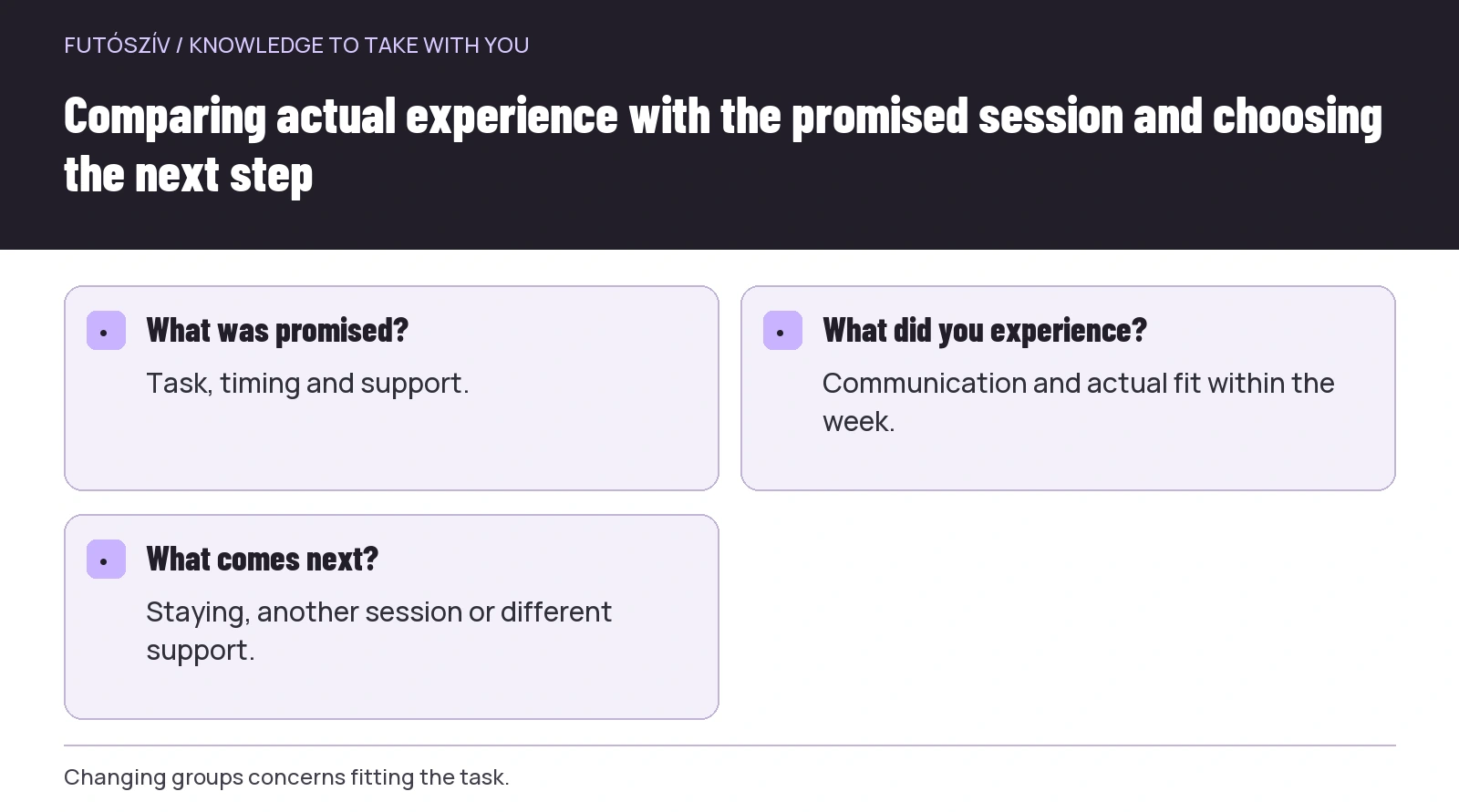 Enlarge diagram
Text version of the illustration
- What was promised?
- Task, timing and support.
- What did you experience?
- Communication and actual fit within the week.
- What comes next?
- Staying, another session or different support.
Two illustrative cases with different needs
The first runner is preparing for a first ten-kilometre event. They want one easy shared weekly outing because an independent routine already exists but they would enjoy company. A reliable time, described route and leader aware of the newcomer matter. They do not necessarily seek more professional tasks or want to hand over the whole preparation.
The second runner wants structured professional support for a new distance. Their main questions concern who plans and monitors the work, how feedback happens and what constitutes an individual service. The same social run may be pleasant for them too, but may not answer those questions by itself.
Both runners may arrive at the same club, perhaps different sessions. The difference is not how seriously they take running. They seek solutions to different needs. Naming expectations at registration makes selection more precise.
What if another group becomes more suitable?
Group choice should have an accessible next step. Ask how to change level or session and whom to consult. The first choice is not a performance promise until season’s end. Your target race, calendar and needed task can all change.
Rather than “slower” and “faster”, discussing the actual session content is more useful. Another group may better fit the current plan. Telling the leader you want to fit the session differently into your week also provides clearer feedback than disappearing or struggling at the back every week.
If something fails, distinguish a one-off organisational error from persistent mismatch. A changed meeting point can be clarified. Regularly unanswered basic task questions, or pressure for participation not agreed upon, is different. It is then worth examining another community too.
Fees and commitments: know what you are joining
A trial, club membership and coaching programme can have separate costs. Do not assume one automatically includes the others. Ask payment arrangements, cancellation options, any separate venue fee and what happens when a session is cancelled. Learn these from the organiser’s current information.
Equipment and clothing expectations should be specific too. A club shirt can be a community item, but equipment prescribed as an entry condition needs separate clarification. If lights, trail kit or another mandatory item are required, know before departure. The first meeting should not replace advance information.
Make race-entry decisions separately too. The group preparing for a certain event does not remove your need to register according to your situation and event rules. A shared goal helps organisation, but should not become an unspoken obligation preventing a different distance or date choice.
Your decision sheet after three meetings
Make brief notes: which session you attended, what the description promised and what actually happened. Then assess the venue and timing’s calendar fit, your understanding of task purposes and whether you know whom to notify of changes. Three meetings here is a personal observation framework, not a compulsory trial period or professional rating.
Finish with one next step: remain in the same session, try another group or seek more specific professional support. You need not deliver a final judgement on the whole club. Deciding whether the format currently helps preparation for the new distance is enough.
The right choice is not necessarily the most spectacular community experience on the first evening. It is a system you can return to, whose tasks you understand and where changes can be discussed. Alongside a new distance, it can also build a lasting, useful running connection.
How Futószív articles are prepared: our editorial guidelines.