
Cross-training means deliberately including another form of movement in a running programme. It may involve cycling, deep-water running, swimming, an elliptical machine, hiking or another sport, but variety alone does not describe its purpose. First decide whether you are replacing something, supplementing it or simply doing it for enjoyment.
Work in another sport contributes to total workload too. Even without appearing as running kilometres, it can require time, energy and recovery. Useful cross-training supports the programme’s purpose without quietly making every day hard.
Replacement, addition or an experience in its own right?
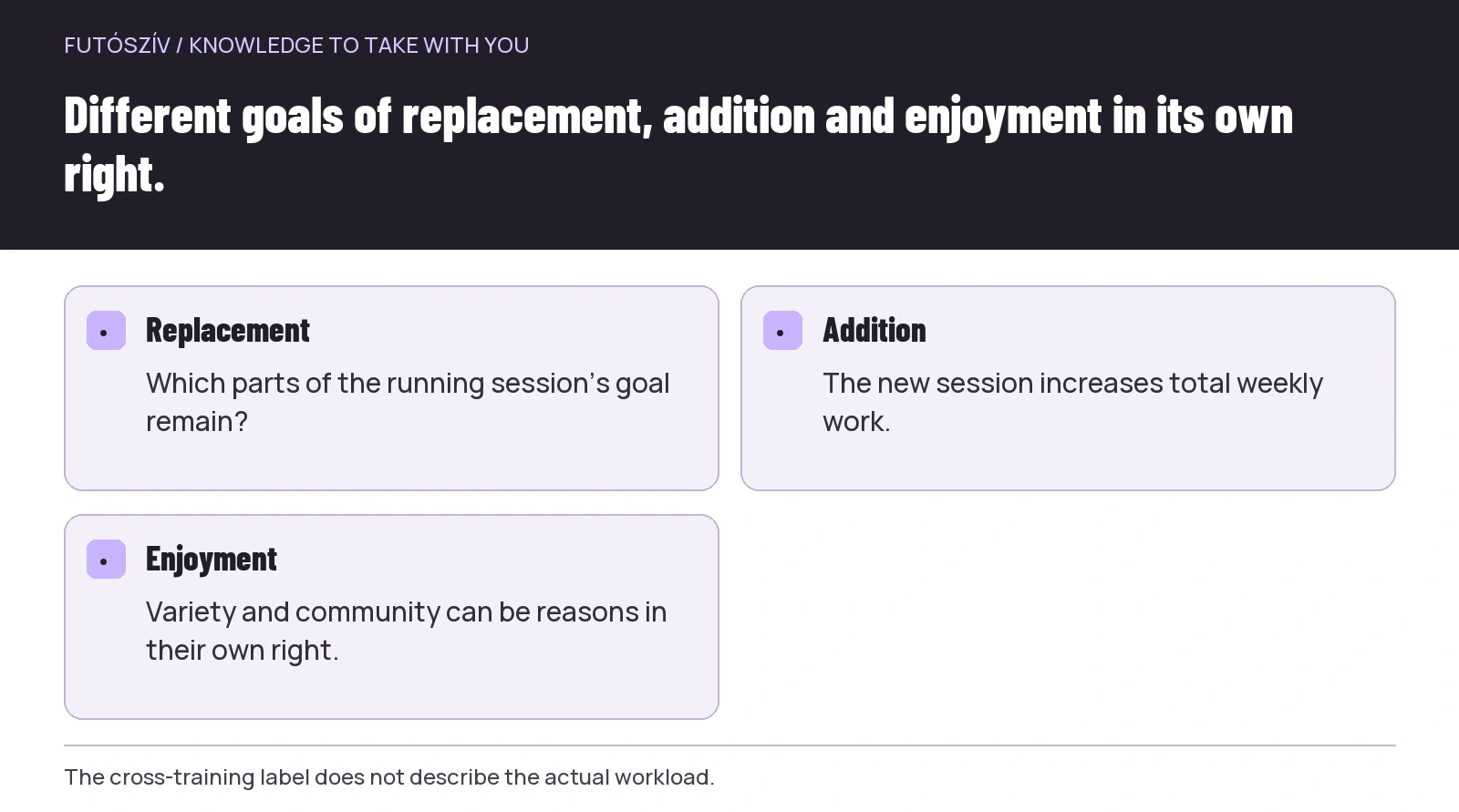
With replacement, another activity takes the place of a planned run. Ask which training goal you want to preserve and which part inevitably changes. Some endurance-work elements may remain, while practising the exact running movement differs.
With addition, a new workload joins the previous running. This can be deliberate, but should not be logged as though the original week remained unchanged. A long ride or hard swimming session is not automatically a rest day.
Enjoyment in its own right is a valid aim too. You may enjoy hiking or swimming because it provides relaxation and another community. Every outing need not promise a definite running-performance gain. Make the reason for your choice honest and clear.
What transfers between sports?
Endurance sports may share several general physiological demands, but movement, muscle work and surroundings differ. The extent of transfer depends on the sport, participant background, programme and which outcome is measured.
An improved general fitness value does not prove every running task improved equally. Pace judgement, descending or movement-specific tolerance of a distance are different demands. Recognise differences alongside cross-training’s benefits.
The question should therefore not be whether it is completely identical. Examine which goal the chosen activity serves and what running-specific part remains in the programme. An appropriate partial solution can be valuable too.
What does a deep-water-running study show?
In an original study following eleven trained competitive runners participants replaced land running with deep-water running for four weeks. The running-performance and physiological measures examined did not change significantly.
The study used a small sample and short period, so it does not prove unlimited substitution for every runner and distance. The water movement was also taught and practised beforehand. Technique is not a minor circumstance.
The practical lesson is that another tool may temporarily support certain abilities. This does not mean an injured runner can independently undertake any water workout. Select appropriate rehabilitation activity according to individual condition.
Comparing several tools does not establish a permanent ranking
A study in male high-school cross-country runners compared cycling and different elliptical training forms within a running programme. Alongside performance, researchers examined several movement and strength measures.
The participant group and four-week period limit transfer to adult recreational runners or longer races. A result for one machine type should not be generalised to every model and use. The study is not an equipment-buying ranking.
In your choice, consider access, technical skill, comfort and purpose together. The theoretically best method offers little help if difficult to access in everyday life or repeatedly causing symptoms.
 Enlarge diagram
Text version of the illustration
- Replacement
- Which parts of the running session’s goal remain?
- Addition
- The new session increases total weekly work.
- Enjoyment
- Variety and community can be reasons in their own right.
Research on supplementation asks a different question
In a comparison involving twenty trained runners additional running or cycling sessions were placed alongside usual running. The groups improved similarly in the five-thousand-metre test examined.
Importantly, most running remained. This differs from replacing every running session with another sport. Evidence about supplementary and replacement cross-training should not be merged.
Do not interpret the study as proof you definitely need three more sessions a week. Participants’ training and the complete programme define the situation. A research protocol is not an automatic personal workload prescription.
Another activity may require learning too
Even a good runner may be a beginner swimmer, cyclist or water runner. General endurance does not solve new technique. Initially, breathing, equipment handling or safety in the situation may matter more than a selected heart rate.
Do not make the first occasion a long performance test. Learn the movement and surroundings, seeking appropriate instruction if necessary. Water safety, road-bike handling and a machine’s operation are skills in their own right.
Include learning needs in the time required. The new sport may become useful long-term support while demanding more attention in the opening weeks. Do not call that failure or a lack of running endurance.
Why not convert everything into running kilometres?
A rule such as “one hour of cycling equals this many running kilometres” seems convenient but hides many differences. Speed, terrain, technique and individual skill relate to workload differently in each sport.
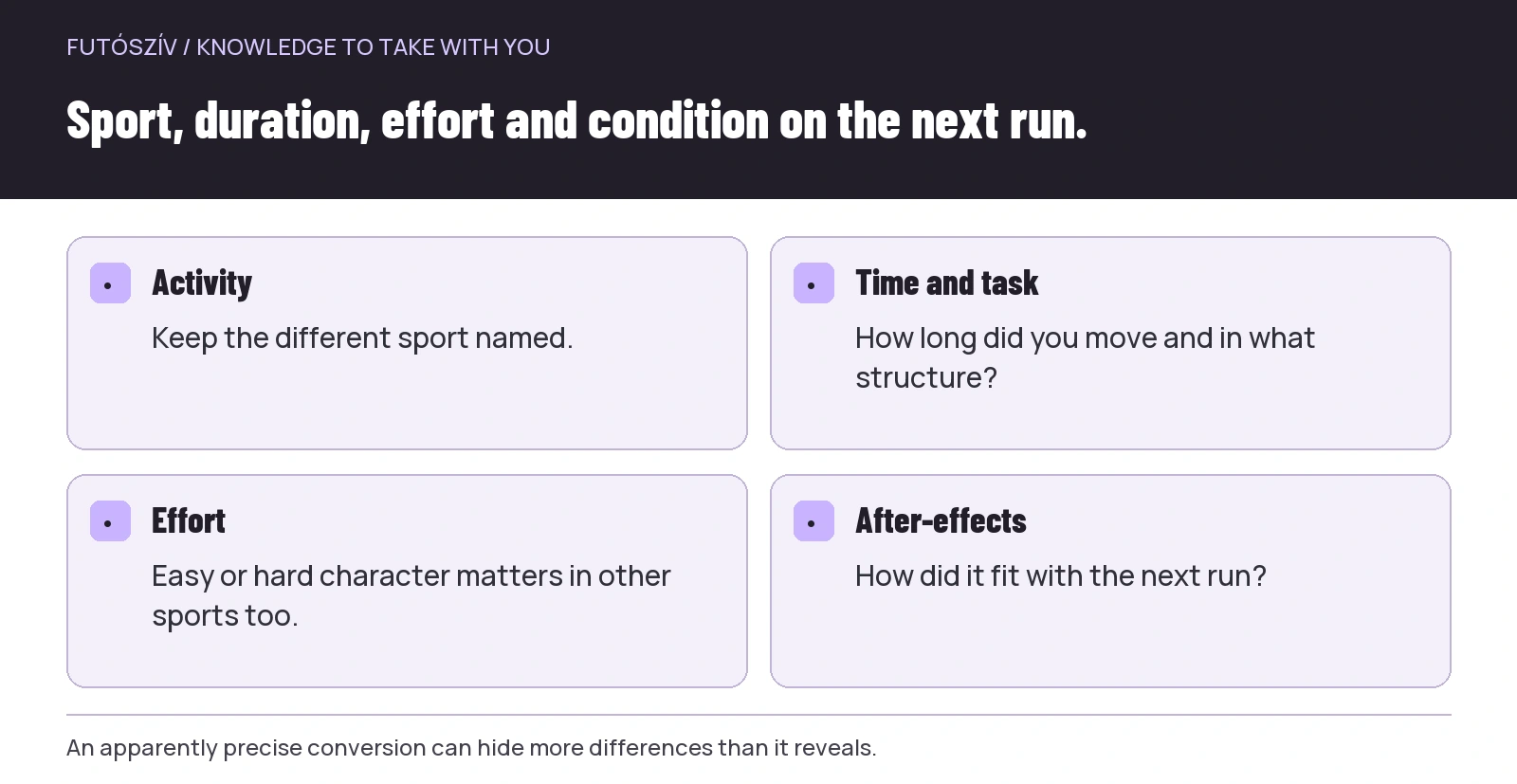
Recording duration, task character and perceived effort while retaining the activity’s separate identity may make more sense. The whole week stays visible without claiming an exact equivalence you have not measured.
Continue following running volume separately. If the goal is a running race, knowing how much actual running took place matters. It should not disappear beside cross-training into one virtual kilometre sum.
Heart-rate zones are not identical in every sport
Different movement positions and muscle work mean running heart-rate guides may not apply literally to another sport. Assessment for a device or sport needs connecting to your own measurement and experience.
In water, measurement and surroundings are separate questions; on a bike, local muscle fatigue can also limit work. A seemingly lower heart rate does not automatically prove the whole task is easy. Wellbeing and movement control matter too.
If you want precise zones, discuss their determination with a suitable professional. A general article need not prompt a new maximal test. A usable, conservative workload choice is possible without an apparently precise number.
Hard cross-training is still a hard day
Somebody may attend a hard cycling class the day after running intervals and log it as rest. Changing the activity does not erase intensity. View the programme’s easy and hard days across every sport.
A group class’s atmosphere or a hilly hike can easily override an originally easy plan. If the aim genuinely is restrained supplementation, preserve the ability to regulate your own effort. Social participation does not require identical performance.
Observe the next run too. If it is repeatedly harder after cross-training, reassess timing or dose. Success is more than work completed in the other sport.
 Enlarge diagram
Text version of the illustration
- Activity
- Keep the different sport named.
- Time and task
- How long did you move and in what structure?
- Effort
- Easy or hard character matters in other sports too.
- After-effects
- How did it fit with the next run?
After injury, replacement is an individual decision
Lower-impact movement or a different body position may be considered in certain situations, but every sport is not suitable for every symptom. A run omitted due to pain cannot automatically be replaced by cycling, swimming or an elliptical machine.
Tell the treating professional which activity you want, for how long and how intensely. A precise question supports a usable answer. “Can I exercise?” may be too broad to establish the conditions of a specific task.
Do not use alternative training to test whether symptoms are real. Stop for increasing pain, altered movement or feeling unwell. Rehabilitation is not about recovering every missed running kilometre at any cost.
How should it fit into the week?
Identify main running tasks and recovery opportunities first. Then choose cross-training with a clear purpose. Filling apparently empty days can easily remove genuine rest.
When introducing a new sport, do not increase running volume and the other activity’s intensity simultaneously. A few well-documented changes are easier to evaluate. Shape the system further from experience over subsequent weeks.
Consider access and total time too. Travelling to a pool, changing or preparing a bike may extend the outing. A good plan works in your calendar and does not survive at the expense of sleep or food.
Three situations, different questions
If seeking variety in an already workable running week, enjoyment and manageable overall workload may be the first measures. If temporarily unable to run, health conditions and the ability you hope to preserve come first. If you enjoy several sports, it may be a joint multi-sport programme rather than merely cross-training.
In the first case, you need not continually justify the other sport through running performance. In the second, making an independent treatment plan is unsuitable. In the third, clarify priorities among goals because everything cannot take precedence in every period.
A useful choice starts from your actual situation. More important than the tool’s name is why it entered the programme and which next decision its experience informs.
How should you return to the running-specific task?
If another sport dominated for a while, do not prescribe returning running solely from preserved general endurance. Running movement and the particular terrain’s demands may need gradual rebuilding. After injury, the individual return plan guides you.
The first successful easy run does not necessarily establish readiness for every former long or intense task. Choose continuation from the actual response. Wellbeing gained through cross-training is valuable, but not automatic permission for every previous workload.
Different activities support one another well when their shared and distinct tasks are understood. Variety can be both enjoyable and useful without exact kilometre conversions or exaggerated promises.
Sources
- Effect of 4 wk of deep water run training on running performance.
- The Impact of Different Cross-Training Modalities on Performance and Injury-Related Variables in High School Cross Country Runners.
- Cross training: indices of training stress and performance.
Shorter studies with small samples do not provide a universal conversion ratio or personal rehabilitation programme.
How Futószív articles are prepared: our editorial guidelines.