Two temperatures on the same watch do not necessarily measure the same thing
The weather screen shows 18 degrees, while the post-run temperature curve sits around 28. It is easy to call one wrong, but first trace their origins. A wrist-worn device’s own sensor and weather data from a service may come from different locations under different conditions. You may not even be comparing the same quantity.
Garmin support treats the Temperature and Weather displays separately. The former shows data related to the device’s local sensor, which body heat can affect; the latter uses official weather-station data when synchronised. Your phone’s weather app may use another provider. Three different numbers can therefore appear around the same run. Source: Garmin, temperature and weather displays.
Ask what you want to know rather than which display is lying. Do you want the route’s current ambient temperature, a nearby station’s observation or simply to investigate why the series saved by the device changed? Each can have a sensible role. Data become useful when purpose and origin match. “Temperature” alone does not tell you where or under which conditions measurement occurred.
Proximity to the wrist is part of the sensor’s environment
A watch on an arm does not float in free air like a conventional ambient thermometer. It touches skin, clothing may cover it and its casing changes with its surroundings. The thermometer senses its own physical situation. A higher number during a run therefore does not automatically mean the air warmed by that amount. Sensor placement matters when framing the question.
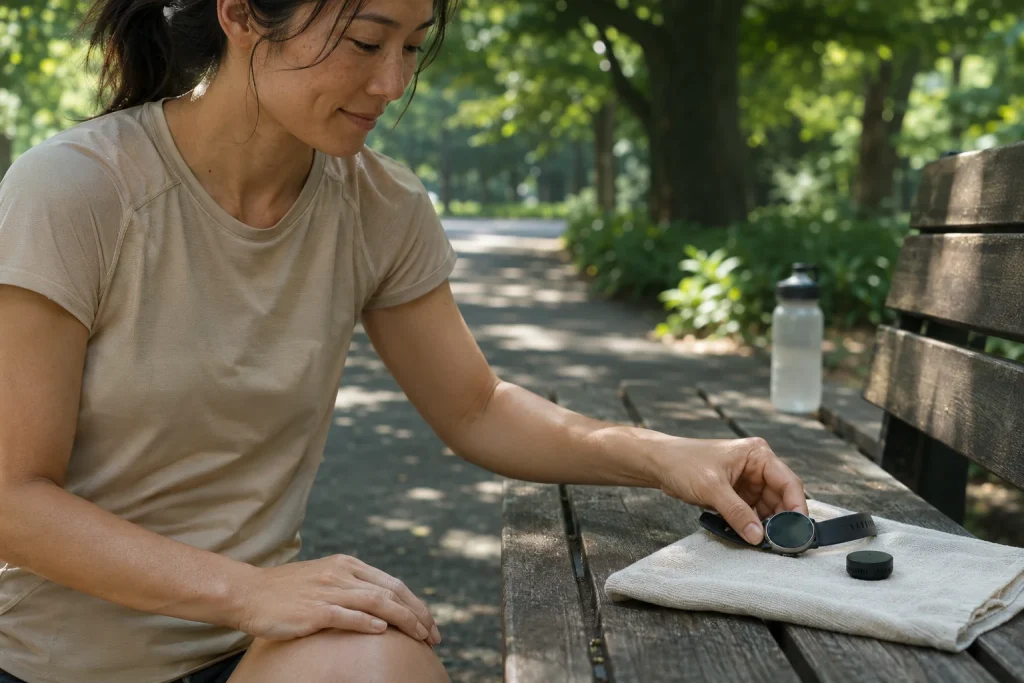
The Forerunner 965 manual mentions body heat’s effect on the internal thermometer and describes removing it from the wrist and waiting 20–30 minutes for a more accurate ambient reading. Other general support materials may mention a shorter minimum; do not combine them into one time valid for every model. Use your device’s specific guide as the reference. Source: Forerunner 965, inaccurate activity temperature.
Putting the watch down immediately after a run and reading it a moment later does not examine the same situation as a comparison after an appropriate wait. Removal alone does not instantly create an independent ambient measurement. Record elapsed time, placement and the comparison reference. Do not automatically call a difference caused by different waiting times a sensor fault.
 Enlarge image
The bench, shade and placement can change the trial
Imagine two personal checks. In the first, you put the watch from a warm wrist onto sunlit metal. In the second, you follow the manufacturer’s procedure in a shaded, unheated, safe location. Do not compare their results as though only the device’s intrinsic accuracy changed. The sensor occupied a different environment. A test setup aims to avoid adding another confounding condition to the question examined.
Record the comparison thermometer’s location too. A device in a pocket, another in open air and a third near a warm wall do not receive the same measurement situation. Shared geographical location does not mean identical immediate surroundings. A fair personal trial shows mounting, shade, time and waiting. Recognising a large placement difference does not require promising laboratory certification.
Do not leave the watch unattended where it may be lost or damaged. A technical comparison is not worth placing equipment on a travel surface, beside water or on an unstable edge. Choose a calm, controlled situation where you can watch it during the required wait. The aim is clarifying measurement origin rather than turning everyday training into a risky improvised experiment. Respect the manual’s environmental limits too.
The weather station may describe another location
Look for the source and update time when interpreting weather data, if the app provides them. A nearby station observation is useful context, but differs from a value measured beside your wrist at that minute. Garmin support specifically highlights the distinct origins of station data and the local sensor. Agreement is not required, and a difference alone does not prove the service is malfunctioning. Source: the weather display’s data source.
In an example, your run begins in a shaded park and ends beside sunlit buildings. One station observation does not necessarily describe variation within that route. Equally, the wrist-recorded series is not automatically an environmental measurement map because wearing conditions affect it too. The sources inform different questions. Placing them together helps when you do not reduce the difference to one universal “true temperature”.
Use the same source when comparing yesterday’s and today’s run. Entering the file’s saved sensor average one day and a station reading the next changes meaning at entry. A brief label solves this: “station data”, “watch internal sensor” or “external sensor”. Origin then accompanies the number, avoiding later guesses from memory about how the entry was obtained.
External sensors: compatibility and mounting are separate tasks
Garmin’s tempe support page describes an external ambient-temperature sensor pairable with compatible watches. Support is not automatic for every watch. Before buying, find compatibility for your full model name and check support for the live display or saving you want. “Wireless” is insufficient: you need a specific data path and receiver. Source: pairing tempe with a Garmin watch.
An external sensor’s advantage does not mean identical results wherever mounted. A sensor enclosed beneath a jacket near the body occupies a different situation from one exposed to ambient air as instructed. Mount it securely according to manufacturer guidance. Note position changes in your trial. Buying the sensor is only the first step; use also shapes the data’s later meaning.
After pairing, check connection, live data and the saved activity separately. The tempe description, for example, separately mentions setting a temperature data field for live display. If the number is absent on screen, inspect the displayed field first rather than necessarily declaring the entire connection faulty. After recording, examine sources for summaries and the curve. Source: tempe live and saved data.
A running file’s temperature curve is not core body temperature
An ambient-purpose sensor or body-adjacent placement does not become a core-temperature thermometer. Seeing 30 or 35 degrees in a running file must not automatically become a health interpretation. First know the field and source’s meaning. The manufacturer’s comment about wrist influence does not say it measures body temperature clinically; it points to susceptibility of ambient measurement.
Read the names of different temperature features precisely too. Ambient data, a skin-temperature-related trend and an estimate from a specially designed device are not interchangeable. All appearing in degrees is insufficient. The quantity and procedure determine permissible conclusions. Do not transfer interpretation from another sports-watch feature to an activity’s ambient-temperature field.
If unwell during exercise, comparing technical values must not delay seeking help appropriate to the situation. This article sets no symptom thresholds or health diagnosis from watch numbers. The technical lesson is simple: interpreting a temperature curve requires its source, while a health decision needs more than an ambient value of unknown meaning. Analyse the file later when the immediate situation is resolved.
 Enlarge image
Air temperature is not the complete environmental load
The National Weather Service treats heat index and WBGT separately. Heat index combines temperature and humidity assuming shaded conditions; WBGT incorporates further factors, including wind and solar conditions. A single air-temperature number does not contain all this. Understand it as a technical conceptual distinction rather than a new capability of the watch’s simple thermometer. Source: NWS, WBGT and heat index.
Add a few actual circumstances to the route description: plentiful shade or exposed sections, wind, stops and the measurement period. No invented comfort score is needed. The aim is understanding next month why two workouts with identical station temperatures had different environments. A short precise sentence may be worth more than an unknown-source temperature displayed to one decimal place.
Do not use WBGT as a synonym for every app’s “feels like” value either. If a program shows a calculated value, find its inputs and purpose in the documentation. Even with identical units, it may summarise another phenomenon. This technical article does not turn foreign threshold tables into personal running clearance. Data meaning and origin matter rather than a general verdict from one coloured value.
Five fields for a traceable temperature log
For your comparison, record time, location, source, placement and value. Keep a wrist reading separately from a later reading after waiting in shade and from the station value, for example. Their difference then becomes part of the measurement situation rather than a troubling contradiction. Recording numbers alone loses the most important explanatory information before later analysis.
Do not derive a constant correction from a single comparison. If today’s watch showed eight degrees more than the station, this does not prove eight should be subtracted from every later run. Wearing conditions, time and environment may differ. Ask whether the manufacturer’s procedure gives consistently interpretable data. A manual correction should be a named assumption rather than a silently altered original datum.
A running watch’s temperature is useful when you know its physical situation and service of origin. Local sensors, station data and complex environmental metrics have different roles. Read no more into each than it measures or estimates. Briefly marking origin and comparing appropriately lets the curve become meaningful running-log context rather than a confused thermometer for wrist, weather and body.
Sources
- Garmin: temperature and weather display
- Garmin: tempe pairing
- Forerunner 965: temperature readings
- NWS: WBGT and heat index
How Futószív articles are prepared: our editorial guidelines.