Water-based activity can appeal when land exercise is uncomfortable, you want a different load or simply enjoy the pool atmosphere. Yet a first visit can stall over details absent from the recommendation: a steep ladder, cramped changing cubicle or a “beginner” class that actually assumes confident swimming. Clarify these before buying a pass and packing your bag.
Having a larger body requires no explanation for wanting a usable entrance, suitable clothing or respectful teaching. Water is not automatically risk-free, however, or appropriate for every symptom. The questions below help you understand a particular venue and class; they do not determine which aquatic activity suits a health condition.
If unexplained illness, fainting, new exertional chest symptoms or severe breathlessness currently make activity uncertain, address that before entering a pool. Acute severe symptoms need urgent help. Becoming unwell in water can involve dangers beyond taking a break at home. Clarify health questions and venue access in parallel, but separately.
Aquatic activity is not one single class
Swimming, shallow-water exercise and deep-water sessions can require different skills, environments and organisation. A programme name is insufficient: ask where it happens, what participants do and what prior experience is expected. “Gentle” or “beginner” does not mean everyone can keep their feet on the floor throughout or that swimming instruction is included.
The NIDDK information includes aquatic activity among options at a larger body size. Buoyancy can change loading and make some movements easier than on land. This does not mean every water task suits everyone, or that someone without swimming skills should experiment independently in deep water.
The CDC information on physical activity and arthritis also lists swimming and water exercises among possible joint-friendly activities. This is general information, not a diagnosis or treatment plan for every knee or ankle symptom. If seeking an option for a particular condition, take the conditions agreed with your healthcare professional to the organiser.
Ask about the whole route from entrance to water
An accessible entrance on a website does not reveal the complete route to the pool. Are there steps beyond reception? How do you get from changing room through showers to poolside? How far must you walk, and can you sit along the way? The route can matter even without an aid if prolonged standing or many stairs are difficult.
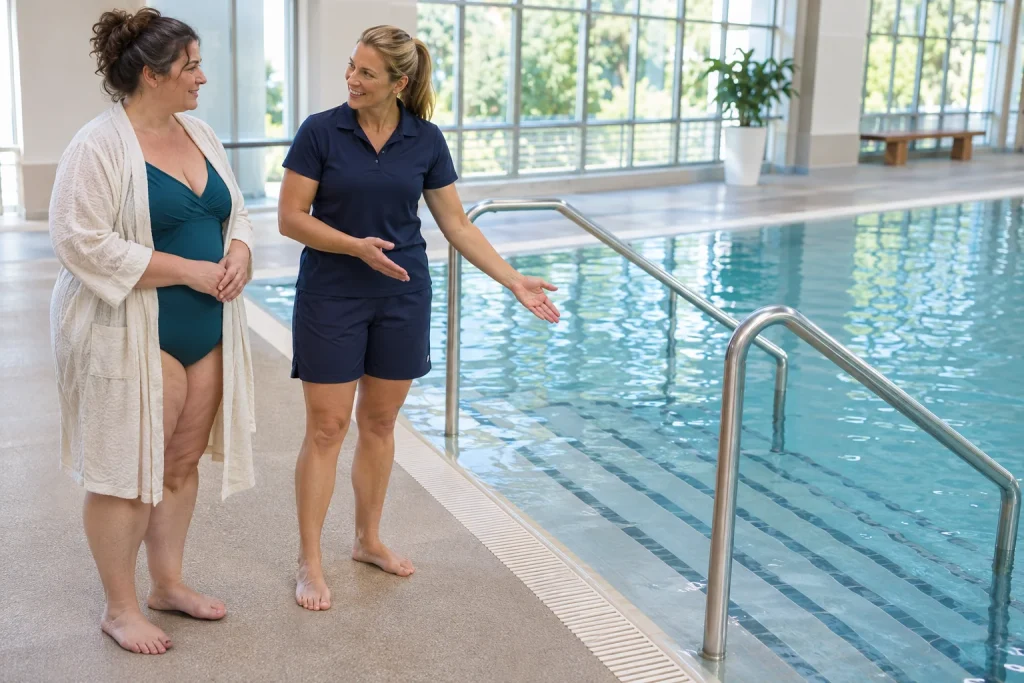
Clarify water entry separately. Are there wide steps, a steep ladder, a ramp or another arrangement? Is there a usable handrail, and can you exit at the same place? Descending and stepping out of water are not necessarily equally difficult. Ask not only whether entry is possible, but how you leave when tired.
If you need a hoist or other specialist equipment, ask its exact type, user requirements, suitably sized accessories and availability of trained staff. Equipment being present does not mean it is usable at every time or for every participant. Do not operate unfamiliar equipment alone. Agreed assistance should be a defined task rather than an improvised favour.
 Enlarge image
Describe your depth requirements in your own words
“Not deep” can mean different things to two people. Ask where the class happens, how depth changes and whether you must enter an area beyond your standing depth. This need not be a surprise at poolside. If touching the floor reassures you, say so; the instructor still separately judges suitable tasks and supervision.
A useful introduction might be: “I have not visited a pool for a long time and do not feel safe in deep water. I want a first session where we discuss entry and tasks beforehand.” This says more than a vague “I can sort of swim”. Former swimming ability and current water confidence are not always identical; you need not prove past performance with an unexpected long swim.
The CDC drowning-prevention guidance emphasises basic swimming and water-safety skills, a companion and supervised venues where possible. An inflatable toy or available foam aid is not automatically lifesaving equipment. Floating easily with a larger body does not settle deep-water safety either: entering, orienting yourself and leaving remain separate skills.
Changing rooms and clothing are not minor details
Ask about changing facilities: cubicles, enough space, stable seating and accessible showers. If rising from a low bench is difficult, say so. You do not need to prove independence by balancing in the smallest cubicle. Knowing facilities beforehand lets you decide what is comfortable and what needs another solution.
Ask the particular pool about swimwear and aquatic sports-clothing rules. Clothing suggestions on an overseas health website do not override local rules. If greater coverage feels comfortable, ask about permitted materials and designs. Rather than a size label, prioritise fit while moving, comfortable breathing and avoiding constant clothing adjustments.
Request a list of required sandals, towel, cap, goggles or other accessories too. It should belong to the particular session rather than a random online shop’s entire range. Expensive equipment is not necessarily the first purchase. Appropriate basics and clarified rules can prevent hurried compromises at the venue.
Supervision and teaching are different tasks
Poolside supervision matters, but does not mean staff individually teach and watch you throughout. Ask who leads the session, which group they teach and what help is available for entry or understanding tasks. Arrange individual teaching separately if needed. “Someone is always there” is too vague an answer.
Alongside group size, choice between tasks matters. Can you stop without obstructing others? What happens if instructions are unclear in a noisy pool hall? Is there a signal for requesting help? These concern organisation; you need not predict every problem, but should have understandable answers for the most important situations.
With a known condition or medication effects that can cause illness, balance or alertness problems, clarify an individual water-safety plan with a healthcare professional too. The CDC says some conditions require additional precautions. This should neither exclude everyone affected nor be replaced by a general group class. Do not independently skip medication to go swimming.
A first visit need not be a full workout
Its aim may simply be learning the venue. Ask in advance whether local rules allow a look at changing facilities, the pool route and entry. Otherwise, request a detailed description or information photographs of public areas. Do not photograph other guests changing or swimming; orientation does not require invading their privacy.
You can also agree flexibly on the first time in water. There is no need to “earn back” a pass’s price through one long session. Know whom to approach, where to stop and how to exit when finished. A calm trial’s value is understanding the situation, rather than immediately completing everyone else’s tasks.
Afterwards, assess activity and access separately. Water may feel pleasant while a changing-room bench causes difficulty; entry may work while class pace is too high. Compressing everything into “good” or “could not do it” makes change harder. Specific details support finding another time, group or access arrangement.
 Enlarge image
Questions for a short phone call
A prepared personal list helps. You need not ask everything at once: clarify conditions essential for using the venue first. Wide-step availability may matter more to you than poolside music. Note the time and contact’s name so each conversation need not start again.
- Which pool and depth hosts the class, and is confident swimming required?
- Exactly how do you enter and leave, and is that entrance usable at every class time?
- What changing facilities, seating and permitted clothing are available?
- Who helps you understand the first visit, and what does supervision during class mean?
- What are the current trial, payment and schedule-change arrangements?
For fees, consider complete use: entry, teaching, any extra service and time allowance can all matter. Pools do not share one pass or discount system. Know where cancellations or inaccessible required entrances are announced. A regularly available, predictable session may be worth more than a cheaper option that is hard to organise.
Enjoyable activity and safety can be planned together
Water-safety preparation need not turn the first visit into an exam. It can avoid hurried decisions at the ladder or amid the group. The CDC overview of healthy and safe swimming emphasises injury and infection risks alongside aquatic activity’s benefits. Learning local rules is an everyday part of this.
One unsuitable detail does not establish that every pool or water activity is wrong for you. Another class, entrance or calmer time may work. Sometimes the responsible choice is staying out until a health question is clarified. Neither calls for shame. Naming your needs separates a changeable organisational obstacle from a real safety requirement.
A successful first visit is therefore not necessarily measured in lengths swum. It can mean knowing where to change, whom to consult, how to reach the water and under what conditions you can move calmly. This can underpin a routine where water activity provides pleasure in its own right or complements another sport. It need not become running to belong in your life.
Sources
- NIDDK: Staying Active at Any Size
- CDC: Physical Activity and Arthritis
- CDC: Preventing Drowning
- CDC: Healthy and Safe Swimming
How Futószív articles are prepared: our editorial guidelines.