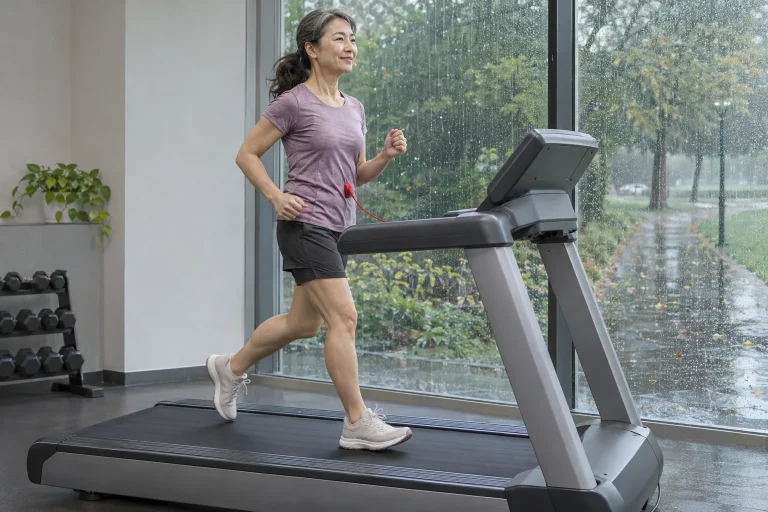
You do not seek the same thing in every treadmill session
One day you want a quiet landscape, another a favourite programme helps you get started. Some sessions need no visual content. Choosing what appears before the treadmill is often instinctive, yet different needs can underlie it: variety, engagement, pleasant mood or making the planned time easier to follow. Different goals do not necessarily suit identical content.
Research therefore finds comparing still images, moving nature scenes and self-selected entertainment interesting. One format may accompany more activity while another is emotionally more pleasant. This does not justify one best screen choice for everyone. Physical and emotional outcomes are separate questions, with your session’s purpose another consideration.
This article uses two specific treadmill studies to help name what may engage attention. It is neither a viewing recommendation list nor a training plan. Practical examples separate boredom, attention demands and perceived load. A useful choice fits your situation without requiring you to override the workout or bodily signals for the screen’s sake.
Three visual environments, three self-paced runs
In Yeh and colleagues’ 2017 experiment, 30 people watched static nature imagery, moving nature imagery or self-selected entertainment during twenty-minute treadmill sessions. Entertainment involved greater distance and heart rate, while post-run happiness was more favourable with nature imagery. Outcomes told different stories rather than identifying one overall winner.
Participants choosing pace is an important detail. The physical task actually completed could therefore differ alongside content. This differs from comparing experience at an identical fixed workload. The findings cannot directly calculate your suitable pace with a selected programme. Describe the research situation and your intended workout separately.
Static and moving nature imagery should not be treated as one generic nature substitute either. One lacks visual progress while the other includes it, but both involve screens. Real outdoor running adds changing ground, distance, weather and actual travel. The study compared indoor setups, rather than fully comparing all outdoor and indoor running.
A still image can have a role too
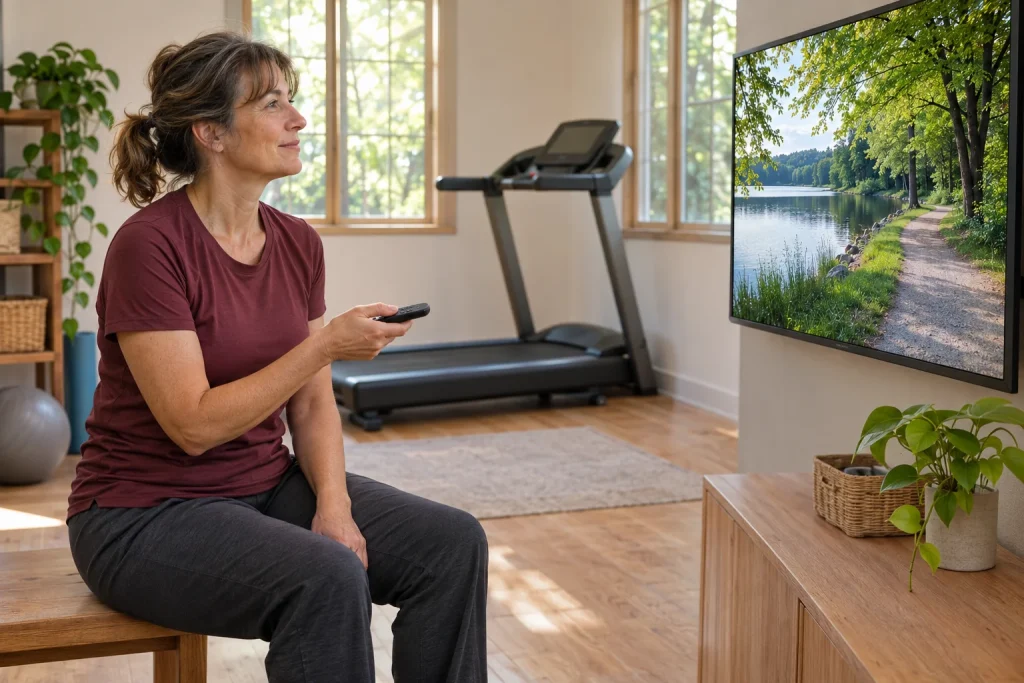
A calm still image does not demand continuous story-following. It can remain in your visual field while you sometimes notice it and sometimes focus on movement. This is a possible use characteristic rather than an effect established for everyone. Some find it pleasantly simple, others insufficiently stimulating. Learning your preference does not require deciding whether still images are generally higher- or lower-level content.
If following your rhythm matters during an easy session, a simpler background may fit. If the passing time preoccupies you, the same image may feel monotonous. These experiences need not conflict, since task and starting state can differ. Describe your choice as a specific situation: it worked comfortably in this session under these conditions.
Placement remains part of comfort. Even a favourite photograph is unhelpful if it requires an uncomfortable head turn. You do not need to watch it throughout for it to have a role. Machine operation, following the task and awareness of movement remain primary. A still image is an environmental option rather than a new attention obligation.
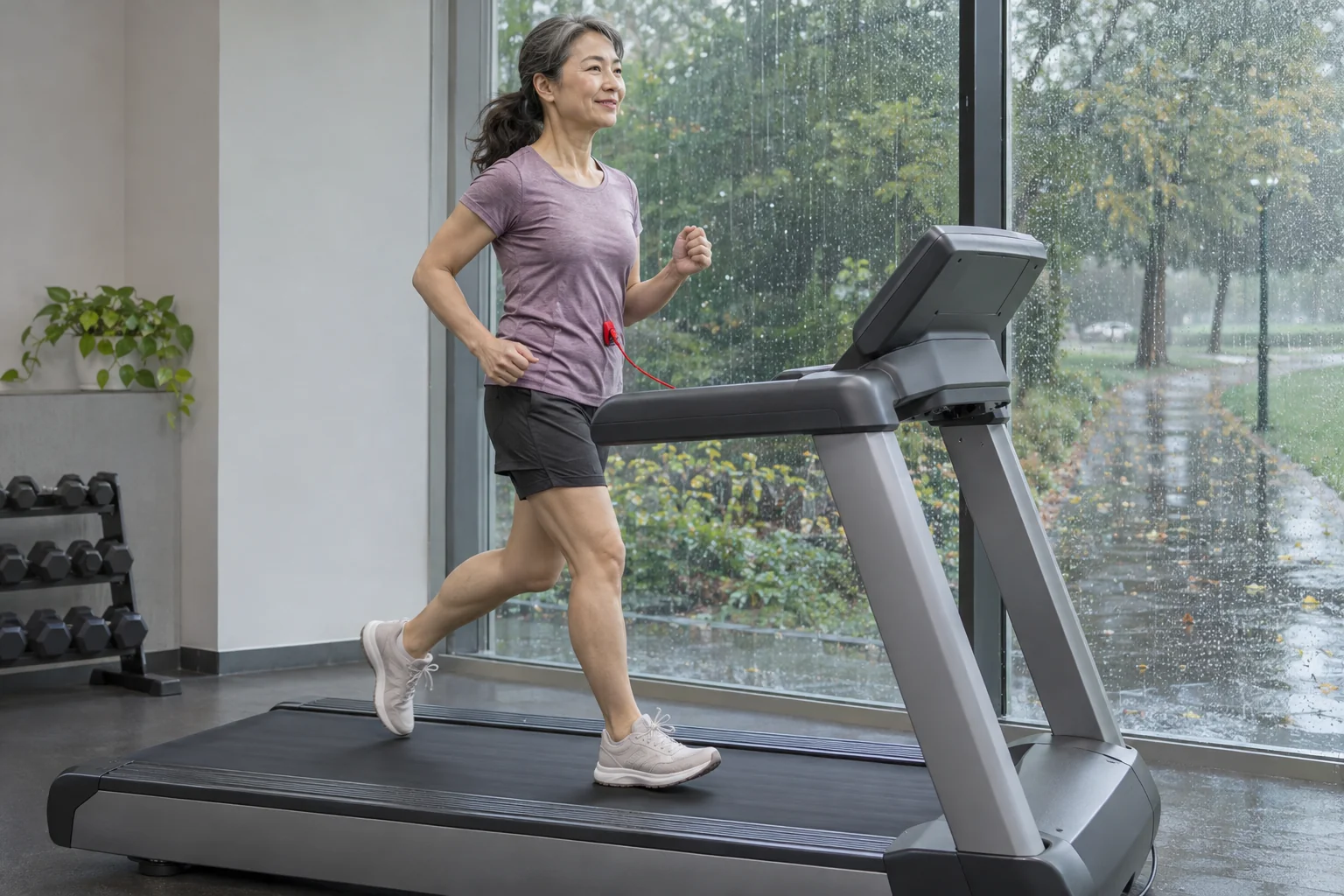 Enlarge image
Moving scenery can suggest progress
An approaching road and changing landscape offer a different visual rhythm from a fixed photograph. They may suggest forward movement while your body stays over the same machine. The relationship between visual and bodily speed depends on the system. A recorded video, content matched to machine data and an interactive virtual route may operate differently. Similar product names do not mean identical movement experiences.
As a user, describe whether the view was easy to follow or distracting. If it changes too quickly, attracts attention to too many details or fits your movement poorly, choose another approach. Research is no reason you must tolerate discomfort. The actual permitted use of the equipment and your sense of safety matter more than a theoretical ranking of images.
A displayed hill or bend does not itself mean automatic treadmill control. Presentation, speed-data transfer and actual machine settings are separate technical questions. Check exact device and version conditions before assuming an app feature. A psychological environment experiment does not validate the control capabilities of arbitrary home hardware.
A favourite programme carries a personal story
Self-selected entertainment can be more than moving images. You know the characters, care about the topic or enjoy choosing. These are possible meanings in use rather than causes separately proven by the research. Comparing a favourite programme with an assigned landscape is therefore not simply a contest of image speed. Choice and personal interest can create different situations.
An easy-to-follow programme may reduce clock-checking. A complicated plot may instead frustrate you when details are missed. What suits exercise is not necessarily your favourite viewing while seated. Subtitles, quiet dialogue and rapid visual changes can demand different attention. Separate what you enjoy at rest from what is comfortable while moving.
The session need not match the content’s ending either. When the agreed task ends, the film can continue another time. An exciting scene is no reason to postpone machine operation or checking your condition. A screen remains helpful when it fits the run’s framework rather than taking over how that framework is set.
What did the music-and-video experiment add?
In Hutchinson, Karageorghis and Jones’s study published in 2015, 24 participants exercised on a treadmill below and above ventilatory threshold with music, music plus video or a control condition. The combined condition involved more favourable affect, lower perceived exertion and attention turned farther away from exertion. This is the particular experiment’s result, not a personal promise for every intensity and content.
Attention shifting here describes an aspect of exercise experience in research. It does not mean ignoring the body or surroundings entirely. Experienced unpleasant exertion, actual load and an unusual symptom are separate questions. Engaging with content does not excuse missing pain, feeling unwell or an uncertain movement situation.
The two studies gave participants different choices and tasks. One used self-selected pace, the other a defined intensity framework. Read outcomes accordingly rather than as product ratings placed side by side. The papers show why content, task and measured experience need specifying together.
Boredom and overwhelming stimulation are different problems
If a session feels long, first name why. Is stimulation lacking, are you watching time, or is the physical task hard? Is the content itself tiring because it demands too much attention? Different questions may need different changes for comfort. A new video may not solve a problem arising from load or general tiredness.
In our editorial example, someone likes moving scenery’s variety during easy steady running but switches it off when following instructions. Another chooses a conversational programme requiring little visual attention. These are options for separate needs rather than prescriptions. Your circumstances need not match an experimental condition for you to decide meaningfully.
If no content is needed, that is not a deficiency. Rhythm, quiet or following your own thoughts can be manageable choices too. More stimulation does not automatically create a more modern or better workout. Ask which available option supports following the task safely.
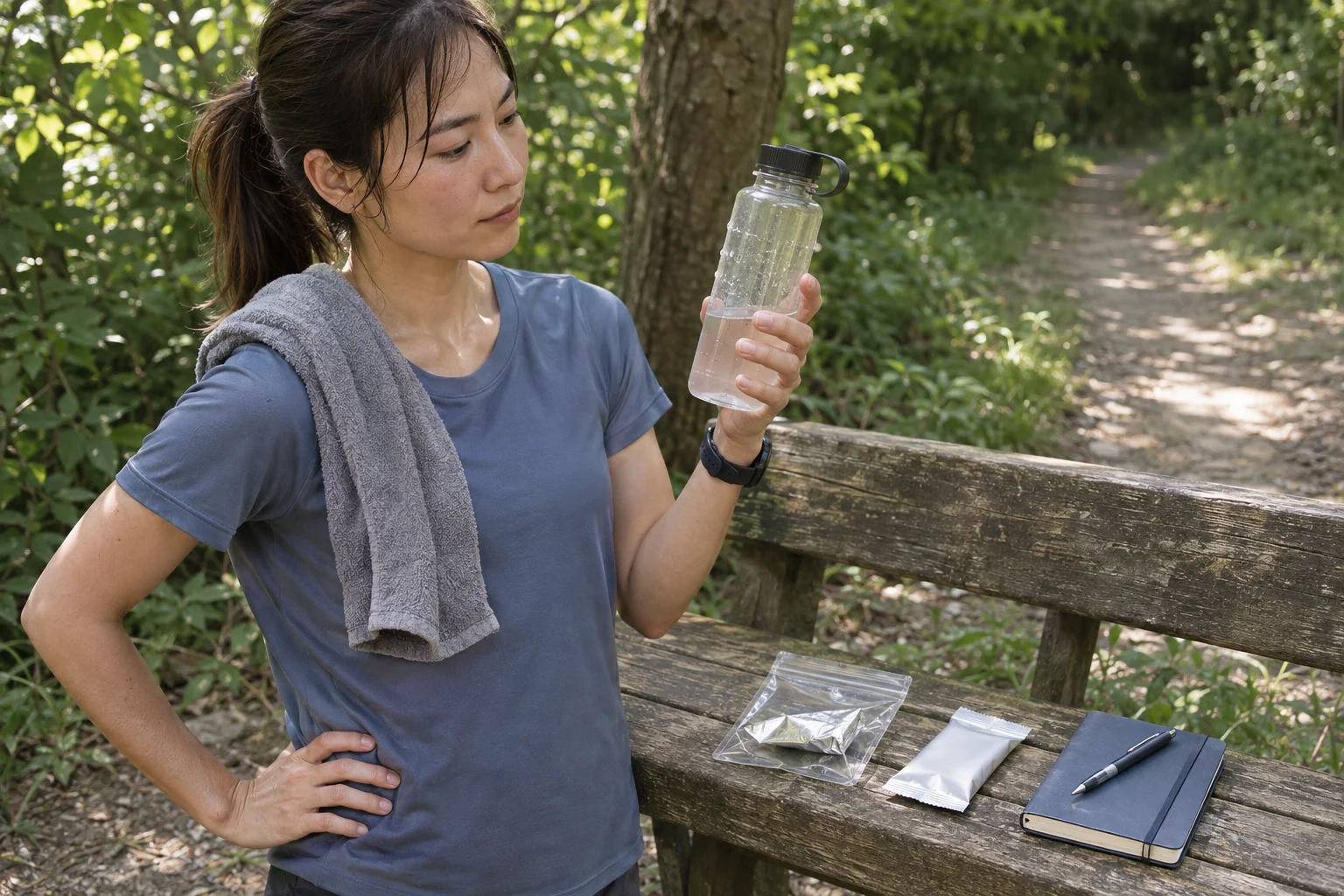 Enlarge image
Three questions before the next indoor session
First, purpose: what do you want from content now? Variety, a pleasant background or following a chosen story are possible answers. Second, attention: how much does it demand from the attention also needed for the machine and task? Third, setup: how can you prepare it while stationary so little handling remains during running?
This brief preparation is not a scientific experiment and needs no new device. An existing screen or content may suffice if comfortable in the space. Match sound, visibility and controls to equipment instructions and shared-space rules. The same programme or volume can create different experiences for others.
Afterwards, consider more than distance. Describe what engaged you, any disturbance and whether you want the choice again. A favourable experience need not be framed as performance-enhancement evidence. It is enough that a circumstance worked for you then. The next session can call for another decision if needs or tasks change.
What is worth recording separately?
In a personal log, give content type, planned task and experience separate lines. Remembering only that a programme was good makes it harder to identify which part to choose again. A more precise note might say subtitles were unnecessary or slowly changing scenery demanded little attention. This is a use observation rather than a psychological score.
Separate load and emotional outcomes too. Did you run farther, enjoy the session more or both? One need not imply the other. Note sleep, time of day and room conditions if relevant. The diary does not become controlled research, but reduces the likelihood of attributing every difference to one screen choice.
Still images, moving scenery and favourite programmes can remain three options for shaping your setting. Research separates physical participation, emotional response and attention. Your choice need not produce the best outcome in every area at once. A comfortable option suited to that particular day is a meaningful decision in itself.
Sources and the role of our examples
We checked the primary publications on 21 November 2026. The 2017 self-paced visual environments remain separate from the intensity-based music-and-video experiment published in 2015. This is not our own test of a particular service or treadmill. Log examples are editorial ideas and images are original AI illustrations.
- Yeh and colleagues: Physical and Emotional Benefits of Different Exercise Environments Designed for Treadmill Running, 2017
- Hutchinson, Karageorghis and Jones: See hear: psychological effects of music and music-video during treadmill running, 2015
How Futószív articles are prepared: our editorial guidelines.