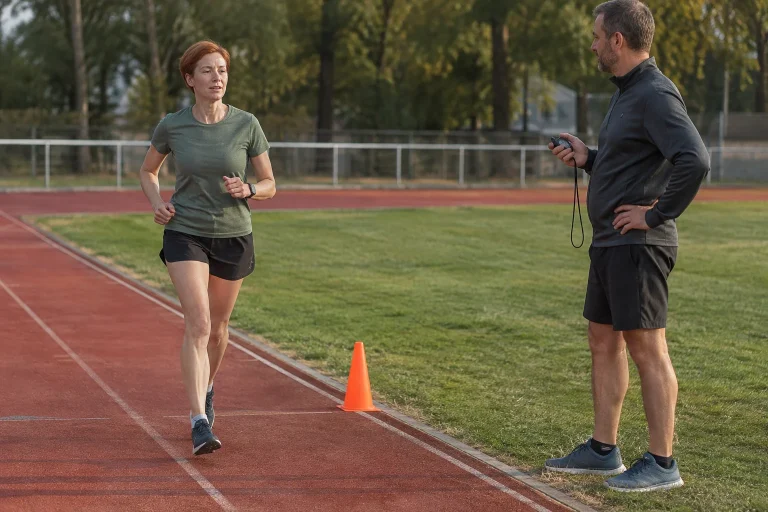
You turn almost imperceptibly around a broad track bend, while the same pace feels different on a small park loop. The difference does not require increasing speed’s magnitude: continuously changing direction is itself acceleration. The tighter the curve, the faster movement’s direction must change at the same forward speed.
The physics of curved running is therefore a separate question from braking before a sharp turnaround. We explain how bend radius and speed enter the equation, what a simple inward-lean model means and why calculated force does not directly become a personal race time. Our own numerical examples reveal the relationship; they are not technique instructions and do not specify the angle at which to hold your body.
Velocity changes direction even at a constant pace
Everyday pace usually expresses only how fast you move: five minutes per kilometre, for example. Mechanical velocity also has direction. Running along a circular arc, you may cover the same distance in equal time while your motion gradually points east instead of north. This directional change involves acceleration towards the arc’s centre.
In the basic relationship for uniform circular motion, its magnitude is v²/r: speed squared divided by radius. The corresponding net force is m × v²/r, where m is mass. Centre-directed, centripetal force is not the name of a special new kind of force, but describes the direction of the resultant needed to change direction. For a runner, contact with the ground also forms part of how this resultant arises.
A person, however, is not a continuously rolling point. Stance and flight alternate, feet contact the ground in sequence, and the centre-of-mass path may deviate from a perfect circle with each step. The simple equation explains the task’s average directional-change requirement. It does not mean lateral force is identical every millisecond or that inner and outer legs each contribute exactly half.
Smaller radius, greater speed: our own numerical example
Let speed be five metres per second, or eighteen kilometres per hour. On an ideal circle with a thirty-six-metre radius, acceleration is 25/36, approximately 0.69 metres per second squared. At a sixteen-metre radius and the same speed, it is 25/16, or 1.56. In this example, the tighter curve requires more than twice the acceleration towards the centre. These are our own rounded geometric examples, rather than measurements from a particular stadium.
Speed features especially strongly in the equation. If you accelerate from three to six metres per second at the same radius, v² rises from nine to thirty-six, quadrupling required centripetal acceleration. Speed only doubled. A curve barely noticeable during comfortable jogging can therefore become a very different task in fast running. Without radius and speed, ‘difficulty of the bend’ conveys too little information.
For a seventy-kilogram point-mass model, the preceding accelerations of 0.69 and 1.56 require inward resultants of approximately 49 and 109 newtons. These are not knee, ankle or tendon forces, and we have not calculated a stance-phase peak. The figures describe average directional change of the entire model body. Local joint forces would need more information and a more detailed model.
| Our own idealised example | Speed | Centripetal acceleration |
|---|---|---|
| 36-metre radius | 5 m/s | 0.69 m/s² |
| 16-metre radius | 5 m/s | 1.56 m/s² |
| 16-metre radius | 3 m/s | 0.56 m/s² |
 Enlarge image
What does the simple inward-lean model explain?
Imagine a simple body continuously supported while circling uniformly: the resultant of vertical support and inward force points at an angle. In this idealised situation, the tangent of the lean angle is v²/(r × g). Greater speed or a smaller radius produces a larger angle. The equation depicts equilibrium for the whole model body, rather than how much a person’s spine or knee should bend.
In our five-metres-per-second example, this simplified calculation gives approximately four degrees for a thirty-six-metre radius and nine degrees for sixteen metres. A real runner’s video may show different trunk, whole-body and segment positions. A moment during stance differs from flight too. Placing a ruler against a side-view image and prescribing this idealised value as a compulsory technique target is unhelpful.
Adding force magnitudes is also a vector operation. We do not simply add the inward component to body weight, because one is horizontal and the other vertical. Doubling the horizontal component therefore does not double the total resultant force. This illustrates why a partial result from an equation cannot be transferred at the same percentage to the demands of the whole run.
Why might changing direction cost energy?
In ideal uniform circular motion, centre-directed force is instantaneously perpendicular to travel. A point body’s kinetic-energy magnitude therefore does not simply increase because we change its direction. This does not mean generating force costs humans nothing. The metabolic cost of muscle activity cannot be described solely through changes in energy calculated from the whole body’s speed squared.
The performance model developed by Taboga and Kram started from a proposed relationship between greater axial leg force and energy demand. It assumed the runner maintains the same metabolic rate and therefore slows on curves. The calculation predicted larger time effects for tighter curves and higher speeds. This is an estimate built from assumptions and earlier relationships, rather than race time lost directly measured in every bend.
The distinction matters in practice too. Someone deliberately maintaining the same pace has already changed one of the model’s starting conditions. Braking before a sharp turn also adds another mechanical task to changing direction. It is not appropriate to explain such a situation’s time result entirely through a constant-speed, continuous-curve relationship. The model must suit the question.
The inner and outer legs may have different tasks
We call the leg towards the circle’s centre the inner leg and the other the outer leg. While completing a semicircle, they do not operate in a symmetrical environment: together they shape travel direction from different positions. This does not automatically make one leg ‘weaker’ or asymmetry measured in a bend pathological. The task differs from roughly symmetrical straight-line running from the outset.
In Mesquita and colleagues’ 2024 study, eleven participants ran straight and around curves of six- and eighteen-metre radii. Speed and radius influenced the centre-of-mass path and mechanical work; inner–outer differences also appeared at higher speeds. Work examined differed little from straight running on the wider curve and at lower speeds on the tighter curve, while the fastest tight condition showed a larger change.
A separate experiment involving nine competitive sprinters examined maximal running at radii around seventeen and thirty-six metres. The tighter curve produced lower peak speed and differing patterns of force generation between legs. Maximal sprinting is a different task from everyday easy laps, however. The result should not prescribe the same percentage slowing to an amateur marathon runner.
A wider arc may also mean a longer route
Mechanical ease is not the only consideration in choosing a line. Increasing a semicircle’s radius by one metre adds π metres, approximately 3.14 metres, to its ideal arc length. For a full circle, the difference is 2π, approximately 6.28 metres. This is our own geometric example, rather than a description of official track measurement lines and staggered starts. Actual race tracks have specific rules governing measured distance.
At an unchanged five metres per second, an extra 3.14 metres would mean approximately 0.63 seconds. But whether speed stays the same and the line is usable are precisely the questions. A wider curve can simultaneously reduce directional-change demand and increase distance. Both would matter for net time, so general advice to ‘always take the tightest line’ or ‘always run outside’ is equally oversimplified.
In an urban race, other runners, the marked course and surface condition add further considerations. A theoretically shorter line is a poor choice if you suddenly cut across others or enter a slippery section with poor visibility. Predictable direction and recognising the bend beforehand provide more practical help than calculating an ideal radius on the move. Physics helps explain the situation without overriding the environment.
 Enlarge image
A continuous curve and sharp turnaround should not be confused
On a broad track bend, speed’s magnitude may remain relatively steady while direction continuously changes. Before a confined 180-degree turnaround, however, slowing and reaccelerating are often needed. Kinetic-energy magnitude then also changes, and available space determines how the turn is negotiated. ‘Number of bends’ alone therefore does not describe a course’s pace characteristics.
Two ten-kilometre routes may each have eight turns, yet a broad roundabout on one differs from a tight car-park turnaround on the other. Prior course knowledge, field density and surface further alter the situation. A split time cannot separate these into precise seconds without measuring and controlling them. Describing curve type therefore gives more information than a simple count.
When planning training, a winding loop can be a useful task in its own right, but should not automatically be considered a copy of a long, straight pace test. The same line and similar conditions may help compare progress. If the route changes, however, another explanation accompanies a pace difference. This does not reduce the session’s value; it makes the performance described more precise.
How can you use knowledge of radius?
At the next course inspection, first identify broad, continuous arcs and places requiring an actual turn. You need not estimate radius to the nearest metre on a phone. Recording where space narrows, where surface changes and where to arrange your line earlier may be more useful. Course knowledge then connects with specific decisions.
When reading equations, retain the sequence: speed and radius first determine directional-change demand, then movement and force generation describe how the runner solves it. A metabolic or time estimate is a further step with its own assumptions. With these transitions clear, you will not automatically read a ten-per-cent change in centripetal force as a ten-per-cent change in race time.
Curved running is therefore a real mechanical task depending on speed and radius. The inward resultant, different functions of the two legs and running-line length matter together. The best practical application is recognising bends in advance and choosing a usable line. A broad track arc and tight turnaround then become two distinct running situations to solve, rather than the same obstacle on a map.
Sources
- Taboga and Kram: a model of curves’ effect on performance.
- Mesquita and colleagues: centre-of-mass path and mechanical work during curved running.
- Diaz and colleagues: radius, maximal speed and leg-specific forces in sprinting.
- OpenStax: centripetal acceleration and force.
How Futószív articles are prepared: our editorial guidelines.