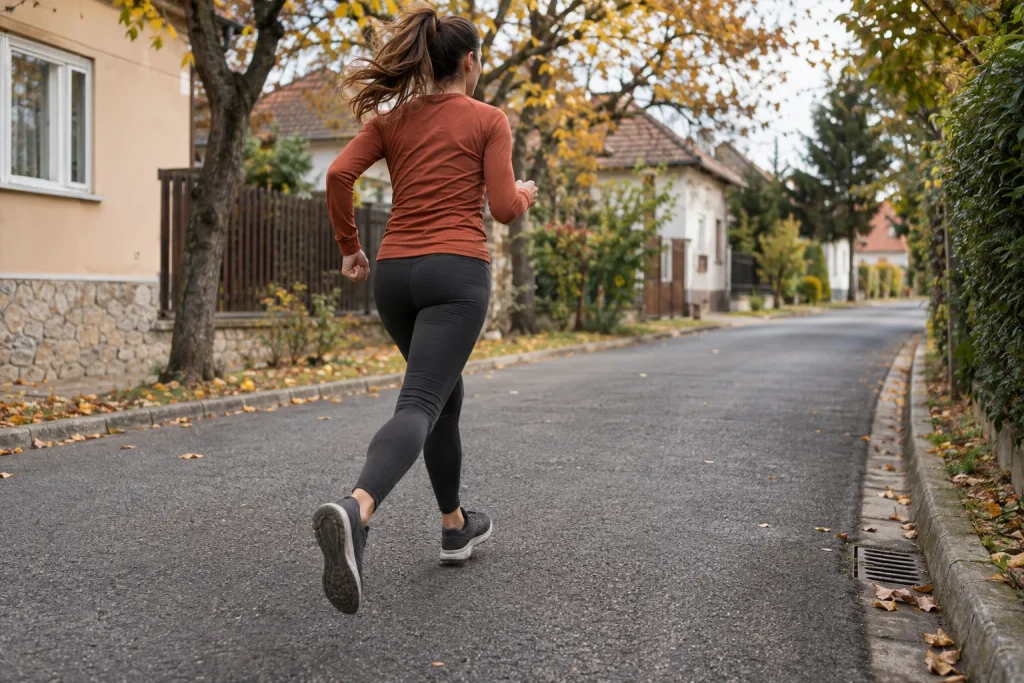
The street looks flat, yet you feel as though one foot always lands slightly higher. Water flows towards the kerb, asphalt slopes sideways and you run along the same strip for a long time. This road design creates a situation a sports watch’s elevation graph can easily hide: there is no substantial rise in your direction of travel, yet geometry beneath the two feet is not quite identical.
It is worth understanding cross slope as a running circumstance. The body can adapt movement to it; adaptation may be visible or measurable even when whole-body energy demand barely changes. Below we separate the road’s shape, each side’s momentary work and what can be inferred for your own training. A slight slope alone cannot establish which leg is ‘wrong’ or calculate your next injury.
Cross slope and longitudinal grade: name the direction first
Longitudinal grade changes surface height in your direction of travel. Running to a hilltop gains vertical metres. With cross slope, the height difference is perpendicular to the line of travel: the road centre may be higher than its drainage side. Both can coexist. A strip sloping towards the kerb on a downhill street therefore has two separate geometric properties, not fully described by ‘three hundred metres downhill’.
Imagine a horizontal shelf tilted around its long axis. A straight line drawn along its length may remain at constant height, while its two edges reach different levels. This is a simple spatial model of cross slope. Raising one end instead produces longitudinal grade. Elevation profiles in race calendars and route drawings usually try to show the second kind of change, rather than a few centimetres of transverse difference between feet.
Percentages and degrees are not identical units of slope either. Percentage grade is one hundred times height difference divided by horizontal distance. Three per cent means a three-centimetre change over one metre of horizontal transverse distance; three degrees is approximately 5.24%. This is a purely geometric conversion, rather than a suitability limit for running. Confusing the two labels creates a very different imagined surface when reading research.
How much difference actually falls between the feet?
The drop across an entire road’s width is not the same as the height difference between two successive foot placements. In our own illustration, suppose cross slope is uniformly four per cent. Across three metres, the height difference is twelve centimetres. If two points are only twenty centimetres apart sideways, their vertical difference on the same plane is eight millimetres: 0.04 × 0.20 metres. This is not a leg-length difference created in your body, but the geometric relationship between two surface points.
The step track moves, however. Feet do not always land the same distance from the line of travel, and a shoe sole supports over an extended area. A local pothole or depression beside a drainage channel can create a much more abrupt change than a uniform plane. The calculation therefore helps explain scale, but cannot calculate exact joint positions from one phone photograph of the road.
The terms uphill-side and downhill-side leg always refer to the slope. In one direction, your right foot may be higher; returning along the same track, the left may be higher. ‘Right leg’ is therefore anatomical, while ‘uphill-side leg’ is environmental terminology. When comparing research results, identify which is used. Omitting this detail may make two apparently contradictory observations actually describe the same situation in opposite directions of travel.
 Enlarge image
The body is not a rigid two-legged stand
If two equal-length rigid rods stood on a tilted board, the structure above would simply change position. During running, however, ankle, knee, hip and trunk movement together shape support. The foot’s position relative to the ground, joint flexion and small trunk shifts may contribute differently to keeping the body on the route. One sentence saying ‘one leg became shorter’ cannot describe this precisely.
In Park and colleagues’ experiment published in a 2026 journal issue, twelve trained men ran on a treadmill with zero, three and six degrees of cross slope, for five minutes per condition at a speed below their own ventilatory threshold. Researchers found changes in knee and trunk movement and some calf EMG measures, but no significant differences in metabolic indicators. The study examined brief, controlled adaptation, rather than months of street-running injuries.
‘Movement changed’ is not a value judgement. You also place your feet differently when avoiding a bus stop than on a long straight. The point is responding to the environment and completing the task. Yet adaptation does not make every surface comfortable for every runner. Personal sensations can remain in a note without immediately trying to back-calculate bone, tendon or cartilage loading from discomfort.
What does muscle activity tell us, and what does it not?
Surface electromyography, or EMG, records electrical signals associated with muscle activity. Measurement and processing methods also influence signal magnitude; it is not simply ‘muscle force’ on a display. Different raw signals from two runners are not a direct contest, and greater activity in a particular muscle does not automatically establish higher whole-body energy expenditure or tissue damage.
In an outdoor study involving fifteen recreational runners, a real cross-sloped road surface was compared with a level surface. During stance, mean activity of tibialis anterior, lateral gastrocnemius and vastus medialis oblique was greater on the gutter side than on the road-crown side; no difference was found during swing. This result belongs to a circumstance and movement phase, rather than a general ranking of the two legs’ ‘strength’.
Outdoor and treadmill measurements control different things. Outside, road and travel are more natural, but the running line and speed may vary. In a laboratory, pace and slope can be fixed more closely, while the belt and measuring equipment create their own environment. Individual muscles and processed indicators do not necessarily match either. The two studies therefore should not become one universal percentage for roadside ‘extra loading’.
How can energy demand remain similar with different movement?
Whole-body metabolic measurement totals things up. One movement detail’s cost might increase in a task while another decreases, or the change may be small relative to overall functioning. Joint movement, individual muscles’ electrical signals and energy demand calculated from expired gases describe the same run at different levels. They need not all change in the same direction or proportion.
In a numerical example of our own, an imagined overall indicator is one hundred units. One subtask needs two more units and another two fewer, leaving the total unchanged. In another possible case, all changes are small and the total remains within measurement fluctuation. These are not measured component-energy data from the research; they illustrate why one muscle signal’s change cannot be equated with total oxygen consumption.
The absence of a significant difference does not, however, prove perfect equivalence between conditions. Sample size, uncertainty and the range examined also inform interpretation. The appropriate reading is that this short study at specified speeds did not detect a clear metabolic difference. It does not automatically establish equivalence for a steep roadside, the final hour of a tiring marathon or a slippery, uneven road edge.
Do not confuse step width with road camber either
Cross slope is a surface property; step width describes movement. They may influence one another, but foot placement can differ on the same road, and ground slope can change with the same step width. Stepping sideways to avoid a road edge creates another new task. If a video shows a foot closer to the body’s midline, clarify travel direction and camera view before naming a movement change.
The step-width experiment by Brindle and colleagues examined deliberately different running widths in thirty healthy runners. Some hip, rearfoot and knee indicators changed with wider steps. This usefully shows that modifying foot placement may affect several joints; it does not establish that everyone should deliberately step wider on every cross-sloped street. An experimental intervention and the road’s natural condition are separate questions.
For your own observation, a descriptive sentence is therefore better: ‘on that road section, downhill-side foot contact felt less certain’. It claims far less than ‘my hip stability is poor’, while being more accurately retained and retrieved. The log’s purpose here is recognising the circumstance. A self-directed corrective programme based on a width or angle would require further assumptions unsupported by the observation.
 Enlarge image
A route note you can actually learn from later
You need not run with an array of instruments to describe a route better. Choose section boundaries you can find again: a park entrance, bridge or start of an enclosed promenade. Instead of ‘it was slanted’, record which way it sloped, how long you ran there continuously and whether local irregularities were present too. Include a numeric slope only if properly measured; do not assign tenths of a degree by eye.
| Note | Usable wording | What does it not establish? |
|---|---|---|
| Surface | It sloped from the road centre towards drainage on the left. | The legs differ in anatomical length. |
| Duration | It was a continuous section of approximately eight minutes. | It becomes generally dangerous after eight minutes. |
| Sensation | Foot contact felt less comfortable on the downhill side. | A specific tissue was injured. |
| Accompanying circumstance | Wet leaves and two depressions were also present in the lane. | Slope alone caused the discomfort. |
The return journey may offer a chance to notice a difference if your out-and-back session already follows a safe, permitted route. This is not an invitation to change direction in the road or override traffic rules. Running on the other side of the same street may also mean a different surface: repairs, water, parked cars and pavement may differ. A reversed section is therefore an observation opportunity rather than a strict laboratory control.
Practical decision: choose the whole running line
Assessing an easy-run route requires several considerations together: visibility, separation from traffic, surface condition, lighting and your own comfort. A geometrically flatter line is not necessarily better if it takes you among cars. Constant sideways weaving to reduce slope creates a new task and different risk. It is more practical to choose an inherently usable section for the planned session.
If a particular road edge persistently bothers you, changing the route is a sensible comfort decision in itself. You need not first prove the asphalt would certainly cause injury. The situation differs when symptoms change running rhythm or repeatedly limit you: symptoms, training volume and surface then need consideration together, rather than a ‘cambered-road syndrome’ diagnosed from a photograph. The useful observation is a precise description of the situation.
Cross slope is therefore a real mechanical circumstance to which running movement can adapt. Support at different heights under the two feet, electrical muscle signals and total energy demand provide separate information. Together, they are more interesting than a single sensational claim that the roadside ruins or trains your legs. Recognising the road’s shape, keeping a meaningful log and choosing a good running line offer tangible benefits in your own running.
Sources
- Unfried and colleagues: a real cross-sloped road surface and lower-limb EMG.
- Park and colleagues: cross slope, movement, muscle activity and running economy.
- Brindle and colleagues: biomechanical consequences of modifying step width.
How Futószív articles are prepared: our editorial guidelines.