The online shop says forty millimetres, the shoe’s side shows a much taller foam wall, and another specification sheet gives a different figure. Before assuming the product description is wrong or the shoe breaks the rules, first clarify where the measurement starts and ends. Stack height is not the height of the shoe’s most conspicuous sidewall, and race rules involve more than checking a single marketing figure.
This article is based on official rules checked on 21 November 2026. Original geometry examples explain what the measurement points mean, before we distinguish stack height, drop, approval and running economy. This is not a home certification procedure. The aim is to help you ask precise questions when checking your shoe and the conditions of a particular race.
The rule specifies two locations and a defined measurement direction
Sections 8.3–8.4 of the World Athletics Athletic Shoe Regulations effective from 20 April 2026 define the distance measured from the inside upper surface to the hard, flat support. The forefoot point is at 75 per cent of the internal length and the heel point at 12 per cent. The standard sample in the approval process is associated with a length of 270 millimetres; the rule treats small differences arising from larger sizes separately. A household measurement from the side is not the same procedure.
In an original calculation, 12 per cent of an internal length of 270 millimetres is 32.4 millimetres, and 75 per cent is 202.5 millimetres. These identify positions along the length, not sole thicknesses. The common misunderstanding lies precisely in merging the two distances: one tells us where to examine the shoe, while the other describes the height between the foot and the support at that location.
If our illustrative example instead has an internal length of 290 millimetres, the two longitudinal positions would be 34.8 and 217.5 millimetres. This calculation does not establish whether the shoe complies. It shows why the position must be tied to the correct length. An overall shoe length measured with a tape on the outside may provide a different basis from internal length; the percentage stays the same while the selected point shifts.
A high sidewall and material beneath the foot have different geometry
The foot sits on a shaped internal surface within the shoe. The sidewall can extend above that surface and partly surround the foot. Measuring externally from the top of the sidewall to the ground does not necessarily give the total height of the layers beneath the foot. This is a straightforward spatial difference that an exterior shoe photograph does not always make clear.
In our original imaginary cross-section, the internal surface supporting the foot is forty millimetres above the flat base, while the top edge of the surrounding foam wall reaches fifty millimetres. The ten-millimetre difference is not automatically additional cushioning beneath the foot. The wall rises beside the foot. This is not a measurement of an existing model, but an explanation of why reading the tallest external rim as stack height is misleading.
The curvature at the heel and toe can create further visual differences. The part of the shoe profile that appears thickest may not coincide with the specified longitudinal measurement point. A photograph’s perspective and the shoe’s tilt relative to the ground can also affect its appearance. A side view helps explain construction, but the location and direction of precise regulatory measurement must be understood separately.
Sockliner, midsole and outsole: what does the specification name?
Several separate layers may lie between the foot and the ground. If a description gives only midsole foam thickness, that differs from the height of the whole layered structure. Read the words literally: midsole, outsole, sockliner and total stack do not necessarily identify the same boundaries. Each may use millimetres, yet measure something different.
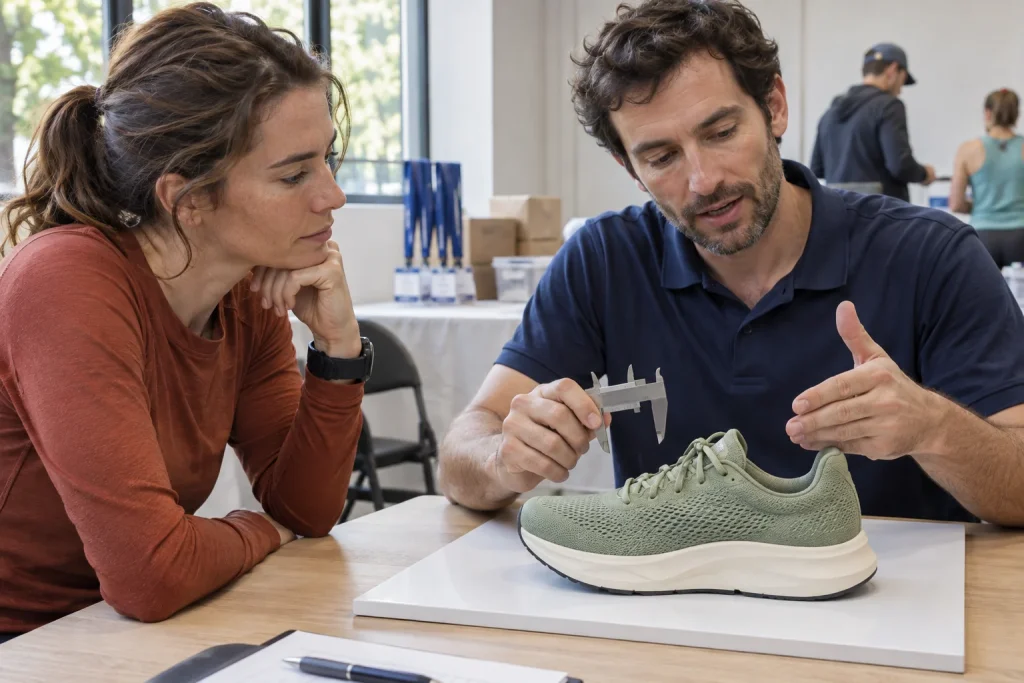
The published RTINGS shoe-testing method, for example, identifies heel and forefoot measurement points relative to internal length and also documents the structure through cross-sectional examination. This describes a tester’s own procedure, not a replacement for official approval. It is a useful example of why a numerical measurement needs a transparent protocol behind it.
In an original layered example, three millimetres of outsole, thirty-three millimetres of midsole and four millimetres of inner layer total forty millimetres. If a summary reports only thirty-three, it is not necessarily a measurement error: it may have named a different layer. Confusion arises when we compare a component value with total thickness. A drawing and the named layer boundaries help clarify the basis of comparison.
 Enlarge image
Drop is a difference, not a third stack height
The official Brooks terminology guide defines drop as the height difference between heel and forefoot. Stack height, in contrast, describes the height of material beneath the foot. The terms are related but name different quantities. A low drop does not establish that the whole sole is thin.
In our simple original example, shoe A has heel and forefoot heights of forty-two and thirty-four millimetres, while shoe B has thirty-six and twenty-eight. Both differences are eight millimetres. The same drop therefore accompanies different total heights. This is purely arithmetic, not a rating of real models or permission to race. A single difference loses the two original heights.
It is worth thinking in reverse too: with the same heel height, two shoes can have different forefoot thicknesses and therefore different drops. Both points must be named for a proper comparison. Calling something an “eight-millimetre shoe” is therefore imprecise shorthand: it may refer to drop when our question concerns total height. A complete sentence can remove many misunderstandings when buying or checking race conditions.
The forty-millimetre figure also needs an event
Appendix 2 of the current rule gives a maximum of forty millimetres for road running and twenty for track running, except track race walking. The document’s scope is linked to the World Rankings Competitions system. The current text includes separate exceptions for several other event groups. A claim that something is “legal in competition” therefore also needs the event type, category and applicable rule.
In our original organisational example, the same person is preparing for a road 10K and a 10,000-metre race on an athletics track. The distance is similar, but the event classification may differ. Shoe selection cannot be settled from the distance number alone. They need to check each race’s regulations and the rules applied before automatically transferring earlier shoe approval from one to the other.
For recreational events, the particular race regulations are especially important. A rule used in the international rankings system does not establish by itself how a local event handles the same shoe. Equally, practice at a relaxed social run does not override a qualifying race’s requirements. The proper starting point is which part of which event you are entering and with what status.
The approved list says more than a single specification sheet
The official World Athletics Shoe Checker allows searches for examined and approved shoes by model name or model number. For a current check, search the exact model, not simply the brand or series family. A new generation or similarly named variant may have a different entry. Interpreting use requires comparing the result with the event relevant to you.
In our original administrative example, an athlete’s box says “Speed Model 3”, the online shop listing abbreviates this to “Speed”, and the entry form gives only the brand. That is not enough for unambiguous identification. Keep the shoe’s own label as well as the exact name, product code and variant. These invented names show how easily several different items can appear identical.
If the result is unclear, clarify the missing information with a precise question to the organiser or relevant authority. Do not turn uncertainty into your own permission, and do not call a model banned simply because the first search failed. Checking the list is a documented identification task. Keep the check date and the particular event alongside the screenshot.
Size, worn condition and modifications are separate questions
The size of your pair may differ from the reference size used for a published measurement. If a manufacturer reports a figure for a particular size, that does not necessarily mean every size has exactly the same geometry. Look for the size in the specification too. Regulatory assessment has its own treatment of sizes; household scaling cannot produce a reliable compliance boundary.
In our original conceptual example, every length of an object is increased by five per cent in a computer drawing. A completely uniform scaled copy would also become five per cent taller. Actual shoe sizing, however, is not necessarily this kind of homogeneous enlargement. Do not use this geometric exercise to infer an actual model’s dimensions or permissible competition height. The point of the example is to expose the assumption behind naive scaling.
Section 6 of the rule treats orthopaedic and individual modifications separately; an authorised, medically justified orthotic is not the same as any extra insole. Clarify the exact procedure before making your own modification. Making a shoe more comfortable and maintaining its approved structural condition are two separate checks. This article does not recommend do-it-yourself thickness reduction or cutting a shoe open.
 Enlarge image
Compliance and running economy are two different assessments
Race rules describe technical and procedural requirements. A laboratory study may ask about the metabolic cost of running in a particular shoe. Approval is not a personal performance guarantee, while a favourable laboratory finding is not, by itself, permission to race. The two questions have separate data and separate ways of checking.
The original 2026 study by Needles, Kim and Grabowski compared specific modern spikes and road shoes with a traditional spike model in seventeen competitive runners. They collected respiratory-gas and ground-reaction-force data during short, repeated treadmill stages. The observed economy difference applied to that particular comparison; the study did not turn a shop’s height specification into a personal advantage score for everyone.
In your own decision, therefore, keep three columns separate: does it meet the particular event’s requirements, does it fit and work well for your task, and is there relevant performance evidence? No single number can fill any whole column. Compliance may be necessary to take part, while usability lets you run meaningfully in the selected shoe. The two checks support each other but are not substitutes.
What should you note for your next shoe check?
Put the event name, date, distance and category on one page with the shoe’s exact model, product code and size. Add the current official list result and the rule version applied. If the question specifically concerns height, keep the data source and what the figure refers to: midsole, total layers, heel or forefoot. The question then becomes a specific situation you can verify, rather than “Do you think it’s too thick?”
You do not have to invent uncertain information on the spot. Ask the retailer how a published value was measured, the organiser about the event’s current conditions and search the approved list for the exact model. Different sources have authority over different questions. Information becomes usable when you know which statement rests on which evidence.
Forty millimetres is therefore a number tied to a location, measurement method and event. Points defined by internal length, the complete structure beneath the foot and precise model identification together make a meaningful check. The appearance of a tall sidewall, drop or another size’s specification is separate information. Keeping these distinct makes shoe selection and checking before a race much clearer tasks.
Sources
- World Athletics: Athletic Shoe Regulations, effective from 20 April 2026; sections 6 and 8 and Appendix 2.
- World Athletics: official approved-shoe checker.
- RTINGS: its published shoe-measurement method.
- Brooks: stack height and drop terminology.
- Needles and colleagues, 2026: laboratory comparison of specific spikes and road shoes.
How Futószív articles are prepared: our editorial guidelines.