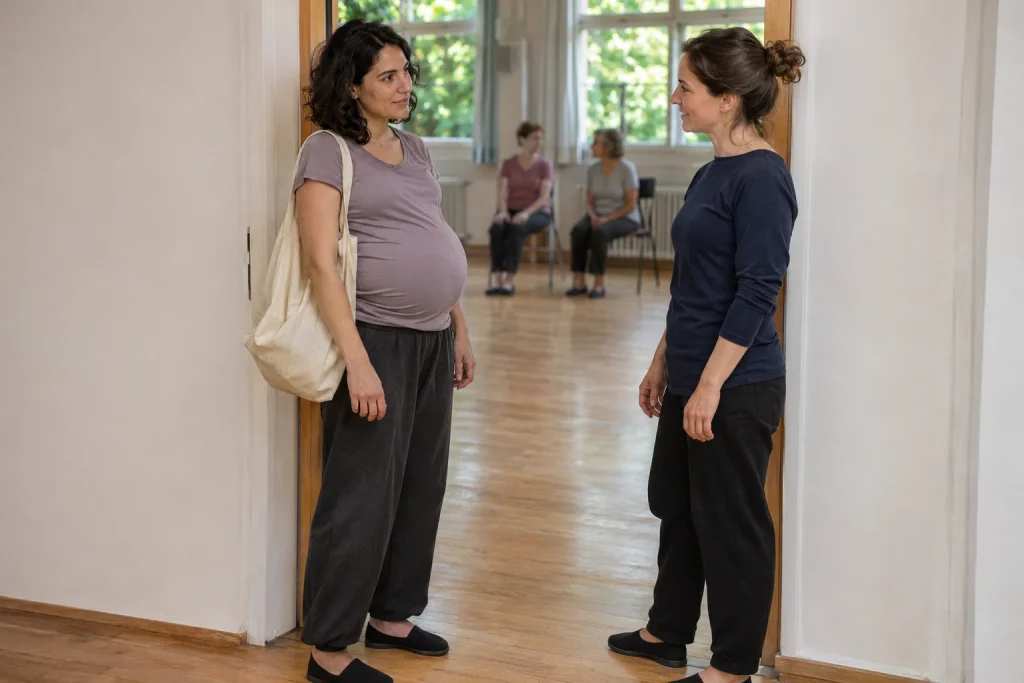
There is little time for a long conversation at the exercise-room door. Others are arriving, the instructor is preparing and, as a pregnant runner, you want to know how to join on your own terms. You do not need to give your complete health history there immediately, but important information should not remain hidden. A good discussion aims for the instructor to understand the situation, for you to understand the class framework and for neither of you to have to invent a modification halfway through a task.
Medical suitability and adaptation within a class are separate tasks. Boundaries discussed with your maternity care professional do not automatically explain practical implementation to an instructor; an instructor’s qualifications do not replace individual medical assessment. Connecting the two requires brief, precise communication. The examples below help make this clear, discreet and usable for action.
Contact can begin before the class
The NHS page on exercise in pregnancy specifically recommends letting an instructor or trainer know that you are pregnant. This need not happen during a group introduction. If possible, write or call in advance and ask when you can speak calmly for a few minutes. You can then learn the particular class’s content before participating.
The first message need not include detailed medical findings. This may be enough: “I am pregnant, previously ran regularly and would like to join this type of class. I am discussing my individual activity conditions with my maternity care professional. I would like to understand the class structure and modification options beforehand.” This communicates interest and important context without sending every detail through a general contact channel.
If the reply is only “Feel free to come”, ask for more specific information. What tasks are included? Is there a continuous group pace, getting onto the floor, equipment or a special environment? The class name does not necessarily describe its actual content. Advance questions can also help you return to your care professional with more than a brand name or an impressive class title.
Explain three things about yourself clearly
First comes pregnancy and the current circumstance you consider important for the individual discussion. Second is your actual activity history: not only having once done sport, but what you do now. Third is any specific framework provided by your maternity care professional. Information is useful when the instructor understands which part affects the activity performed in class.
“My doctor says I can exercise” may be too broad. If the scope of that discussion is unclear, clarify it with your clinician. The CDC activity information emphasises discussing activity modifications with a doctor. A general sentence does not necessarily answer the question of a particular exercise, class or new activity.
Naming the specific uncertainty can help too: “The task name is familiar, but I have not done your version before.” Or: “My individual guidance requires me to modify this position, and I would like to know beforehand how that can work in class.” An instructor should not have to infer your conditions from clothing, the size of your bump or your running background.
Private details and necessary boundaries are not the same thing
You can explain information important to working together without sharing everything with the group. Ask for a short private conversation and say if you do not want a particular medical detail discussed publicly. Discretion does not mean concealing a circumstance affecting participation from the instructor too; it means choosing an appropriate channel.
Ask whom to speak with if someone else sometimes leads the session. You do not need to repeat the whole story every time, but it should be clear whether the current instructor knows the necessary boundaries. If uncertain, say so before starting. Do not automatically assume how the provider handles internal handovers; it is easier to check briefly what the professional present knows.
You can also say separately if you do not want to appear in photographs or video. This is communication about personal comfort, not proof of medical suitability. Images of an exercise class may easily suggest a general safety message to others, while your participation rests on individual discussion. You do not have to decide hurriedly at the door how public your own story should be.
 Enlarge image
Understand the modification before the task begins
“Just make it easier” can mean many things, so ask about the particular task. Which version applies to you? How does it begin, what support or equipment is needed and what happens if that is unsuitable too? One universal exercise cannot answer every situation, but the next step should be clear. Do not try to infer an individual modification by rapidly copying movement.
The ACOG patient information also mentions activity variations adapted to pregnancy and precautions concerning certain positions. A modified class is not, however, one list of movements applying to everyone. If your own maternity care advice differs from what the group is doing, clarify this with the instructor beforehand.
| General answer | Clarifying question | What should you understand? |
|---|---|---|
| Just take it easier. | Which version do we mean for this task? | Know specifically what you can do within your individual boundaries. |
| If it does not work, do something else. | Can we agree beforehand on omission or an appropriate alternative? | Avoid improvising a new load on the spot. |
| Other pregnant people attend too. | How can this work with my history and modification? | Discuss your situation rather than another participant’s example. |
| Follow the group. | How can I signal that I need more explanation or to stop? | Learning and interruption should be parts of the class too. |
If the explanation still leaves you unsure of your task, say back what you understood. This can quickly reveal a mismatch. “So I leave this out now and join the next section?” is much clearer, for example, than silently choosing another movement. You do not need to keep moving simply to avoid a pause in the group’s appearance.
Know beforehand how you can stop
The NHS asks you to stop with discomfort, overheating or feeling unwell. This is easier when you know before class how to signal the instructor, where you can interrupt the task calmly and whether help is available. Stopping is not disruption and does not require the whole group’s approval.
The practical question can be simple: “If I do not perform a task, where should I position myself and how can I let you know?” The aim is not for the instructor to watch you exclusively at every moment, but for an understandable shared arrangement. Group pace should not create a situation in which you continue only because leaving feels difficult.
With a new or unusual symptom, discussion with the instructor does not replace medical help. When necessary, stop the activity and report the symptom to your maternity care professional or current care service. For severe acute illness in Hungary, call 112. Returning to the next task then does not depend on the class rhythm.
Keep the instructor’s and care professional’s roles clear
The instructor knows the class content, equipment use and how to teach the task. Your maternity care professional assesses individual medical condition, with other healthcare professionals potentially involved in appropriate assessment. Good cooperation sends questions to the right place. You do not need to expect one person to answer everything.
The ACOG professional statement emphasises clinical assessment of medical and obstetric circumstances before recommending activity. Instructor training or extensive group experience does not turn that into an individual examination. An instructor may say that a question needs further clarification from your maternity care professional; this is an understandable part of cooperation.
Equally, your maternity care professional may need the class’s actual content. When taking a question back, do not say only that the instructor “recommends strengthening”. Describe the task, position or circumstance. Instead of exchanging general terms, precise information reduces the chance that everyone understands something different by the advice.
Do not use a running history as a participation certificate
Even as a runner, you can be a beginner in a class type. Group activity may involve a new technique, pace or equipment that needs separate learning. Describe your previous activity, but do not feel that it requires you to follow every task immediately. Knowing which part is new and where you need a slower explanation is useful for the instructor too.
Referring to past performance can sometimes conceal precisely what matters now. You may previously have run long distances but have been less active in recent weeks or received an individual modification. Explain the present situation. You do not need to defend your sporting self-image by displaying more experience than you really have in an unfamiliar task.
Progress in class does not necessarily mean more repetitions or a harder version either. It may mean simply understanding your task better or signalling more easily when something is unclear. This independence in communication supports cooperation and does not require competition with other group members.
 Enlarge image
Three short dialogues that move a real question forward
In the first situation, the beginning of class reveals a new task in the programme. You could say: “We have not discussed this yet. Can I first understand what it involves and leave it out for now if necessary?” The sentence does not declare the task definitely dangerous, but does not make rapid imitation a condition of participation either.
In the second situation, a substitute instructor arrives. You can briefly say: “I am pregnant and follow these modifications based on an earlier discussion. Can we review how this will work in today’s class?” You are then not relying on every detail of a previous conversation having automatically reached them. What matters is current shared understanding.
In the third situation, the familiar version is uncomfortable today. You can say: “This feels different today, so I am stopping now. I would like to discuss the next step.” A new symptom also needs medical clarification. You do not have to end the sentence with an apologetic explanation that you are otherwise strong and used to complete everything.
A short report after class makes the way forward clear
If something was uncertain, tell the instructor while the memory is fresh. What was unclear, what did not fit your individual boundaries and which modification needs clarification? Feedback should be more than saying the class was good or bad. A specific task and question are easier to resolve before next time.
If medical guidance changes, update the framework shared with the instructor too. Do not assume previous participation means everything can remain the same. A process you can follow has room for change, without requiring you to prove again each time why you want to adapt to the present situation.
At the end of a good class discussion, three things are clear: the instructor knows the boundaries needed for participation, you know your task and you know how to request an explanation or stop. The aim is neither publicly sharing a whole health history nor completing a flawless class. It is being able, as a pregnant runner too, to ask precise questions, learn and participate in line with individual conditions.
Sources
- NHS: informing the instructor and exercise in pregnancy
- CDC: discussing activity modifications with a care professional
- ACOG: modified activity and pregnancy precautions
- ACOG: clinical assessment and individual activity advice
How Futószív articles are prepared: our editorial guidelines.