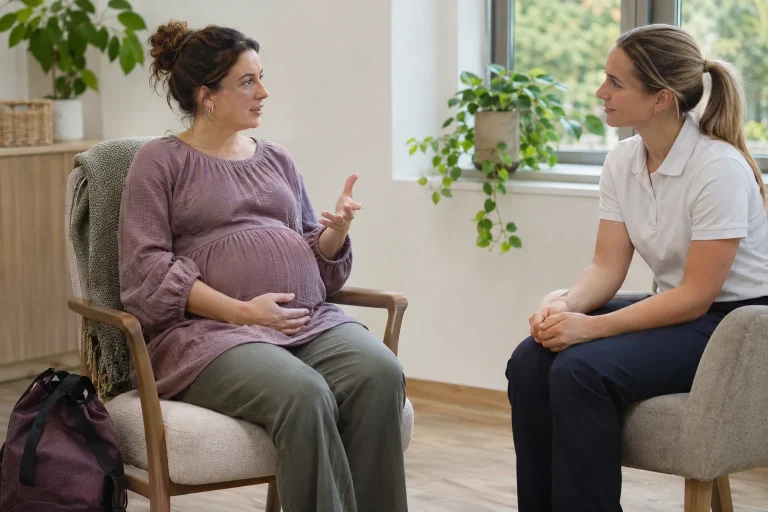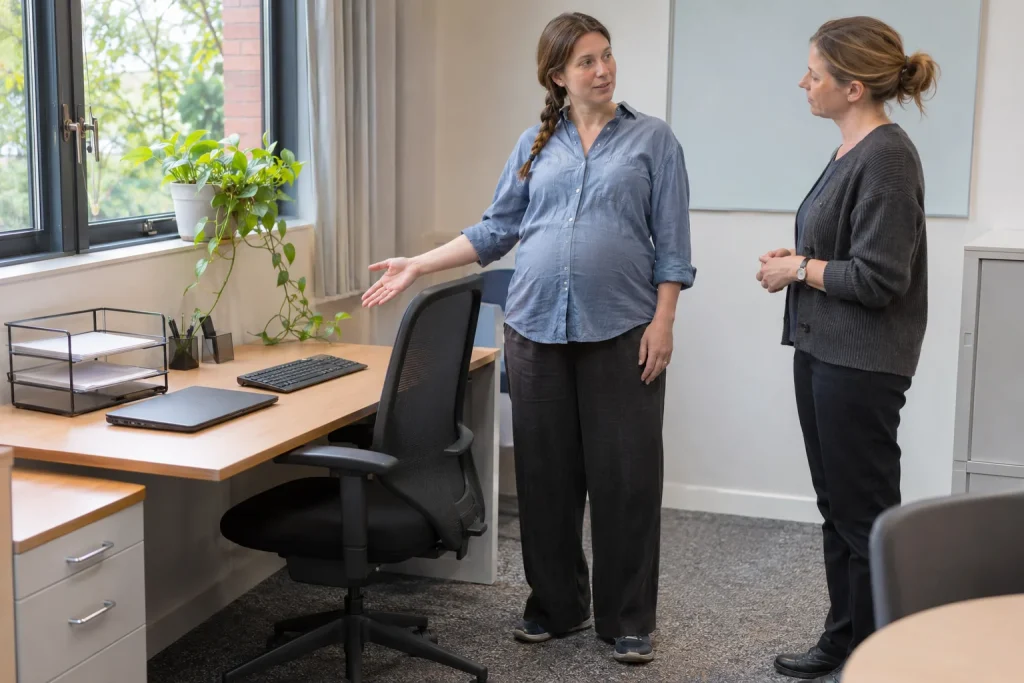
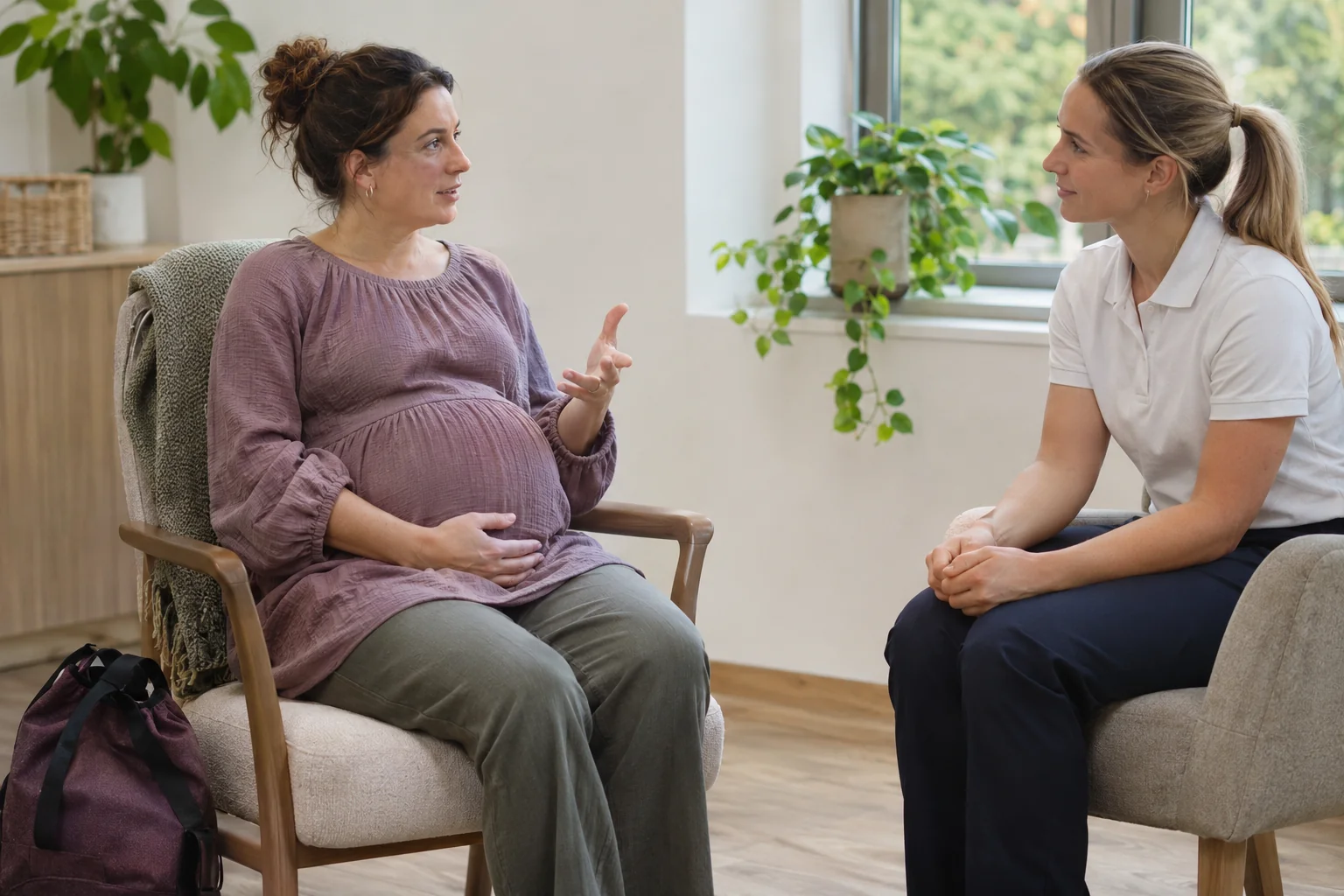
Describing a pregnant runner’s back symptoms at work often falls between two extremes: either little more is said than “My lower back hurts”, or a ready-made explanation immediately appears about poor posture and a chair that needs buying. There is a more useful step between them: showing and explaining the task you perform, when the symptom appears, how it changes and what makes work difficult. Your maternity care professional, physiotherapist and workplace professional can each use this account from a different perspective.
The aim is not a diagnosis of your own, or deciding whether running or the office is “to blame”. Sport and work tasks belong to the same person’s day, but the cause of a symptom cannot be established from chronology alone. A precise account is valuable because it helps frame the next question well. Medical assessment and review of the actual working environment are worth connecting without either replacing the other.
Describe the symptom first, then the task associated with it
According to the NHS information on back pain in pregnancy, back symptoms are common, but severe pain and warning symptoms accompanying it need to be reported. Being common does not mean every symptom must be endured or treated with the same exercise. Your own story starts with what you actually experience, not what you have read about pregnant people in general.
Explain in your own words where you feel the pain, whether it is new and how it differs from before. Naming different parts of the back does not require an anatomical map. If uncertain, you can simply indicate the location to the professional without pressing it or provoking it with a movement. “Lower down, more on the right” is more useful information than the name of a condition chosen from the internet.
The task should come next: were you typing on a computer, standing at a counter, moving an object or travelling to a client? Do not reduce the whole job to a label. The same office role may include long phone calls, brief typing, moving things and many seated meetings. The differences can help identify which situation needs more detailed discussion.
Make the sequence of events more precise than the blame
A few simple details make “It hurts while I work” useful. Was it already present on arrival or did it start later? Did you notice it during a particular task, or did it become apparent only at the end of the day? Did it continue after the task? You do not need a minute-by-minute record, but explaining the sequence helps distinguish observation from an assumed cause.
For example, “My chair is bad, so it hurts” is a ready-made causal claim. “It became uncomfortable during prolonged typing in the afternoon, and I have noticed this several times over recent days” is a specific account. The chair may indeed be one element of the environment to review, but the work task and your individual condition also belong in the assessment. The more precise sentence does not close the question too early.
If an observation is uncertain, do not turn it into a rule. Perhaps you also travelled more than usual that day, or only had a quiet opportunity to think about the symptom late on. You can explain this too. You do not need to hand the professional a flawless investigation, but real, interpretable information about what changed.
Show the whole workstation, not just your seated posture
The UK HSE occupational health guidance considers equipment, furniture, working conditions, the task being performed and individual requirements together when assessing a display-screen workstation. This is a useful perspective even when you seek help through your Hungarian workplace’s own procedure. We are not copying the UK page’s local legal requirements into Hungarian obligations; the point here is the completeness of what is assessed.
A photograph from one side does not show how you work all day. You may be sitting at the desk when it is taken, but regularly turn elsewhere for your phone, reach farther away for documents and spend meetings in a different chair. Describe these actual situations of use. The goal is not to produce an attractive photograph of “correct sitting”.
If a workplace professional requests a photograph or video of the environment, agree first on what may be visible. Client information, an internal screen or another person must not be disclosed accidentally. A simple written list is often enough to start: which tools you use, where you need to reach, what you can adjust and what needs help. Your personal medical symptom description does not need to be sent to a public workplace group.
 Enlarge image
Make standing and lifting visible as specific work processes
For someone who works standing up, chair height is not necessarily the main question. They may need to remain at a counter for a long time, work at several heights or have no easy way to hand over the task. A useful description shows the process: what happens in sequence, when you can change position and which part has become difficult to manage.
For moving objects, do not create a strength test at home. Describe the object, where it moves from and to, how often it must be handled and what help is available. Its size, how easy it is to grip and the environment are also part of the task. Do not derive a general kilogram limit applying to you from this article; pregnancy and workplace circumstances may require individual assessment.
| Situation | A less useful label | A more precise description |
|---|---|---|
| Display-screen work | I sit badly. | It appears during prolonged typing; I use the phone and documents on another side. |
| A task at a counter | I stand a lot. | This part of the workflow has no interruption, and this is when the symptom becomes noticeable. |
| Moving an object | I must have strained something. | The object has to be moved from here to there; I noticed the new symptom while doing this. |
| Travelling work | I am on the go all day. | Several short journeys, getting out of vehicles and different seats alternate. |
The description does not prove that the named task causes the problem. It helps the professional ask questions connected to the activity actually performed rather than a general job title. This also makes it easier to check the advice later against the real situation.
It is worth explaining the opportunity to take a break too
The HSE page on work routines for display-screen work emphasises breaks and changes of activity while taking the nature of the work into account. The practical question for a reader is whether the day genuinely offers an opportunity to interrupt that situation. A reminder app alone does not resolve an inability to change because of the workflow or lack of cover.
“I can get up whenever I like” can differ from actual daily experience. Movement may be permitted in principle, while online meetings run back to back or the task offers no natural stopping point. Do not describe this only as a lack of personal discipline. A workable solution needs a place in work organisation too; otherwise, the advice becomes another task to complete.
A break is not a compulsory stretching demonstration. With pregnancy symptoms, individual advice about current activity takes precedence; you do not need to perform the same online exercise sequence at every notification. Discuss which change of position or task is appropriate and how it can happen in your job. A general idea about work routines and choosing individual exercises are separate questions.
Give your running history briefly and in a comparable form
It may help your maternity care professional to know which sport you did before pregnancy, what you do now and what has changed since symptoms appeared. The NHS page on exercise in pregnancy also considers previous activity and modifying activities. This does not mean you can give yourself permission, on the basis of fitness, to continue running with pain.
The actual recent weeks matter. If you used to run regularly but are now active only rarely, say so. If the symptom does not occur during running at all, that is important information too, but does not rule out a need for medical action. Work and sport should not compete to provide the entire explanation.
You do not need to show every training graph during the appointment. A short summary and a timeline relevant to the symptom are generally a better start. The professional can ask if more data are needed. A running watch may help you recall activity, but does not identify the cause of back pain or assess whether the work environment is suitable.
With a new accompanying symptom, describing the situation is not a waiting task
The NHS specifically highlights urgent reporting of back pain in pregnancy accompanied by fever, vaginal bleeding, painful urination or pain in your side below the ribs. Do not automatically treat a new or severe symptom as the same problem previously experienced while sitting. With new back pain later in pregnancy, also seek maternity care guidance promptly, because other assessment considerations may arise.
According to the NHS, loss of sensation in the legs, buttocks or genital area requires immediate emergency care. In Hungary, call 112 for a severe acute condition. This is not the time to try every chair adjustment first. Naming the symptom, stating that you are pregnant and accessing help matter more than finishing a workplace note.
Knowing warning signs does not mean you need to test yourself constantly. Describe your own new observation and follow the guidance received. The situation account is a tool for discussion, not a compulsory observation period to complete before seeking help.
 Enlarge image
Let the discussion produce a specific, practical next step
At the healthcare appointment, clarify whether further assessment is needed, which activity changes are recommended and when you should report back. At work, the question may be how the necessary change can be implemented in that environment. These conversations may not be with the same person, but they are connected.
Ask for clarification if a suggestion is too general. Rather than only hearing “Watch your posture”, understand what the professional means for that task and how you can try it within the agreed boundaries. Do not buy new equipment or stretch more intensely because the explanation was unclear. It is worth taking uncertainty back into the conversation.
For the next report, three questions may be enough: was the proposed change implemented, how did the symptom develop and what remained difficult? If the solution did not work in actual work, that is important information. You do not need to describe an unusable adjustment as successful. The aim is better understanding and individual help, not a perfectly completed ergonomics checklist.
A short model for preparing your own account
“I am pregnant. Over recent days, I have noticed a new back symptom, mainly during longer periods of typing in the afternoon. Several tasks alternate at my workstation, and the phone and documents are on another side. I do not know the cause. I would like to discuss whether an examination is needed and which individual adjustment would be appropriate.” This example makes no diagnosis, but still conveys important starting points.
For standing or travelling work, fill in the story with your own task in the same way. Put any accompanying symptom first, and do not replace urgent help with a detailed workstation description. Precision is not a matter of length: a few specific sentences are more valuable than many general phrases about a weak core or faulty posture.
A useful account ultimately preserves the difference between what you experience, what you suspect and what still needs clarification with a professional. This is particularly useful as a pregnant runner: you do not need to use a sporting background to explain away or minimise symptoms. Your work details and medical situation deserve attention together, and the next step can be adapted to real circumstances.
Sources
- NHS: back pain in pregnancy
- NHS: exercise during pregnancy
- UK HSE: assessing the whole workstation
- UK HSE: work routines and changes of activity in display-screen work
How Futószív articles are prepared: our editorial guidelines.