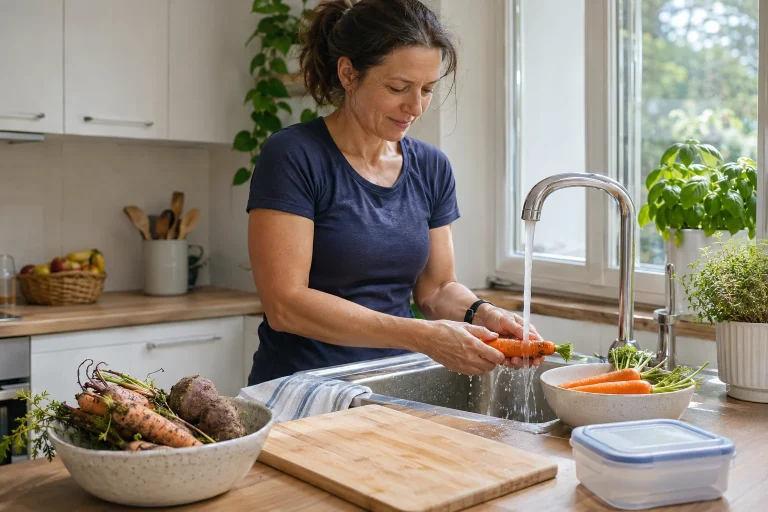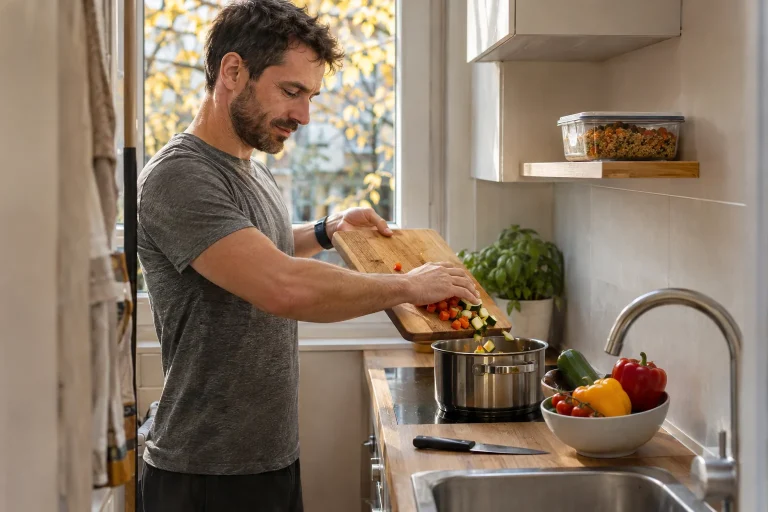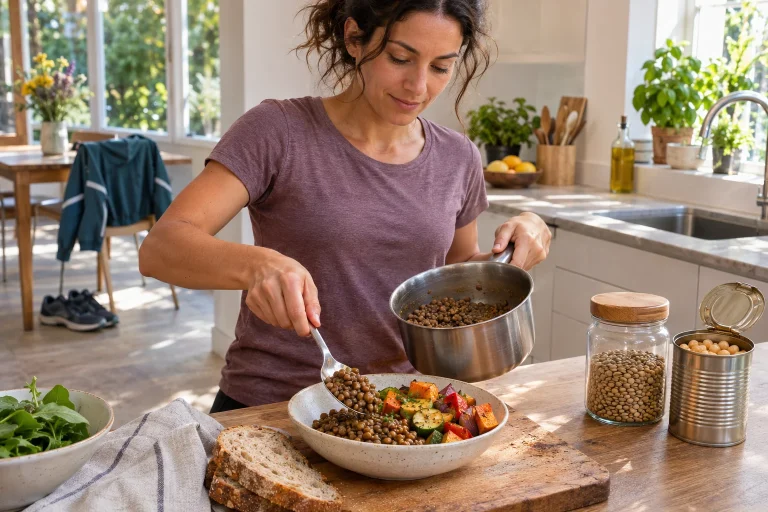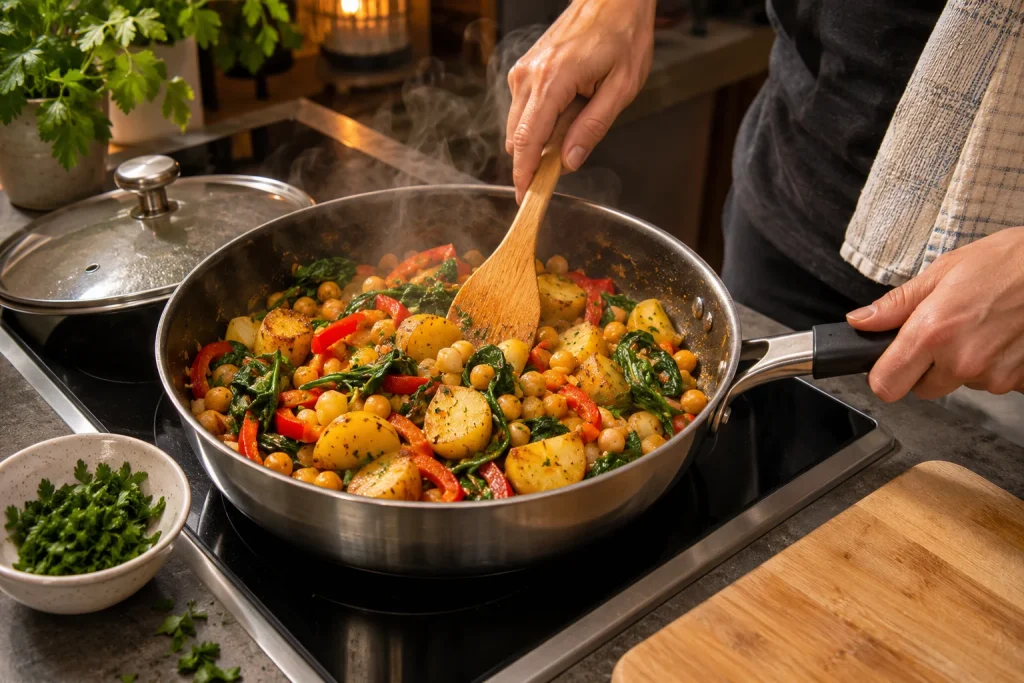
The greatest advantage of a one-pan dinner may be a clear workflow. The necessary operations follow one another in a suitable pan, producing a coherent meal at the end. This does not mean adding every ingredient at once. Different ingredients may need different preparation and appropriate cooking. Without a planned sequence, compressing everything into one pan can become harder than assembling a dinner from separately prepared elements.
This guide offers kitchen-organisation help for adult recreational runners. It is not a personalised diet, a prescribed portion or a compulsory format for every post-training meal. Adapt the ingredients and quantities to your own needs, diet and training load. If you have an allergy, illness or prescribed diet, every ingredient and preparation condition must be suitable. The sequences shown are teaching examples, not sports recipes validated through our own performance testing.
First decide which cooking method you will use
One-pan meals include quickly tossed pan dishes, meals cooked together in liquid and thicker dishes with sauce. These do not use the same technique. For a rice dish cooked under a lid, liquid and appropriate cooking time are central. In a pan-based combination, piece size, space and the sequence of different elements may matter more. Choose the specific recipe first, then plan its operations.
The pan’s size, sides and available lid matter too. A shallow, small pan may not suit a meal made with more liquid. If the recipe finishes in the oven, use the cookware only in ways permitted by its manufacturer. Do not discover that you lack the necessary equipment while the meal is half cooked. Matching the recipe and equipment is the first time-saving step.
The aim of using one pan must not override safe preparation. If an ingredient requires separate preparation, carry it out. Dried pulses, raw meat and a side ingredient specified as already cooked cannot simply be combined at random in the same short process. When a recipe calls for a previously cooked element, that is the state meant by its ingredient list. The preliminary work belongs in the total time unless you choose an appropriate ready-prepared product.
Organise ingredients into four groups
The first group contains flavour bases needing preparation and the elements with which the recipe starts. The second holds ingredients added during the middle stages. The third contains the required liquid, sauce and seasonings; the fourth, appropriately prepared elements added at serving. This is a general organisational method, not an identical order of addition for every recipe. The specific recipe determines what belongs in each group.
Prepare the groups within reach, keeping raw and ready-to-eat foods appropriately separate. You do not need an elaborate bowl for every group. What matters is avoiding searches at the next step and knowing each ingredient’s state. Have clean equipment for opening the tin, a suitable container for measuring liquid and a clean serving utensil for the finished meal. Mise en place here means calmer cooking, rather than covering the worktop with bowls.
| Operation group | What should you prepare? | What should you distinguish? |
|---|---|---|
| Starting. | The appropriately prepared elements cooked first in the recipe. | Not every vegetable or seasoning automatically belongs here. |
| Middle stage. | Main ingredients to be added in the required state. | A cooked ingredient is not the same as its dry or raw version. |
| Liquid and sauce. | Ingredients of known composition, measured for the recipe. | Different products do not necessarily need the same liquid quantity. |
| Finishing. | An appropriately prepared accompaniment or seasoning. | An ingredient needing cooking is not a ready-to-use garnish. |
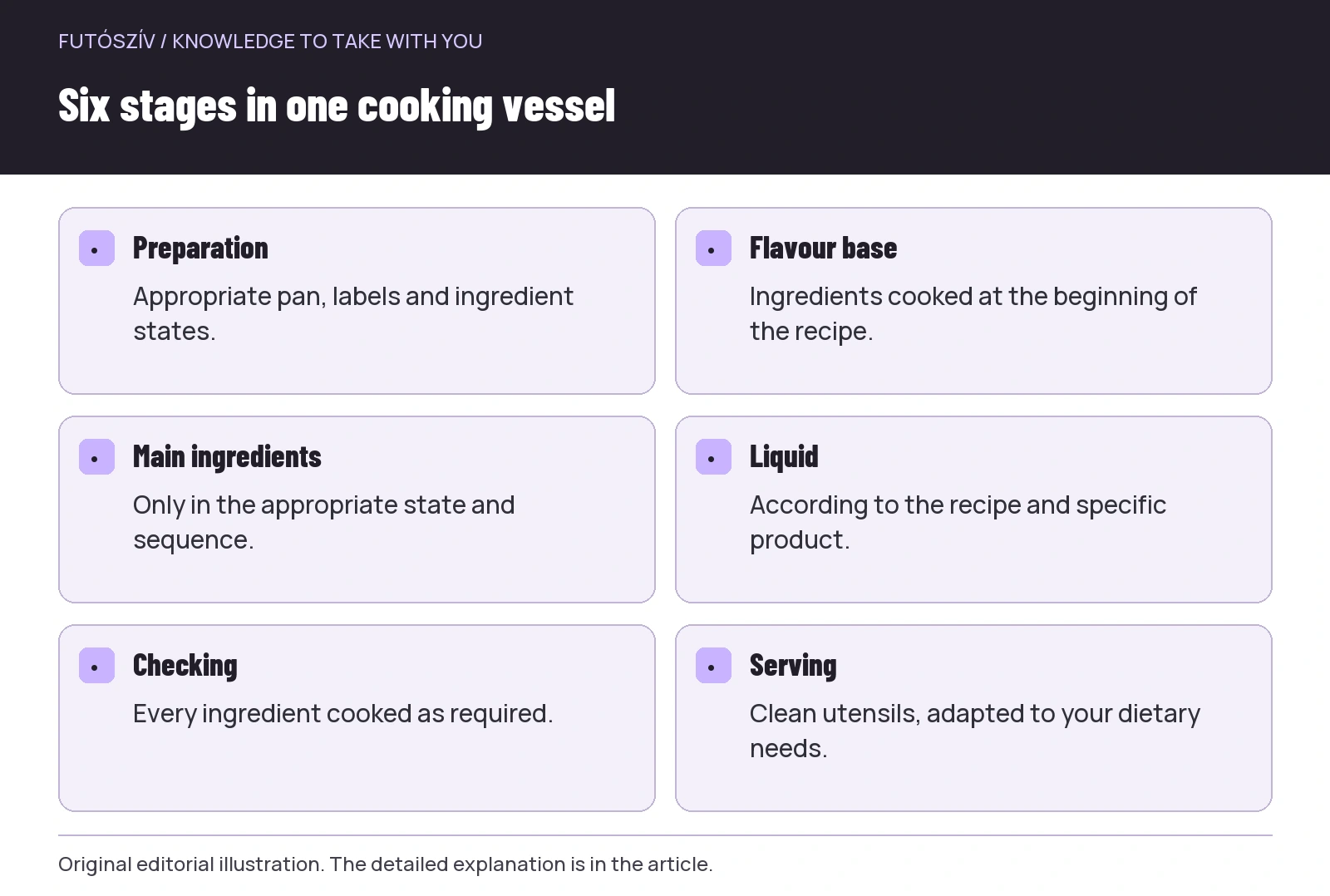 Enlarge diagram
Text version of the illustration
- Preparation
- Appropriate pan, labels and ingredient states.
- Flavour base
- Ingredients cooked at the beginning of the recipe.
- Main ingredients
- Only in the appropriate state and sequence.
- Liquid
- According to the recipe and specific product.
- Checking
- Every ingredient cooked as required.
- Serving
- Clean utensils, adapted to your dietary needs.
First sequence: a rice dish cooked together with liquid
The NHS vegetable rice recipe first makes an onion-and-mushroom base, then adds rice, liquid and further ingredients. During proper cooking, monitor the liquid and top it up as the recipe directs when necessary. The lesson is gradual construction: the rice and vegetables are not simply separate elements mixed at the end, but cook within a planned process.
For this type of meal, do not change the rice variety while keeping every other instruction unchanged. Coordinate the package’s cooking instructions with your chosen recipe. An alternative to the processed type used in the original recipe may require different liquid or time. If you do not yet know that version, first choose a reliable recipe written for that ingredient. Kitchen routines become faster when you already understand the process.
Do not judge readiness solely by the elapsed minutes. Follow the recipe and package, observe the food’s condition and ensure every ingredient receives the preparation it requires. If you add liquid, do so as directed and allow the necessary cooking afterwards too. Hastily pouring in water and serving immediately does not necessarily reproduce the original method.
Second sequence: a one-pot meal built from a flavour base
In the NHS jollof rice recipe, a tomato, onion and pepper base is followed by seasoning, liquid and rice. The recipe specifically notes that the brown-rice version may need a different cooking time and attention to liquid. This is a family recipe, not an individual sports portion. Its sequence demonstrates that building flavour and cooking the ingredient appropriately are stages that depend on one another.
At home, do not treat a dish’s name as a universal cooking programme. Regional recipes and individual family versions can differ. If you follow a specific guide, read all its ingredients and method. Clearly record your own adaptations afterwards. This respects the original dish’s context and makes your kitchen version understandable too. Different seasonings alone do not justify omitting necessary cooking steps.
If you need a further main ingredient or vegetables to complete your meal, plan those too. A one-pot dish’s name does not prove it meets your personal needs on its own in every situation. A family recipe’s portion is not automatically an adult runner’s portion either. Consider the meal as a whole and, if needed, adapt serving with a suitable accompaniment or a different combination.
Liquid is more than a number at the start of the recipe
The liquid used is part of the cooking method. Whether the pan is covered, the cookware and the ingredients added all matter. You cannot therefore transfer another recipe’s water ratio at will. Ingredients containing sauce or moisture may also alter your result. On your first attempt, follow the full method of your chosen reliable recipe and record observed differences alongside the specific equipment and product used.
If the food seems too thick or too thin, avoid changing several things at once. First check whether you used ingredients in the appropriate state and measured every quantity in the correct units. Confusing dry and prepared weight is a different problem from evaporation differing on your hob. Identifying the problem precisely helps next time. Instead of an immediate improvised correction, prioritise a safe finish consistent with the recipe.
Adding meat or fish introduces new requirements
The Food Standards Agency’s cooking guidance explains that appropriate cooking depends on the ingredient and method; poultry, for example, must be cooked through. Adding raw meat to a previously plant-based dish introduces a new cooking requirement. The former short finishing time does not automatically establish that the new ingredient is ready. Choose a recipe giving an appropriate method for the entire dish you intend to make.
Separating and then appropriately cleaning containers, boards and utensils used for raw ingredients remains necessary even when using one cooking pan. “One-pan” does not mean every task in the kitchen can use a single contaminated spoon. The finished meal needs clean utensils. If you prepare different dietary versions, arrange personal suitability and necessary allergen handling from the beginning of the workflow too.
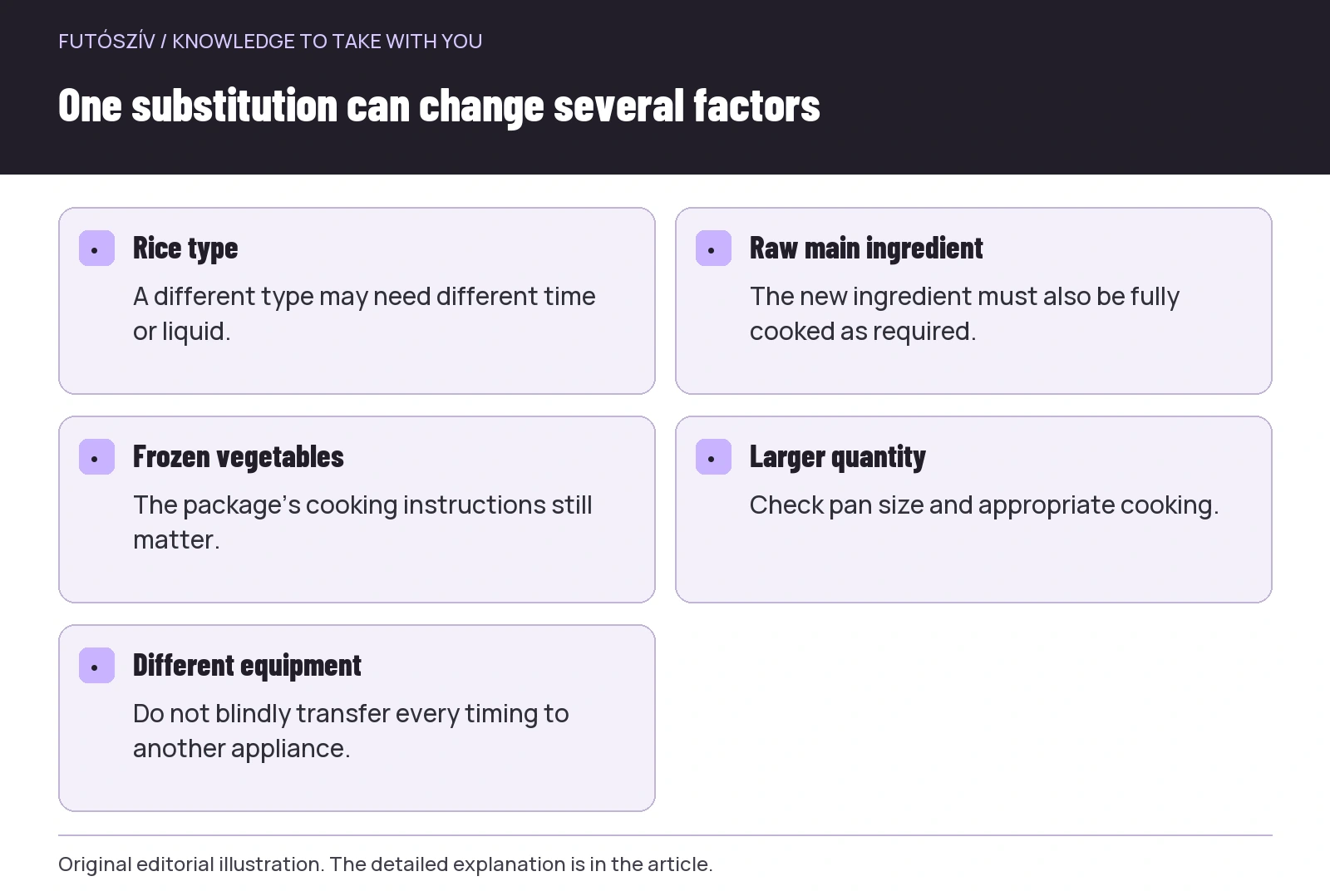 Enlarge diagram
Text version of the illustration
- Rice type
- A different type may need different time or liquid.
- Raw main ingredient
- The new ingredient must also be fully cooked as required.
- Frozen vegetables
- The package’s cooking instructions still matter.
- Larger quantity
- Check pan size and appropriate cooking.
- Different equipment
- Do not blindly transfer every timing to another appliance.
Frozen or ready-prepared ingredients have their own instructions
Follow the package’s required cooking instructions for frozen vegetables. Do not automatically assume that a quick toss at the end is enough. A ready-to-eat tinned product is in a different state from a frozen or dried product requiring cooking. A recipe substitution is appropriate only if the new product’s preparation requirements are met too. The ingredient name on the package is not enough to establish that the two processes are identical.
Using food cooked earlier is another separate question. Start only with appropriately handled, traceable prepared ingredients, within the limits applicable to that food. A fresh ingredient does not make an old leftover fresh again. If reheating food once is part of the process, do it properly and thoroughly. Using fewer pans is no reason to disregard storage history.
Why is making a larger quantity not always better?
Doubling a recipe does not necessarily mean simply doubling every number in the same pan. Available space, heating and the cooking process can change too. If the pan is too small, another method or recipe may be more appropriate. Do not try to learn the dish for the first time through an overcrowded, large-batch version. Once you know the basic recipe, it is easier to decide how much more your own equipment can cook appropriately.
Storage is also part of planning a larger quantity. If you are making food for later, know the appropriate rapid-cooling and food-specific usage rules beforehand. A large batch left in its cooking pan is not automatically a safe reserve. Without a realistic, appropriate storage plan, make the quantity needed for that meal instead. The advantage of a one-pan meal is an orderly process, not unlimited extra production.
Write your own recipe sheet as a sequence of operations
Record the pan type, specific ingredients and their states. Then number the steps: preparation, initial base, middle-stage ingredients, liquid and required cooking, checking and serving. Mark separately any element that needs to be cooked beforehand. Next time, the sheet will provide an actual work plan rather than an incomplete shopping list. Add personal quantities and accompaniments according to your needs.
On a training day, a familiar recipe and a clear sequence can make cooking easier. The next operation is already known, the required equipment and ingredients are within reach and the appropriate preparation conditions remain visible throughout. This is what makes a one-pan dinner convenient: it consists of a few well-understood stages and finishes with properly cooked food that can be adapted to your own needs.
Sources and further reading
How Futószív articles are prepared: our editorial guidelines.