Two runners finish in almost the same time, yet may not have experienced the same thing. One ran continuously throughout; the other used planned walking transitions. What does a marathon trial tell us, how can the average pace of alternating sections be calculated, and what needs organising on the course? We consider completion through finishing time, experience and execution of the strategy.
Walking can be part of the plan from the opening kilometres
Walking in a marathon can describe two very different stories. In one, the runner uses transitions designated in advance; in the other, they unexpectedly have to slow down late in the race. The movement at a particular moment may look similar, yet its background and experience differ. To assess it, therefore, it matters whether this was a planned strategy or a response to a changed situation.
Walking agreed in advance is not necessarily an emergency reserve set aside at the start. It can form part of the whole programme’s structure, with its timing and method tried earlier by the runner. There is then no need to decide anew at every transition whether slowing down is allowed. Part of the decision has already been made. Real conditions still require adaptation, and the plan must not override safety.
It is worth using the strategy’s name precisely in conversation. If you say you walked, you can add whether it was a planned transition, how long it lasted and how it fitted the programme. The statement then does not automatically become shorthand for falling apart. You also preserve more information for the diary than a single finishing time or average pace can reveal.
What did the small marathon trial compare?
In the study published by Hottenrott and colleagues, the marathon runs of 42 participants were compared: one group used a run–walk strategy and the other continuous running, with random group assignment. The researchers examined more than finishing time. Alongside muscle pain and fatigue reported at the finish, they followed selected blood-based measures of strain.
The groups’ average finishing times were approximately 4 hours 14 minutes and 4 hours 8 minutes. The difference did not reach statistical significance, while the run–walk group reported less muscle pain and fatigue after finishing. This is interesting precisely because participants’ subjective experience differed despite similar times. Not every important race outcome appears in the time column of the results list.
The small sample and conditions examined mean the finding should be kept in context. A finishing-time difference not established statistically does not prove two strategies are exactly equivalent for everyone. Participants’ results are not a promise for your marathon or a general invitation to start unprepared. The study showed a difference in experienced discomfort within a specific comparison.
The same finishing time can conceal a different story of the day
Finishing time compresses performance between start and finish into one duration. It does not reveal how much progress was deliberately paced, how transitions worked or how manageable the programme was. Two runners can finish in the same time with one moving in a predictable rhythm and the other slowing greatly near the end. The results list does not necessarily show the distinction.
In your own assessment, therefore, choose a few separate outcomes: total time, how workable the plan was and the experience of finishing. You do not need to create an artificial score for them. A few precise sentences on when you changed, what worked and what needed modification are enough. Success in one area then does not suppress an important experience in another.
Less discomfort is not a less valuable goal because it does not appear on the finish gantry’s clock. At the same time, express it as a personal goal rather than promising a certain effect. The more favourable experience observed in the study does not mean every runner using the same name for a strategy will finish with less fatigue or pain. The specific strategy and preparation still matter.
 Enlarge image
Calculate pace from the whole cycle
In our own purely arithmetic example, nine minutes of running at 6:00 minutes per kilometre covers one and a half kilometres. The following minute of walking at 10:00 covers one tenth of a kilometre. The ten-minute cycle totals 1.6 kilometres, giving an average pace of 6:15 minutes per kilometre. This is not the simple average of six and ten: the two parts have different durations, and their distances need to be added.
The same 6:15 average can also be achieved through continuous running, but the pace of the running sections is then not 6:00. In the alternating example, the running section is faster than the average of the whole cycle. It is therefore unhelpful to add walks unthinkingly to a previous continuous target pace and expect the same total time. The strategy’s timing needs to be understood from its actual running and walking sections.
The example is not a recommended nine-to-one ratio or a personalised pace. Its purpose is to make the programme calculable. The full marathon time is also affected by the last, possibly incomplete cycle and every other stop. If preparing for a particular event, check the actual programme together with the event’s timing conditions rather than turning one cycle calculated on paper into a guarantee.
A biomarker is not another name for comfort
In the study, walking transitions did not reduce the response of the selected cardiovascular strain measures compared with continuous running. More favourable reports of muscle pain and fatigue therefore do not imply lower measured strain in every other system. Comfort and laboratory outcomes are separate questions. How you feel during sport matters, but does not replace a different type of measurement.
Keep this distinction in everyday interpretation too. A walking section does not become a medical protective measure because it feels easier. The article claims neither injury prevention nor protection against heart disease. Blood findings from a particular study cannot establish a personal diagnosis, and a symptom after a marathon should not be classified as harmless on the basis of an average change described in a study.
In practical decisions, state two things separately: I found this pacing pattern more manageable, and the long event still involves exertion. The two are compatible. There is no need to support the method’s value with an exaggerated health promise. A rhythm organised in advance, manageable transitions and your own experience are meaningful planning considerations in themselves.
Other people are on the course too
The location of a transition needs to suit the actual surroundings. In a dense starting area, on a narrow bridge or at a tight turn, sudden slowing may surprise others too. During preparation, think about looking ahead, moving predictably and not occupying the entire route with a group spread across it. The particular event’s instructions and on-site directions always matter.
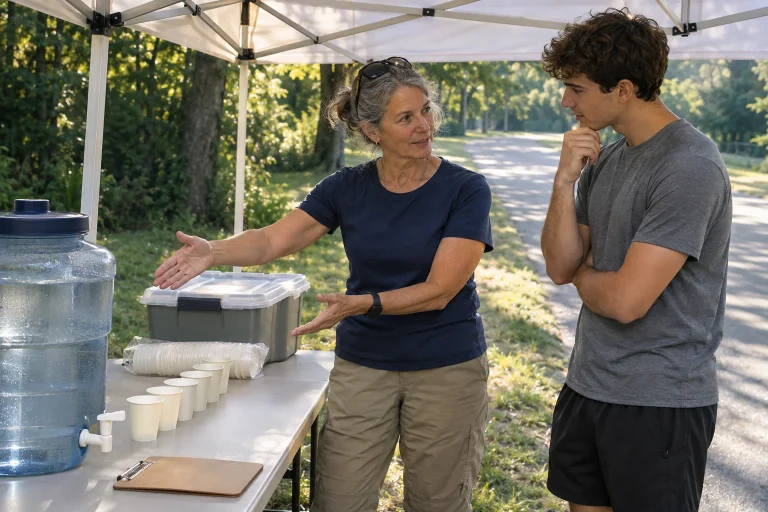
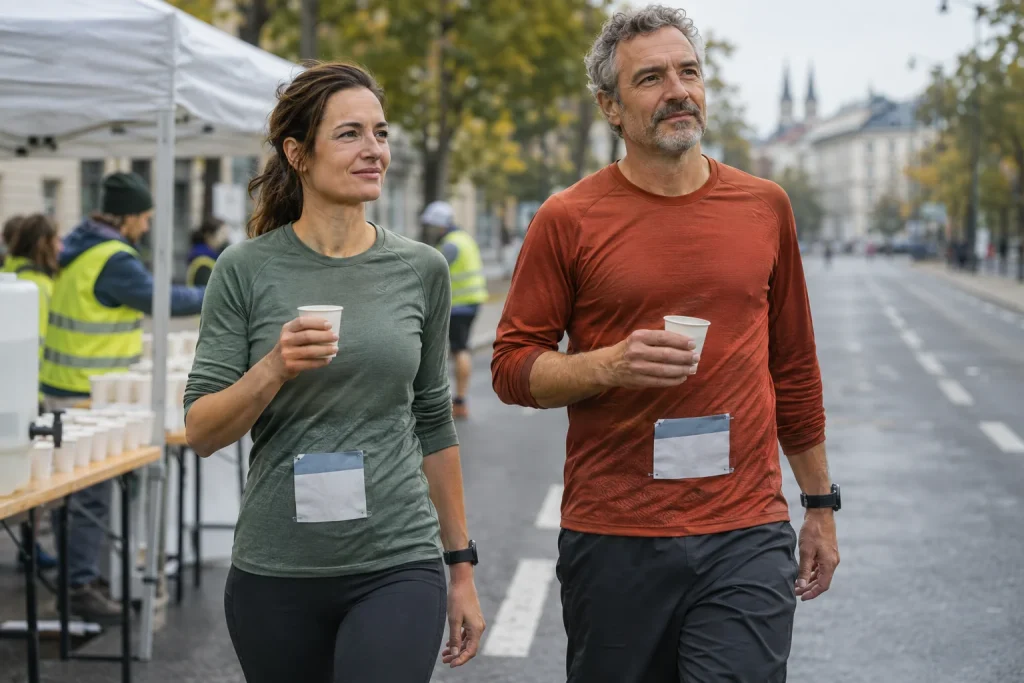
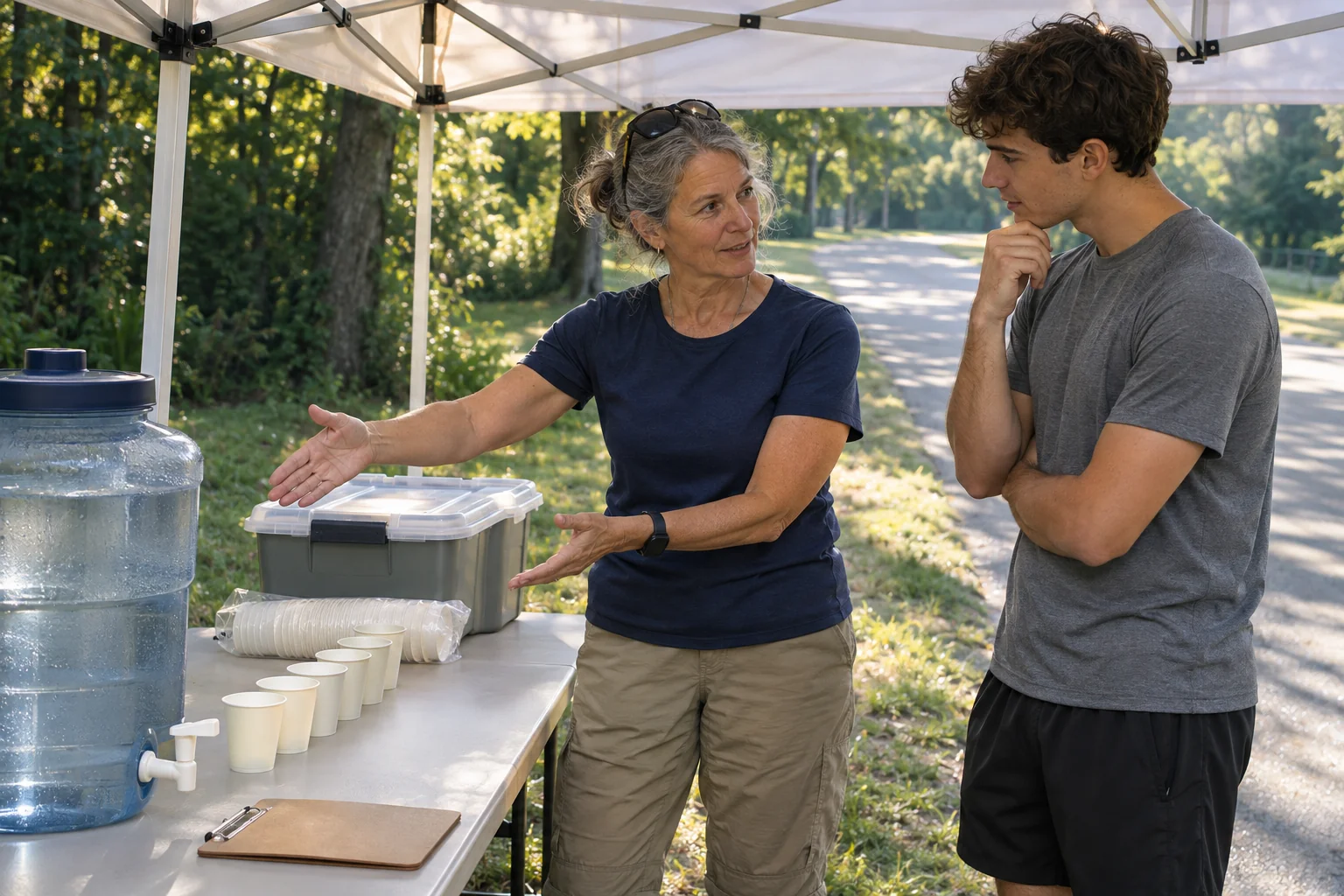
Many movements meet around refreshment stations: someone takes a cup, another returns to running and there may be litter around the designated collection point. If your programme includes walking here, think through approaching and leaving the station too. Walking does not necessarily mean standing, and the station is not a private resting place. The aim is to pass through clearly and predictably for others too.
When running together, discuss transitions in advance. Will everyone follow the same programme, or can you differ? Who signals the change, and what happens if someone continues differently? These are simple questions but can prevent considerable tension. The method does not become valid only when the entire group moves identically at the same time; individual plans and shared use of the route can be coordinated.
A major late slowdown is a different analytical question
The analysis of several million marathon result records used sustained late deterioration in pace as a data-based approximation of hitting the wall. This pace pattern is not identical to a planned walking transition applied consistently through the race. Rather than the movement at one instant, consider the whole pattern over time and its background.
An official split can also combine several events. A slower five-kilometre segment may contain planned walking, a toilet stop or other waiting. The time series alone does not reveal every cause. When assessing your own programme, preserve what happened in a note. You can then avoid confusing a transition calculated in advance with something that unexpectedly changed your performance.
If the planned strategy nevertheless breaks down, describe that precisely too. From which point could you no longer follow the intended rhythm, and which circumstances changed? The aim is not to place every difficult moment under the same ‘wall’ label. Planning the next race is helped by a lesson tied to a specific situation rather than carrying forward an explanation that obscures everything.
 Enlarge image
The strategy builds on preparation
Run–walk does not make consistent preparation for a longer event unnecessary. The research analysing the relationship between marathon training volume and the longest run also shows that preparation characteristics can be associated with race results. This does not imply one alternating pattern for everyone. The method’s name does not replace your own training history.
You can observe your chosen arrangement in familiar surroundings: are transitions manageable, is the watch alert simple and does restarting cause a rush? Do not first encounter using your own programme on race day. This is not a reason to repeat the full marathon in training. Trying it out aims to understand how it works, not to prove the entered distance in advance as a requirement.
Review the event rules separately too. The time limit, intermediate checkpoints and route-use conditions do not disappear because you use a deliberate strategy. Moving time and total elapsed time can differ, while official assessment follows the event’s own rules. If the calculated programme and these conditions do not fit together, notice this before the start.
At the finish, ask more than the clock
After finishing, note which parts of the chosen rhythm worked, where you needed to depart from it and what you would retain. Finishing time is naturally part of the assessment, but not its only line. Executing transitions calmly can also be a specific result, as can having to modify the programme at a crowded station. Such experience can inform future organisation.
When comparing with a friend using another strategy, retain your different histories. Two finish photographs cannot determine who would have done better with the other method. You can discuss experience and practical lessons without declaring one programme the winner for everyone. The small trial also concerned several outcomes rather than one general ranking.
Planned walking can therefore be a deliberate marathon strategy whose value is revealed by the whole execution and your own experience. Different experiences alongside similar finishing times are a genuine research question, but a comfort advantage is not a health guarantee. Considering rhythm, arithmetic, cooperation on the course and preparation together allows a more precise decision than the label ‘I ran’ or ‘I walked’ alone.
Sources
- Hottenrott and colleagues: run–walk, finishing time, experience and biomarkers.
- Smyth: sustained late-marathon slowing in a large database.
- Fokkema and colleagues: preparation volume and marathon results.
How Futószív articles are prepared: our editorial guidelines.