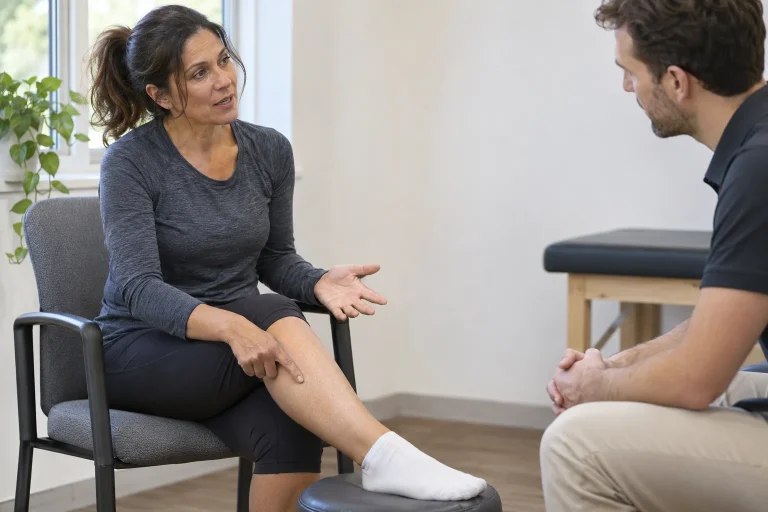
The report shows no fracture, yet the same small area of your foot still hurts while walking. You need not assume the symptom is imagined, nor that you definitely have a hidden fracture. An early X-ray result is one part of the history. Pain location, onset, individual examination and subsequent changes together determine whether further review is needed.
Seek urgent medical help for severe pain, inability to walk, a change in shape after injury, a hot and swollen foot, or symptoms accompanied by fever or chills. The NHS treats these as specific warning signs. A previous negative image is no reason to ignore a new or worsening condition. The explanation below is not a way to exclude injury at home.
The history of metatarsal pain says more than a single point
According to the AAOS, the forefoot contains five metatarsals that work with the toe bones during walking. Show the location of a pinpoint symptom at the assessment. An individual evaluation establishes whether the sensation actually originates from bone and which condition it belongs to. An area marked on the skin is not itself a diagnosis.
There can be two kinds of onset. Sudden symptoms after an impact, awkward step or object falling on the foot provide a specific injury history. Pain associated with repeated loading can instead develop gradually without one major event. You do not need to invent an accident retrospectively for the latter. An accurate description of gradual onset can be just as important.
Changes in the affected activity matter too. Did you initially feel it only at the end of a long run, but now ordinary walking is troublesome? Or has it eased continuously since an injury without disappearing yet? Describe the real sequence. You do not need to press the painful point hard every day or check with another run whether it is still in the same place.
A bone stress injury is not always one major moment of fracture
The international Delphi consensus published in 2025 discusses bone stress injury as an umbrella term covering different levels of severity. Its explanation involves the balance between microdamage from repetitive loading and bone remodelling. The process does not necessarily begin with an audible crack followed by a fracture line visible to everyone.
This does not mean every sensation noticed during training is bone damage. The consensus is an expert agreement, not an investigation determining the state of your foot. It provides a useful framework for why reassurance cannot rely solely on the absence of a major accident or an immediately visible fracture line. Individual assessment remains necessary to interpret symptoms.
The loading background does not always mean an exceptionally high weekly mileage either. Bone condition and adaptation to load can also form part of the question. You do not need to prove a strikingly excessive training series for symptoms to deserve assessment. “I only ran a little” may be relevant context, but does not universally exclude a role for bone health or loading.
 Enlarge image
Why can an early X-ray be negative?
The AAOS explains that the small changes of an early stress fracture can be difficult to see on X-ray. Changes associated with the healing response may make it visible later. A negative early image therefore does not necessarily establish that every possible bone-related condition can definitely be excluded.
The investigation’s timing matters here. Explain when symptoms began and when the image was taken. You do not need to decide yourself whether enough time elapsed between the dates. In clinical interpretation, the sequence helps clarify which question the image answered then and what the current question may be. You do not have to declare a report invalid for further action to be possible.
The result can therefore be useful and limited at once. Useful because it provides information about the condition examined with that method; limited because not every change appears in the same way or at the same time. Avoid both extremes: “X-rays are worthless” and “it’s negative, so I can definitely run through pain”.
The possibility of MRI also needs a specific question
The American College of Radiology’s 2024 guideline update discusses X-ray as a basic initial investigation and emphasises MRI’s role in identifying stress fractures not visible on X-ray. This is not an instruction for everyone to order an MRI. The current clinical question, affected location and individual condition determine further investigation.
If the clinician suggests more imaging, ask which uncertainty they want to clarify. “Why is this needed?” is more useful than choosing whichever method sounds most advanced. Availability and timing may also form part of the individual plan. You do not need a shopping list of every imaging investigation for assessment to continue.
Even a more detailed image is not an independent truth separate from symptoms. The Delphi consensus also notes the risk of overinterpreting incidental imaging findings that do not fit the clinical history. The aim is therefore not to find as many abnormalities as possible. What matters is how the result relates to the symptom and functional difficulty for which you sought help.
| Part of the process | What can it add? | What does it not replace? |
|---|---|---|
| Symptom history | Onset, location, changes and relationship to tasks. | It is not an independent home diagnosis. |
| Early X-ray | Assessment of bone changes visible at that time. | It does not definitely exclude every stress injury. |
| Further imaging | Clarification of a remaining clinical question. | It is not automatic clearance for sport. |
| Follow-up | Reassessment of symptoms, function and the plan’s results. | It is not another painful running test. |
Pinpoint pain does not call for a home hopping test
A seemingly simple test can spread quickly in running communities: hop on one foot to discover whether bone is involved. Such a task does not recreate the full context of a clinical assessment. One movement cannot safely clarify every injury, and producing pain is not a requirement for an assessment to be justified.
The international consensus also discusses recognition through the relationship between medical history, physical examination and imaging. It provides no universal exclusion rule based on one home test. Your task is to report symptoms already experienced in ordinary life, rather than produce the right pain or examination sign before a consultation.
If you have already pressed or tested the foot, you can mention it. You need not demonstrate it again or prove pain severity. The professional determines the examination process. Your account still matters if pain is milder in the clinic or does not appear exactly as it does at another point in your usual day.
Work and health background belong in the loading history too
The AAOS discusses changing activity, work and leisure demands, previous health and medicines among the background relevant to assessment. Running can therefore be only one chapter of the story. More walking, travel or standing work can place the same weekly running distance within a different week.
Mention previous bone injuries or a known bone-metabolism problem. You do not need to explain symptoms using a dietary or supplement list seen on social media. Such history provides information for individual assessment. It neither prescribes a vitamin dose in itself nor means the cause of current pain has been established without examination.
Reviewing the background should not become a retrospective search for blame. There may have been no single obvious change, or you may not recall exactly which day the load increased. You can say that too. The legitimacy of seeking help does not depend on naming a workout as the trigger. The present condition still needs assessment when the past does not fit together perfectly.
 Enlarge image
Even with a negative report, the interim plan should be clear
If assessment is not complete, clarify what applies to everyday walking, work and sport in the meantime. Interim actions are not identical for everyone. A general article cannot choose a support, offloading method or permitted distance. Care should explain clearly what is being monitored and how your actual day fits into it.
If the guidance makes getting to work or managing home tasks impossible, report this. “Rest it” may be too broad for a day involving essential walking and standing. Ask for clarification to make arrangements workable. You do not need to conceal the difficulty or independently replace everything with another sport while the loading question remains unresolved.
The AAOS also ties return to the particular injury and the care provider’s guidance. The word “negative” in a report does not decide whether to run. Symptom and functional changes matter alongside the established condition. Feeling easier after pain relief is not the same as assessing the state of the affected bone.
Follow-up may need a specific date and conditions for earlier contact
Know when and how to report back if symptoms remain. There is no identical waiting period for every metatarsal symptom; agree it according to the clinical question and individual condition. If pain worsens or new swelling or another important symptom develops meanwhile, do not wait rigidly because an earlier appointment date was promised.
Describe changes concretely in your feedback: which previously ordinary task has become harder or easier, and what happened under the plan you received. Do not treat a negative report as disproving your symptoms. Equally, you do not need to infer a definite hidden injury. Follow-up exists precisely to refine assessment using new information over time.
An early image is therefore an important stage, but not always the end of the story. Localised foot symptoms need interpreting alongside onset, loading background and functional change. A good next step rests on an understandable individual plan and follow-up, rather than the supposed proof of a painful run. The negative result remains useful information without claiming too much or too little for it.
Sources
- AAOS: foot and ankle stress fractures, early imaging
- AAOS: forefoot anatomy, fractures and follow-up
- ACR: stress-fracture imaging, 2024 update
- Hoenig and colleagues: international Delphi consensus on bone stress injuries, 2025
- NHS: pain on top of the foot and urgent signs
How Futószív articles are prepared: our editorial guidelines.