
You search for the same event name and find three different dates. One calendar marks the whole weekend, another the half-marathon start, while a third still shows last year’s edition. That does not necessarily make every source wrong, but you need to resolve the difference before entering, booking accommodation or forwarding information to the team. More search results do not, by themselves, mean more independent confirmations.
Checking information is not about collecting everything at once. First clarify the few details your participation depends on: which edition of which event, which race, on which day, where and with what current entry status. Other details connect to those. If the basic identification is wrong, a neatly attached price, picture and map may also belong to the wrong programme.
Identify an event by more than its name
A race name can remain for several years while the venue, distance or format changes. A series may also have several stops with similar creative names. Record the name, year, town, organiser and selected race. If any of these differ between two pages, do not yet try to fill missing information with details from the other result.
Name variations do not necessarily mean separate events. Sponsor names, abbreviations, accents or Hungarian and English names may differ. Equally, a similar name does not establish identity. Find how the organiser names that edition on its own website and use that as the basis for your list. You can retain another source’s variant as a note.
Record the date with its year. Month and day alone are insufficient, particularly on a page whose header has been updated while some body text remains old. Checking the day of the week can help reveal a contradiction, but does not establish the correct year on its own. A date fitting an automatic calendar is not yet an organiser’s announcement.
Separate discovery sources from confirmation sources
An aggregate calendar can be excellent for discovering activities. It makes many events searchable, often by distance or location. Nevertheless, check details needed for your own participation against the organiser’s current published information too. An organiser link in the calendar should be a starting point, not the end of verification.
Secondary pages often work from the same earlier list. Seeing the same date in five places does not necessarily mean five separate checks took place. Where a claim originates therefore matters more than the number of results. A clear, current organiser announcement can say more than several calendar entries repeating one another.
The organiser’s own site is not automatically current in every line either. Check whether the detailed race information, entry platform, recent news and programme table refer to the same year. If contradictions remain within official sources, clarify them through the organiser’s current contact channel. An official domain alone does not eliminate the possibility of old content.
 Enlarge diagram
Text version of the diagram
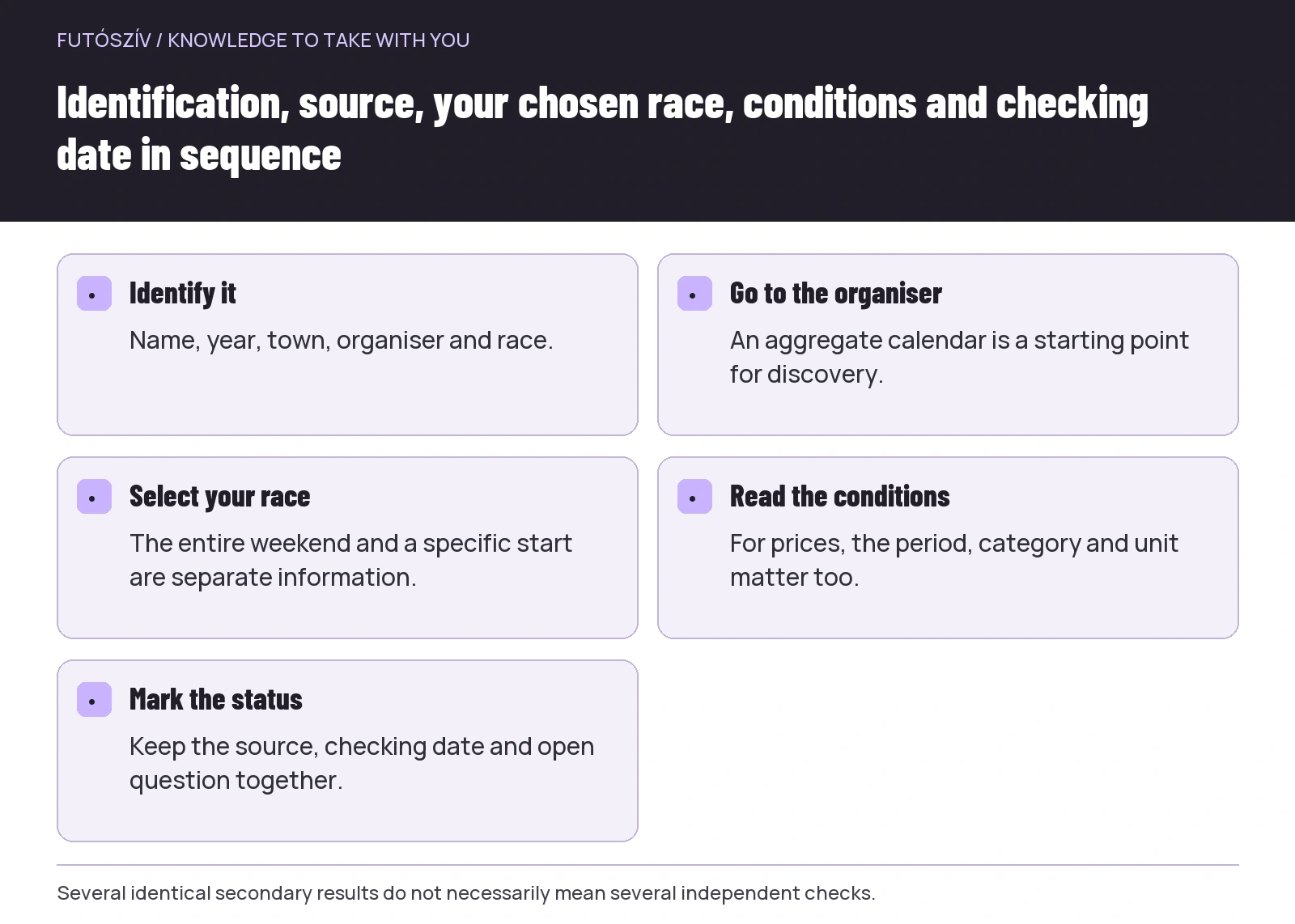
- Identify it
- Name, year, town, organiser and race.
- Go to the organiser
- An aggregate calendar is a starting point for discovery.
- Select your race
- The entire weekend and a specific start are separate information.
- Read the conditions
- For prices, the period, category and unit matter too.
- Mark the status
- Keep the source, checking date and open question together.
The event weekend and your own start are separate information
The official schedule for the 2027 Telekom Vivicittá distinguishes the programme on Saturday 10 April from Sunday 11 April. The half marathon appears in Sunday’s programme. This is a concrete example of a two-day event’s first day not necessarily being the day of your race. An aggregate calendar can correctly show the whole weekend while your travel needs more detailed information.
In your own record, use separate fields for the event period and the chosen race’s start. The same applies to race-pack collection: it may happen on earlier days without making the race earlier. Compressing the whole weekend into one date can bring the misunderstanding back during later coordination.
After the day and time, clarify the location too. The event’s town, the event-centre address and the actual start are not always identical. This can matter especially for events with several locations or point-to-point courses. Do not automatically treat the first map-search result as the start location.
Do not manufacture next year’s event from a previous edition
A race taking place around the same time for several years provides, at most, an idea to follow up, not a certain new date. Confirm next year’s entry, price and programme through a separate announcement. Calculating the equivalent weekend in the calendar does not replace that. An organiser can pause, change seasons or end a series too.
The official Balaton Szupermaraton homepage shows a message concluding its sixteen-year history and the 2026 edition as of 18 November 2026. Readable parts of an earlier event page therefore cannot automatically be treated as announcing a new 2027 event. This is not a general assumption but the concluding state shown on that particular page. Without a new announcement, do not turn it into a future event open for entry.
For another activity, the organiser may explicitly state that next year’s information will follow later. Record that as pending. ‘Details coming soon’ is not the same as confirmed distance, price or start time. Your own list is accurate when it preserves uncertainty too, not only when every box is filled.
Read the price conditions alongside the amount
A fee table may contain several periods, distances, discounts and service packages. The smallest number is not necessarily the current price available to you. It might belong to an earlier entry period, another distance, a team fee rather than a per-person fee, or a conditional discount. Record the associated category alongside the amount in your list.
Check validity using complete dates. A previous year’s price band may remain on a page even if its header already shows a new year. If you cannot establish which price applies to the current edition, do not automatically transfer it beside the following year. An unknown fee is not zero and does not mean free participation. You simply do not yet have a confirmed price.
Handle mandatory extras and optional additions separately. A T-shirt, a no-medal option or another service package can affect comparability. If the exact difference is unclear, a source link and an open question are worth more than confidently ranking amounts. Before booking, always read the final conditions of the entry option actually selected.
Keep source notes for each claim
You do not need a long research diary for every event. A short table is enough: which information came from where, which year it concerns and when you checked it. If the programme page confirms the date, the fee table the price and the race briefing the location, note those separately. You will not later need to pretend a single page established every detail equally.
| Information | What should you keep alongside it? | When should it remain open? |
|---|---|---|
| Date | The particular year and organiser’s page | If only previous-year or secondary information exists |
| Race and distance | The current information for the selected race | If only the festival’s general name is visible |
| Start location | The organiser’s precise place description | If you found only the town |
| Price | Category, validity period and unit | If the price band’s year or conditions are unclear |
| Entry status | The current official entry platform | If only an old announcement or general advertising is visible |
The checking date is not a lasting guarantee. It shows when you looked. Changing details may need rechecking as participation approaches. Distinguish more stable background information from rapidly changing entry status: they need different updating schedules.
 Enlarge diagram
Text version of the diagram
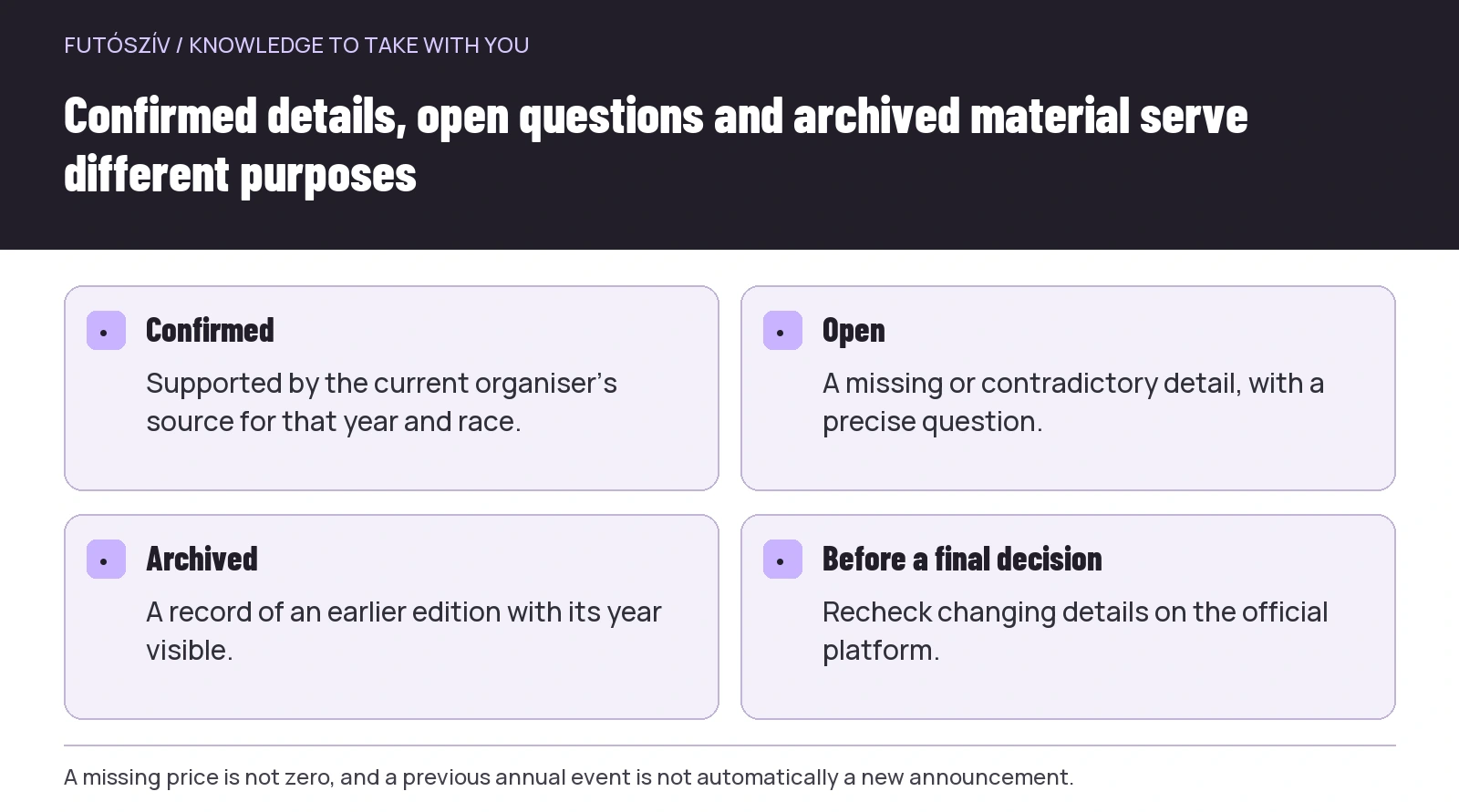
- Confirmed
- Supported by the current organiser’s source for that year and race.
- Open
- A missing or contradictory detail, with a precise question.
- Archived
- A record of an earlier edition with its year visible.
- Before a final decision
- Recheck changing details on the official platform.
Name the exact difference when sources conflict
Instead of ‘the page is wrong’, explain that the homepage shows a new year while the detailed fee table still contains earlier dates. Or that the aggregate calendar lists the event’s first day while your race programme is for the next day. A precise question is easier for an organiser to answer than a general expression of uncertainty.
When contacting them, the necessary event name, year, race and two conflicting sources are enough. You do not need to send personal entry information immediately for a question about a public date. If you are handling an existing registration, use the identification requested by the organiser through the official channel.
Until an answer arrives, do not publish your assumption as certain. Tell companions precisely which information is confirmed and what still depends on checking. Partial certainty is a better basis for shared planning than an attractive summary whose missing details are filled with guesses.
Identify photographs and videos by year too
Promotional material can convey atmosphere well but often comes from an earlier edition. Find when it was created or published, its organiser source and your purpose in using the video. Archived footage of a costume or night run can encourage participation without automatically establishing the next event’s course, start time or services.
Do not treat the address of a start arch in an older photograph as a new venue if the current event information says otherwise. Visual memories and organisational information have different roles. In your report, simply identify archived footage and provide the current official link for the new edition. Inspiration and participation information can then coexist without contradicting one another.
Permission to use the image is another question. Finding it on an official website does not automatically mean you can freely copy it into your own material. For fact-checking, retaining the source and linking to the original page may be enough. Clarify terms of use separately if preparing material for republication.
A fictional example of three different results
A group of friends looks for a May event. The first calendar shows a Saturday opening day, the second a Sunday half marathon and the third last year’s price beside this year’s name. The organiser’s current programme confirms a two-day festival and a Sunday half-marathon start. The fee page, however, does not yet give a clear new-year price. The team records the date as confirmed and the price as open.
They do not choose the most common of three dates by voting or increase last year’s fee by an arbitrary amount. The idea of taking part remains, but they wait for the necessary information before making a booking decision. The summary sent to the group lists the event weekend separately from their race day.
When the fee table appears later, they add a new checking date to their record. The earlier incomplete state does not need erasing from existence, but the current summary now rests on the new source. If someone forwarded the old information earlier, they flag the correction on the same shared platform too.
Make the final check before the actual decision
Before entering, booking accommodation or finalising group travel, reopen the important official pages. Information saved during research may have changed by then. Your chosen race, year, start and entry option should match what you are actually selecting. A shared spreadsheet or earlier screenshot should not replace this step.
If significant uncertainty remains after checking, give it a visible name and consequence. For example, the programme is interesting, but costs cannot yet be planned using a confirmed price. That is a usable status, not an editorial failure. A precise running calendar is reliable because it reports details actually known from sources and identifies what it does not yet know with equal precision.
How Futószív articles are prepared: our editorial guidelines.