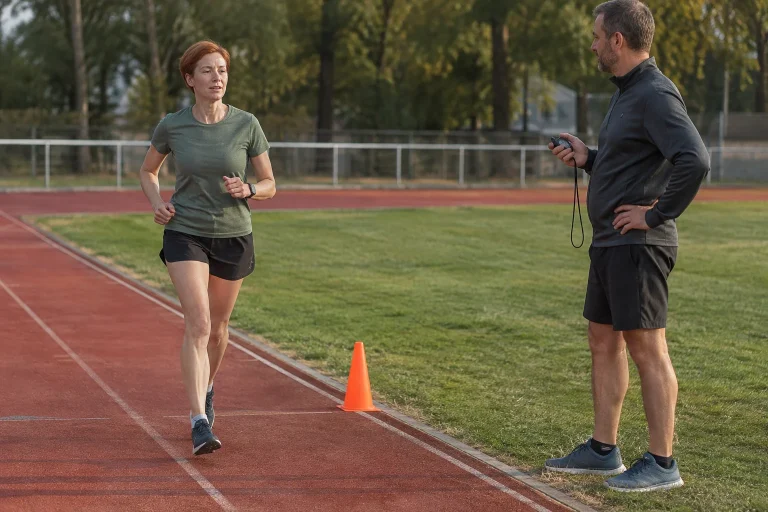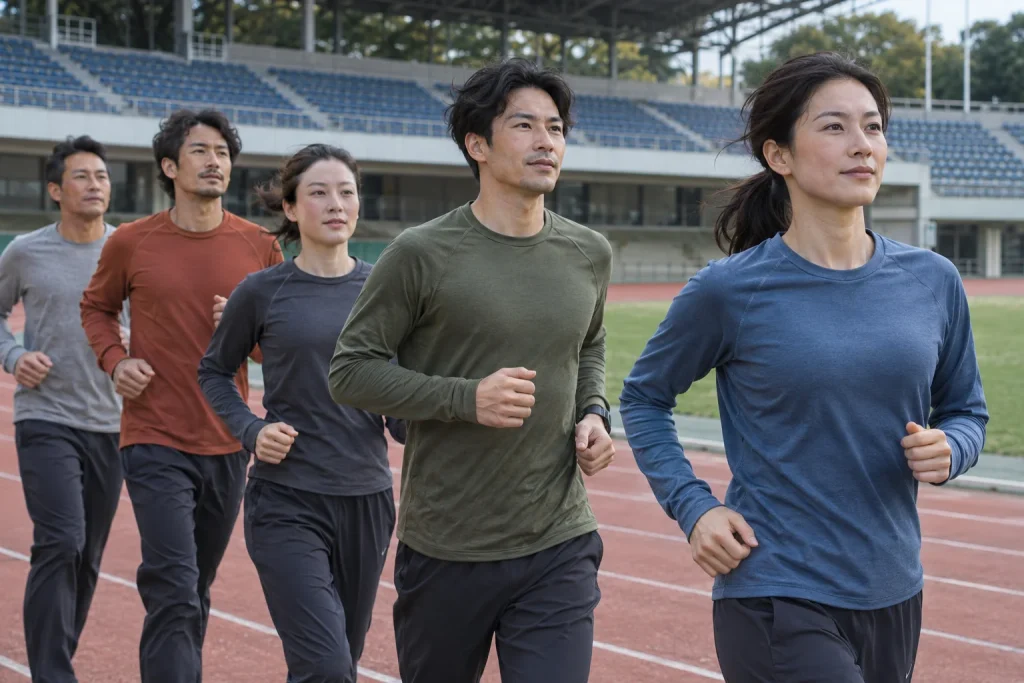
It is easy to imagine that the front of a running line takes the full headwind while conditions progressively improve farther back. Group aerodynamics is more complex. Flow around nearby bodies can interact, so each participant’s drag needs separate examination. The leader, middle runner and last runner do not necessarily fall into a simple, predictable ranking.
The interesting scientific question is not only who receives the most shelter. How the leader’s surroundings change, the total drag of the group and whose benefit is the objective matter too. Original pressure and group examples help explain this. We read real research models alongside what they calculated directly and what they derived using additional assumptions.
Flow behind the leading body matters too
A body’s drag through air does not come only from effects on its frontal area. We need the resultant of pressure and friction over its entire surface. The flow behind therefore matters to the leader too. Another body’s presence can change that environment, even when apparently the same undisturbed air arrives ahead of the first.
The basic relationship between pressure and force links pressure to force acting perpendicular to surface elements. Across a real human shape, surfaces face many directions, so their contributions must be summed to obtain the total resultant. The difference between conditions at the front and rear can be an important part of drag. This is a fluid-mechanics explanation, not a claim that the following runner physically pushes the leader.
In our simple model, imagine a body with two opposing flat faces, each half a square metre. Suppose pressure relative to the surroundings is plus ten pascals on the front and minus five on the rear. The difference gives 15 × 0.5, or 7.5 newtons of resultant force. If the rear difference changes to minus two, the result becomes six newtons. These are fictional uniform surface pressures, not measurements from a runner.
The example shows one relationship: changing conditions at the back can also modify the first body’s resultant force. It does not predict how much a particular follower changes it. Real bodies and flow are much more complex, and the second person enters with their own shape and movement. Specific measurements or models are therefore needed, rather than the simple picture that ‘the person behind only receives and the leader only gives’.
Position within a line is a study variable in its own right
The single-file CFD research by Beaumont and colleagues analysed calculated aerodynamic force at different line positions, then estimated energetic and time benefits using further relationships. In the five-person arrangement studied, second position gave the target runner the most favourable result. This belongs to that geometry; it is not a positioning law for every line and wind.
The model matters precisely because it went beyond the front-or-back distinction. It asked how outcomes develop through interactions among several bodies. Conditions can also differ between the middle and end. Changing the line’s length or body spacing or size creates another system. One favourable position does not prove that adding the next person improves things further for everyone.
Position must always be named in relation to the group and direction of travel. The second runner in a five-person line does not experience the same surroundings as the rear member of a pair. Each has one body ahead, but one has three further bodies behind while the other has none. Preserve the complete geometry alongside the result. Interactions between bodies need to be considered in both directions.
 Enlarge image
The leader’s result can also change with formation
The 2025 modelling study by Fernandes and colleagues explicitly incorporated pacers’ drag and power requirements into formation analysis. They showed that pacers’ demands can vary in alternative arrangements, and that the main runner’s benefit should not be interpreted in isolation from the helpers’ functioning. This is a strategic model based on CFD and energetic assumptions, not a controlled marathon experiment actually run under every condition.
The lesson is to consider the group. A leader’s situation is not simply a copy of a solo runner’s because they lead the line. Others’ positions can influence the bodies’ shared flow environment. Its direction and magnitude need to be established by the particular model or measurement. Do not assume the leader faces identical drag in every arrangement or that every possible follower necessarily helps.
The work by Schickhofer and Hanson comparing several formations likewise supports examining individual runners and arrangements separately. Side-positioned group members could modify flow too, with unfavourable effects on target-runner drag in some geometries. Rather than ‘more helpers, more shelter’, what matters is how bodies are positioned within the chosen airflow.
Individual and group optima are separate objectives
In an original, entirely fictional example, three runners move at the same speed and the model lists only drag forces. Arrangement A gives nine newtons at the front, three in the middle and three at the back. Arrangement B gives seven, four and four. Both groups total fifteen newtons, yet A is better for the middle target runner. B gives the leader the lower value.
Let arrangement C give eight, two and six newtons. This gives the middle runner the lowest force, but the group total is sixteen, which is higher. These figures are not research results or rankings of three real formations. They show why the objective function needs naming: are we trying to improve conditions for one designated person, equally for everyone or for the group’s total?
| Our illustrative model | Front / middle / rear | Total | Who benefits? |
|---|---|---|---|
| A | 9 / 3 / 3 N | 15 N | Better for the middle runner than B. |
| B | 7 / 4 / 4 N | 15 N | Better for the leader than A. |
| C | 8 / 2 / 6 N | 16 N | The middle runner has the lowest force, but the group total is higher. |
At identical speeds, mechanical aerodynamic power components are the products of force and speed, so their sum is easy to compare in this simple example. However, total metabolic costs involve more than this, and people are not necessarily identical. Assessing a group task therefore involves more than adding newtons. The table illustrates a logical distinction, not a complete physiological planning tool.
Keep the denominator when using percentages
If an article says the middle runner’s drag fell by sixty per cent, ask: compared with what? Their own solo model, another line position or another formation? If a ten per cent difference is reported for the leader, was the same control used? Percentages with different reference points cannot simply be placed side by side as independent points on one scale.
In our table, moving from A to B changes the leader’s force from nine to seven, a decrease of approximately 22 per cent. The middle runner’s rises from three to four, approximately 33 per cent. You cannot directly calculate the group-total change by averaging those different percentages. Use absolute values and original denominators together; here, the group total is unchanged.
Likewise, percentages for overall economy and aerodynamic drag concern different quantities. A further model relationship links lower force to energy cost. Predicting race time is another step, with assumptions about pace and sustainability. Accurate reporting preserves that pathway instead of compressing it into ‘the line is this much faster’.
Why does this not produce a ready-made rotation schedule?
A group’s instantaneous aerodynamic positions and the manageability of a longer task are different things. During a change of leader, runners move, may change speed and rearrange the line. A model calculating a rigidly fixed formation does not necessarily include this whole transition. Deciding how often to rotate therefore requires more than the positions’ drag values at one instant.
Participants’ goals can differ too. One group wants to finish together; elsewhere, a pacer undertakes a defined task beside a racer. Fair sharing of roles may matter in one situation, support for a designated goal in another. These are human and training-planning decisions to which aerodynamic figures can contribute information, but they do not replace agreement.
In practice, a predictable task and signals agreed beforehand are important. An easy community run does not require constant position changes simply because a study found one model position more favourable. If a team plans targeted training, details need to fit the actual pace, route and participants. Safe movement space must not become secondary to a theoretical force saving.
 Enlarge image
What does a well-reported group result look like?
First, the geometry is clear: how many runners, their body sizes, distances and lateral offsets. Next come airflow conditions: airspeed, direction and how movement is represented. Then each relevant runner’s drag is shown separately, not only the best target-runner result. Finally, the control is clear, as is whether the claim comes from direct force, estimated metabolism or a further time model.
If an article discusses a leader’s benefit, find that person’s actual data. Favourable flow for the rear runner does not itself prove lower leader drag, even if interaction is physically possible. Good evidence demonstrates the difference in a specific configuration. The same applies to ‘everyone wins’: results for everyone affected or an appropriate shared outcome need to be shown.
An attractive flow-colour image does not automatically replace a total-force figure. A large velocity deficit in one plane is interesting, but several spatial surfaces and directions shape the resultant on the body. The image should therefore ideally come with calculation or measurement uncertainty and a method description. Visuals help explain flow; data and an appropriate comparison support the conclusion.
The front of the line belongs to the shared system too
The precise answer is therefore that the leader’s aerodynamic situation can depend on formation too, but the direction and size of change belong to a particular system. Positions within a line are not merely progressively greater levels of shelter. Pressure and velocity-field interactions mean the leader, intermediate and rear runners need separate evaluation.
The practical benefit is thinking in terms of the group. One person’s minimum drag, lower demands for the leader and improved functioning of the whole team can be three different goals. Naming them makes research figures clearer and shared running tasks easier to agree fairly. Physics then offers more information about roles without promising a ready-made tactical schedule.
Sources
- Beaumont and colleagues: aerodynamic interaction between line positions.
- Schickhofer and Hanson: running formations and differing drag outcomes.
- Fernandes and colleagues: a combined model of the target runner and pacers.
- OpenStax: the relationship between pressure and surface force.
How Futószív articles are prepared: our editorial guidelines.