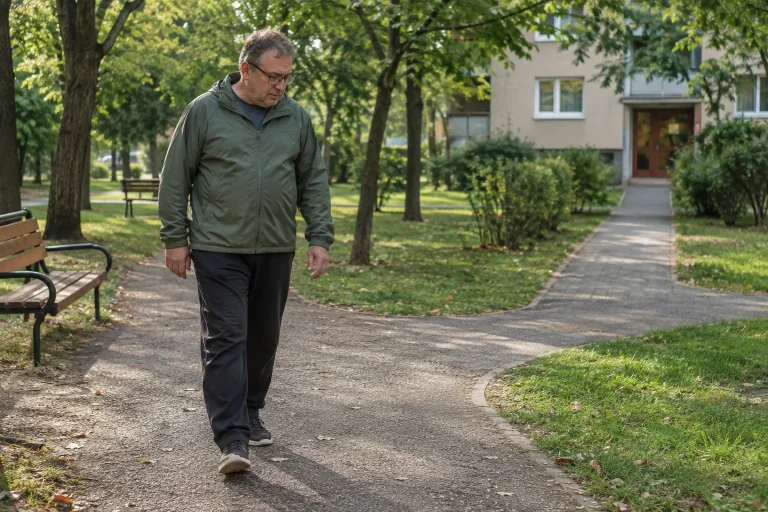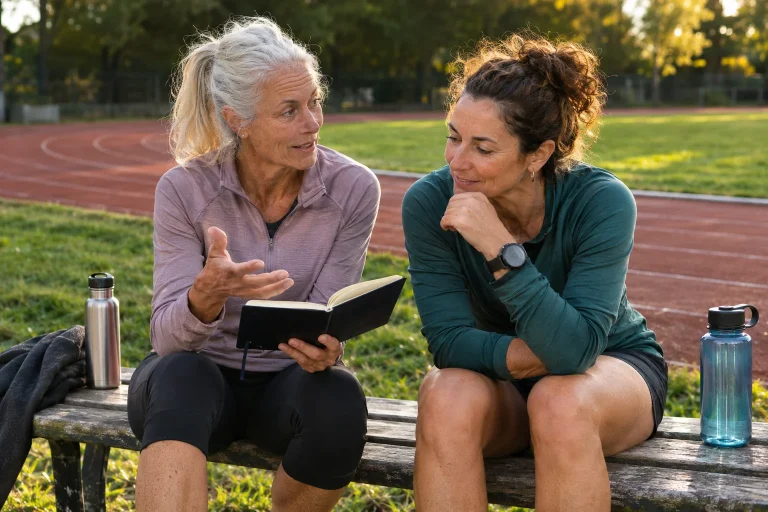
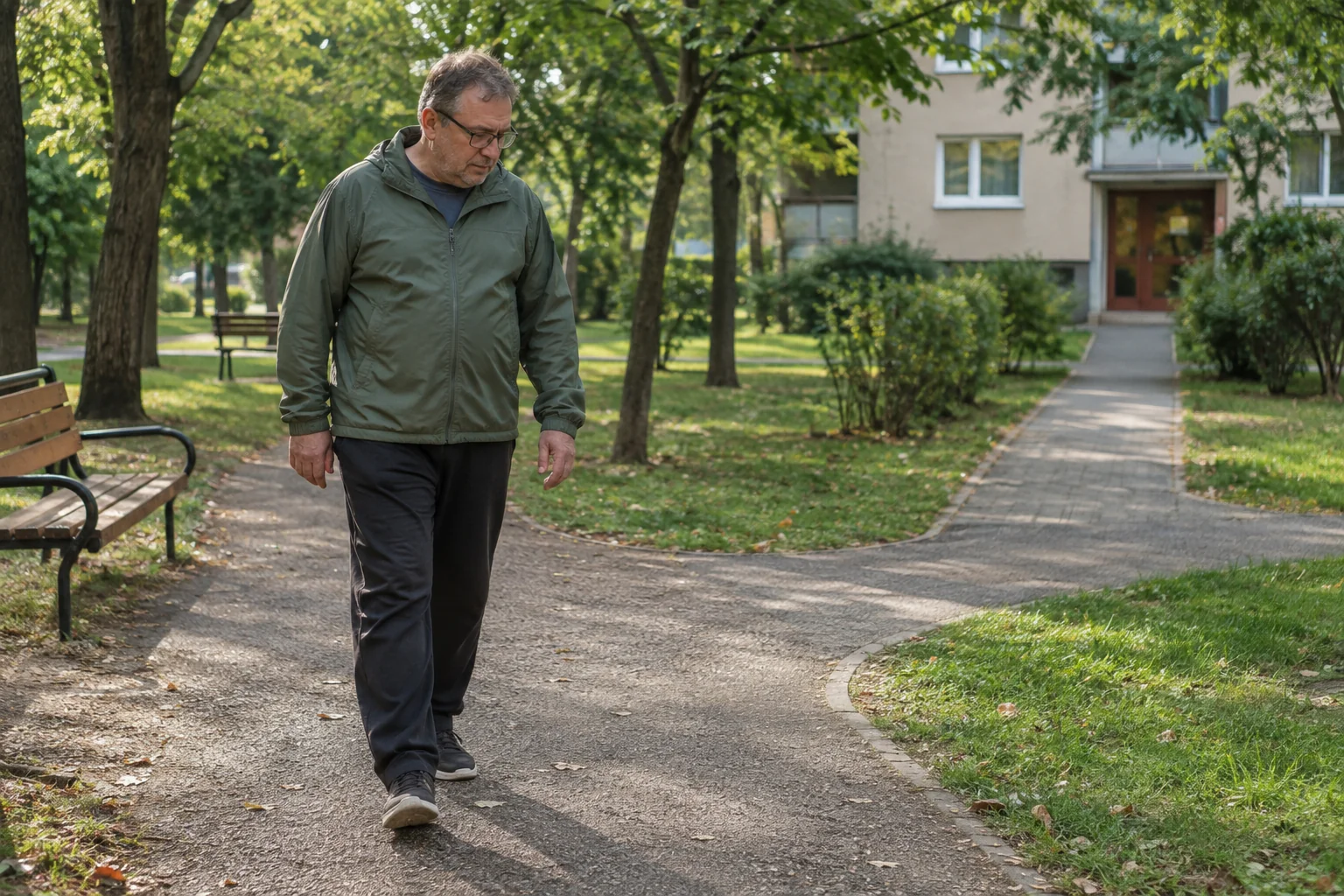
Your shoe catches, you regain your balance with a larger step, and you do not end up on the ground. It is easy to close the matter with “Luckily, nothing happened.” There may indeed be no injury, but the incident can still offer useful information. It deserves particular attention if it happens repeatedly, is new for you or changes your confidence in moving afterwards.
Here, a near-fall means an everyday situation in which you lost your balance, or felt close to losing it, but avoided reaching the ground by holding on, taking a corrective step or receiving help. This is a description, not a home diagnosis. If the incident involved feeling unwell, near-fainting, injury or another serious new symptom, arranging appropriate help takes priority over continuing the running loop or completing a diary.
No injury does not make the incident invisible
The outcome and the event are two different pieces of information. Remaining upright does not mean there was no loss of balance or uncertain moment. Equally, one stumble does not automatically imply a persistent problem. The useful middle course is noticing the incident factually without immediately turning it into a prediction of personal catastrophe.
Your description can include what helped you recover. Did you reach a handrail, stop, or feel safer because your companion was there? These details are not a score. They help you recall the actual circumstances later, rather than remembering only that “Something nearly happened.” You do not need to go through the same place again to make the memory more certain.
The CDC STEADI professional tool asks about unsteadiness while standing or walking and concern about falling, alongside falls history. We are not using it for self-classification or calculating an online risk value. The point is simply that an incident need not end on the ground to provide an important basis for discussion.
First make the immediate situation safe
If you managed to stay upright, allow yourself to stop calmly. You need not hurry to prove that everything is fine. Find somewhere you do not have to dodge others suddenly or keep balancing. With companions, a brief interruption can be a natural organisational step rather than an inconvenience inflicted on the group.
Then clarify whether there is an injury or illness. Even a near-fall can involve an uncomfortable strain or impact—for example, if you braced against an object; the absence of injury does not rule out preceding illness. With uncertain or serious symptoms, do not use an exercise test to decide whether you can continue. Seek help appropriate to the situation.
If the incident became an actual fall, other questions also arise. The NHS information on falls separately addresses injury and the need for help. We do not describe an independent getting-up or injury-exclusion test here. An urgent situation does not become less important because you originally planned brief, easy activity.
Circumstances and bodily experience deserve separate sentences
The location’s description may include the surface, lighting, an obstacle or an unexpected turn. Your own experience includes what happened to your step, what you felt and whether you needed to hold on. Mixing them can create an overly ready-made explanation: surely only the pavement was poor, or surely you were merely inattentive. Instead of declaring a definite cause, first separate the two accounts.
| Circumstances | Your experience |
|---|---|
| There was a raised slab at the entrance. | My shoe caught, and I took a corrective step. |
| I unexpectedly had to move aside. | Turning felt uncertain, so I stopped. |
| The location appeared unchanged. | I experienced new dizziness or a need to hold on. |
These are editorial examples, not symptom–diagnosis pairings. The same circumstances can produce different experiences, and similar experiences can have different causes. The description’s value is precisely that it does not decide the explanation in advance. It allows clearer thinking about both environmental changes and individual assessment.
 Enlarge image
A recurring pattern raises a different question from an isolated memory
If the incident repeats, consider whether it is linked to the same place or happens in several environments. You need not start an elaborate observation programme; a few brief notes about events that have already happened may suffice. Frequency and onset are worth mentioning even if you were never injured. You do not have to wait for a more serious outcome to discuss unsteadiness.
Repetition may raise questions beyond the time spent moving. Has your vision changed, was there a new medicine, did you wear different shoes, or has a new bodily symptom appeared? These relationships in time do not prove a cause, but may be useful in professional assessment. Do not turn the list into your own treatment plan or change medication independently.
The NIDCD balance information mentions several possible influences and supports accurate description of symptoms’ circumstances. For runners, the lesson is not that every system needs separate testing at home. Rather, do not dismiss a recurring event with one unproven explanation.
What did one study find about near-falls?
A prospective study published in 2017 followed near-falls and subsequent falls in older adults. Participants first recorded incidents in diaries, followed by further monitoring. The researchers found an association between an earlier near-fall and a later fall. This suggests that episodes in which balance was recovered also deserve attention.
The study’s analysis included sixty participants from a particular community setting. This is an observational finding, not an experiment predicting every recreational runner’s personal future. Uncertainty around the result matters too. We therefore derive no individual probability from the article and do not claim that someone will definitely fall after stumbling.
The practical conclusion is more restrained: an incident can be recorded and reported even when it did not end in injury. A research association does not prohibit running, but neither does it remove the need to understand the individual situation. Let symptoms, history and environment contribute together to your decision, rather than an extreme claim derived from a study title.
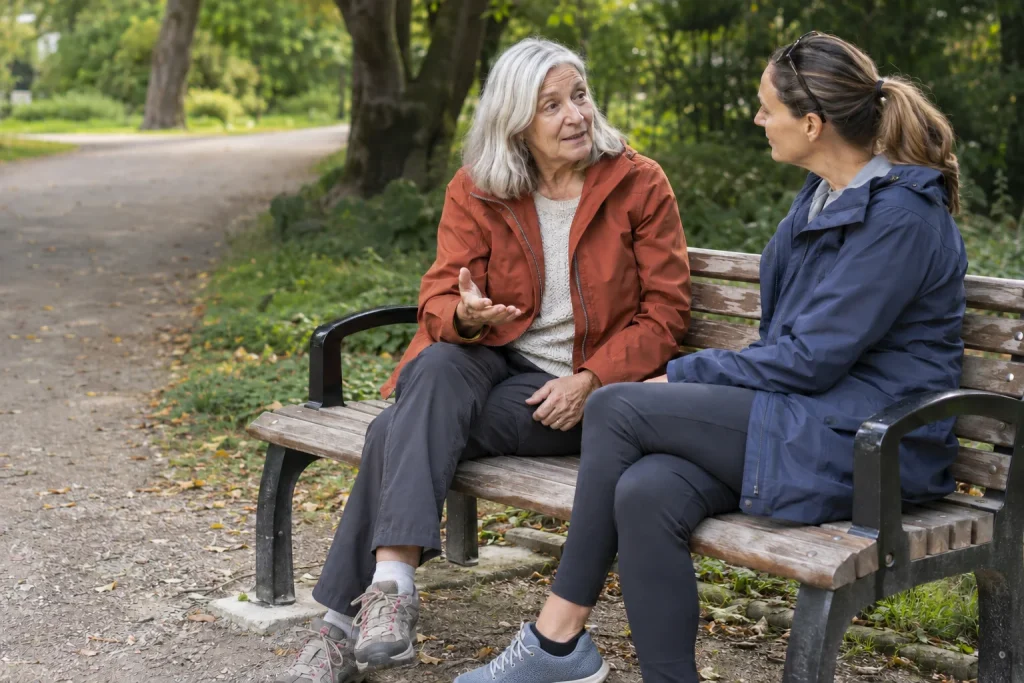
Your companion’s observation can help without overriding your experience
If someone saw the incident, ask what they noticed. Where was the obstacle, was there a sudden change of direction, or how did they help? External observation adds information. It does not establish what you felt. “It did not look serious” is no reason to conceal new dizziness or unsteadiness.
In the conversation, separate description from opinion. Stopping at the gate and touching the railing is observable. Being too old to run is a judgement. Likewise, “You are sporty, so surely nothing is wrong” is not an assessment. Specific details offer more help than reassuring labels in either direction.
You can also agree simple organisational changes: another entrance, a gentler shared outing or an easier opportunity to stop. This does not make your companion a treating professional. Keep help within its role, and do not try to close healthcare uncertainty with a sentence of encouragement or prohibition.
Do not make the next outing a deliberate replay
After a near-fall, returning to prove that you can manage the same place without difficulty can be tempting. It is unnecessary. Once you identify an obstacle, avoiding it or choosing another route can be useful. If a question arose about your own functioning, do not try to answer it with a more dangerous repeat.
The activity goal can be retained in several ways. If you wanted company or time outdoors, a calmer location or another activity may serve that purpose. Changing the loop does not automatically mean abandoning sport entirely. Equally, a justified pause for a new health symptom need not immediately be filled with a substitute task.
A clearer decision about continuing is possible once the incident’s significance has been clarified. Sometimes changing the environment provides a useful solution; in other cases, individual assessment or several forms of help are needed. The NICE falls-prevention guideline also supports an approach matched to individual factors rather than prescribing an identical set of tasks for every older participant.
 Enlarge image
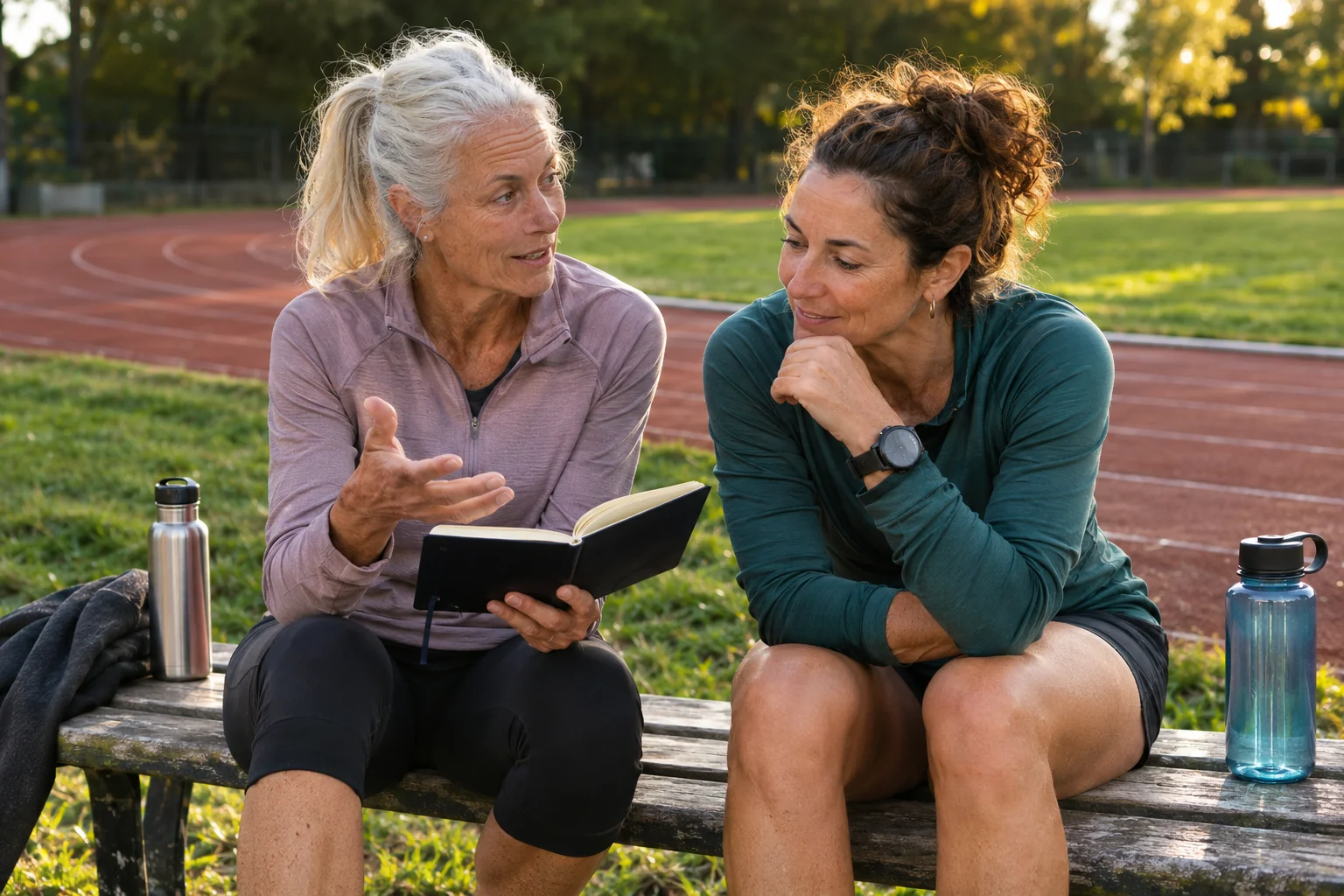
A group outing should allow a calm stop
If the incident occurred during an organised outing, the group’s pace should not make it difficult to speak up. You can say that you need to stop or change the plan without giving a detailed medical history in front of everyone. Practical information can be simple: where you will remain safely, whom you will coordinate with, and how the journey home changes. The individual assessment needed remains a separate matter.
Include only what you want to share for that particular help in a message to your companion or group leader. Your precise location may matter for meeting, but a public sports post need not list your medicines or other people’s observations. Discussing the situation and sharing it socially are separate decisions. Documentation aims to support traceable help, not prove the incident to everyone.
Keep notes brief so the substance remains clear
A simple note can contain the location, activity, your experience and how the moment ended. Add associated symptoms or help if relevant. You need not collect ever more detailed maps, videos and measurement lists. The purpose is not constant reliving, but avoiding a later conversation resting only on uncertain fragments of memory.
Changes in your behaviour can belong in the note too. Have you since avoided the familiar place, constantly watched the ground or become afraid of setting out? This does not mean worry caused the original incident. It shows how the episode affected your everyday participation and what support may matter next.
A near-fall is therefore neither a compulsory major issue nor an insignificant detail to erase. It is an experience that may belong in your own movement history. Factual attention helps preserve choice: neither fear nor excessive confidence drawn from remaining uninjured needs to decide every subsequent outing for you.
Sources
Nagai and colleagues: prospective study of near-falls and subsequent falls; CDC STEADI: professional falls-risk algorithm; NIDCD: balance and describing symptoms; NHS: falls and seeking help; NICE NG249: individual assessment. Checked: 20 November 2026. The editorial examples are not risk scales, and the research result is not a personal prediction.
How Futószív articles are prepared: our editorial guidelines.