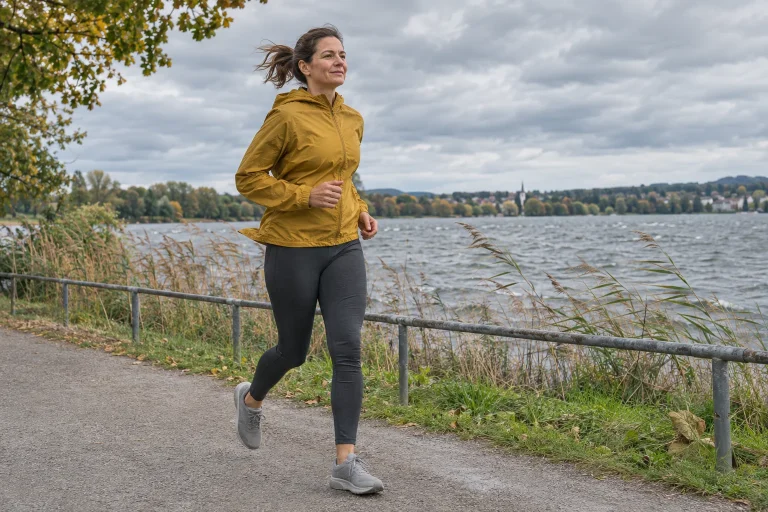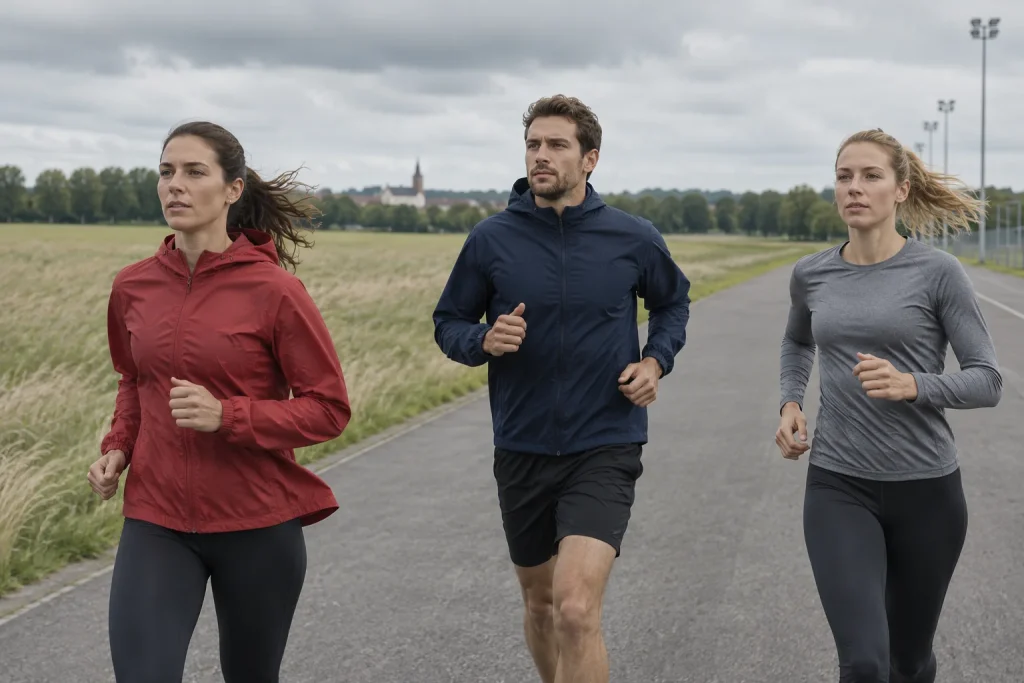
In a headwind, moving one behind another can seem instinctive. In a crosswind, however, the air arriving at a runner does not necessarily align with the course’s lengthwise axis. The space behind another runner is therefore not simply a protected strip drawn along the road. Airflow direction, body positions and movement jointly shape the situation.
It is useful to understand drafting as a flow phenomenon rather than a guaranteed place to stand. We separate simple directional calculations, the complex real airflow behind a runner and the conclusions of formation models. The aim is to understand the geometry: this article does not give centimetre-by-centimetre race-positioning instructions or derive a running formation valid for every crosswind from the models discussed.
The wind reaching a runner can turn away from the road’s direction
Meteorological wind describes air movement relative to the ground. A runner’s own forward motion changes the flow relative to their body. According to the Met Office explanation of wind measurement, meteorological direction names where the wind comes from. You need to relate your running direction to that before interpreting relative airflow. A northerly wind and a runner heading east, for example, do not use direction in the same way.
In our simple example, a runner moves forwards at five metres per second while the ambient wind arrives perpendicularly at two metres per second. Combining those perpendicular components gives an air speed relative to the runner of approximately 5.39 metres per second. Its direction turns about 22 degrees sideways from a directly head-on flow. These figures assume steady flow in a plane; they are not measurements from an actual race section.
If the runner slows to three in the same wind, the relative-flow angle increases to approximately 34 degrees. The weather’s wind is unchanged, yet the air reaches the runner from a different relative direction. The same meteorological conditions can therefore produce different flow geometry for faster and slower groups. Even at this stage, ‘always stand here in a crosswind’ tries to cover too many situations with one answer.
The space behind a runner is not a stationary protected tube
A runner’s body deflects air, and a flow field containing velocity and pressure differences can form behind it. This is not a uniformly slow mass of air following the course as a corridor of constant shape. The head, torso, arms and legs create different regions, and movement changes the surroundings over time. ‘Shelter’ is a useful everyday word provided we do not interpret it as a completely wind-free cavity.
In D’Angelo and colleagues’ 2026 field study, particle tracking mapped the flow behind six athletes running at approximately eight metres per second. Body outline, especially the torso, strongly influenced the shape of the near wake, and vortical structures were identified. The researchers studied moving runners and interpreted estimated benefits for a follower from the measured flow field. This was not a direct test of group positioning in a crosswind.
That last distinction matters. Measuring the space behind a real runner brings us closer to the flow consequences of movement, but does not itself show where a second person should position themselves in a crosswind. That would also require studying the interaction of the added body and the different flow direction. The lesson here is the field’s complexity and the limitations of a simple static drawing.
 Enlarge image
Why can you not simply rotate the single-file line?
In an idealised picture, you might imagine the centreline of the wake aligning with the relative wind. However, it does not follow that rotating the whole running formation by the same angle leaves every result unchanged. Runners still travel along the road, with their bodies and limbs oriented to that movement. They present a different side to the airflow, and the space between them becomes a new geometric problem.
In our thought experiment, we draw a two-dimensional line of zero width along the wind direction. Rotate it and the line simply moves to a new position. A real person, however, is an extended three-dimensional body; the flow beside and behind them cannot be compressed into one line. Moving arms and legs cannot be rotated independently of the running direction either. The line illustrates direction well but would make a poor positioning map.
The road also has finite width. A theoretically laterally offset line may not fit within the designated running area or leave room for overtaking. Actual course space therefore shapes a group alongside the aerodynamic question. Understanding physics is not an invitation to occupy the road sideways or step suddenly in front of other runners.
What do running-formation models actually calculate?
The CFD study by Schickhofer and Hanson calculated drag using a specific runner geometry, speeds and several defined formations. Configurations gave different results, and side-positioned pacers could sometimes create unfavourable local flow. This is not a general guide optimised for crosswinds: positions and flow conditions are part of the model.
The single-file study by Beaumont and colleagues examined a runner’s place in a line with a defined geometry. Further assumptions were used to estimate metabolic and time savings from aerodynamic drag. Differences between group positions are therefore results for that system, not rankings valid across every possible wind direction. A different airflow direction or body size would be a new study condition.
When reading a model, look for four things: the specified air direction and speed, how bodies were positioned, the posture used and which runner’s result was being optimised. The term single file describes only part of the arrangement. Separation, lateral offset and height differences between two bodies also belong to the specific calculation. A formation’s name alone is insufficient to compare two studies.
Lower drag requires another step before it becomes a personal energy benefit
If a model calculates a lower aerodynamic force in a particular position, that does not automatically mean the same percentage improvement in energy use or speed. The force is only one component of running. The mechanical and physiological relationship must be specified separately to estimate total energy demand; race time also depends on chosen pace and other circumstances. Do not read these three linked estimates as one direct measurement.
In a 2025 treadmill experiment in a wind tunnel, thirty-three trained distance runners ran under several airflow conditions, partly behind a mannequin. Lower oxygen uptake was measured while drafting compared with the headwind condition. This is direct physiological evidence, but from a defined laboratory arrangement, not a universal map for freely moving running groups in crosswinds. A mannequin and a living pacer are not identical settings.
Your own experience can also involve psychological factors and pace organisation. If keeping rhythm feels easier in a group, the experience is not entirely airflow. A lower sense of effort is valuable feedback, but does not itself demonstrate a particular wattage saving. An accurate article identifies which component was studied and which remains a further possible explanation.
What happens when the road turns or the wind changes?
On an urban loop, running direction can keep changing even when the weather’s wind stays constant. Relative airflow arrives from a different angle in the next street. Local surroundings can further alter air movement between buildings. A position that previously felt favourable may therefore not remain the same. A fixed formation drawing enters a task that changes over time.
With a gust, airflow strength and direction can change quickly. Meanwhile, the runner’s response, other people’s movements and obstacles interact. Responding to every change with rapid sideways repositioning is not practical. Predictable movement and appropriate personal space are prerequisites for running together to remain manageable. A theoretical aerodynamic advantage does not justify a sudden move.
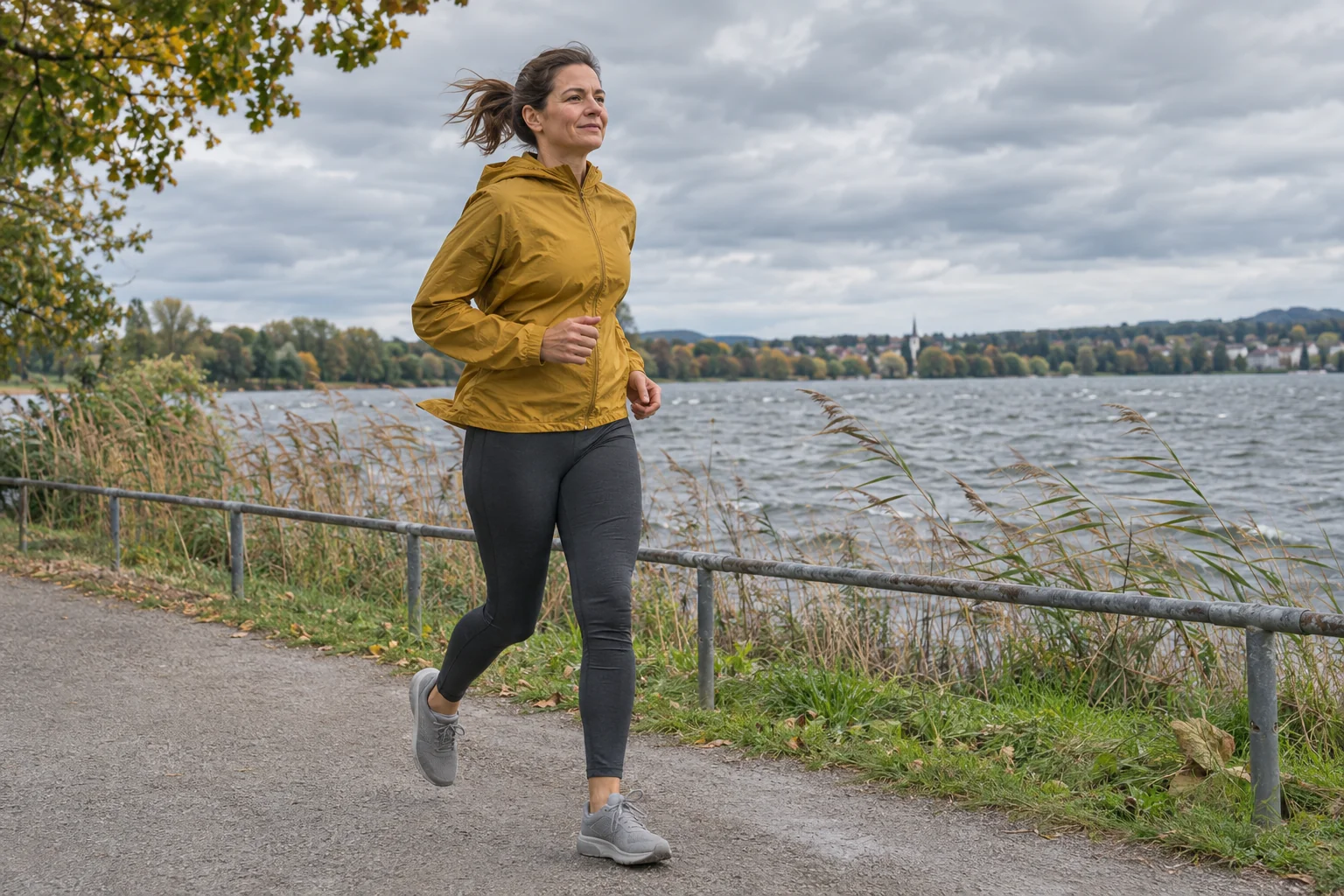
When observing a training session, describe sections instead. An exposed straight, wind from the side, then a sheltered bend: that description preserves the changes. An average claim that ‘it was this much easier in a group’ does not reveal which part mattered. If comparing several outings, include running direction and the group’s task in the diary. Precise circumstances are worth more than a falsely precise constant drafting multiplier.
 Enlarge image
Available space is the first filter for positioning
Even on a wide, closed training surface, everyone needs to see where they will next place their feet and have time to react. Agreeing direction changes, stops or overtakes in advance helps make shared running predictable. The studies discussed do not establish a safe following or lateral distance valid in every situation. Such centimetre-specific values therefore cannot be borrowed from the best model position.
In practice, the first answer to ‘where should I go in a crosswind?’ is: where can you move lawfully and comfortably without obstructing someone else? If usable space is absent, seeking supposed shelter is not worthwhile. Maintaining direction and spacing, seeing the route and following the group’s shared pace are more important decision criteria. The physical explanation remains interesting background knowledge.
In our example, a relaxed training trio reaches an exposed section. They notice the crosswind but do not try to close into a tight staggered formation. Their shared task is an easy run, so they prioritise a comfortable pace and predictable movement. Their later discussion may produce an interesting observation about wind direction. They do not have to turn every metre into an aerodynamic experiment for the run to be useful.
How to interpret a crosswind claim
If a diagram marks a precise position behind a runner, find the airflow direction it was derived from. If only a headwind was modelled, applying it to a crosswind is a new inference, not a direct result. If stationary bodies were used, transfer to live running also needs examination. If only flow was measured, energy and time benefits may be separate estimates. These questions help identify the level of evidence accurately.
A simple single-file line is therefore not a universal answer because the direction of air reaching a runner, the shape of the wake and interactions between bodies change together. The space around a moving runner is richer than a protected straight strip in a drawing. The useful lesson is to recognise the geometry and check the conditions behind claims, while adapting real shared running to the safe space available.
Sources
- Schickhofer and Hanson: CFD analysis of specific running formations.
- Beaumont and colleagues: aerodynamic interaction between bodies running in line.
- D’Angelo and colleagues: field measurements of moving runners’ wakes, 2026.
- Met Office: explanation of meteorological wind direction and measurement.
- Steele and colleagues: aerodynamic drag, drafting and oxygen uptake on a treadmill.
How Futószív articles are prepared: our editorial guidelines.