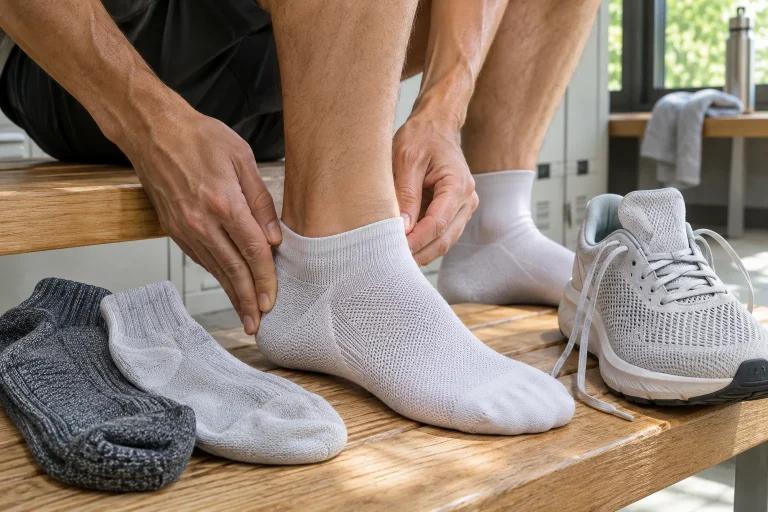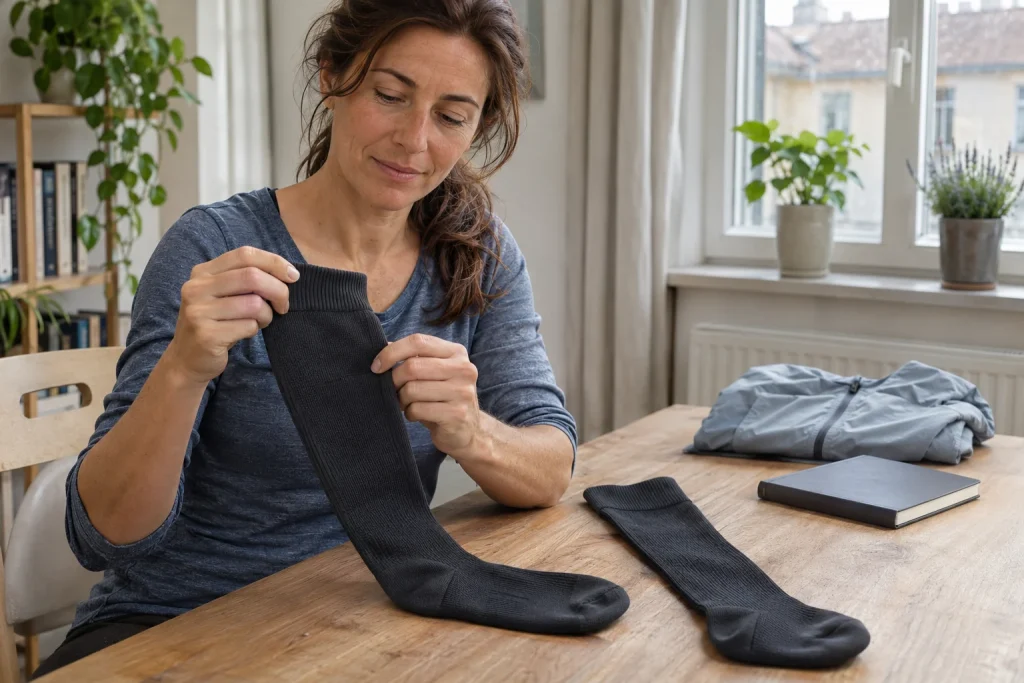
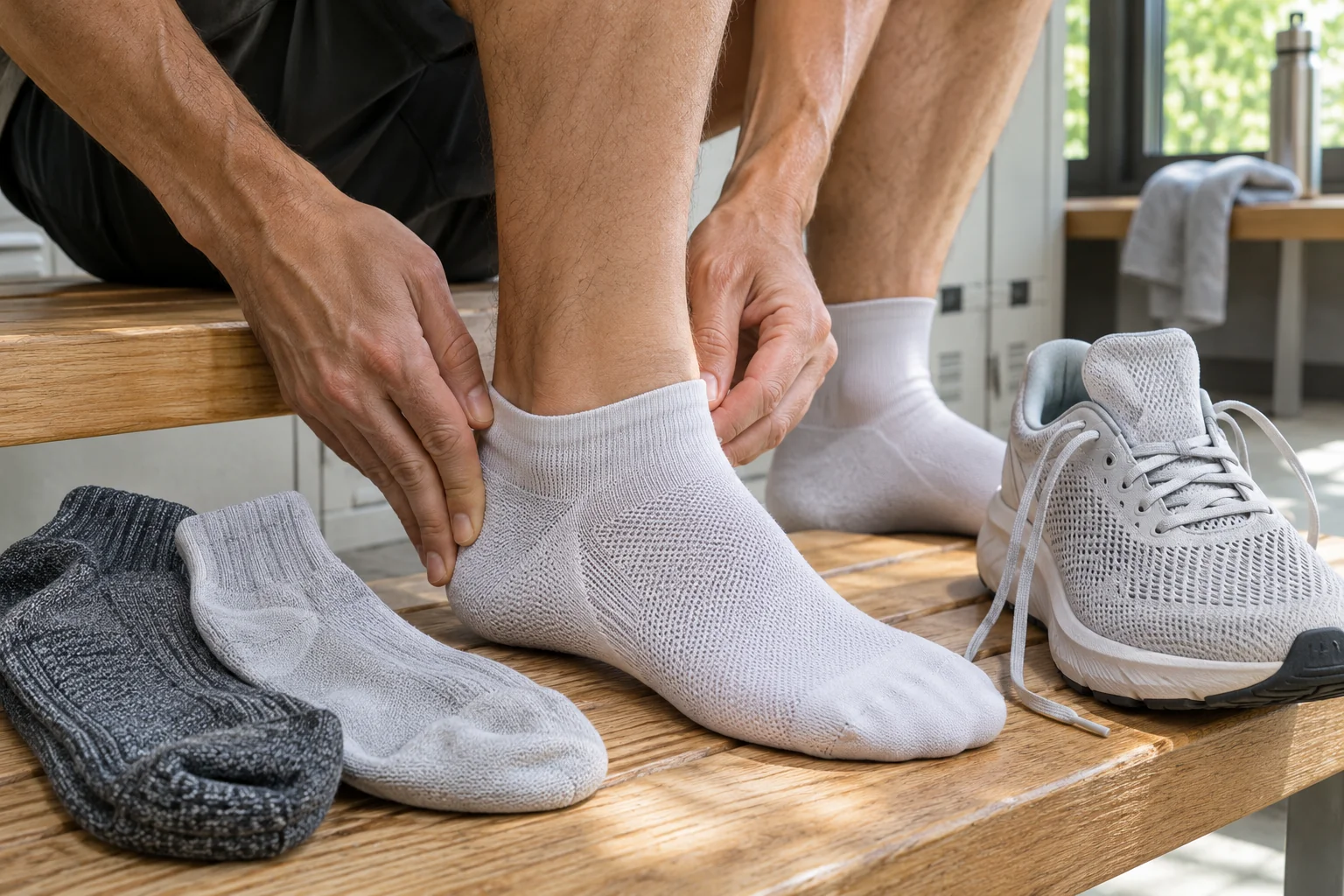
Compression sportswear can be a favourite part of running kit: you may like its support, cut or feel. Recovery promises are a separate question. Less soreness, a smaller circumference change and better running performance are different outcomes. Do not automatically infer one from another even when a product description groups them under faster recovery.
Keep sports purchases separate from medically prescribed compression too. A tight running sock does not become an individual medical device through a favourable sports study. Nor should prescribed hosiery be replaced by sportswear on the basis of advertising or a companion’s experience. This article helps interpret recovery studies and clarify decisions; it cannot select compression class, pressure or wear duration without knowing your condition.
When was it worn: during running or afterwards?
This is an early question when reading sports-clothing research. Wearing it throughout weeks of training and racing differs from receiving it only after finishing. Later soreness can be assessed in both designs without making interventions identical. Results during activity do not simply establish effects during rest at home, or vice versa.
Calf hosiery, lower-body tights and full-body clothing are not one product either. Retain the garment in any research statement. Size, material and exercise also form part of the conditions. If advertising says compression effects are proven, check whether a similarly constructed item with a similar purpose was studied. An umbrella term is insufficient for transfer.
In our example, two product pages can share a recovery sentence while one shows calf socks worn racing and another tights for rest. Neither is necessarily poor, but each claim needs relevant evidence. Ask: “Does the cited study support this exact use?” This is more precise than one universal yes-or-no verdict on all compression clothing.
A fifty-six-kilometre study produced mixed findings
In Geldenhuys and colleagues’ 2019 randomised study, forty-one healthy, injury-free endurance runners participated. The experimental group wore below-knee compression during six weeks of preparation and a fifty-six-kilometre ultramarathon; controls did not. Circumference, muscle characteristics, pain and performance were among the outcomes. This was not simply a post-finish clothing change, but use during training and racing.
Ankle circumference increased less from finishing to two days later in the compression group, but other objective measures and race performance showed no corresponding demonstrated group advantage. Some pain ratings were worse with compression. The study therefore does not support a simple account that smaller circumference change necessarily means greater comfort and faster running. Read outcomes together.
Keep the distinction in everyday language: measured circumference and a runner’s experience provide separate information. Neither needs to be declared the “real” result instead of the other. For a buying promise, however, identify exactly what changed. Selecting only a favourable detail can imply more effects than research found. The complete table row may matter more than an extracted word.
 Enlarge image
Post-ultra comfort benefits do not imply improvement in every other measure
In Martínez-Navarro and colleagues’ study involving thirty-two athletes, full-body compression was compared with control after a 107-kilometre ultra-trail race. Clothing was worn for one day after finishing. Change in delayed soreness reported at the back of the leg was more favourable, but clothing did not demonstrably affect the tracked blood markers. Measurements continued for two days after racing.
The research examined markers related to muscle loading, inflammation and kidney function alongside sensory reports. A favourable soreness detail cannot therefore establish acceleration of every investigated recovery process. Authors also identified possible expectation effects as a limitation. A sensory outcome can remain valuable while mechanism and other endpoints stay unresolved or show different findings.
The study does not prescribe one day of wear for every runner. That was its research condition, not instructions for your product or healthcare advice for your condition. Do not confuse a sportswear duration with prescribed medical hosiery use. Timing and timescale belong to interpretation; individual applicability raises further questions.
Positive functional evidence exists too, with a specific subject
In Armstrong and colleagues’ 2015 randomised study, thirty-three marathon runners were compared under compression-sock and placebo-sock conditions. They wore the assigned socks for two days after racing. Function was assessed through treadmill time to exhaustion before the marathon and two weeks afterwards. Change in test duration favoured compression. Retain this specific positive finding alongside neutral studies.
The endpoint was neither next-day pain nor the finish time of another race. It was a defined exhaustion test at a specified time in a small sample. This cannot calculate minutes gained in any sock or prescribe identical wear after every marathon. The interest lies in the task and design rather than an unlimited “performance improvement” label.
Do not make the studies vote against each other. Garments, wear timing, exercise, participants and outcomes differed. One reveals sensory findings, another particular measurements or function. Seek the relevant detail for your expectation. A citation does not make a promise accurate if it extends far beyond the reported result.
| What appears in research? | What does it directly mean? | What should you not infer? |
|---|---|---|
| Circumference change. | A measurement difference at a specified location and time. | Automatically less pain or a better race time. |
| Reported soreness. | The participant’s experience on that particular question. | Faster recovery of every laboratory marker or tissue process. |
| A later treadmill test. | Completion of that task at that follow-up. | Identical gains from any product or race. |
Comfort and expectation differ, but both can affect interpretation
A garment’s feeling is hard to hide from its wearer. If someone feels tighter fabric and knows the expected benefit, this matters in comparison. Similar-looking controls or placebo designs try to address it without making every experiment perfectly blinded. Check what participants knew and how outcomes were measured.
This does not make a good feeling imagined or worthless. Comfort can matter independently in clothing. Claiming it proves a physiological mechanism or guarantees fitness for the next session is different. “I enjoy wearing it” is enough without uncertain circulation explanations or recovery promises for everyone.
Discomfort matters too. Do not convince yourself painful or troublesome wear must be more effective. Greater tightness is not a reliable measure of personal benefit. Choosing smaller does not turn a sports product into deliberately calibrated treatment. Purpose, clear product information and your condition matter more than difficulty putting it on.
Medically prescribed compression belongs to a separate plan
The South Tees NHS information on compression treatment emphasises prior healthcare assessment and equipment appropriate to the condition. Compression then forms part of treatment rather than simply sports kit. Discuss type, fit and wear with your own provider. A running-portal study does not permit replacing prescribed hosiery with arbitrary recovery clothing.
If already using prescribed hosiery, ask how sport and chosen clothes fit alongside it. Do not automatically add another tight layer assuming more is better. Overnight or travel use cannot be derived from a post-race experiment either. Your condition, device and professional instructions belong together; sports research answered another question.
The Kent Community Health NHS guide says to remove hosiery immediately and seek advice for altered sensation, tingling or numbness. South Tees also flags pain, excessive tightness and discolouration. These do not prove effectiveness. Seek appropriate assessment for new or significant symptoms; a severe situation with chest pain or breathlessness needs urgent help, 112 in Hungary.
 Enlarge image
A few precise questions make a sporting choice more realistic
Name what you expect. For comfort, consider cut, sizing information and intended setting. For additional recovery effects, find the exact study, timing and outcome. If symptoms drive the choice, first clarify whether healthcare is needed. Three different decisions do not require forcing the same justification onto them.
- Which garment was studied: calf socks, tights or a full-body product?
- Was it worn during exercise, afterwards or across a longer training period?
- Were comfort, pain, circumference, laboratory markers or sporting tasks measured?
- What was the comparison and how long were participants followed?
- Does my own condition or prescription require individual professional advice?
Find sizing and care information for the particular item. Another brand’s recommendation does not automatically apply, and a research garment’s name does not describe every current variation. You need not measure pressure yourself or guess a smaller size. If instructions are unclear, do not fill uncertainty with a scientific sentence about another product.
A pleasant, well-fitting optional garment without special performance promises is a realistic outcome too. Research shows favourable details in some situations and neutral or less favourable outcomes elsewhere. A precise decision can include comfort, evidence limits and individual medical instructions together. None needs to replace another.
Sources
- Geldenhuys and colleagues: Below-knee compression garments, 2019
- Martínez-Navarro and colleagues: Full body compression after ultra-trail
- Armstrong and colleagues: Compression socks and functional recovery after marathon
- South Tees NHS: Compression hosiery
- Kent Community Health NHS: Applying graduated compression stockings
How Futószív articles are prepared: our editorial guidelines.