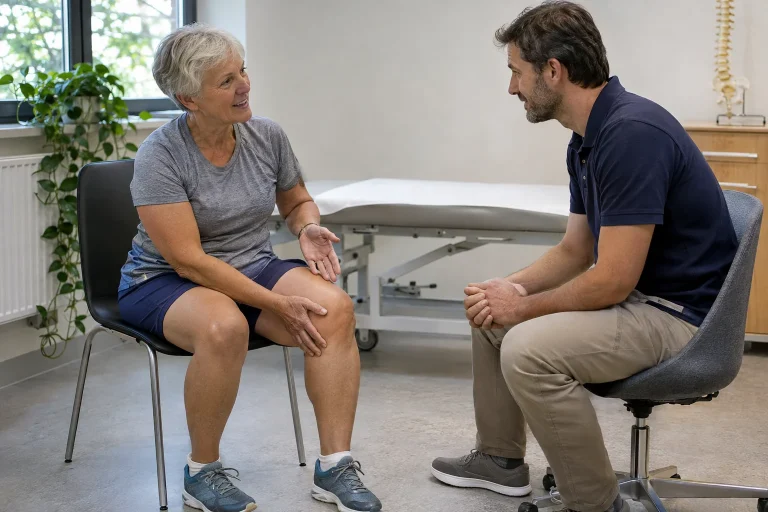
The ankle fracture happened years ago. Treatment ended then, and later you returned to work, walking or running, but now the same everyday route feels harder. There is more stiffness, pain appears sooner or the ankle feels more swollen by the end of the day. The old injury is important history, but not a ready-made answer. Today’s change needs assessment alongside your current function.
With a new accident, sudden severe pain, inability to walk or deformity, seek urgent help rather than regarding it as a familiar consequence of the old fracture. The NHS ankle-pain information specifically highlights severe or new injury-related symptoms. Even a slower change may warrant assessment, particularly when it limits everyday activities or repeatedly worsens.
Bone healing and later joint function are separate questions
Earlier care assessed fracture healing, bone position and safe loading for that period. Later life may raise another question: how does the ankle move now, which tasks can you perform comfortably and what changed recently? An old discharge report is not a functional forecast for every subsequent year, but may contain important information for understanding the present situation.
The AAOS overview of foot and ankle arthritis describes post-traumatic joint disease developing after an earlier fracture or dislocation, sometimes many years after the original injury. An injury involving the joint surface can be particularly relevant history. Possibility is not inevitability: not every old ankle fracture leads to the same condition.
“It healed properly back then” and “my walking has changed now” do not contradict one another. One concerns the earlier injury and the other current function. A professional can assess their relationship. You need not call earlier care faulty because a later question arises, or conceal today’s symptoms because treatment once ended.
What does a post-traumatic joint problem mean?
Post-traumatic simply means following injury. The cartilage covering bone surfaces, structures surrounding the joint and the system moving it contribute together to function. The AAOS describes cartilage as a layer helping surfaces glide and ligaments as stabilising structures. Assessing an earlier injury can therefore involve more than finding a fracture line.
Changing exercise tolerance does not prove cartilage damage is definitely present. Pain, stiffness or swelling can occur in several situations, and the exact symptom location needs clarification too. It matters whether the problem is truly in the former injury area or merely somewhere on the same leg. “It must be the old fracture” can prematurely close a question needing further assessment.
The everyday image of wear and tear often suggests a joint is a simple component from which every step consumes a little more. This image does not provide a useful individual plan. The NHS osteoarthritis information says symptoms differ between people and the condition does not necessarily worsen continuously. Even with a known diagnosis, care needs adapting to current function and needs.
 Enlarge image
Describe today’s change first, then find the old paperwork
The current symptom history can start with when your usual day became different. You once walked the same route comfortably but now need to stop; or stairs after work became harder while symptoms remain less noticeable in the morning. These are concrete reference points. Finding the old report helps, but is not a prerequisite for seeking help about a new functional change.
Name stiffness, swelling, pain and unsteadiness separately too. You need not compress everything into a pain score. You might explain that getting started is harder, the ankle feels tight after prolonged standing or movement in a particular direction has become awkward. There is no need to force a movement to find its limit meanwhile. Record experiences already encountered rather than arranging a new examination for yourself.
Both improving and worsening periods belong in the timeline. A better morning does not erase the rest of the week, and a worse day does not necessarily describe your next month. If symptoms fluctuate, say so. Professional assessment needs the pattern of change rather than the moment at which you can present the ankle as bad as possible.
Total daily demand is more than kilometres run
Two days with the same running distance can differ greatly. On one you work at home with a short commute; on another you stand a lot, carry packages and climb stairs too. Comparing only sport data hides the difference. Describing everyday tasks does not mean calling every one harmful; it allows the next steps to be planned around real demands.
In an illustrative situation, someone notices more ankle tightness on weekdays and less at weekends, despite spending more time outdoors at weekends. Do not immediately decide that work or a particular shoe causes it. Show how much time is spent standing, what tasks fill the day and when change appears. Timing can form part of assessment rather than replacing the cause.
The NIAMS also mentions asking about leisure and workplace activity and changes in these when assessing injuries. Take more than previous race results to the appointment, therefore. Everyday walking, work and travel goals are as much part of a meaningful conversation as whether you want to run again.
What in the old documents can genuinely help?
If you can access the original discharge report, operation summary or later follow-up, bring the relevant documents. Which ankle and area were injured, whether surgery took place, whether fixation material remains and what follow-up occurred may matter. You do not need to reconstruct these in technical terms from memory. Documentation helps the examiner know the history as accurately as possible.
Alongside images, the earlier rehabilitation story deserves attention. What guidance did you receive, what resolved well and was there a function that never returned to its previous level? Report a long symptom-free period too. Symptom-free years do not make the history irrelevant, but refine the timeline. A new change and difficulty persisting continuously since injury are different stories for today’s assessment.
If you cannot find the papers, seeking help can still begin. List what you reliably remember and mark uncertainty separately. “Perhaps a plate was inserted”, for example, differs from an exact implant type; the care provider can clarify what is needed. Missing documents are no reason to manage a current functional problem only with home methods for months.
| Earlier information | A current question it may relate to |
|---|---|
| Date of injury and affected side | Where does the history sit within the timeline of current symptoms? |
| Fracture type and joint involvement | Which earlier problem matters for current assessment? |
| Surgery and fixation material | What must the examiner know about care so far? |
| Earlier rehabilitation | What improved, and what remained harder in daily life? |
| A longer symptom-free period | What changed recently compared with earlier function? |
Clarify the relationship between findings and function
The AAOS describes history, assessment of walking and the affected area, and imaging if needed when evaluating ankle-joint symptoms. A targeted examination question can therefore matter after an old injury. A finding in a report does not itself determine which daily task is suitable or select your personal sporting load.
The NICE osteoarthritis guideline links management to symptoms and physical function. It does not recommend routine imaging in typical cases, while unusual features or suspicion of another cause may change the investigation question. This cannot be simplified into always needing imaging after an old fracture or never needing it when osteoarthritis is suspected.
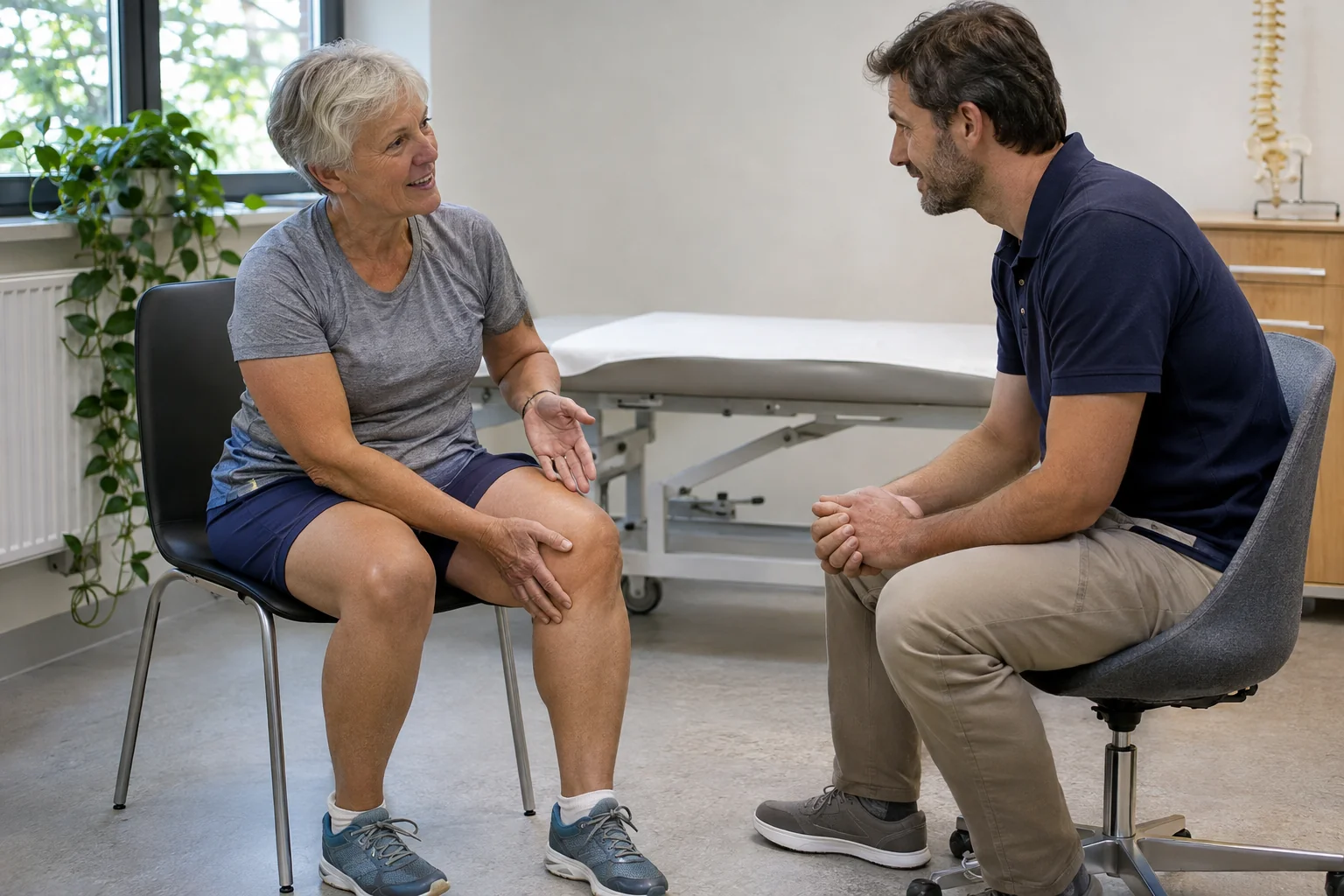
Clarify with the doctor how the identified finding relates to today’s symptoms and whether another possibility remains to investigate. “There is some arthritis” is useful when you understand its meaning for your function and care. One image need not predict your entire sporting future, and an old favourable report should not lead you to dismiss current change.
 Enlarge image
Decisions about movement follow clarification of the situation
A diagnosis does not mean the same movement type or restriction for everyone. The NICE guideline recommends individually tailored therapeutic exercise for osteoarthritis. This is neither automatic running clearance for an ankle symptom not yet assessed nor a general instruction to give up movement permanently. An appropriate task connects with current condition, everyday needs and goals.
If modified loading is recommended, ask what it means practically. How can each task change, is help or equipment needed and how will you monitor change? “Move less” alone is hard to use for someone whose work involves standing or whose home is reached by stairs. The plan must connect with real life rather than merely look good in a running calendar.
Consider the possible role of new shoes, an ankle support or an insole individually too. Not every old fracture requires the same device, and a device does not answer the cause of symptoms. If recommended, clarify its purpose and how you will judge whether it helps. Product selection can form part of care rather than being a prerequisite for assessment.
Meaningful follow-up connects with tasks that matter to you
Choose functional goals with the clinician that matter in your day. These could include more predictable travel to work, your usual walk or a sporting task discussed later. They are goals directing assessment rather than home loading tests. Success is not measurable only in faster pace; handling usual activities more easily is meaningful change too.
Until the next appointment, be clear which changes to report and how to seek help if the agreed solution does not work. NICE also emphasises reviewing personal needs and difficulties with the agreed plan in follow-up. A new sudden symptom alongside an existing diagnosis is not necessarily the same matter as slowly changing everyday function; preserve this distinction.
Recalling an old ankle fracture helps when it does not close today’s question in advance. The history is information, while current exercise tolerance is a present experience. Individual examination, understandable explanation and a feasible plan connect them. Sporting goals can then be discussed according to the current condition rather than becoming an automatic prohibition arising from an earlier injury.
Sources
- AAOS OrthoInfo: foot and ankle arthritis, post-traumatic changes
- NIAMS: sports-injury assessment and rehabilitation, 2024
- NHS: osteoarthritis, symptoms and variable progression
- NICE NG226: management linked to symptoms and function, imaging and follow-up
- NHS: ankle pain and signs requiring urgent assessment
How Futószív articles are prepared: our editorial guidelines.