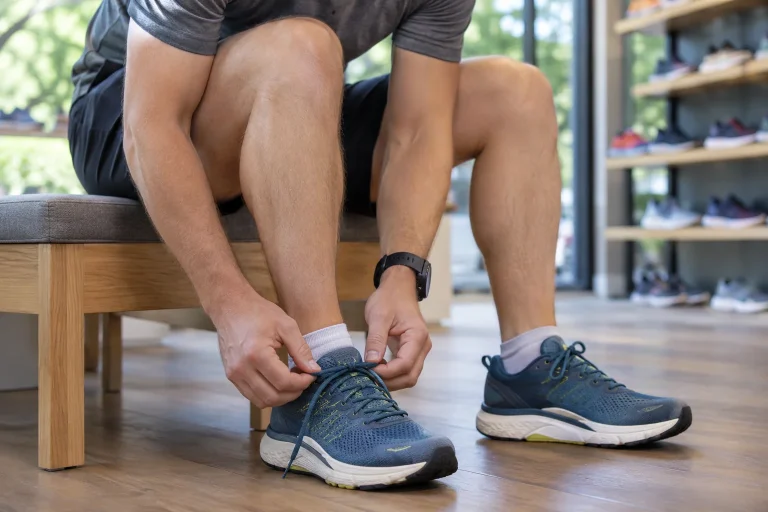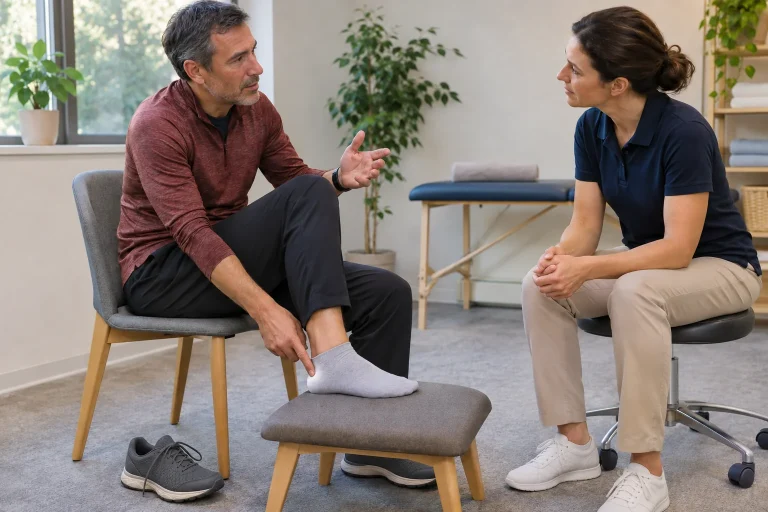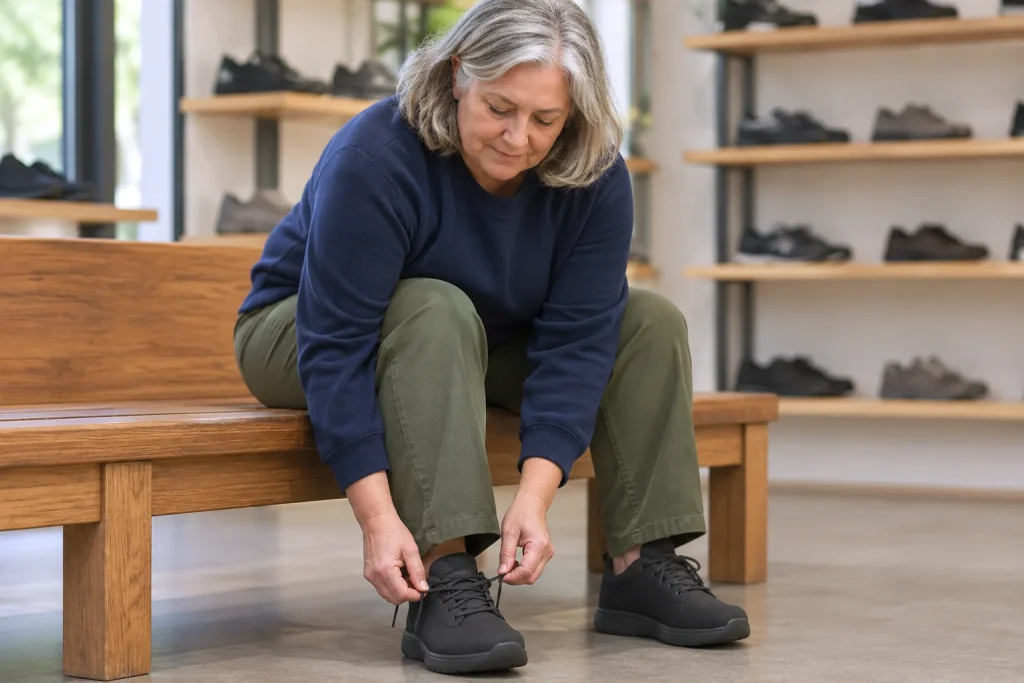
You bought the same running shoe again because it worked before, but now it presses at the base of your big toe. Shoe fit does matter with a bunion, yet not every discomfort is the same. Rubbing from the upper, pressure on the bony prominence and pain when the joint moves are different experiences. Describe them separately before assigning the solution to a product or a single size.
If your foot has newly become hot, swollen and severely painful, you cannot walk, its shape changed after an injury, or fever, chills or feeling unwell accompany the symptoms, seek urgent medical help. The NHS lists these as specific warning signs. A previously known bunion does not automatically explain every sudden change; do not start investigating it by changing shoes.
A more comfortable shoe and a change in shape are different goals
The Royal College of Podiatry describes a bunion as a condition involving a change in the big toe’s direction and a bony prominence at the side. Appearance alone does not establish the extent of symptoms: a smaller change can be painful, while a larger one may be less troublesome. Your own symptoms and function are therefore a more useful starting point than comparing your foot’s shape with other people’s.
The NHS clearly separates easing symptoms from removing a bunion. More comfortable footwear may reduce troublesome pressure, but cannot promise to restore the bony alignment permanently. This does not make improved comfort worthless. It simply means that walking more easily in a shoe is a different outcome from changing the underlying deformity.
Clarify this for yourself before buying. Are you looking for a shoe to make an uncomfortable situation easier, or hoping it will change your foot’s shape back? For the first goal, fit and your own use can be discussed meaningfully. For the second, a shop’s promise is insufficient. A “made for bunions” label does not prove that a shoe can restore any person’s foot.
Pressure, rubbing and pain with movement
Pressure can often be described as the shoe bearing on a particular point of the foot. With rubbing, movement between the surface and shoe is more noticeable. Symptoms associated with joint movement may occur at different times from material touching the skin. You do not need to turn these into a diagnosis at home, but distinguishing the three experiences enables a more precise conversation.
Describe what you feel when putting shoes on, during normal walking and after taking them off. If all you know is that it becomes uncomfortable after a while, that is useful information too. You do not need to produce pain with different movements or press hard on the prominence. Repeatedly seeking pain will not reliably establish the role of the skin, surrounding tissue or joint.
Socks, the shoe upper, lacing and any padding can also be included separately in the history. These are wearing conditions rather than automatic causes. Changing everything at once makes it harder to identify what accompanied an improvement or worsening in comfort. You do not need to try every possible home solution before receiving individual help.
 Enlarge image
The right length is not the whole fit
The AAOS emphasises footwear suited to the shape of the foot, adequate space and checking actual fit; the size printed on the label is not enough. Two shoes with the same size number can surround the forefoot differently. A bunion may make insufficient room at the widest part particularly noticeable.
Adding length therefore does not always resolve pressure at the side. A longer shoe may still have an unsuitable shape while allowing more movement elsewhere. This is not a general ban on changing size, but an explanation of why the number alone is insufficient. Shape, width and how the foot is held can all form part of the fit questions.
If you choose a previous model again, do not rely only on memory. Your experience of the old pair is useful, but your current foot and the actual feel of the new pair matter. It is acceptable for a previously comfortable shape no longer to work. This does not prove that you chose badly before, and loyalty to a brand is no reason to conceal current pressure.
Forefoot space and the rest of the shoe matter together
Even with a roomy toe box, the whole shoe needs to work. Fit around the heel and midfoot is a separate question from freedom in the forefoot. You do not need tight compression everywhere to create a “sporty” feeling. At the same time, abundant room alone does not establish that a shoe follows your own foot appropriately during normal walking.
The two feet may differ. The AAOS recommends accounting for the fit of both feet and cautions against buying shoes that are already tight in the hope they will stretch. This is not a home diagnosis measured in millimetres. It is a buying consideration that helps prevent discomfort noticed in the shop from being dismissed as compulsory breaking-in.
At a fitting, describe your usual use: the socks you wear, any individually recommended insole and the situations in which symptoms occur. Removing an aid or adding another can change the arrangement. You do not need to override previous professional advice independently in the shop. If an existing aid and a new shoe do not fit comfortably together, take that forward as a separate question to clarify.
| Fit question | What can you note from normal use? | What should you not expect? |
|---|---|---|
| Forefoot space | Where does the shoe press around the prominence or toes? | Extra room does not remove the bunion. |
| Material and surface | Where do you feel rubbing or uncomfortable contact? | Soft material does not resolve every joint symptom. |
| Holding the foot | How does your foot sit in the rest of the shoe? | Strong compression everywhere is not a virtue in itself. |
| An existing aid | What is the insole or pad for, and how does it change the space? | Stacking aids is not automatically better. |
A protective pad takes up space too
A soft pad may seem an obvious help: put something between the shoe and the sensitive spot. The AAOS also warns, however, that a pad’s bulk can increase pressure in a tight shoe. This illustrates why an aid cannot be evaluated in isolation. Foot, pad and shoe together create the actual wearing situation.
If a pad makes the shoe more uncomfortable, do not regard that as compulsory adaptation. Discuss its purpose and use, particularly if it was introduced for persistent or recurring symptoms. This article does not select a pad size or provide taping instructions. The relationship to understand is that more soft layers do not automatically mean less pressure within the space available.
A toe separator or night splint is a different aid from a pad intended to reduce rubbing. According to the AAOS, permanent bunion correction from splints has not been established. A straighter position shown in a product photograph must therefore not be read as a ready-made promise of recovery. If something is personally recommended, clarify its symptom-related purpose and limits too.
Follow real use as well as appearance
You do not need to photograph the bunion daily to evaluate a shoe change. It may matter more where discomfort occurs during normal walking, what has become easier and what remains unchanged. Shape in a photograph and comfort are different measures. Useful symptom improvement can occur without a change in shape, while a more flattering photograph does not establish that the symptoms have resolved.
Do not treat the first minutes of a run as the only feedback. Wearing shoes at work, everyday travel and difficulty developing by the end of the day may also be part of the history. This is not an instruction to arrange a long test day. Keep experiences already known from normal life without organising the day specifically to produce pain.
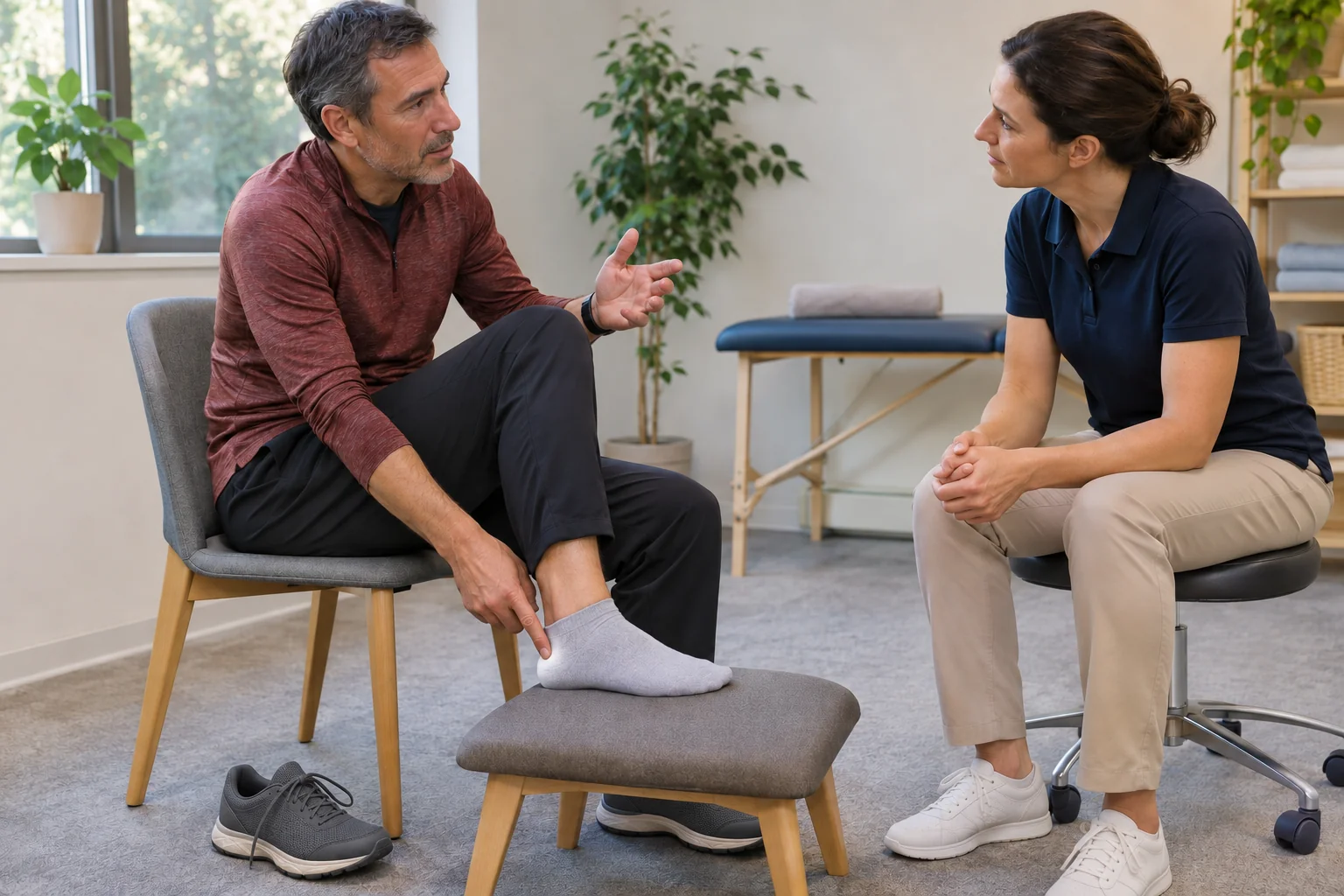
If you cannot currently manage a task comfortably, describe it concretely. “By the end of the shopping trip I have to take my shoe off” provides different information from “it’s not perfect”. A personal goal can be specific too: travelling more comfortably, completing necessary work tasks or returning to sport later. The same single goal need not be prescribed for everyone.
 Enlarge image
When is shopping advice insufficient?
The NHS recommends healthcare help for bunion symptoms that interfere with life, do not settle or worsen; feet require particular attention with diabetes. If the problem is more than discomfort from a particular upper, a shoe shop cannot replace an individual assessment. You do not need to buy every available model first.
Previous attempts also belong in the history of recurring pain. Which shoes became uncomfortable, what changed in another pair, and what professional advice did you receive? Something failing to help does not invalidate your symptoms. It provides information for the next plan. At an assessment, you do not need to prove a successful purchase or a disciplined series of self-treatments.
Describe the nature of new pain even if your foot has looked similar for years. An old change in shape does not exclude another cause, and new symptoms need not be forced into the bunion’s history. Onset and accompanying symptoms may matter. Urgent signs call for prompt care, while persistent difficulty calls for workable individual follow-up.
The question of surgery does not follow from one shoe failing
The NHS links consideration of surgery to significant pain and difficulties affecting everyday life; the operation is not simply intended to improve appearance. One uncomfortable shoe therefore does not mean surgery is already necessary. Options need to be compared using symptoms, function, history and an individual examination.
If a procedure is considered, its purpose, expected benefits, risks and recovery involve individual questions. A general shop conversation or discussion among runners cannot decide these for you. While seeking more comfortable shoes and understanding medical options, nobody needs to promise immediate correction or running at all costs. Your circumstances and preferences also form part of the decision.
With a bunion, a good footwear choice can show its value in real comfort and usefulness. It need not claim more. Distinguishing symptoms from structural change helps identify what footwear can address and where another kind of help is needed. A practical choice then avoids becoming a false promise of restoration, and persistent symptoms do not get lost among repeated purchases.
Sources
- NHS: bunions, symptom relief and care
- NHS: pain in the ball of the foot and urgent warning signs
- AAOS: bunions and shoe-fit considerations
- Royal College of Podiatry: hallux valgus and variation in symptoms
How Futószív articles are prepared: our editorial guidelines.