
A running weekend in Hungary rarely costs only the entry fee. Getting there, local journeys, accommodation, decisions about luggage handling and shared activities together determine the amount you actually commit to. Budgeting therefore does not mean choosing the cheapest of everything. The aim is knowing beforehand what you agree to and what changes if a weekend condition shifts.
This guide presents a simple original planning method. Sources for operator examples were checked on 18 November 2026. Every amount in the calculation table is fictional and illustrates only the method; none is an accommodation, ticket or race-price offer. For your decision, collect information valid for your own travel date and participation.
First define the weekend’s boundaries
A one-day race, an overnight trip and a multiday programme combined with family sightseeing need different budgets. State when you leave and return, who participates, who runs and what belongs to the shared commitment. Otherwise one person may understand the shared budget as race day and another as the entire long weekend.
Separate items necessary because of the event from activities added by choice. Both can belong in the budget, but their roles differ. Accommodation the evening before, needed for pre-start collection, is a different decision from an extra leisure day. Separating them helps if you later want to simplify the trip.
Then set your own manageable limit. No amount or percentage fits everyone. The running weekend fits into your life and that of anyone travelling with you. If the plan fits only by leaving several important items blank, the total is not ready to support a decision. An unknown cost is not zero forints.
Six cost groups keep the sheet clear
Under entry, include mandatory fees for your race and extras actually chosen. Travel includes the complete outward and return chain, including local connections. For accommodation, examine the full amount of your booking. Estimate meals and daily necessities from your actual programme. Separate activities and flexibility retained for changes should each have their own line.
Do not make the system more complicated than necessary. Entering one item twice distorts the total; if it belongs clearly nowhere, it can easily disappear. A short comments column helps: total shared-car cost, allocated later or my local ticket, for example. This preserves the amount’s meaning as well as its number.
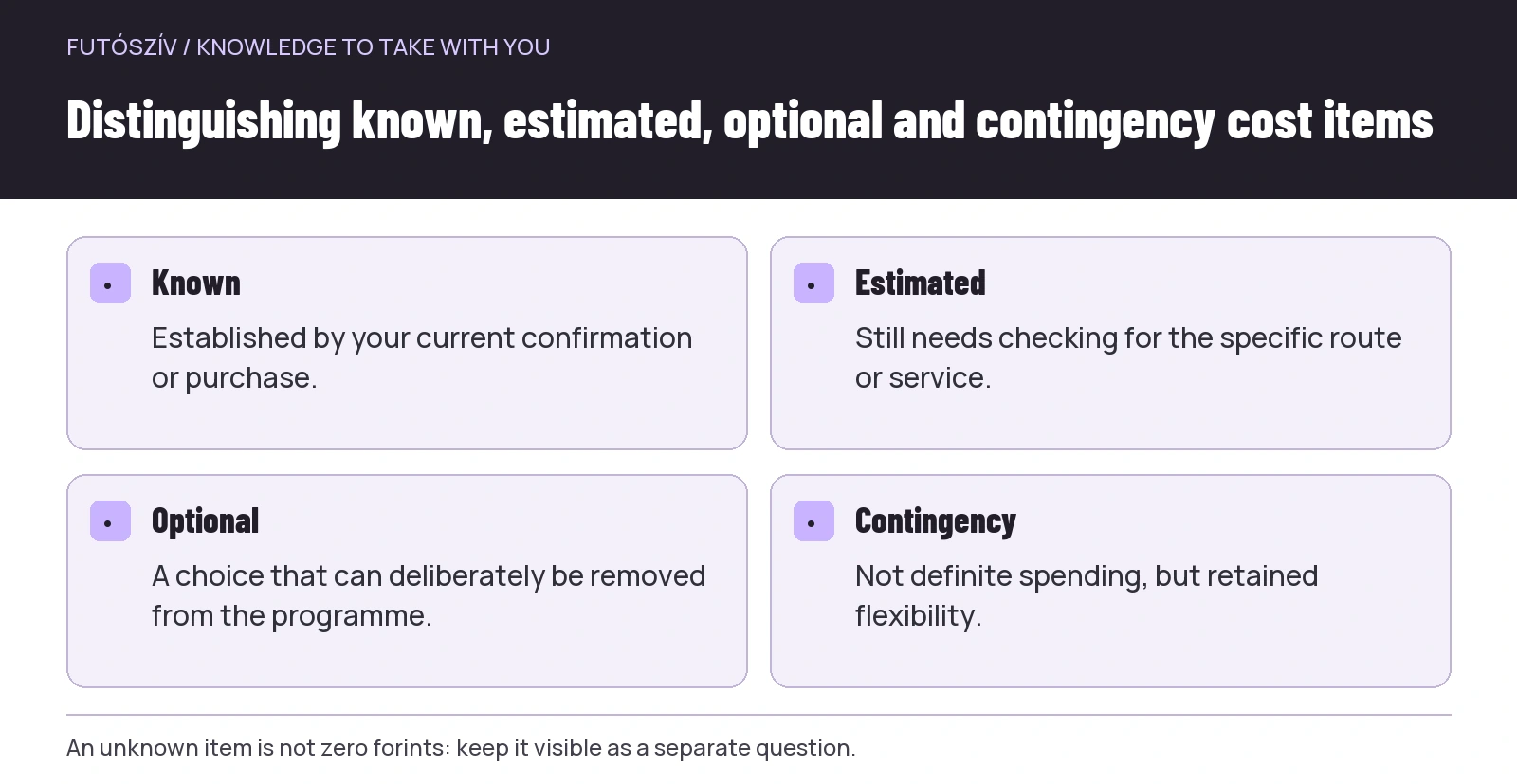
Give every line a status. A confirmed amount rests on your current confirmation or purchased product. An estimate remains a figure to check. A chosen but non-compulsory item may be omitted. Marking these separately shows how much of the total is known and how much depends on later decisions.
Entry prices have dates and inclusions too
The fee table in the Debrecen Marathon 2027 regulations gives amounts tied to periods. For planning, this means the price seen now may not be your later payment price. Use your own distance and the current fee band, not the lowest number in the table.
Check what the fee includes and which extras are separately optional. If an event offers several package versions, compare only the product actually selected with another race. A difference between basic entry and a gift-enhanced package price does not itself describe event quality. Decide what you need according to your priorities.
Keep the payment deadline separate from the race date. The trip may be months away while an entry item must be paid earlier. A budget is therefore a timing plan too: it shows not just the total commitment but when payments are needed. This is particularly important for shared team entry if one person advances others’ shares.
 Enlarge diagram
Text version of the diagram
- Known
- Established by your current confirmation or purchase.
- Estimated
- Still needs checking for the specific route or service.
- Optional
- A choice that can deliberately be removed from the programme.
- Contingency
- Not definite spending, but retained flexibility.
Calculate travel for the entire route
Alongside a train or bus ticket may come local transport, required seat reservations or another verified connection. The MÁV fares information provides a starting point for different products and concessions. Use your own eligibility and actual route in the budget; do not copy another passenger’s discounted price.
For a car journey, clarify shared travel items and allocation. Every trip with friends need not use the same accounting, but the agreement should be made beforehand and be understandable. Sharing only certain direct expenses produces a different result from treating further items as shared. Do not discover after travelling home that people meant different things by the per-person amount.
Assess parking, possible road-use charges and changes from local diversions solely for your route. The existence of a nationally familiar product does not establish that you already have it or need that one. Learn conditions for the specific vehicle and route. This article gives no general driving tariff.
The nightly accommodation price is not yet your full amount
Check dates, participant numbers, room and included services together when booking. Apparently equal nightly rates may conceal different conditions. Record your full amount and any separately payable items from the confirmation. If unsure whether a cost is included, retain it as a question rather than letting it disappear from the total.
An early race departure or later departure from accommodation may affect services used. Bag storage may suffice, or a separate arrangement may be necessary. Do not enter an imagined convenient late checkout as free until confirmed for your booking. Equally, do not automatically add a surcharge for which you have no information.
With several participants, nights and actual presence matter. If someone joins only on the second day, agree allocation beforehand. Equal division can be a good agreement, but need not become an unnoticed default in every differing situation. The full shared booking amount and one person’s share are separate information.
A fictional cost sheet for one person
The following numbers are invented examples and represent no current race or service offer. The table shows how to separate confirmed items, estimates and optional choices. In the example, contingency belongs to the spending plan but is not money that must be spent.
| Item | Fictional amount | Status in the example |
|---|---|---|
| Entry | HUF 12,000 | Known from personal confirmation. |
| Intercity return journey | HUF 8,000 | Checked for the chosen journey. |
| Local journeys | HUF 3,000 | Still an estimate linked to the route. |
| Personal accommodation share | HUF 22,000 | Known from the booking. |
| Meals and daily necessities | HUF 10,000 | Estimate from the personal programme. |
| Separate leisure activity | HUF 5,000 | Optional choice. |
| Contingency for changes | HUF 7,000 | Not definite spending. |
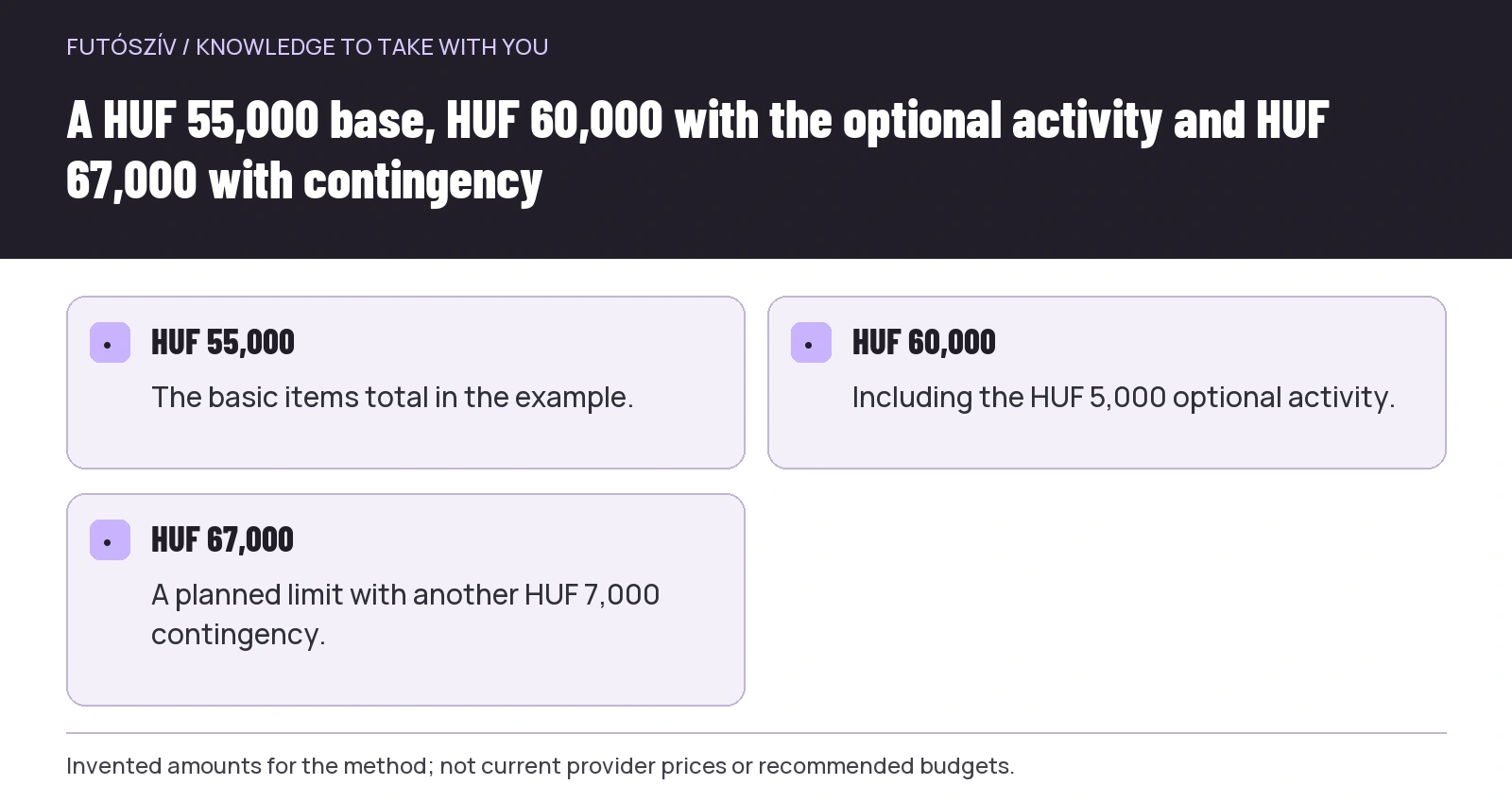
In the example, basic costs without the optional activity or contingency total HUF 55,000. Including the optional choice gives HUF 60,000; the full planned limit with contingency is HUF 67,000. These are three separately useful numbers. Calling them all one final total makes it harder later to understand where simplification is possible and which amount has actually been paid.
If the personal manageable limit is lower, the plan needs changing. The example’s optional activity can be omitted, but that does not verify the unknown part of local travel. You can seek another accommodation or travel option or another weekend format. Do not erase the difference simply by unjustifiably lowering estimates.
Do not count an included service twice
If entry genuinely includes something you would otherwise buy separately, you can account for it in comparison. First understand precisely what is included and how it can be used. A post-finish service available at a particular time does not necessarily replace similar needs throughout the weekend.
The same applies to accommodation. If your booking includes a meal, do not add the same unchanged item again to daily spending. If service timing prevents use, however, resolve that practical situation. Package value and actual personal use do not always coincide.
Avoid double-counting shared costs too. If the car’s full cost already appears on the group sheet, enter only shares on individual sheets, not further full amounts. Mixing group and individual views can easily produce unrealistically large or small results. The comments column should always clarify which level you are viewing.
 Enlarge diagram
Text version of the diagram
- HUF 55,000
- The basic items total in the example.
- HUF 60,000
- Including the HUF 5,000 optional activity.
- HUF 67,000
- A planned limit with another HUF 7,000 contingency.
Flexibility can have value too
Two apparently equally priced options may differ in how and until when they can be changed. The MÁV exchange and refund information also shows that product and purchase method matter. Instead of a general refundable comment, find your choice’s specific condition on the cost sheet.
For accommodation and entry, likewise read your own contractual or participation rules. Once a deadline passes, the committed amount may have a different status. Add a change deadline to the planning sheet where one exists. This does not mean every choice must allow cancellation; it means knowing when each decision becomes more binding.
Money already paid is no reason to automatically add further expenses no longer manageable for you. If the programme changes, examine the new decision alongside costs still ahead. Separate what has already happened, what can be handled under known conditions and what you choose now. This prevents an old decision hiding new options.
For shared travel, agree first and transfer money afterwards
Agree who books, who pays in advance and when others settle their shares. If one person collects money, clarify the item and amount. A large round figure in a group message without explanation can easily cause misunderstanding. Short parallel lines can show what is shared and what is personal.
Agree what happens with changes too. What if someone does not come, requests another night or chooses a separate journey home? Do not automatically promise refunds for amounts you can no longer recover under provider terms. Equally, do not treat a genuinely avoided, unpaid cost as definitely incurred. Settle according to your agreement and actual items.
Preserve choice in social activities. If a more expensive shared dinner or extra paid activity is unaffordable for someone, they should not have to give up the whole running weekend. A budget can support inclusion when optional items remain genuinely optional rather than everyone receiving the same payment expectation afterwards.
When simplifying, compare connections too
Cheaper accommodation may require more local journeys, while a seemingly dearer travel option may replace another necessary cost. Compare two versions over the whole weekend. Nightly price, ticket or entry fee alone does not always reveal your full cost. Associated time and access also affect manageability.
Do not automatically treat every money-saving idea as good. If a version works only through an uncertain lift or unconfirmed service, the smaller number is not yet a complete offer. Verify feasibility first, then compare price. A simpler programme fitting your limit is often a clearer decision than a weekend cheap on paper but dependent on many hidden conditions.
A budget is ready when it can be updated
End the sheet with the known total, still-estimated portion, optional choices and retained contingency. Add the next payment or modification deadlines. If an item changes, do not merely enter a new number: review its status and effect on shared settlement too.
After the weekend, learn from differences. What was omitted from planning, which estimate worked, and which shared item’s meaning needed clearer agreement? Every small purchase need not become an evaluation. Useful observations for the next trip enable better decisions or clearer agreements. A well-maintained running-weekend budget makes your own choices visible.
How Futószív articles are prepared: our editorial guidelines.