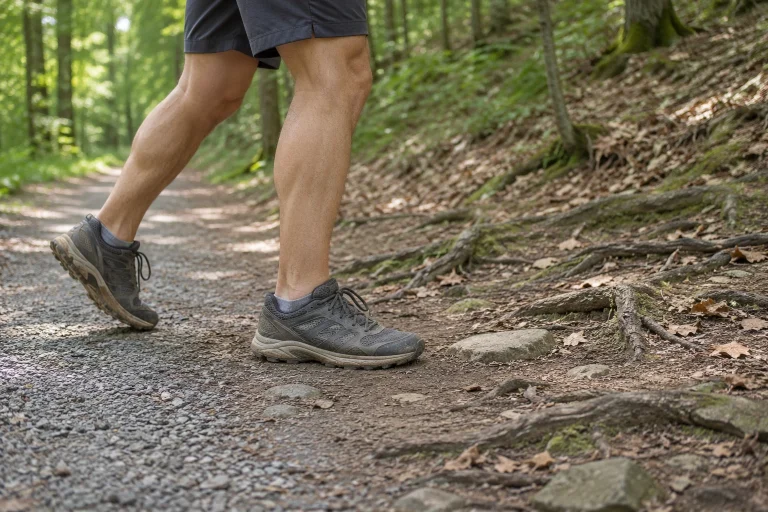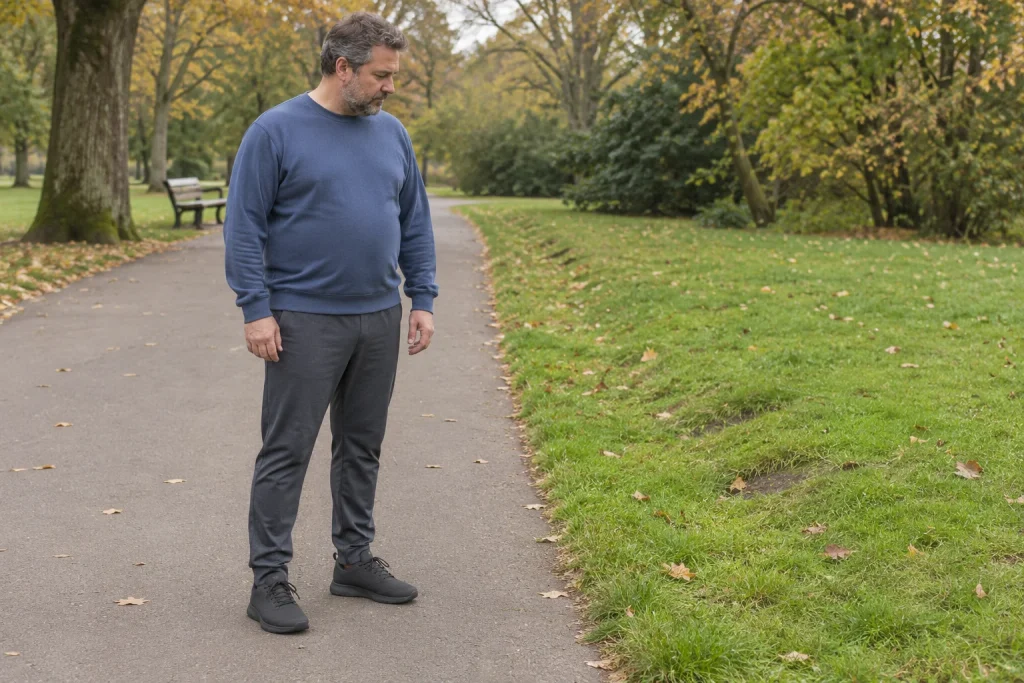
Your knee hurts, so you decide to run along the park’s grassy edge instead of asphalt. The thought is understandable: something softer seems likely to mean less load. But a surface has more than one property. It may be soft and uneven, firm and level, clearly visible or concealed by vegetation. A decision suited to joint symptoms needs more than changing the material’s name on a map.
For severe pain, substantial swelling, deformity or inability to bear weight after a new injury, seek medical assessment. Moving to another surface does not turn continued painful running into personalised treatment. The NIAMS information on sports injuries treats symptom assessment and condition-appropriate rehabilitation as separate tasks. Surface choice may relate to them, not replace them.
Softness, evenness and grip are separate considerations
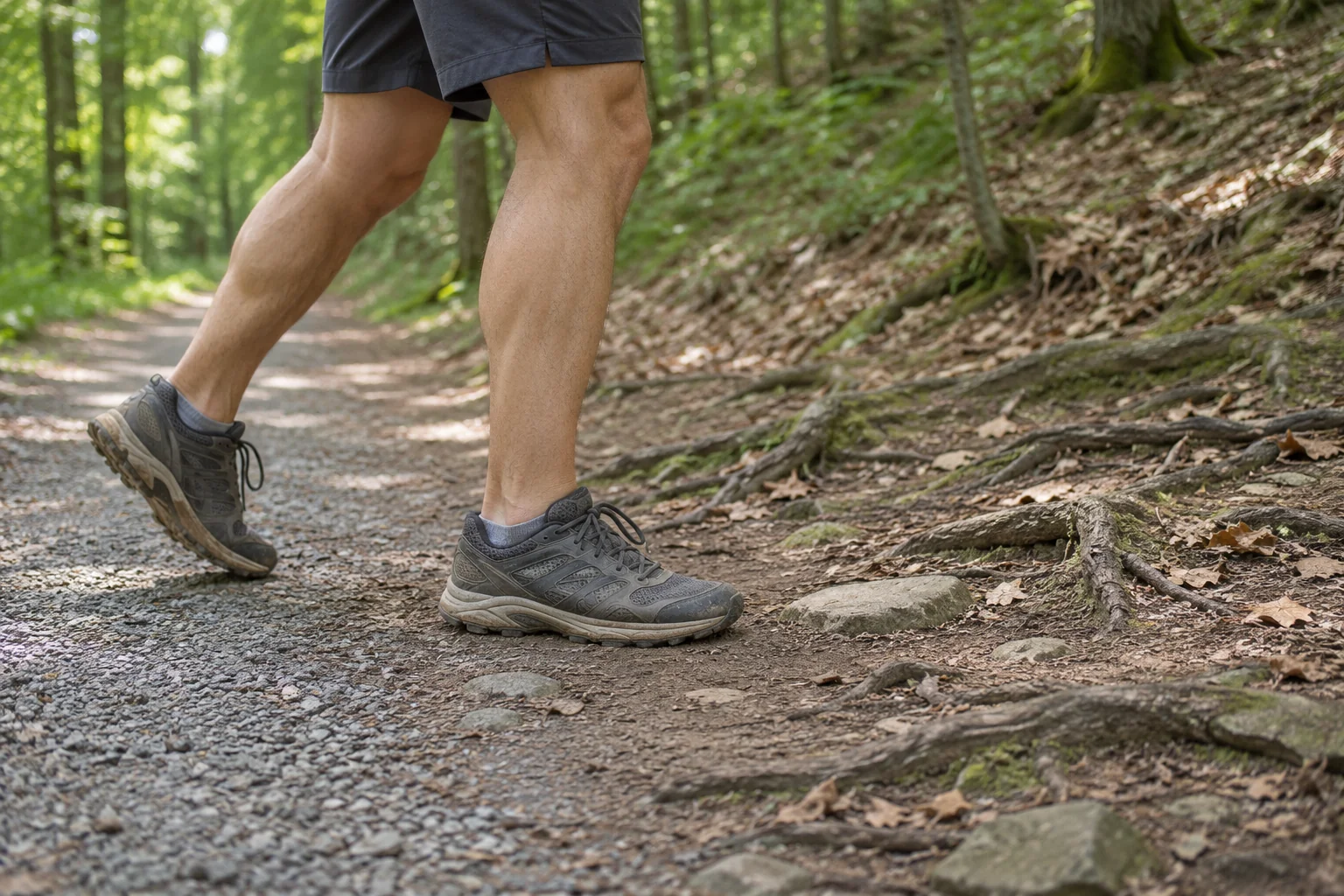
Softness describes a sensation or mechanical property of how the surface responds to load. Evenness concerns holes, stones, roots or sudden level changes. Grip concerns the practical relationship between shoe and ground. None automatically establishes the others: soft turf can be slippery, a firm path uneven and an attractive-looking surface can hide a problem.
Describe these separately when viewing a route. Instead of ‘good terrain’, say a wide, mostly level trail or a narrow root-covered section. ‘Grass’ can mean maintained sports turf, a worn park margin or tall vegetation. An identical label does not make an identical task. Experience provides useful information when it describes the actual place.
Visibility is a separate practical issue. Not seeing your footing makes a level change or obstacle harder to anticipate. You need not convert that into an injury percentage to include it in planning. A familiar clear route differs from a grassy strip sought under leaves in darkness in more ways than hardness.
The runner’s body also contributes to the surface response
The ground is not a passive label revealing every joint load directly. Movement circumstances and the runner’s steps matter too. In an original 2023 laboratory study, thirty healthy men who habitually landed on their heels ran on artificial grass, rubber and concrete. Researchers compared several movement and force measures separately rather than giving one ‘joint-friendly’ score.
Not every measure changed alike: for example, vertical ground-reaction force and its loading rate did not differ statistically between surfaces, while some joint moments differed. This concerns that sample and laboratory situation. It establishes neither universal benefit nor harm from concrete and was not long-term injury follow-up on naturally uneven park grass.
The lesson concerns interpretation. A measurement should not be shared as though it identifies a safe material for every runner with painful knees. Laboratory biomechanics helps explain what can change but does not replace assessment of an individual’s symptoms. Softer sensation, a measured force variable and later injury frequency are different claims.
Ankle history matters in a route chosen for the knee
If you previously sprained an ankle, regularly feel instability or struggle with uneven ground, mention it when considering a surface change. The 2021 ankle guideline separately addresses first lateral-ligament injury and chronic ankle instability. Resolution of the original symptoms and later persistent instability are not necessarily the same question.
This does not mean everyone with a previous ankle injury is forbidden from walking or running on grass. It means knee considerations should not be isolated from other history. Surface predictability and an agreed rehabilitation goal may matter in individual route advice. An internet article should not decide your entire musculoskeletal situation from one property.
Be specific: perhaps you repeatedly stopped on a root-covered section or a sloping grassy edge felt different from level ground. These are observations. Do not turn them into a self-made instability diagnosis or provoke the uncertainty again to strengthen the story. A professional can assess experience that has already occurred.
 Enlarge image
Asphalt and grass each come in many forms
A sound level footpath and a broken pavement can belong to the same broad surface category without being the same environment. Similarly, short, clearly visible grass and a strip marked by wheel ruts and molehills are not interchangeable because both are green. Observing the route can reveal more about the task than its general material label.
Include transitions between sections. A kerb, narrow edge, waterlogged entrance or sudden slope may lie where you step off the firm path. There is no need to test these while running if they already look unsuitable. Planning includes whether the route is accessible within your individually advised activity.
Other park users matter too. Grass may be a resting area, sports space or a section where free access is not permitted. Respect signs and rules. This article does not name unverified runnable courses; choosing a place and matching movement to your health require separate checks.
Weather changes the same place
Ground that looked dry and orderly yesterday may be waterlogged, covered in wet leaves or frozen today. A surface name does not fix daily conditions. Do not rely only on an earlier memory. Check the entry point and actual state, retaining the option to rearrange if surroundings no longer fit the agreed plan.
Light matters too. Grass accessible only after dark differs from a lit firm path. Do not disregard visibility for softness. A lamp does not automatically make every uneven area appropriate either. Assess several features together rather than expecting one item of equipment to erase every limit.
A new shoe or tread pattern is another circumstance. If changing footwear alongside surface, mention it separately in feedback. Do not immediately attribute every improvement or worsening solely to the ground. Everyday experience is not controlled research, but can be accurately described without choosing one cause.
Changing route because of symptoms is not the same as treatment
If running repeatedly causes pain, changing surface may offer hope of avoiding consultation. But a new location does not identify the cause. The NIAMS overview distinguishes acute and repetitive-load injuries and mentions several risk circumstances. Changing one environmental factor does not assess the rest.
Tell a professional more than ‘grass feels better’. Explain other differences: was the outing shorter, did you stop more often, move at another pace and what happened to daily function afterwards? These do not deny a possible surface role. They prevent reducing a multi-component situation to one word.
A less unpleasant route is not automatic permission to increase load. Relate environmental changes to any personal rehabilitation or activity plan. The aim should not be completing the same painful amount at all costs somewhere new. A meaningful adjustment belongs alongside following symptoms and function.
A route description you can actually discuss
A useful description can be short: material, evenness, slope or camber, daily condition and access. ‘I run in a park’ is less precise than a level paved loop with a narrow grassy edge of varying height. No engineering survey is needed, only the real context of your choice.
| Consideration | Observation question |
|---|---|
| Evenness | Are holes, roots, edges or sudden level changes visible? |
| Daily state | Is the section dry, waterlogged, leaf-covered or frozen? |
| Visibility | Can you see the next section, and is lighting adequate? |
| Personal history | Which earlier symptom or functional difficulty matters to the choice? |
| Programme | How does the route relate to individually agreed activity? |
This table does not score medical safety. It helps you see several factors together. If a section is unsuitable, the decision is not restricted to a forced switch between asphalt and grass. Discuss timing, another location or another version of agreed activity; every day need not be solved with the same movement.
 Enlarge image
Getting there and home matters too
A suitable-looking short section may require long walking, stairs or a difficult crossing. Leaving that out means a ‘joint-friendly place’ describes only the middle of the outing. Include the complete journey, particularly when getting around is currently limited. Do not assume everything at the finish will work exactly as it did at the start.
Learning about unfamiliar terrain beforehand can reduce practical uncertainty but is not a medical trial. A photograph or description may help explain a route. If your condition makes reconnaissance inadvisable, you need not walk it to provide better data. Adapt the way you assess surroundings to real possibilities too.
Agree with companions that completing the group’s usual route at all costs is not the programme. You do not need a scientific surface ranking to justify another place or arrangement. Your condition and agreed plan are enough reason not to be drawn into an unsuitable situation now.
The question is not which material heals a joint
At the next discussion, ask: ‘With my current symptoms and ankle history, which surroundings fit the agreed activity, and which route feature should I avoid or report separately?’ This includes the whole condition and actual task alongside material. The answer may be a combination of conditions rather than one surface.
Keep a more comfortable feeling as personal experience without generalising to every runner. Another person’s history, shoes, movement and route may differ. ‘I prefer grass’ is more precise than saying grass protects every joint. Keep the difference between preference and a health claim visible.
Surface choice helps when it does not elevate one feature over all the rest. Put evenness, grip, visibility and personal condition beside softness. If symptoms prompted the change, the real question remains how the route fits the assessed problem and jointly developed activity plan.
Sources
- NIAMS: types and circumstances of sports injuries
- NIAMS: assessment and rehabilitation
- Martin and colleagues: ankle instability and lateral-ligament injury, 2021 guideline
- Zhou and colleagues, 2023: laboratory biomechanical comparison of different surfaces
How Futószív articles are prepared: our editorial guidelines.