A half-marathon plan can easily become a list of twenty-one separate kilometre paces. That looks precise, but the course, starting crowd and conditions on the day do not always fit such rigid rows. Dividing the distance into sections lets you assign each part a specific task and checking question. Numbers then help interpret your plan rather than becoming instructions overriding every other consideration.
Sectioning does not bypass individual preparation or a target time. First you need a commitment suited to your circumstances, with appropriate professional help where necessary. The approach presented here supports organising a personal race plan. It prescribes no universal pace and does not guarantee that a particular division makes everyone finish faster or more easily.
Name the section’s role before its boundary
First ask what you want to handle deliberately in that part. Settling after the start, following your plan, managing an aid station or reviewing the remaining task may call for different attention. You can then choose its boundary on the route. The same task need not attach to the same kilometre at every event.
If the course begins with a narrow section, settling in may feel longer. A significant bridge or climb later may provide a section boundary of its own. The aim is a few recognisable decision points. An excessively detailed division can create as much attentional burden as checking every kilometre separately.
In the London Marathon Events Big Half course guide a pacer connects experience with particular route locations. The usable planning principle is that distinctive course sections can provide recognisable tasks. The specific London details cannot, of course, be copied to a Hungarian event.
Four roles for a personal division
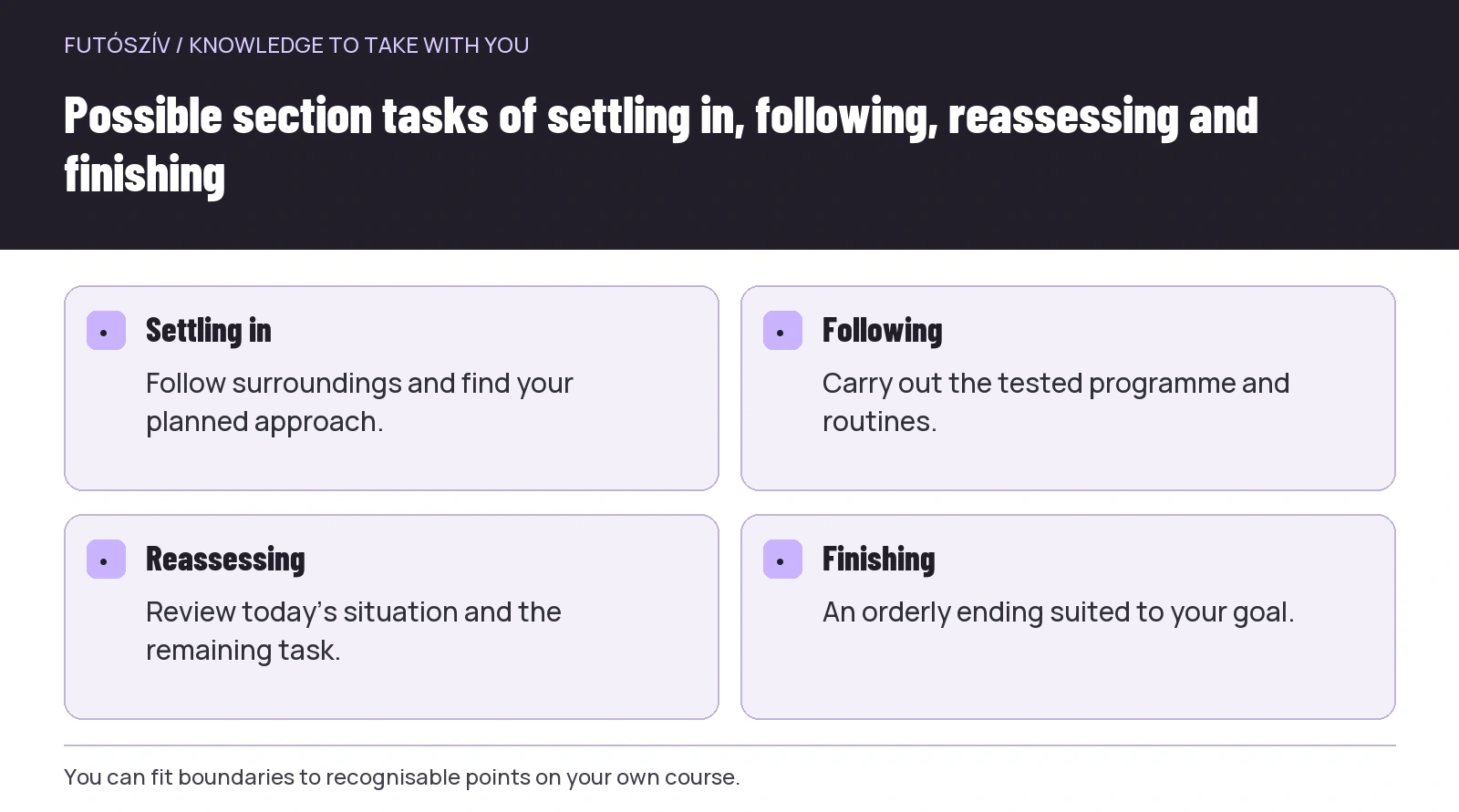
Settling in. The task is to follow the post-start environment and find your own intended progress. Not every nearby runner starts at your rhythm. Knowing the zone, narrow sections and bends helps you imagine this part. Its actual length depends on the particular route and situation.
Following. In this part, focus on carrying out your plan and necessary routines. Fuelling and other personal tasks should use tested approaches. The section need not be spectacular; simple, manageable execution may be precisely its value. A few understood values may be enough for checking.
Reassessing. At a preselected point, examine how the programme has gone and what remains. The task is not automatically to accelerate. You may retain the plan, adjust it or make another decision if necessary. The current situation matters more than a rigid promise made before starting.
Finishing. Focus on managing the remaining section and arrival at the finish. Finish-area arrangements, shared progress with others and your own situation still matter. A spectacular sprint is not compulsory to define the day’s value. An orderly ending suited to your goal is a complete task too.
 Enlarge diagram
Text version of the illustration
- Settling in
- Follow surroundings and find your planned approach.
- Following
- Carry out the tested programme and routines.
- Reassessing
- Review today’s situation and the remaining task.
- Finishing
- An orderly ending suited to your goal.
An illustrative route example
Imagine a half-marathon with a crowded city section near the start, then a longer straight and a bridge. The runner focuses on settling in until the first recognisable, calmer section. Through the longer middle part, they follow their original plan. At a clear point after the bridge, they reassess, then move to the finishing task as the finish approaches.
In this example, the specific kilometre number is not the constant. The boundary connects to a recognisable feature on the actual course. The runner knows beforehand where and what to ask themselves. This may reduce constant replanning in response to every display change while leaving attention available for current conditions.
| Role | Location in the example | Checking question |
|---|---|---|
| Settling in | End of the narrower section after the start | Have I found my intended approach? |
| Following | Longer, clear middle section | Am I following the tested routines? |
| Reassessing | Clearly identifiable point after the bridge | What next step fits today’s situation? |
| Finishing | Final familiar section towards the finish | What does an orderly finish require? |
The table is neither a specific race recommendation nor a suitable scheme for every course. Use the official map and current information for your route. Without distinctive landmarks, a few clear distance markers may provide boundaries too. Recognisability matters more than creative names.
Develop your own goal from the whole preparation
The section plan does not replace prior training or a realistic commitment. The official Boston Half training page also emphasises selecting a programme suited to experience and goals. Here we use only that general consideration, without copying or adapting its specific training plans. Your personal programme relates to your own circumstances.
Preparing for a first half-marathon may call for a different goal from one after several completions. The plan should reflect this. You need not adopt other people’s splits as your obligation. The route, preparation and chosen completion approach together determine the basis for today’s programme.
If working with a coach, agree the sporting tasks for each section with them. These can appear on your sheet in short, understandable wording. Preserve the meaning of your agreement. A shortened sentence should not become a different, harder or more rigid expectation on the course.
Do not confuse pace and effort
The same pace number can feel like a different task under different route or weather conditions. Mark the more unusual parts on the course plan. Climbs, many turns, narrow sections and wind-exposed stretches are all environments a kilometre-by-kilometre table does not fully describe. Your personal sporting task needs to account for them too.
Interpret split data for the appropriate section. A slower, twisting part and the overall average so far may answer different questions. If the display shows an unexpected value, first examine what happened. Clarifying the measurement field and on-site situation is more precise than immediately accelerating at every numerical discrepancy.
A general article cannot determine your personal interpretation of effort or how to modify the programme. The aim is to use your own prepared framework clearly. If today’s situation requires another decision, leave room for adjustment. A section name is a reminder, not a compulsory order.
Give each part one short sentence
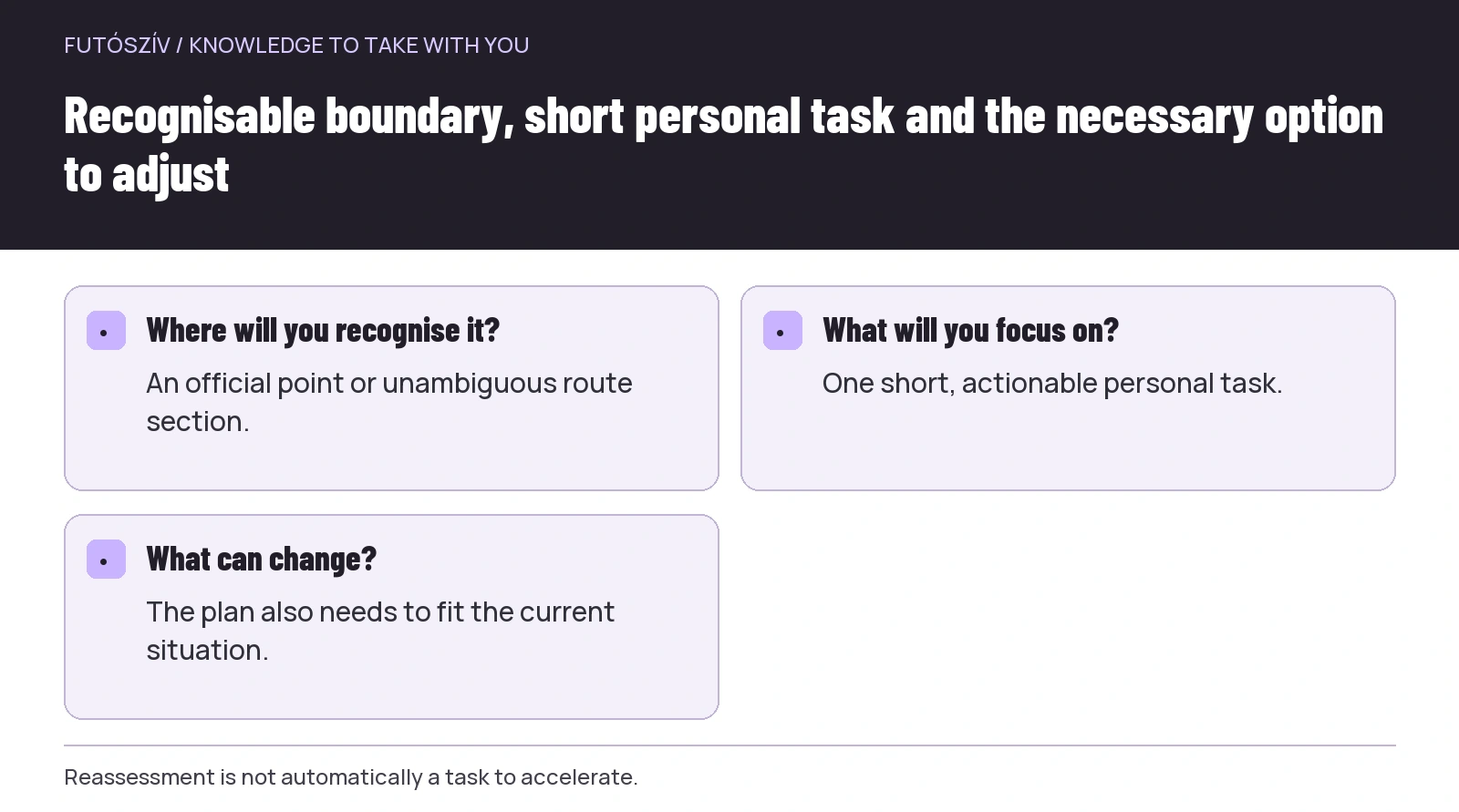
You can choose a simple action-focused sentence. “First I find space and my own rhythm.” “I follow the agreed programme.” “At this point I review the situation.” “I finish the section towards the line in an orderly way.” These are illustrative examples to adapt to your task.
The sentence should not demand a state you cannot guarantee through willpower alone. “I will definitely feel fresh” is not an actionable organisational task. “I check the route remaining to the next point” is specific. A useful reminder tells you where to direct attention.
If too many sentences enter the sheet, shorten it. You should not be reading a long essay on the course. A clear task, recognisable boundary and necessary data for each may suffice. Think through the detailed reason beforehand; the short reminder can guide you on location.
 Enlarge diagram
Text version of the illustration
- Where will you recognise it?
- An official point or unambiguous route section.
- What will you focus on?
- One short, actionable personal task.
- What can change?
- The plan also needs to fit the current situation.
Do not treat an aid station as a random interruption
Check station locations and organiser-published supplies on the course map. Compare these with your tested fuelling plan. Not every station needs a separate section name, but imagine the practical approach and departure. Personal requirements need appropriate separate clarification.
If running with a group or pacer, learn its procedure. Will there be slowing, walking or separation? Routines can differ despite identical target times. Your task and the group’s approach fit only when these details are understood. Following the flag does not replace understanding your own programme.
After the station, return to your next section, without hurriedly recovering every previous second. Stops may be part of total time. Your personal goal and interpretation of the official cut-off provide separate frameworks. Adapt the specific sporting decision to today’s circumstances.
Include adjustment points in the plan
One benefit of sections is preselecting a few places for review. You need not choose a new goal every hundred metres. At the point, examine your situation, surroundings and remaining task. If the plan still fits, continue; if change is needed, handle it deliberately.
Reassessment is not necessarily permission to speed up. It may mean slowing, another personal goal or following the procedure for ending participation. Health symptoms may require suitable help and a separate decision. The section plan neither forces continuation nor serves as a diagnostic tool.
Learn the race’s cut-offs and withdrawal procedure beforehand. This organisational framework also belongs to your sheet. If the programme ends differently, know whom to notify and how to travel onward. An orderly day has several possible outcomes beyond the originally imagined finish photograph.
Check recognisability during practice too
On an occasion fitting your preparation programme, try how a few section tasks work mentally. You need not repeat the entire race. The question is whether you remember the next task and understand the selected marker. Sporting details still need to be shaped independently around your situation.
If using a digital route, do not recognise important points only by a tiny mark on one device. Describe them in your own words too: designated point after the bridge, end of a longer loop or official kilometre marker. Always follow on-site changes and instructions. The saved plan can adapt to fresh conditions.
Simplify overly complicated section names. The purpose is not another memory task, but making the run manageable. A sentence easily recalled in your own voice may be more useful than a long motivational text. Its content should follow the decision made beforehand.
After finishing, review section tasks
Which boundary was easy to recognise? Where was there too much or too little information? Did you follow your task, or did the watch and others’ progress repeatedly draw attention away? These questions can be answered alongside the overall result. Choose one specific adjustment for next time.
You may need fewer sections, another recognisable point or a clearer distinction between your sporting task and an organiser condition. A plan develops when it follows actual experience. The half-marathon then becomes more than twenty-one separate numbers on a display: it becomes a few meaningful tasks for which you know your next step.
How Futószív articles are prepared: our editorial guidelines.