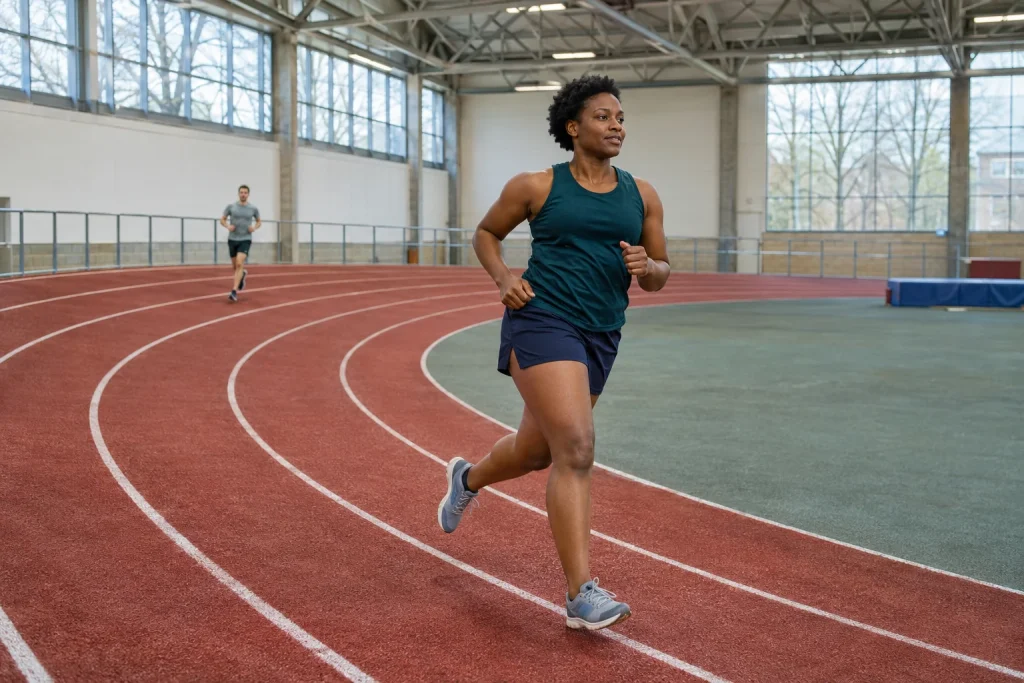
An indoor athletics track can provide predictable surroundings for winter running, but shorter laps, more frequent bends and shared space require particular attention. It is not simply a four-hundred-metre outdoor track with a roof. Before entering, learn the local usage rules and the track’s actual layout.
A good session here often depends on organisation: where you warm up, which lane you use, when you start and how you finish a fast section. Clarifying these may provide more calm than another precisely calculated split.
Indoor track and short track: related concepts
In its announcement introducing the term short track World Athletics described more flexible use of two-hundred-metre tracks, including arrangements outside traditional indoor halls. Short track and an indoor venue therefore do not mean the same thing in every context.
For a recreational runner, the practical question is which track you are visiting. How long is the lap, are the bends banked, and which lanes and separate practice areas exist? The hall’s name alone does not describe all on-site conditions.
For competition, current rules and organiser information matter. The official World Athletics rule collection is where to check international documents. Local training-use rules, however, must come from the facility.
Do not begin your first visit straight away with fast training
Arrive with time to orient yourself. Ask where to change, warm up, run easily and perform faster work. Lane allocation may vary between venues, and training in other disciplines may also determine the space available.
On the first laps, notice how the bend feels, visibility and the movement of other runners. Learning the track’s rhythm is easier at low speed. You need not choose the week’s most complex interval session for your first visit.
If attending with a coach or group, discuss local organisation alongside the technical task. Who signals, where do you wait and which route do you take back for the next start? Shared understanding reduces rushing.
A shorter lap means more bends for the same distance
On a two-hundred-metre measurement lap, the same distance requires twice as many laps as on a four-hundred-metre track. This is simple geometry, but can substantially shape the workout experience. You return to the same points more often and encounter bends more frequently.
Do not assign the lap length shown on the wall to every lane, however. The distance run in an outside lane and markings for officially measured distances may differ. Ask for local help interpreting start and finish markings if unfamiliar.
Not every indoor run needs to be an exact, official distance test. For an easy or moderate time-based task, safe lane use and appropriate effort may matter more than reconstructing distance to the metre.
Why is running a bend different?
On a bend, direction continuously changes, requiring different force production and movement organisation from a straight. Speed and bend radius both matter. A tighter curve at the same speed creates a different task from a wider one.
An original study in competitive sprinters compared flat bends of different radii with straight running. Maximum speed and leg-specific force characteristics changed with conditions. This was not a direct injury-risk measurement or a general pace correction for recreational runners.
The practical conclusion is to treat a bend as a movement situation of its own. If it is new, reduce speed and learn gradually. A pace achieved on an outdoor straight does not automatically qualify you for a tighter indoor curve.
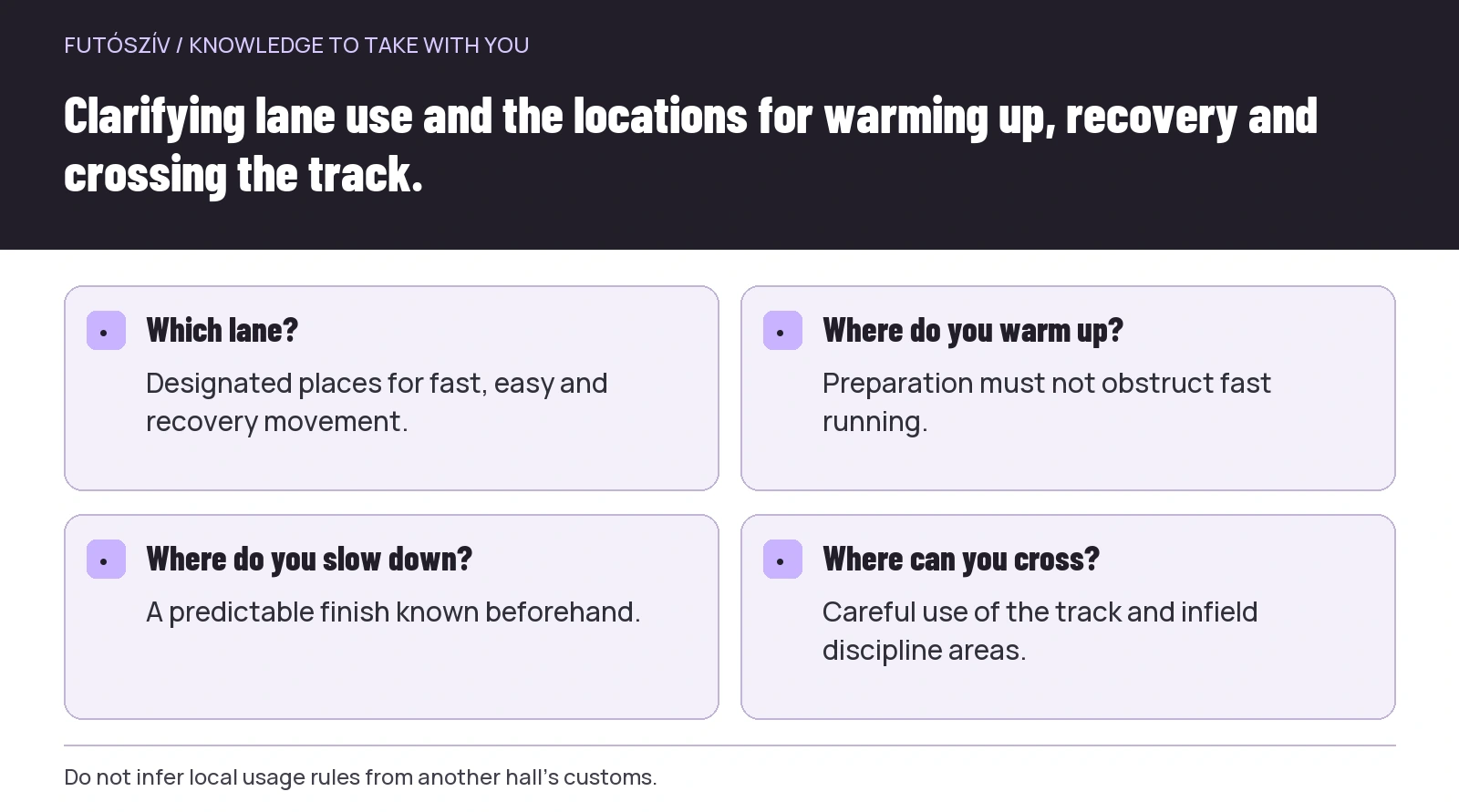 Enlarge diagram
Text version of the illustration
- Which lane?
- Designated places for fast, easy and recovery movement.
- Where do you warm up?
- Preparation must not obstruct fast running.
- Where do you slow down?
- A predictable finish known beforehand.
- Where can you cross?
- Careful use of the track and infield discipline areas.
The inside and outside legs may have different tasks
A study of athletes sprinting on bends and straights described different movement characteristics on the two sides. Asymmetry on a bend is therefore not automatically a general fault to correct; it may be part of the task.
The study involved a small number of high-level sprinters and a particular bend. It cannot prescribe the same leg position or lean angle to everyone. Do not try to solve the movement by precisely imitating a research illustration.
If a bend feels uncertain, simplifying the pace and task may be more useful than consciously adjusting many body parts. Recurring pain requires an individual assessment; getting used to the hall does not justify ignoring symptoms.
Banked and flat bends: do not expect the same experience
Track banking changes your relationship to the ground, so familiarisation may be needed at a new facility even if you have run in another hall. Exact construction varies between tracks.
Your comfort during easy running may differ from faster movement. Do not increase speed just to make the bend feel as you imagined it. Agree the task and usable lane with the local arrangements and a coach where needed.
Do not independently reverse direction in shared traffic. If the facility permits another direction at separate times or in a separate area, follow those rules. Your individual training idea must not override predictable movement for others.
Lane choice is a shared agreement
Do not assume the same lane is reserved for easy running, fast work and recovery everywhere. Clarify the local arrangement on arrival. If uncertain, step aside somewhere appropriate and ask before moving in front of the next group.
After a fast section, do not stop suddenly in the running line. Know beforehand where to decelerate and leave the track. Look around and move predictably; somebody behind may not know your watch just signalled recovery.
Do recovery jogging and social conversation in the designated area too. Several runners alongside each other can easily occupy the available space. Sharing the venue belongs to group training as much as the fast lap does.
Overtaking: predictability matters more than a second
Watch approaching runners and follow local overtaking arrangements. When passing, leave sufficient room and do not cut unexpectedly in front of somebody. When being passed, a sudden sideways move may cause more disruption than maintaining a straight, predictable course.
On a crowded track, not every plan can be carried out unchanged. You may need a shorter main section, another start time or a simpler task. The available space is a real constraint, not an affront to the seriousness of your training.
Do not turn ordinary shared training into a competitive tussle. Your lap time does not justify putting somebody at risk. If running as a group, its leader should consider other track users too.
The infield is not an empty shortcut
The central area may hold other athletics disciplines, exercises or equipment. Do not habitually cut across an area that appears free at first glance. An imminent throw, jump or sprint’s path may not be obvious to a new visitor.
Ask where and when crossing is permitted. Cross the running track attentively too, rather than backwards or looking at a phone. Different movements occur at different speeds simultaneously in the hall.
Give your belongings a designated place too. Coats, bottles and bags should not narrow running or circulation space. Small organisational decisions create a usable shared environment.
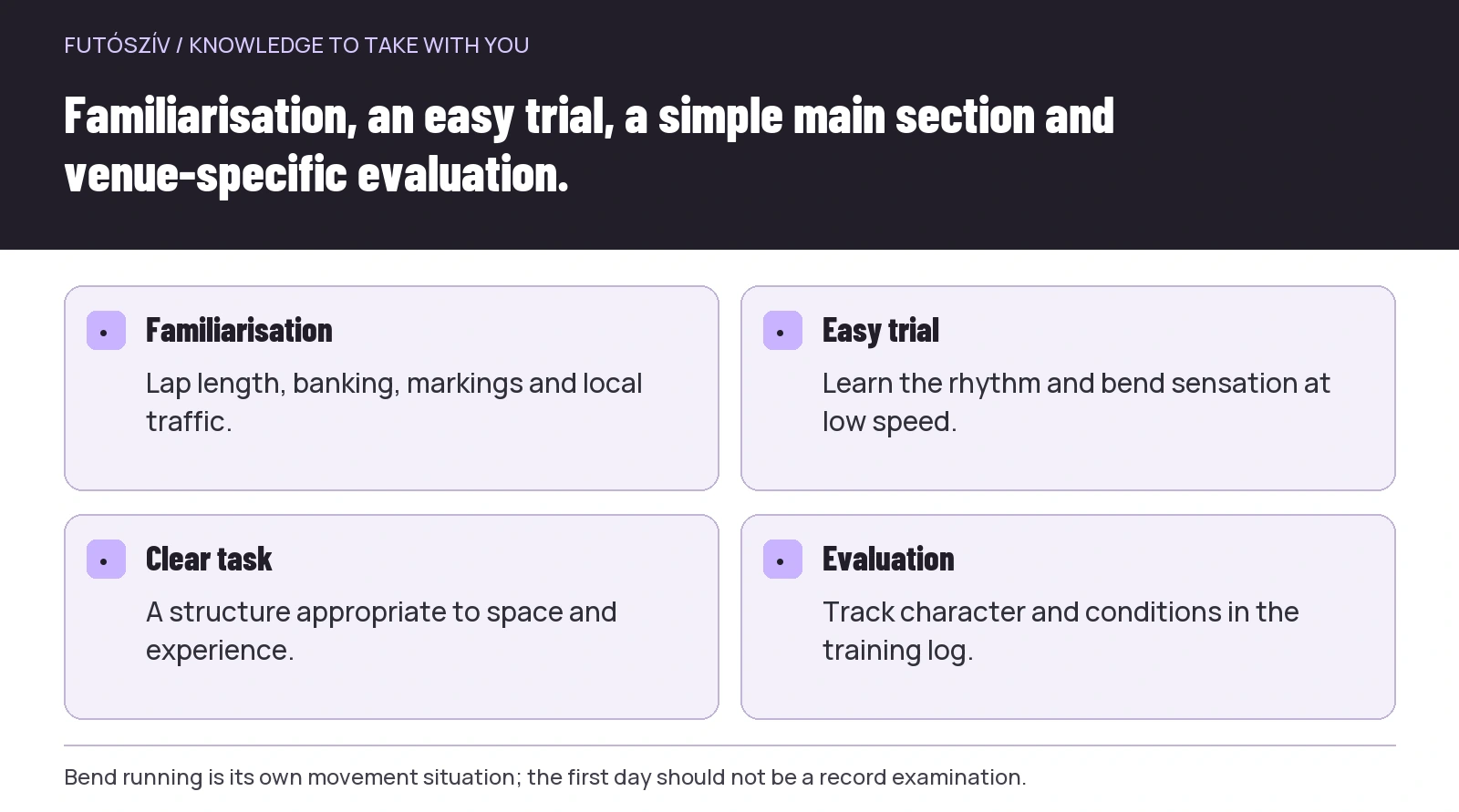 Enlarge diagram
Text version of the illustration
- Familiarisation
- Lap length, banking, markings and local traffic.
- Easy trial
- Learn the rhythm and bend sensation at low speed.
- Clear task
- A structure appropriate to space and experience.
- Evaluation
- Track character and conditions in the training log.
How should you adapt an interval session?
Clarify the starting point, section endpoint and recovery route in advance. The shorter lap can make split checking easier, but more frequent bends and overtaking change the task. An outdoor plan cannot always transfer without changing a single line.
Between fast sections, do not stand spread alongside one another near the finish line. If every repetition starts from the same place, waiting needs organisation too. Other groups’ routes and timing are part of your own planning.
If progress would be repeatedly interrupted, switching to time or a simpler structure may be reasonable. Preserve the workout’s purpose rather than necessarily every original number. An organised, slightly modified task can provide better feedback than constant braking.
The track and timing can guide you instead of GPS
Indoors, satellite positioning may be limited or inaccurate. Measured track markings, manual lap times and knowledge of local distances may provide a better basis. The watch’s indoor estimate can still be useful log data; simply know its source.
On a correctly measured two-hundred-metre lap, five laps equal one kilometre and fifteen equal three thousand metres. This calculation is correct for your distance only if you actually follow that measurement line and starting mark. Outside lanes or diversions may produce a different route.
For longer sets, agree lap counting beforehand. Manual marking, a helper or a simple time-based task can reduce uncertainty. Counting laps should not distract from monitoring track traffic.
The hall’s climate is also a condition
A room that feels warm compared with outdoor cold, drier air or crowding can alter comfort. When arriving in layers, allow for changing between the warm-up and main section. Outdoor clothing may not suit the whole indoor session.
If you have a respiratory or other health problem, follow your own prescribed plan and do not automatically explain unusual symptoms as the hall’s air. Pain or feeling unwell means stopping the run and seeking help as necessary.
Plan the journey home afterwards too. Outdoor weather, changing and travel belong to the whole outing. The hall’s comfort does not remove scheduling and recovery needs.
What makes an indoor-track day successful?
A workload suited to the goal, controlled bends and predictable shared use together make good execution. You need not convert an outdoor record into an indoor equivalent every time. Knowing the venue’s differences keeps the task evaluable.
Record the track’s character, distance marking used and important traffic or organisational circumstances. If you adapted the task, include why. An indoor track is a useful tool when the plan respects both your own goal and the functioning of shared space.
Sources
- World Athletics: short track concept.
- World Athletics: Book of Rules.
- Maximum velocity and leg-specific ground reaction force production change with radius during flat curve sprinting.
- Lower extremity kinematics of athletics curve sprinting.
Biomechanical studies are not local track rules or personal injury-risk estimates. Always check the hall’s current arrangements with the facility.
How Futószív articles are prepared: our editorial guidelines.