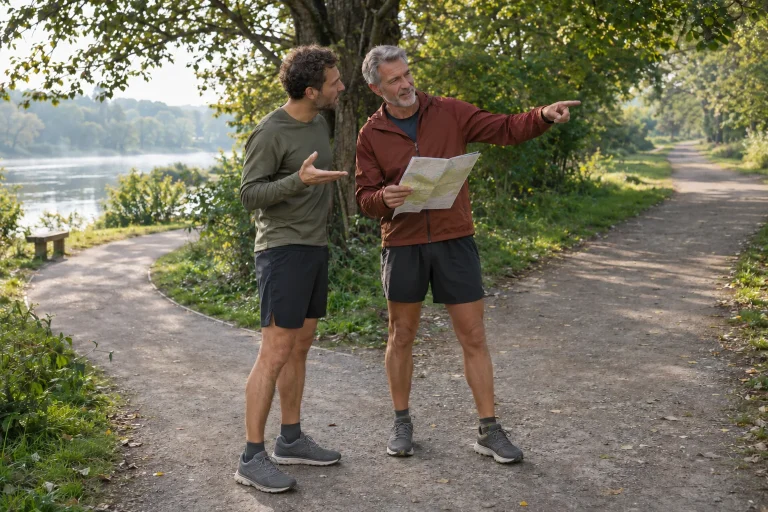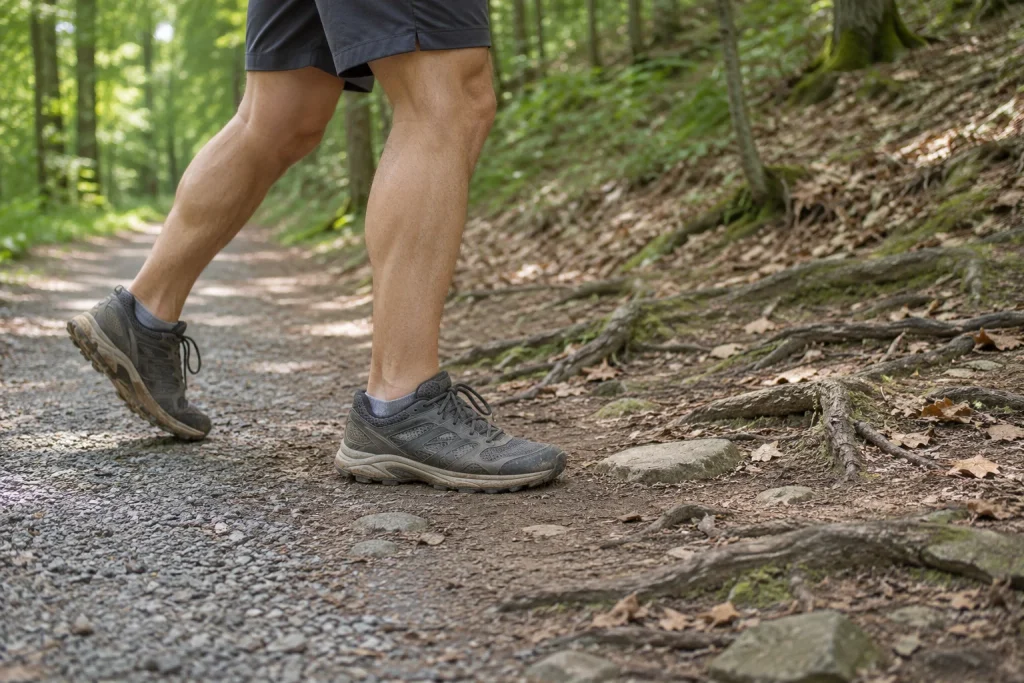
The endurance you have developed as a road runner is a valuable foundation on trails, but it will not solve every task for you. The rhythm of the route, ground, elevation changes and navigation call for new decisions. Your first trail run should therefore be an exploration rather than proof that your road pace belongs in the forest too.
Trail terrain is not a single category. A wide, dry forest track, a root-covered path, a muddy meadow and a steep hillside create different situations. Progression is not just about kilometres, but also about which new demand you introduce.
Choose the type of route first
For your first trial, look for a route that is easy to follow, easy to shorten and not technically extreme. A familiar walking route, wide forest track or gently rolling, predictable section may be better for learning than a spectacular mountain race course.
Examine the surface and descents too, not just the distance on the map. A five-kilometre route can be a comfortable introduction or a difficult, time-consuming task. Kilometres alone do not tell you what you will need to handle.
If uncertain, walk part of it first. This is not wasted training time: you learn the junctions, ground and opportunities to turn back. Learning navigation and the movement task simultaneously may add unnecessarily many new factors.
Make effort your first measure rather than pace
The kilometre pace familiar from roads is not an automatic trail target. Uphill, on softer ground or among obstacles, the same speed carries a different workload. Defending the number on your display can easily produce a harder run than planned.
An easy trail run can be slow and include walking. The question is whether movement and breathing fit the day’s purpose. Do not automatically classify adapting to terrain as inferior performance.
A time limit can be especially useful for the first outings. It prevents the run expanding indefinitely if the route is slower than expected. Enjoying the route and choosing the workload well can matter more than comparing average pace afterwards.
What does research on ground surfaces show?
In a study using an uneven treadmill researchers measured movement and energy demand in twelve participants. That particular uneven surface required more energy and produced different movement characteristics than a smooth one. This finding concerns a specific laboratory surface, not a percentage surcharge valid for every trail.
An original study using a differently constructed undulating surface found a much smaller energetic difference. Together, the two observations are particularly informative: the word “uneven” does not fully describe terrain’s mechanical properties.
The practical conclusion is not to expect a single conversion formula between road and trail. Surface, speed and the runner’s adaptation shape the task together. Experience of your own route matters more than a percentage measured on another type of ground.
Count descents alongside elevation gain
Elevation gain shown on a map helps assess a route, but a downhill section is not simply a gift. Regulating speed, braking and handling the ground create a different task. Your legs’ after-effects following a long descent can differ from those after flat running.
In the first trail-running weeks, do not only celebrate reaching the top: observe control on descents too. Walking an uncertain section may be an appropriate choice. Technical learning is not made effective by continually pushing the limits of speed.
If descending is new, you can begin with a smaller, easier amount. Do not automatically add the same length already familiar from road running. A new surface and new descents are changes in the programme in their own right.
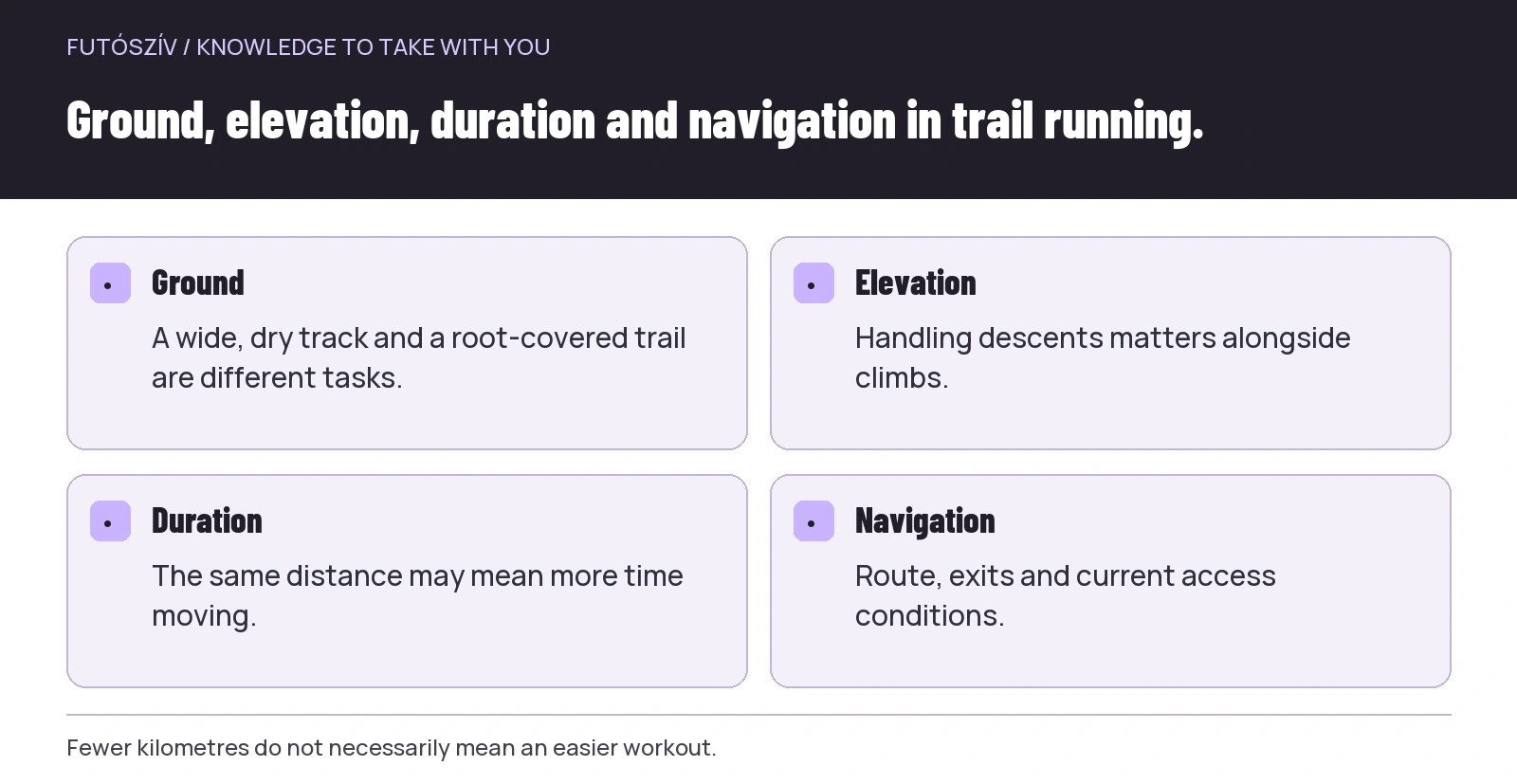 Enlarge diagram
Text version of the illustration
- Ground
- A wide, dry track and a root-covered trail are different tasks.
- Elevation
- Handling descents matters alongside climbs.
- Duration
- The same distance may mean more time moving.
- Navigation
- Route, exits and current access conditions.
Use walking deliberately
On steep or uncertain sections, walking can preserve control and help regulate effort. You do not need to run every climb so that an app can call the outing a run.
The transition is worth observing too: when do you switch to walking, and when does running feel reasonable again? Let terrain and the task guide the decision rather than another participant’s gait. Comfortable progress can differ between individuals.
Walking is not necessarily rest either, especially on steep paths or with a backpack. It contributes to total time and workload. Do not let the work disappear from your log simply because you did not run throughout.
Gaze, foot placement and attention
Choose a speed that lets you notice and handle obstacles in time. You need not stare rigidly at one point, but do not let constant watch reading take over your attention. Both the ground immediately ahead and the continuation of the route matter.
Small adjustments in steps may be natural. Maintaining the same stride length and rhythm as on a flat road at all costs is not the goal. Movement suited to terrain may be more varied, so road reference values for running-dynamics data may not apply literally either.
If you cannot assess an obstacle, slow down or stop. A root, rock or wet leaf is not a technical examination question. Choosing speed well helps keep the route enjoyable and suitable for learning.
Shoe choice depends on the task
Different traction and protection may suit a dry, wide forest track than mud or a rocky hillside. The label “trail shoe” does not itself guarantee suitable behaviour on every surface. Fit, handling and the actual ground matter together.
You do not need to buy a complete equipment collection for one easy forest trial. First understand where and in what conditions you want to run. For longer or harder routes, however, equipment requirements may change too.
Try new shoes on a shorter, predictable outing. Take chafing, heel movement and toe room on descents seriously. A brand or competitive runner’s endorsement does not replace a suitable fit of your own.
Navigation is a running skill in its own right
Before departure, know the route’s main points, opportunities to turn back and junctions. A downloaded map is useful when you know how to use it and it is genuinely available without a network. Phone charge and a backup plan matter too.
Do not follow only the line on the screen: observe signs and the actual surroundings. There may be closures, changed paths or a track that is hard to follow. If uncertain, stop to orient yourself before increasing your distance from a known point.
When running alone, it helps if somebody knows your intended route and roughly when to expect your return. Adapt details to the route’s length and accessibility. A nearby forest loop and a remote mountain outing need different preparation.
Always check current access separately
Forestry work, hunting, weather damage or conservation measures can change whether a route can be used. Look for information close to your departure date from the area’s manager. A previously downloaded route is not current permission or opening information.
A Hungarian example is Vérteserdő’s own forest-access information page, which also explains where to check current information. In another region, seek the relevant guidance from its local manager. One forestry organisation’s news is not a national situation report.
Respect on-site restrictions and choose another route. Do not enter a work area you cannot assess merely because an earlier running track leads there. Selecting a backup route beforehand can make this decision simple.
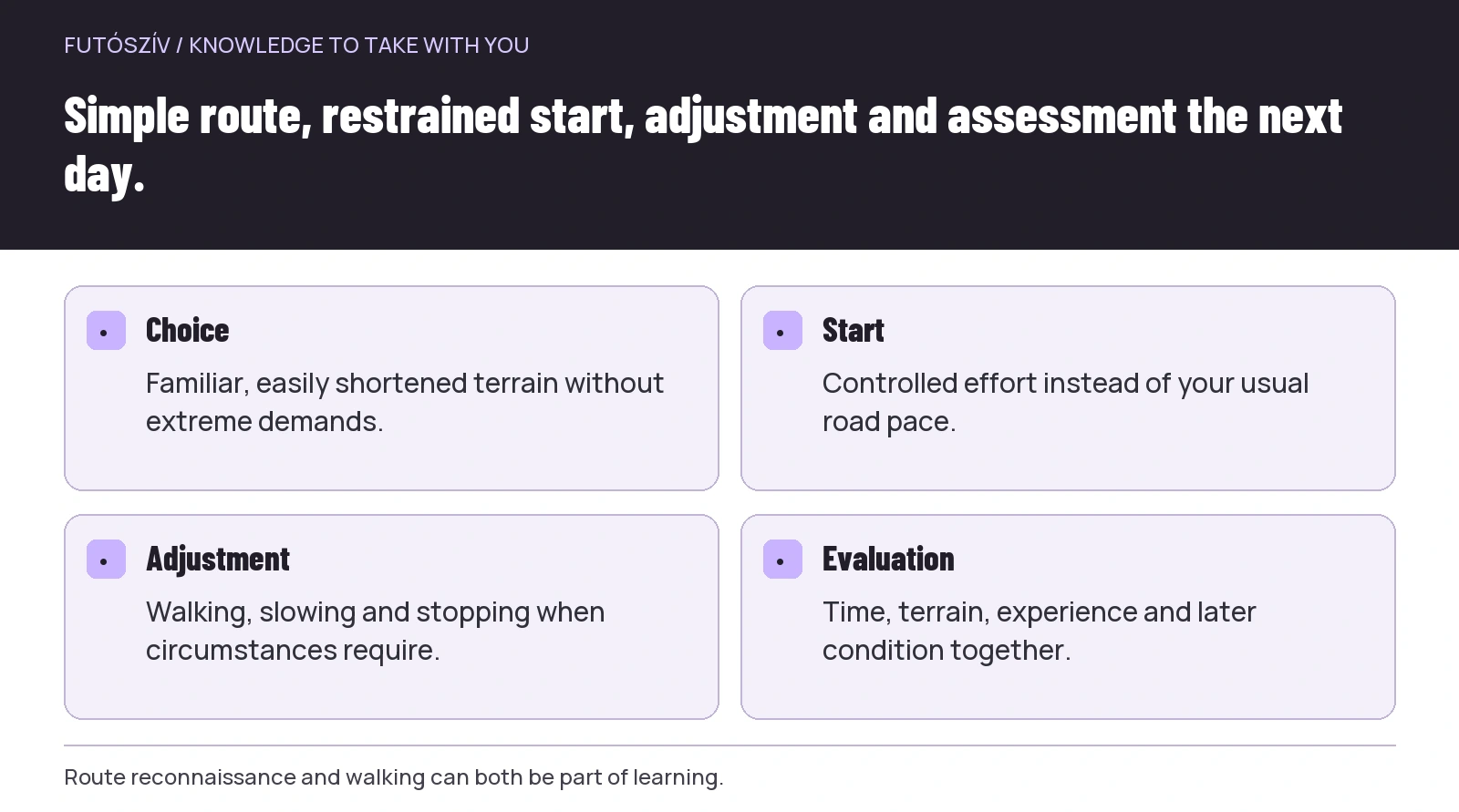 Enlarge diagram
Text version of the illustration
- Choice
- Familiar, easily shortened terrain without extreme demands.
- Start
- Controlled effort instead of your usual road pace.
- Adjustment
- Walking, slowing and stopping when circumstances require.
- Evaluation
- Time, terrain, experience and later condition together.
Racing and running independently have different safety support
The ITRA safety guidelines are intended for trail-race organisers and cover matters including communication, prevention and arranging rescue. This shows that an event’s supporting framework is more than a marked track.
On an independent run, aid stations, course closures and ready organiser assistance are not automatically available. A route familiar from a race can therefore be a different task on an ordinary day. Plan your own supplies and means of contact separately.
At a race, check the particular organiser’s mandatory equipment and rules. A general article does not replace the event’s current briefing. Weather or organiser decisions can change conditions even in the final days.
How should it fit into your running week?
The first trail outing need not replace your entire familiar longest road run. A smaller, simpler trial may offer more opportunities to observe. The aim is recognising new demands, not immediately preserving all your previous numbers.
Observe how you feel afterwards and the next day. New descents, different ground or a longer duration can produce different after-effects even with fewer kilometres. Include duration and the character of the terrain in your log.
Choose the next increase from actual experience. You need not increase distance, elevation and technical difficulty together. Changing only one new demand makes it easier to understand your response.
Shared trail, shared attention
On trails, you may meet walkers, other runners and, depending on the situation, other users. When overtaking, give polite notice in good time, slow down and leave room. Your training does not give you priority over the whole width of a narrow trail.
Leave no litter and use the route in ways that protect the environment. Creating a new trail edge to avoid mud or taking shortcuts can damage sensitive areas. Knowing local signs and land-manager requirements is part of preparation.
In a group, consider the least experienced participant’s situation too. Agree meeting points and how to handle somebody falling behind. The value of running together is not that everyone takes the same risks.
When should you shorten the outing?
Adjust for deteriorating visibility, uncertain navigation, slippery ground or a route harder than expected. You need not wait for complete exhaustion. Retaining a reserve is particularly useful where getting home is itself a task.
For pain, limping or feeling unusually unwell, stop running and seek help appropriate to the situation. Becoming accustomed to trails does not justify ignoring symptoms. A manageable learning challenge and a health problem are not the same.
At the end of a successful transition, you are not necessarily faster. You may choose routes better, walk steep sections more calmly and regulate effort more accurately. These are genuine trail-running skills.
Sources
- Biomechanics and energetics of running on uneven terrain.
- How human runners regulate footsteps on uneven terrain.
- ITRA Safety Guidelines.
- Vérteserdő: Forest-access information.
How Futószív articles are prepared: our editorial guidelines.