
A long run is not a single number of kilometres that means the same thing for everyone. Relative to a beginner’s usual workload, even a shorter route can be long, while the same distance may be an easy everyday session for someone who has run regularly for years. Your background, goal and possibilities over the following days define the task.
Well planned, it offers an opportunity for sustained, manageable effort and for practising pacing and certain race situations. Poorly chosen, it becomes the week’s one excessive undertaking, whose after-effects disrupt the other days. A good long run is not only achievable: your programme remains manageable afterwards too.
Which goal calls for a longer effort?
The first question is not how many kilometres other people usually run on Sundays. Define why you want to keep moving for longer. It might be experience needed for a longer race, comfortable endurance work, exploring a route or one element of an established programme.
A longer easy run can have a role when preparing for a shorter race too, but that does not mean adopting marathon runners’ distances. The volume needed for your goal makes sense within the total weekly workload. A bigger number does not automatically mean better training.
If your main goal is general activity and wellbeing, completing a long run every week is not compulsory. Consistency, varied movement and a sustainable schedule are worthwhile goals in themselves. The tools of race preparation are not obligatory in every life situation.
Start from your own usual workload
Look at the runs you actually completed over recent weeks, particularly the longest sessions you tolerated well. What matters is not what appeared in the plan, but what you did and its after-effects. A large, one-off achievement in the distant past is not the same as a workload sustained consistently in the recent past.
After a break, illness or injury, reassess the starting point for your long runs. Your previous record is not a compulsory comeback target for next weekend. Your current condition and health determine what continuation is reasonable.
There can be several practical planning options: repeating the same length for a while, making a smaller increase or having an easier week. Each successive long run does not have to be longer. Becoming accustomed to a workload is as much part of the process as increasing it.
Should you plan by time or distance?
Distance connects easily to a race and route. Its disadvantage is that the same kilometres mean very different durations for runners at different paces. A two-hour run for one person can be a substantially longer effort for another.
A time limit helps you plan the day and recovery. It can be particularly useful on hilly routes or variable surfaces because it does not force you to complete a predetermined distance at any cost. Distance covered then becomes an outcome, rather than necessarily a compulsory target.
You can combine both: a known route, with a reasonable time limit and opportunities to shorten it. This avoids staying out far longer than planned simply because the terrain or weather required slower progress.
Part of the total weekly workload
The week’s longest run cannot be assessed without considering the other days. If weekdays contain very little running, a huge weekend volume represents a different proportion from that in a more evenly structured week. Proportion is a useful question, but it need not be tied to one rigid percentage rule.
An observational study of people training for half-marathons and marathons analysed weekly volume and the longest run together in relation to performance and injuries. Such findings show associations, not a minimum distance that applies to everyone or a personal safety threshold.
Include hills, more intense days, strength training and other sports too. The total strain of a week can differ despite identical running kilometres. Real life, rather than simply a mileage chart, determines where the long run fits.
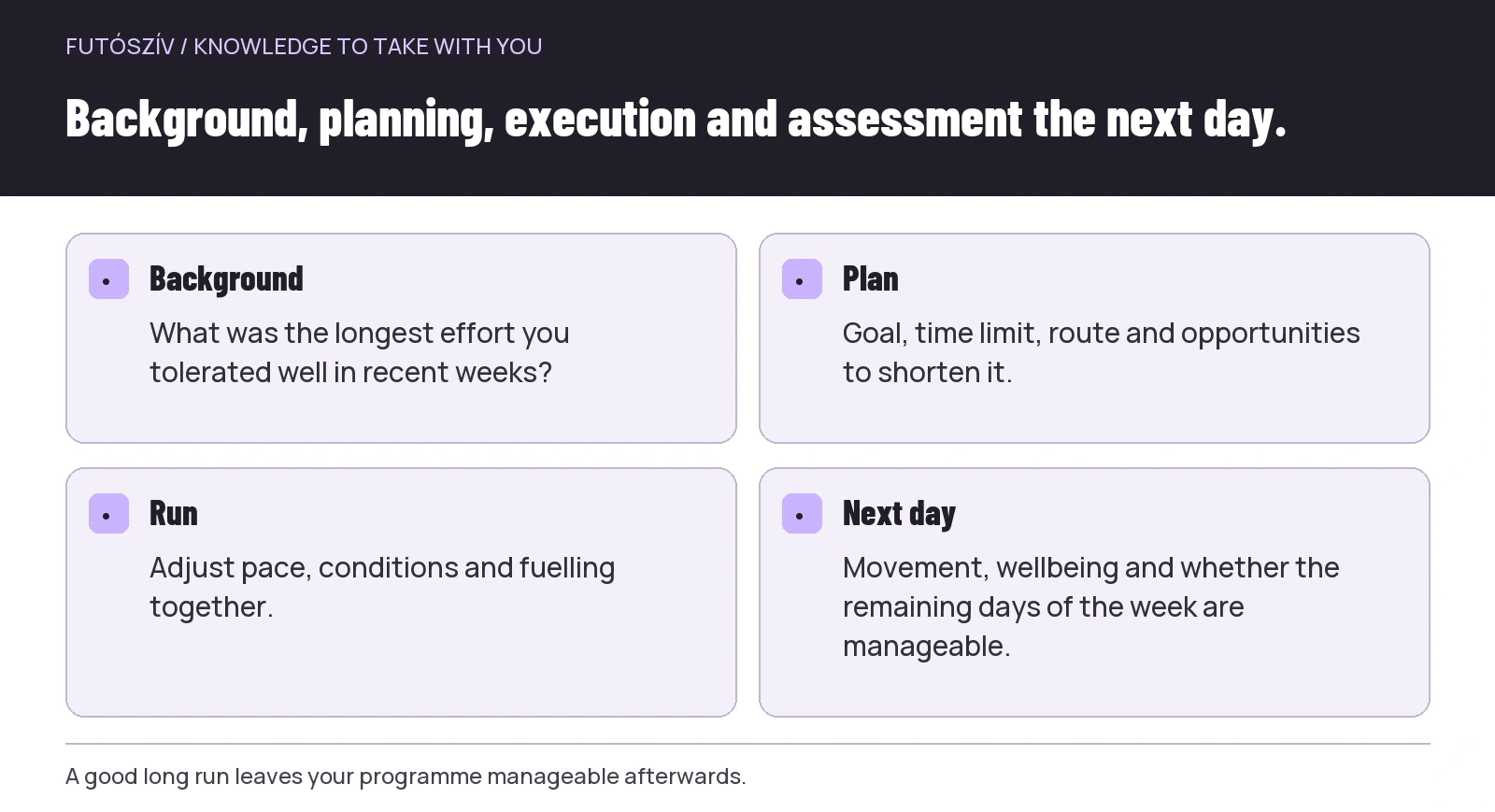 Enlarge diagram
Text version of the illustration
- Background
- What was the longest effort you tolerated well in recent weeks?
- Plan
- Goal, time limit, route and opportunities to shorten it.
- Run
- Adjust pace, conditions and fuelling together.
- Next day
- Movement, wellbeing and whether the remaining days of the week are manageable.
Why does a single big jump matter?
It is easy to take on much more in one long run: a new route, a group outing or urgency about an approaching race can carry you along. Your weekly total may still look moderate, even though this single session differs substantially from what you have recently been accustomed to.
A cohort study following 5,205 runners also analysed increases in the distance of individual runs, finding an association between larger increases relative to the longest recent run and injuries. The study was not a prevention trial and does not establish an injury-free threshold applicable to everyone.
The practical lesson is to examine a weekend spike separately too. The weekly average does not automatically make a single unusually long session manageable. Changes in speed and terrain matter alongside distance.
What does the link between long runs and durability show?
A study comparing trained male runners by performance level associated regular long runs and higher training volumes with better running-economy durability. This is an interesting association, but it is not the result of an experiment testing one particular training dose.
It cannot support the claim that a specific distance produces the same improvement in everyone. Participants’ backgrounds and complete training systems matter too. Runners who tolerate higher volumes well may differ from those whose training is repeatedly interrupted.
The question in your own programme should therefore be how to build a workload you can manage consistently. An exceptional, extremely long session does not replace weeks of consistency. Durability does not require visibly exhausting yourself every time.
Do not let a fresh first kilometre dictate your pace
For an easy long run, choose a pace at which the first part is genuinely restrained. Comfortable conversation and perceived effort can provide useful guidance. Increasing distance is itself a change in workload; a faster pace does not automatically need to accompany it.
In a group, clarify each person’s task. Following a pace that feels comfortable to a faster companion can turn your own easy day into a sustained hard run. Starting together should not mean losing the option to hold back.
Do not try to defeat hills and wind by maintaining average pace at any cost. If the main goal is sustained easy work, keep effort appropriate to that task. Slowing down on the display may reflect a suitable adjustment.
Route: leave yourself a way out of the plan
For a new, longer task, several shorter loops or a route with an easy way home can be useful. A distant turnaround point can also create psychological pressure: you still have to get back if your condition or the weather changes.
Think about access to water, toilets, transport, telephone reception and the type of surface. In forests or mountains, network coverage and navigation are not guaranteed either. Route planning is a substantive part of a long run, not a separate logistical detail.
Do not choose unfamiliar, difficult terrain on kilometres alone. Elevation gain, technical descents and slippery surfaces create new demands. Introducing these alongside a distance increase makes the after-effects harder to understand.
Do not leave fuelling experiments until the last minute
A longer run can provide an opportunity to try individually tolerated options planned for your target race. Have an approach in mind beforehand, and do not change every food, drink and item of equipment at once. Record your digestive experience too.
Personal quantities can be selected from general guidance only by considering duration, intensity, the environment and health circumstances. Fuelling is not a competition to see who can finish on less. Unnecessary deprivation is not a general requirement for a good long run.
Excessive drinking does not provide unlimited safety either, and can be dangerous. Seek individual advice for recurring digestive symptoms, illness or medication effects. A long run should not replace investigating a symptom.
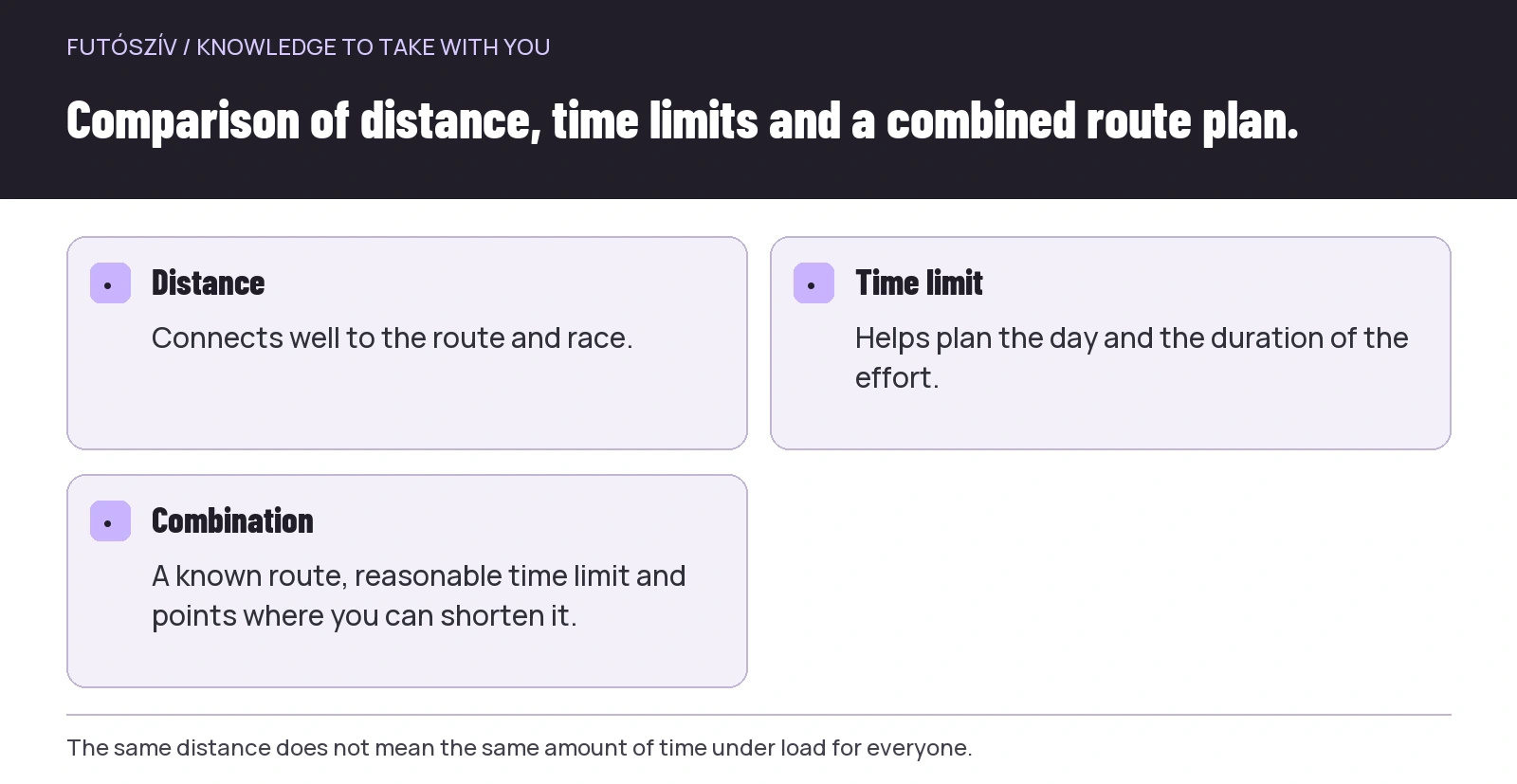 Enlarge diagram
Text version of the illustration
- Distance
- Connects well to the route and race.
- Time limit
- Helps plan the day and the duration of the effort.
- Combination
- A known route, reasonable time limit and points where you can shorten it.
Weather is part of the workload
Heat, strong wind or extreme cold turns the same route into a different task. Check the forecast and current conditions, then adjust the route, timing, pace or length. Having prepared a plan earlier does not make carrying it out unchanged compulsory.
The weather can also change during a longer run. Plan where you can shorten the route or ask for help. Depending on the situation, extra clothing, a charged phone and a navigation solution may be basic training equipment.
If you feel unusually unwell, become confused or collapse, activity must stop and urgent help may be needed. Completing the next kilometre is not an appropriate check in that situation. A safety decision does not make the session weak.
What should happen afterwards and the next day?
After finishing, allow time for your usual food, fluids, changing clothes and rest. Several hours of physical work or a long journey immediately afterwards also count towards the day’s total workload. Recovery opportunities should matter at the planning stage.
The next day, do not simply ask whether you can somehow get going. Notice how comfortably you move, how you feel and whether the day is manageable. Recurring, disproportionate after-effects lasting several days may suggest adjusting the long-run dose or the structure of the week.
General muscle fatigue and increasing or clearly localised pain suggestive of injury are different situations. If symptoms arise, the next session already entered in your plan should not be the sole basis for a decision. Any necessary assessment must be individual.
Is splitting it into two the same?
Two shorter runs may be useful for a different purpose or schedule, but they are not automatically equivalent to a continuous long run. The rest between them changes the continuity of the workload, opportunities to eat and your condition at the start of the later section.
If a long run does not fit your day, you do not need to describe two parts as though they replaced all its characteristics. Instead, redefine the goal for that week. Choosing a worthwhile shorter run and moving the longer one to a more suitable time can make sense.
Nor do you have to repay a missed long run by adding it to the following week. Missed training is historical information, not a debt. Choose the next step based on the work you have actually completed and your current condition.
Five sentences for your log
Record the goal, duration, distance and character of the route. Describe how effort developed at the start and end. Include fuelling, conditions and how you felt afterwards. Together these provide a useful basis for planning the next long run.
Your final evaluation question could be: did this make the rest of the week more manageable, or disrupt it? The long run should serve your preparation. Finishing earlier can be a good decision even if your phone app originally expected a bigger number.
Sources
- Training for a (half-)marathon: Training volume and longest endurance run related to performance and running injuries.
- How much running is too much? Identifying high-risk running sessions in a 5200-person cohort study.
- Regular Long Runs and Higher Training Volumes Are Associated with Better Running Economy Durability.
The observations cited do not establish a long-run distance applicable to everyone. The examples are planning considerations, not personal training prescriptions.
How Futószív articles are prepared: our editorial guidelines.