
Lactate threshold often appears as one pace on a running watch or at the end of an exercise test. The number can be a useful reference, but only if you know what was measured or estimated, by which method and for which training decision you want to use it. “My threshold is this” provides surprisingly little information on its own.
Understanding the concept does not require a biochemistry exam. Separate blood lactate concentration, its changes during exercise, different boundary values and the running speed assigned to them. They are connected but are not different names for the same thing.
What is lactate, and why is it not simply waste?
Lactate is part of metabolism: the body produces and uses it. Its measured blood concentration reflects appearance, distribution and use together. A higher value therefore does not mean only production is occurring, without removal or further use.
Direct metabolic research illustrates this too. A human study using labelled lactate tracked oxidation and the pathway related to glucose production before and after training. Lactate’s role in energy metabolism does not fit the simple image of waste that merely needs eliminating.
Everyday descriptions of “lactic acid build-up” often just mean hard effort. They are not direct measurements and do not explain every kind of fatigue. Unpleasant sensations cannot establish a precise blood lactate value or diagnosis.
What does concentration mean?
A laboratory or portable meter generally reports millimoles per litre. This is concentration: lactate measured in a given quantity of blood, not the total produced throughout the body. Even two consecutive samples do not directly reveal every muscle’s metabolism.
Sampling location, device, sample handling and timing belong to the result. The number is not independent of how it arose. Do not try to learn the technical details and healthcare safety of home sampling from a general running article.
Interpret an individual measurement point alongside the loading history. It means something different in an incremental test, at the end of a longer steady-paced run and after a fast section. Ranking numbers without circumstances misleads.
What happens in an incremental exercise test?
In a typical test, you complete several stages with increasing speed or workload. Samples taken at specified times are assigned to speeds and plotted as a curve. A threshold is derived from particular changes in the curve or a predetermined rule.
Stage duration matters. Shorter and longer stages allow different times for physiological responses to develop. A study examining reliability of a treadmill test also evaluated a specific protocol, stage length and lactate markers. Methodological detail is not a small-print appendix.
The practical question is therefore: which test produced this result? Different values from two locations using different tests do not necessarily mean your body changed by the same amount. Clarify protocol comparability first.
 Enlarge diagram
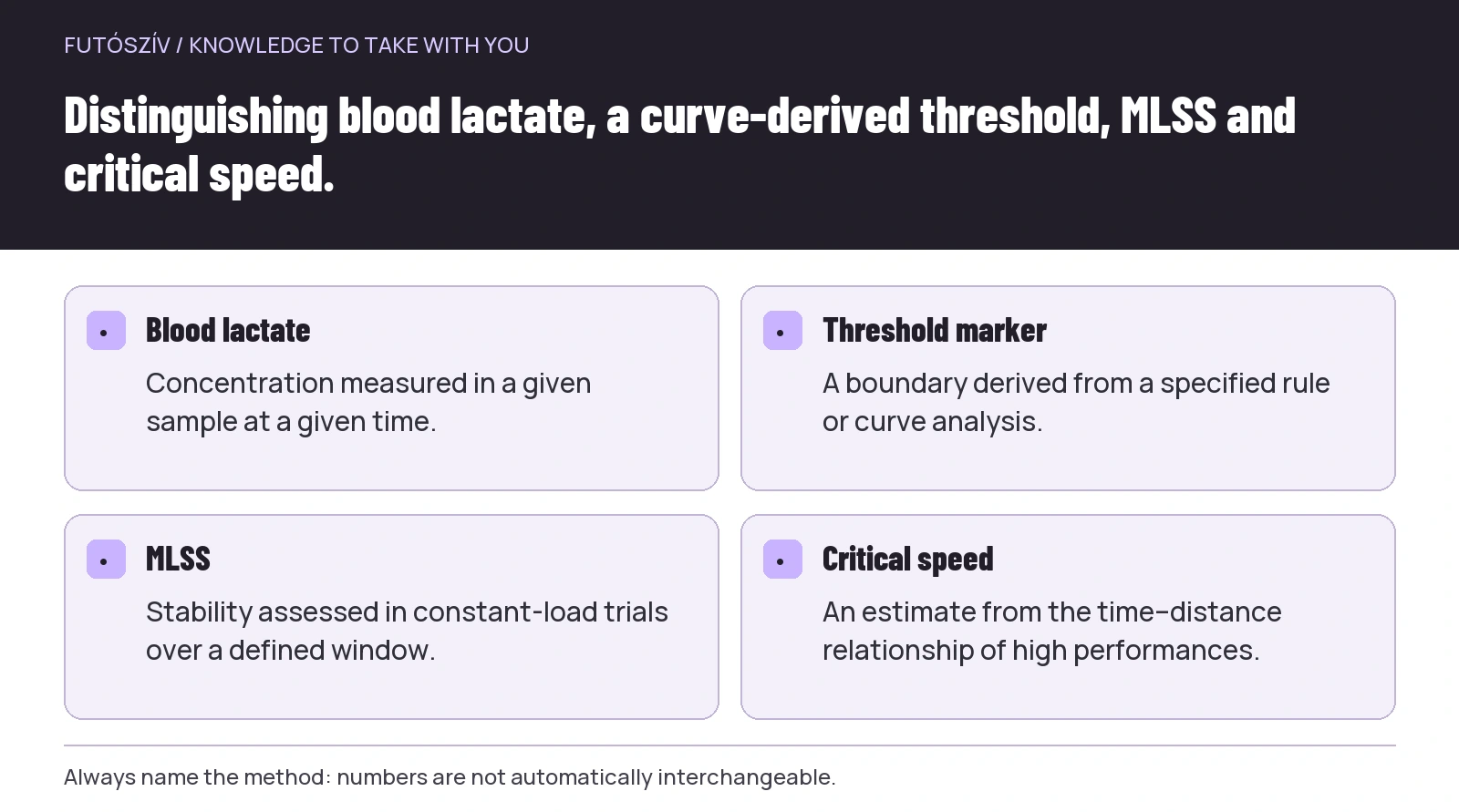
Text version of the diagram
- Blood lactate
- Concentration measured in a given sample at a given time.
- Threshold marker
- A boundary derived from a specified rule or curve analysis.
- MLSS
- Stability assessed in constant-load trials over a defined window.
- Critical speed
- An estimate from the time–distance relationship of high performances.
Lower and upper boundaries: LT1 and LT2
Training planning often uses two boundaries separating different intensity ranges. The lower is often labelled LT1, the upper LT2. Their specific definitions can vary by method: curve analysis, a rise from baseline or another rule.
Ask for a definition alongside LT1 or LT2 too. Calling one aerobic and the other anaerobic is insufficient. Energy supply does not work by using only one system below a line and switching exclusively to another above it.
The boundaries’ practical role is helping distinguish different types of loading. A precise label is valuable when translated usefully into running: associated sensations, duration, uncertainty and environmental adaptation.
Four millimoles is not a personal law of nature
Sometimes a threshold is assigned to a fixed lactate concentration. This is an applied calculation or assessment rule. It does not prove the same physiological change occurs at the same concentration in every person.
The study comparing lactate and ventilatory markers in runners evaluated several definitions and their relationships. Understanding such studies requires seeing individual marker definitions, not just their shared word “threshold”.
Do not force every session below a concentration selected online. If you want measurement-based planning, it needs appropriate professional support, a reliable procedure and individual interpretation. Do not automatically compare your number with one shared by a professional athlete.
What is MLSS, and why is it not identical to every threshold?
Maximal lactate steady state, or MLSS, seeks under a defined procedure the highest constant workload at which blood lactate rises within a predetermined limit over the assessed period. Measurement usually requires several constant-load trials.
This differs from selecting a point on the curve of one incremental test. The results may be related, but names and numbers cannot swap without explanation. The specific time window and permitted change also determine an MLSS value.
“Steady state” here does not mean running sustainable for ever. Fatigue, energy needs and time limits still exist with a lactate value classified as stable. A laboratory definition does not make an intensity indefinitely sustainable.
What about critical speed?
Critical speed is estimated from another principle: the speed–time or distance–time relationship of high performances over different durations. It is not direct blood lactate measurement. Though important for interpreting endurance exercise ranges, it is methodologically distinct.
A study in ten trained male distance runners compared MLSS and critical speed using different constant-speed trials. The values differed and did not identify the boundary of stable oxygen uptake in the same way. The detailed investigation supports distinguishing the concepts.
This does not tell runners to discard either number. Rather, name the source and method. If a watch, lab sheet and coach’s chart contain three different numbers, first establish whether they intend to describe the same thing.
Heart rate is not the threshold itself
A test may assign heart rate to a particular speed too. This is a useful accompanying practical measure, but does not mean the same thing happens at that heart rate under every condition. Response to loading varies over time and can change with the environment.
Treat a test-derived heart-rate zone as a range with application guidance. In short sections, heart-rate delay and, on longer runs, changing conditions can complicate literal following. One momentary deviation does not necessarily mean crossing a physiological boundary.
With known illness, medication effects or unusual symptoms, general zone rules are even less sufficient. A threshold test does not replace medical investigation and does not itself clear you for any intense sporting activity.
 Enlarge diagram
Text version of the diagram
- Which marker?
- What did the report call a threshold?
- Which method?
- Stage length, workload and calculation rule.
- How much uncertainty?
- Which difference can be interpreted as real change?
- Which training decision?
- How does the result fit the aim and background?
- How is it comparable?
- Agree retesting conditions beforehand.
Why is the aim not the lowest possible lactate?
Interpret concentration within the particular task. A lower value may result from lower external workload; it does not prove better preparedness by itself. Differences between runners cannot translate into better and worse metabolism without background information either.
To track training-related change, consider speed, sensation and accompanying data under identical or comparable protocols. One concentration is only part of the picture. An interesting question might be how speed assigned to a defined rule changed and how reliable that difference is.
A high lactate value measured after harder work is not a moral achievement badge either. You do not need to beat it session after session. The aim is selecting an appropriate stimulus rather than increasing or decreasing a laboratory measure at any cost.
Next-day muscle soreness is not lactate left behind
Delayed-onset muscle soreness is often mistakenly explained by accumulated lactic acid. Results from research specifically examining this relationship did not support lactate causing delayed soreness. Assessing next-day symptoms after exercise therefore requires different thinking.
Do not combine ordinary stiffness, pain suggesting injury and strong sensations during exertion under one word, “acid”. Symptom location, timing, course and effects on movement provide more important information than a previous measurement.
Recurring, increasing or movement-altering symptoms may require individual assessment. Understanding lactate threshold is not a diagnostic tool for determining the origin of pain.
Five questions when receiving test results
Ask exactly which marker was reported, which protocol calculated it and how certain the estimate is. Request an understandable example of how it would be used to plan an easy run and a harder session. The explanation should go beyond “hold this heart rate from now on”.
Clarify comparison conditions too: what preparation, interval and method would make retesting meaningful? The aim is not the most frequent testing, but a next measurement that genuinely helps a decision.
Finally, clarify who interprets health symptoms and fitness questions. Sports-performance testing and medical investigation may overlap, but not every service includes the same things. Check what the chosen provider actually offers.
How can you use this without testing?
The main lesson applies without a meter: distinguish easy work, sustained harder work and work sustainable only briefly, rather than expecting every session to do the same thing. Sensations, breathing, pace and next-day condition together provide usable feedback.
You do not need to resolve uncertainty in one watch estimate with more exhausting trials. If the number does not fit regular experience, examine the data source and zone settings. A useful training decision matters more than having an apparently precise threshold at any cost.
Sources
- Effects of endurance training on lactate removal by oxidation and gluconeogenesis during exercise.
- Reliability and validity of a continuous incremental treadmill protocol.
- The Relationship Between Lactate and Ventilatory Thresholds in Runners.
- Steady-state oxygen uptake above MLSS in well-trained runners.
- Is Lactic Acid Related to Delayed-Onset Muscle Soreness?
This article explains concepts. Interpret an individual test with a professional familiar with its measurement conditions; the examples cannot calculate a personal training threshold.
How Futószív articles are prepared: our editorial guidelines.