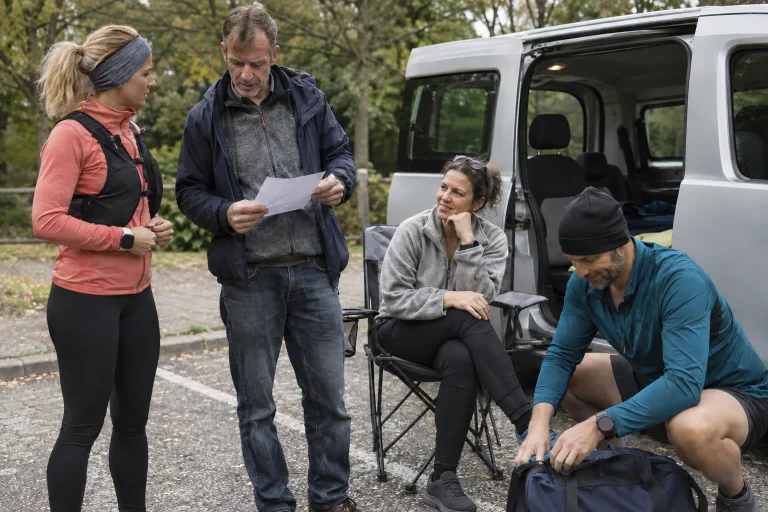
“Six times four hundred metres” is not yet a complete session description. It does not tell us how fast you run, how long or how you recover, what precedes the set or how you decide when to finish. The same few numbers can mean very different tasks for two runners.
Understanding interval training requires seeing fast work and recovery as a joint plan. Recovery is not an awkward pause to squeeze as short as possible, but one of the main variables. A well-chosen set allows repeatable work at an effort suited to the aim.
How to read the shorthand
“6 × 400 metres, with 200 metres easy between” usually means six work sections with easy movement between consecutive fast parts. Yet even this does not clarify whether the two hundred metres are walked or jogged, how long they take and whether a separate easy section follows the end. Clarify these details with a coach or group.
A “repetition” may mean one work section; a “set” is a block of several repetitions. Longer recovery between two blocks is another planning element. Do not preserve only fast sections in the log: recovery between sets is a significant part of what you completed.
Interpret kilometre pace against your current condition. Planned race pace and a pace you can realistically run now may differ. A result targeted six months ahead is not automatically a speed prescription for today’s intervals.
Purpose first, distance second
Short, fast repetitions can practise composed fast running; longer, more restrained sections can divide sustained effort. Making race pace familiar differs from intervals designed for strong cardiovascular loading. Similar-looking sets do not necessarily have the same intention.
The aim determines which error you want to avoid. If movement control matters, a frantic last repetition is not good evidence of success. If practising steady, sustained work, a much faster first section can easily spoil the main set. The best single time does not measure the session’s value.
A useful aim might be: today I want to complete sections at roughly consistent effort, keeping movement composed at the end too. This is not yet a dose, but helps assess whether speed and recovery serve the task.
Should time or distance be the measure?
When running by distance, the same section takes different lengths of time for faster and slower participants. One kilometre may be a short, hard work section for one person and substantially longer loading for another. A shared distance does not necessarily mean a shared physiological task.
With time-based repetitions, duration is the same and distance differs. This can work well in community training if meeting points are planned too. Choose not merely for watch convenience, but for which feature of the task you want to control.
On a track, measured distance makes comparison easier. On a winding, hilly or poorly measured route, time and perceived effort often provide more meaningful reference points. Four hundred metres measured by GPS is not equivalent to four hundred metres on an athletics track in every setting.
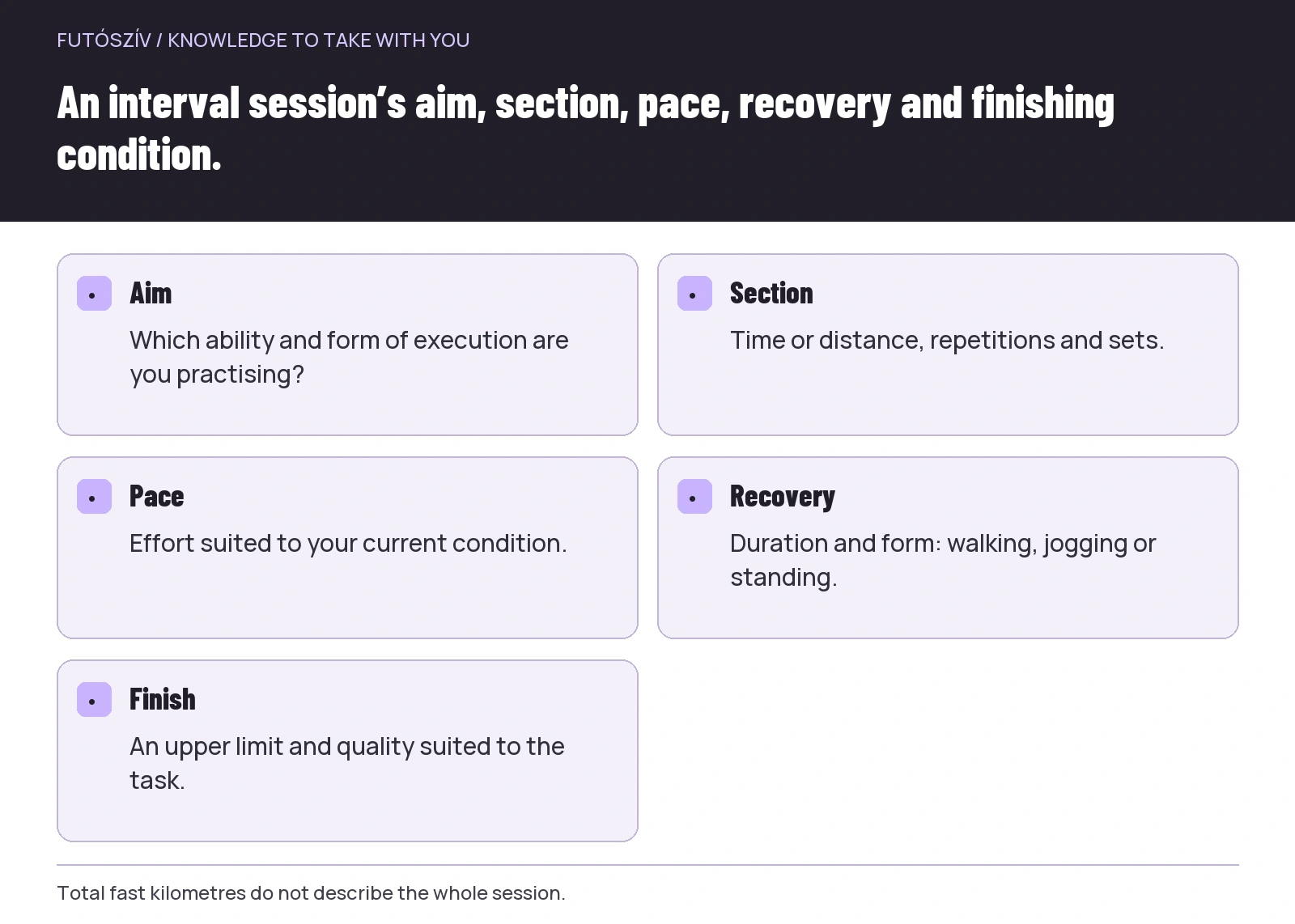 Enlarge diagram
Text version of the diagram
- Aim
- Which ability and form of execution are you practising?
- Section
- Time or distance, repetitions and sets.
- Pace
- Effort suited to your current condition.
- Recovery
- Duration and form: walking, jogging or standing.
- Finish
- An upper limit and quality suited to the task.
Recovery duration changes the session
A study with nine trained male runners assigned different recovery durations to the same task of four-minute work bouts. Researchers examined self-selected intensity, physiological responses and perceived effort. The question itself shows recovery is not incidental data.
In another experiment , eleven moderately trained men ran four times four minutes with two-, three- and four-minute active recovery. Shorter recovery increased certain stress measures and perceived effort, while several oxygen-uptake measures did not differ between recovery conditions.
This does not establish a universally ideal recovery. Speed, duration and the population studied belong together with the result. The practical lesson is that more suffering and a shorter pause do not automatically mean a training stimulus better suited to the aim.
Active or passive recovery?
Walking, easy jogging and standing fill a pause differently. During active recovery, you keep moving, but its intensity matters too. An “easy” section run too fast can become another load, particularly if someone follows the group’s fastest member.
Passive recovery is not laziness either. For some speed tasks, it may be justified to preserve the next repetition’s quality. However, standing a long time beside a cold, windy track also makes environment and comfort important. Choose recovery form for the whole situation.
If you change the recovery method, note it. Two sessions with identical fast times differ if you walked between one and jogged briskly between the other. Comparison needs the complete structure of the set.
Why are total fast kilometres insufficient?
Six kilometres of fast running can consist of more short sections or fewer long ones. With the same total distance, section duration and recovery arrangement may produce different experiences and responses. Do not treat fast kilometres as identical currency in every session.
A primary study in middle-distance runners found different muscle-oxygenation and heart-rate responses during four-hundred-metre and one-kilometre repetitions. It does not select a winning protocol for every aim, but illustrates that session structure can emphasise different measures.
In your log, record total fast time, section length and recovery separately. Looking only at weekly intense kilometres may lose the difference most important for planning the next day.
Make the first repetition part of the plan
Starting too fast is common: legs are fresh, the group is lively and target pace feels slow. A few seconds gained over a short distance are not free, however. Later deterioration often develops from this first decision.
Use the first work section as a check. Is the route suitable, the watch cue understandable and the target apparently sustainable without a straining finish? If not, you can modify before the next section. A good session is not defined by stubbornly maintaining a bad start.
In a set intended to be even, interpret roughly similar times alongside gradually changing effort. A few seconds’ difference is not failure in itself; wind, bends and measurement affect it too. Large fluctuations deserve explanation rather than automatic disregard.
The first fast section is not the warm-up
Before the main set, allow time for comfortable movement and the transition the task needs. Preparation length is individual and environment-dependent; the same long drill sequence is not needed before every session. Do not use the first interval as a substitute for warming up from complete rest.
Check beforehand where sections start and end. On a running track, follow local usage rules and attend to other athletes. If crossing a fast lane during recovery, look around; stopping your watch does not stop everyone else.
Easy movement afterwards and getting home are part of the time window too. If you have only twenty minutes for the main set but no time to prepare beforehand, the solution is generally to simplify the main set. A session that does not fit the schedule does not improve by omitting preparation.
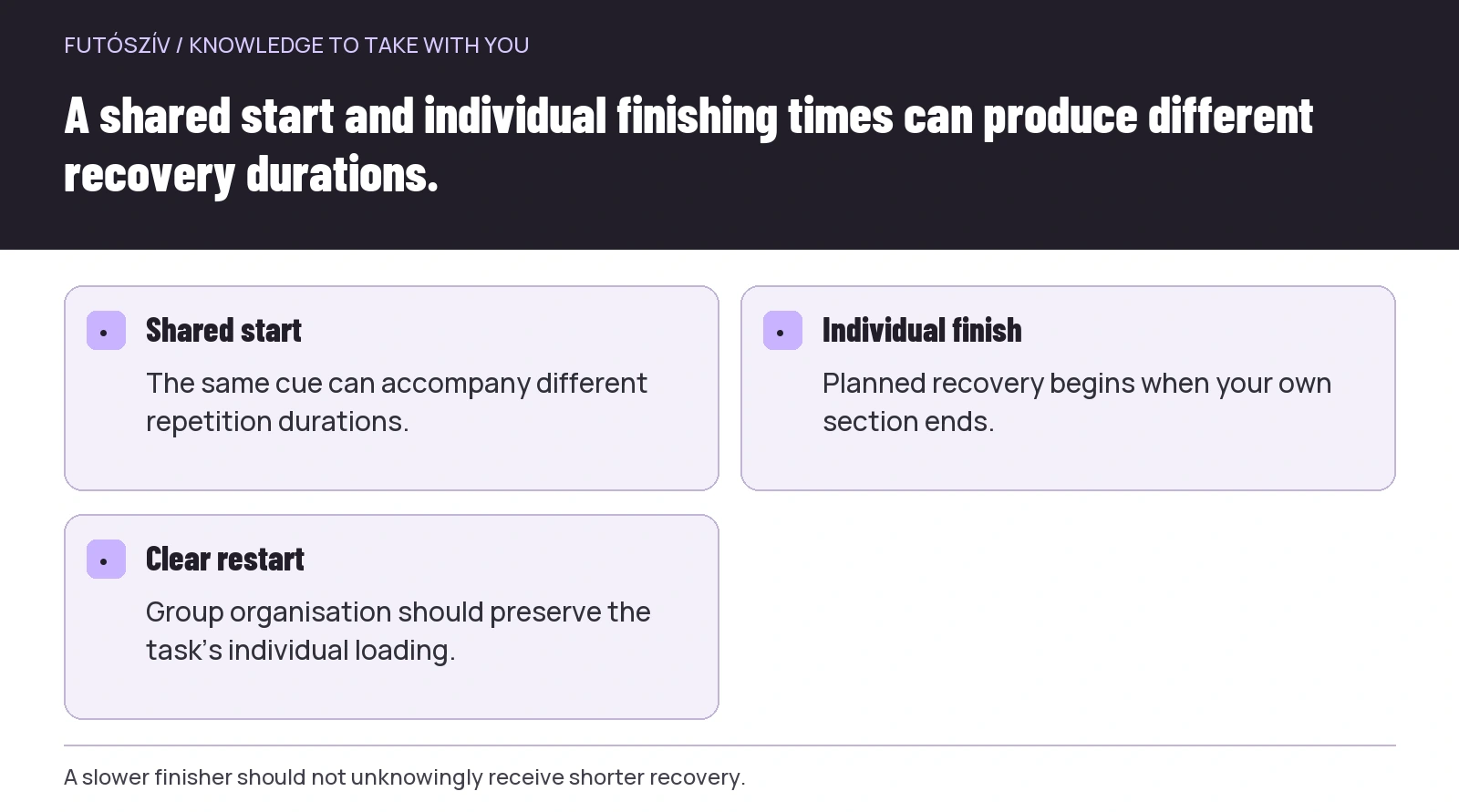 Enlarge diagram
Text version of the diagram
- Shared start
- The same cue can accompany different repetition durations.
- Individual finish
- Planned recovery begins when your own section ends.
- Clear restart
- Group organisation should preserve the task’s individual loading.
In a group, do not let the start list set the pace
With the same starting signal, everyone can complete their own task. Smaller groups based on ability and aim may help, or switch to time if equal distance produces too large a difference. Company can help, but copying another person’s repetitions should not be compulsory.
Clarify when recovery begins too. If everyone restarts when the fastest person has finished recovering, a slower finisher gets a shorter pause. This unknowingly increases loading for precisely the person who already finds the set harder.
Use accessible signals: sound, a visible cue or an individually agreed solution can support participation. A short written task description and the opportunity to ask questions help too. The value of a shared session is not identical execution at all costs.
When should the set end?
Have a known maximum repetition count but a quality-based stopping condition too. If movement breaks down relative to the aim, you repeatedly slow too much or only a hard finish keeps the section on target, assess whether continuing would still deliver the same task.
This does not mean stopping whenever something feels hard. Intense training can be demanding. The distinction is between composed effort suited to the aim and a struggle no longer serving the plan. Experience and professional feedback can help you recognise it increasingly well.
With pain, limping, unusual illness or breathing difficulty, the next lap time is not the question. Stop and seek help appropriate to symptom severity. You can learn from an interrupted session’s data later too; running through symptoms is not a necessary test.
One change at a time teaches more
When developing a set with the same aim later, do not automatically change everything: speed, repetitions, section length and recovery. Increasing several variables together makes it difficult to understand why the load became excessive.
A meaningful step forward can be the same task with less scrambling or a more predictable condition the next day. Shorter lap times are not the only progress. Training serves the whole week, making after-effects part of evaluation too.
After illness, a break or substantial life demands, the old set is not an automatic starting point. Your last successful session is historical information, not an obligation. Plan restarting from current condition and health circumstances.
Keep the decision in your log too
Alongside repetition times, note recovery form and duration, conditions and the set’s aim. If you adjusted, record the reason in a sentence. Later, this makes it clear whether a slower result was sensible adaptation or a different kind of task.
A useful separate question is: would I choose this again in the same situation? Perhaps section length worked but the route was poor; pace was appropriate but recovery too hurried. More detailed evaluation is not necessarily longer, just more precise.
Interval training then becomes a meaningful process rather than a few numbers. Work sections, recovery and the whole week together determine loading. A well-planned set leaves you able to explain what you practised, not just how tired you became.
Sources
- The impact of rest duration on work intensity and RPE during interval training.
- The Effects of Recovery Duration During High-Intensity Interval Exercise.
- Maximizing muscle deoxygenation during interval training in middle-distance runners.
The studies’ specific protocols are not personalised training doses. This article’s examples help interpret session descriptions and do not replace a medical fitness assessment.
How Futószív articles are prepared: our editorial guidelines.