With regular running, a clothing rotation answers a simple question: will you have a suitable, clean and dry outfit for the next outing? This does not necessarily require a large wardrobe. First coordinate your existing supply, opportunities to wash and the actual drying process. A weekly system is useful when running and clothing care both have space in the same real calendar.
The following method does not prescribe the same number of items or wash programme for everyone. Clothing materials, construction and manufacturer guidance may differ. Start with your own labels and plan alongside the rest of the household laundry. The aim is to prepare the next outing, rather than organise your entire life around the washing machine.
List the usable outfits
Do not count only tops. Depending on weather and individual needs, a run may also require bottoms, socks, a supportive garment where necessary and another layer. Even with ten tops, an essential piece may be missing. Reviewing supplies as complete usable outfits reveals the real bottleneck sooner.
Separate pieces used regularly in current weather from those needed rarely. Every garment does not serve the same role. According to its instructions and use, an outer layer may be treated differently from items worn directly against the body. The weekly list should contain what is actually used, rather than every object in the wardrobe.
Mark pieces needing repair or causing discomfort. Do not automatically count these as working supplies. If a zip cannot be used or you regularly put an item aside, it does not provide a real calendar backup. An inventory helps when it shows the current condition, rather than the number theoretically owned.
The label shows limitations and procedures
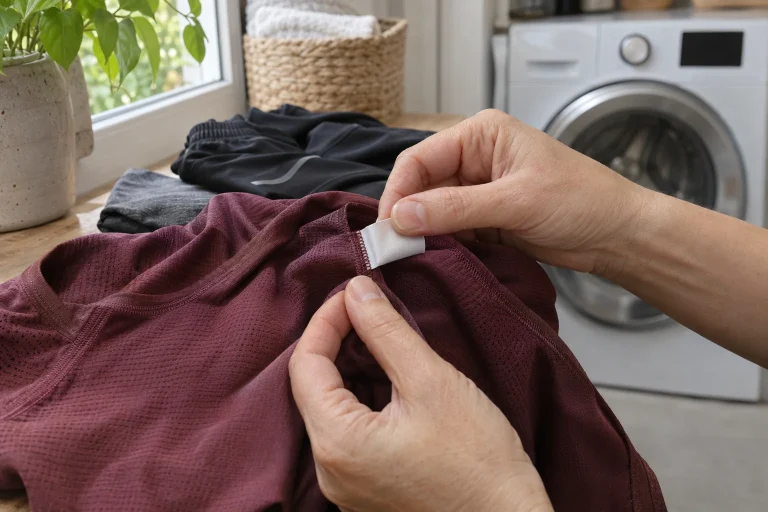
According to the GINETEX information on care symbols , symbols provide information about permitted treatment and appropriate care. The first step in clothing rotation is therefore reading your own items’ instructions. A T-shirt and a technical jacket do not necessarily belong in the same care group simply because both are used for running.
Check washing, drying and other care conditions. If a symbol is unclear, find the manufacturer’s official explanation. Do not fill missing information with guesses. The material name alone may also be insufficient because the complete garment can include other details, bonded areas, prints and accessories.
You can make a brief personal note about clothes needing special care. You do not need to find every label again each time, but keep the instructions retrievable. If asking the manufacturer a question, precise product identification helps. “Sports jacket” is too broad a description for a specific care decision.
Wash time is only the middle of the process
It is easy to put Wednesday-evening washing into the weekly calendar. What matters for the next run, however, is when the whole outfit will be ready to use. This includes sorting, the appropriate wash programme, unloading, drying and putting away. If the clothes are still damp the next day, the wash time alone did not resolve preparation.
Do not treat drying time as a number independent of all circumstances. The garment, permitted method and conditions at home can all matter. First observe the actual process in your household. This shows more accurately how much earlier care needs to start before the next outing.
If using a tumble dryer, the particular garment’s instructions determine whether and how this is permitted. Do not change the requirement for speed. One purpose of clothing rotation is precisely to avoid thinking about accelerating drying at the last moment.
 Enlarge diagram
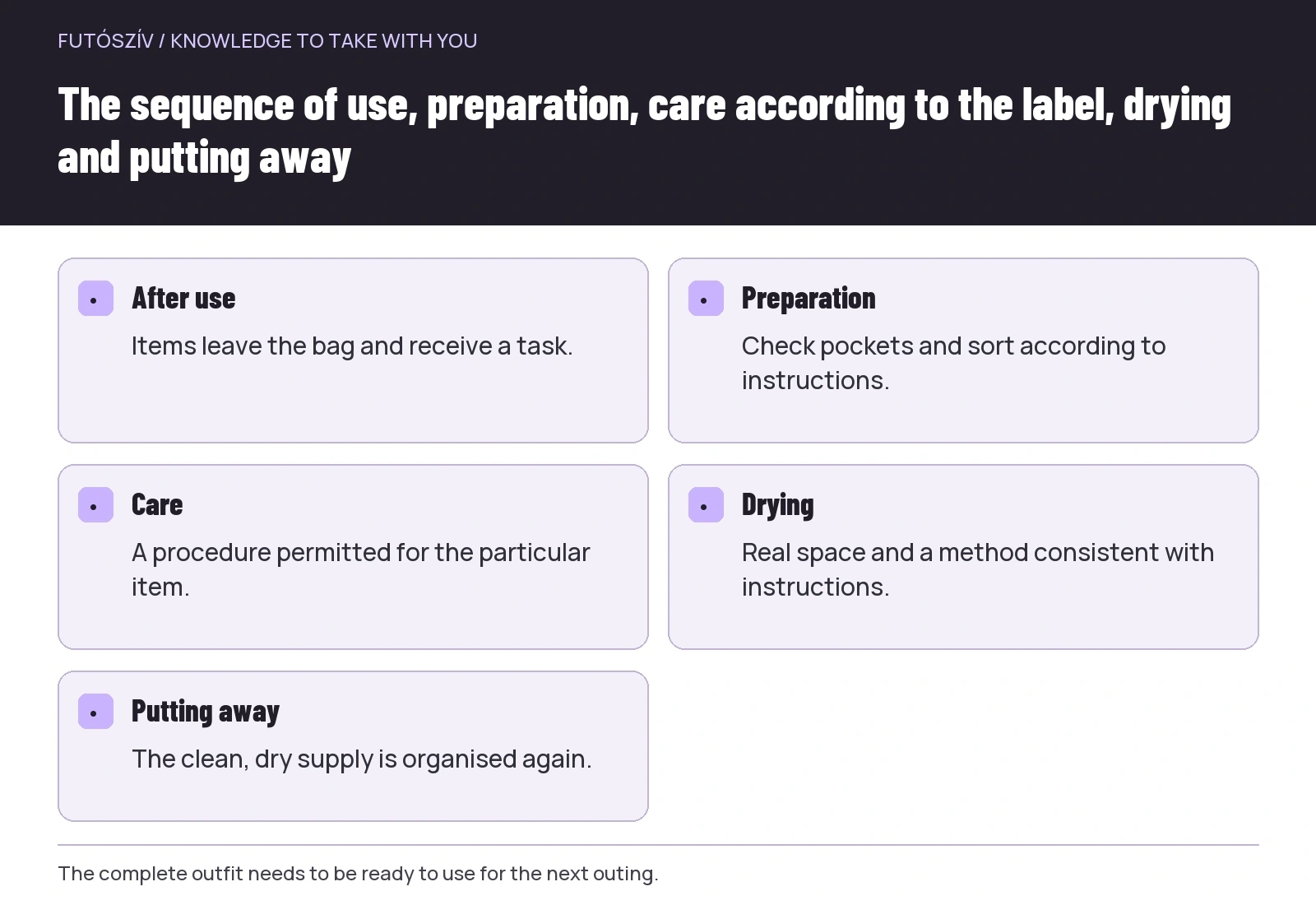
Text version of the diagram
- After use
- Items leave the bag and receive a task.
- Preparation
- Check pockets and sort according to instructions.
- Care
- A procedure permitted for the particular item.
- Drying
- Real space and a method consistent with instructions.
- Putting away
- The clean, dry supply is organised again.
Create compatible care groups
Base grouping on clothing and machine instructions. Colours, materials and care conditions may require different groups. This article does not offer one temperature or detergent that solves everything. Instead of a general internet recipe, use the procedure permitted for your own clothing.
For a technical outer layer, product-specific guidance may be particularly important. The GORE-TEX outerwear care page , for example, describes separate washing, drying and water-repellent treatment steps for its own product groups. These cannot automatically be copied to every running T-shirt or every garment described as waterproof. The example shows why precise identification matters.
Do not confuse organising a clothing rotation with experimenting with chemicals. When using a cleaning product, consider both its own label and the garment’s requirements. More products or greater quantity are not solutions in themselves. For a persistent care problem, information from the manufacturer or an appropriate professional may be the next step.
A weekly map for your clothes
| Question | What should you note for your own week? |
|---|---|
| When is the next outfit needed? | The day of the next planned outing |
| What is clean and dry now? | An actual, complete outfit |
| What awaits care? | Specifically named garments and their next tasks |
| When is there room for washing? | A usable occasion in the household’s shared schedule |
| Where and how can it dry? | A real option appropriate under the label |
| When will you check readiness? | In good time before the next departure |
The weekly map can be one phone note. You do not need to track every sock in a separate database. The aim is to recognise dependencies: tomorrow’s item still awaits care, the backup is incomplete, or drying space is occupied by other clothes. Seeing this earlier makes a simpler solution easier to choose.
An illustrative example with two usable outfits
A runner uses two complete basic outfits appropriate for current conditions. After the first outing, set A enters the care process and clean set B is available for the next one. Washing is organised so that A is ready according to its instructions before its next use. Time for care appears in the calendar as a separate task.
If the programme changes unexpectedly, the runner does not assume partly prepared A is already usable. They check its actual condition. If there is no suitable supply, clothing logistics and outing arrangements need reorganising. Depending on their situation, this may mean another time or another suitable outfit. The training-programme decision remains a separate question.
The example does not imply that two sets are enough for everyone. Different frequency, weather, a shared washing machine or longer drying may make another quantity practical. Actual rotation time reveals the number needed. Learn how your own system works before buying.
Keep the post-run handover short and clear
On arriving home, take used items out of the bag. After separation during transport, give them an appropriate next place and task. If everything remains in the bag until the next departure, the weekly rotation cannot work. Closing the outing may involve a few simple decisions: what you handle now, what enters the next wash and what awaits separate inspection.
Check pockets before care. Keys, tissues, cards and small wrappers can remain inside. Handle fastenings and prepare clothes according to instructions. Checking before they enter the machine is not glamorous, but can prevent plenty of avoidable inconvenience.
Returning clean clothes completes the cycle. If supplies remain on the airer, they are theoretically available yet may still be difficult to assemble at departure. A complete outfit returned to its own storage location clearly indicates usable condition. The system aims to make the next departure easier, so putting away is a task too.
 Enlarge diagram
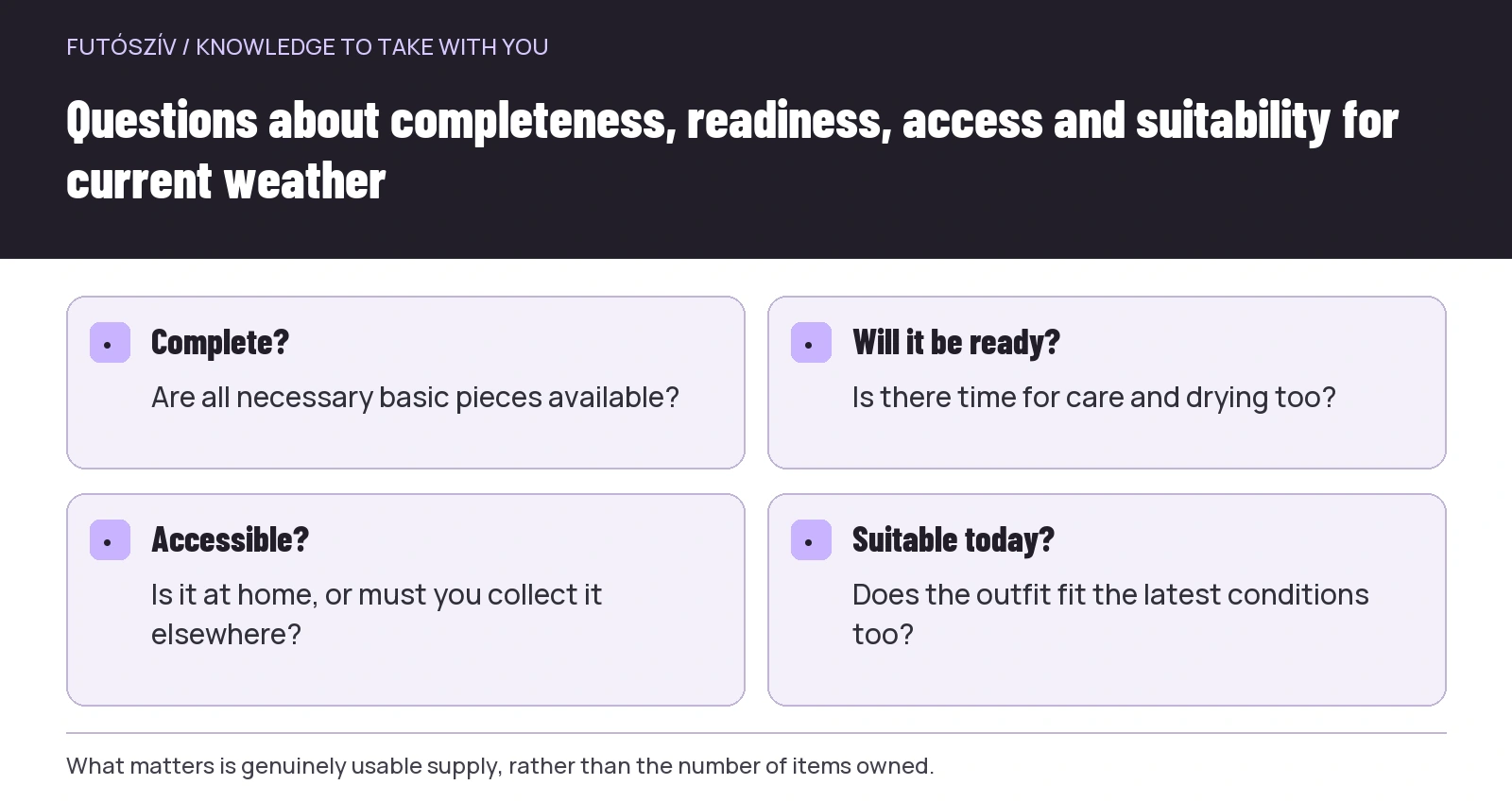
Text version of the diagram
- Complete?
- Are all necessary basic pieces available?
- Will it be ready?
- Is there time for care and drying too?
- Accessible?
- Is it at home, or must you collect it elsewhere?
- Suitable today?
- Does the outfit fit the latest conditions too?
Prepare separately for changing weather
A weekly clothing rotation should allow for needing another layer. Select for the next outing according to current conditions rather than insisting solely on the pack chosen at the week’s start. A prepared outfit is an organised basis, but does not replace the daily check.
If the same outer layer matters for several outings, check when it can enter care and be ready appropriately afterwards. Timing must not mean postponing necessary care indefinitely. Product instructions and actual use together provide the basis for a decision. If every programme relies on one item, its availability is a real organisational question.
Do not count confidently on borrowed clothes or items stored elsewhere until access is agreed. A jacket left with a friend or a top forgotten at work should have a separate place in the weekly inventory. “I own it” and “it is available when I leave tomorrow” are different states.
Travel and a shared household may create a different rhythm
Before travelling, plan not only clean supplies but also transport home and later care of used items. At accommodation, use only facilities permitted there and appropriate for the garment. If washing or drying is unavailable, packing and programme arrangements need to reflect this. Ask about the accommodation’s facilities beforehand.
In a shared household, washing-machine and drying-space use may require coordination. Running clothes do not automatically take priority over all other laundry. When the need is known beforehand, finding a suitable time is easier. Recurring arguments often arise because the need only becomes clear the evening before departure.
If someone else handles the clothing, make instructions and special needs clearly available. Do not expect them to remember every specialist item’s conditions. Precise coordination and your own preparation reduce misunderstanding. Clothing rotation connects with the household’s shared operation.
When is buying another item worthwhile?
Name the shortfall first. Is rotation time too long for the supply available? Has a basic item worn out? Is there no suitable outfit for current conditions? A specific problem supports a targeted decision. Buying more tops may only temporarily conceal a disorganised washing process.
If supplies are adequate but care timing fails, change that first. If the real constraint is infrequent access to a shared machine or a longer permitted drying time, additional supply may be practical. Let the decision follow from your own system. The quantity needed is not a general runner’s rank or expectation.
With a new item, care conditions can matter before purchase. If it needs a procedure difficult to manage at home, using it may also be more cumbersome. Comfortable clothing and sustainable care together make an item useful in your own system.
At week’s end, look for the bottleneck
Review where the cycle stopped. Did clothes never leave the bag? Was washing complete but no suitable drying provision remained? Were clean supplies left in different places? Each needs a different small change. Naming the problem precisely helps simplify next week.
Keep what worked and change one detail at a time. A good clothing rotation does not demand major tidying every day: it needs a few clear states, following care instructions and checking before the next outing. When the location and ready time of the next clean, dry outfit are clear, much guesswork disappears from getting ready to run.
How Futószív articles are prepared: our editorial guidelines.