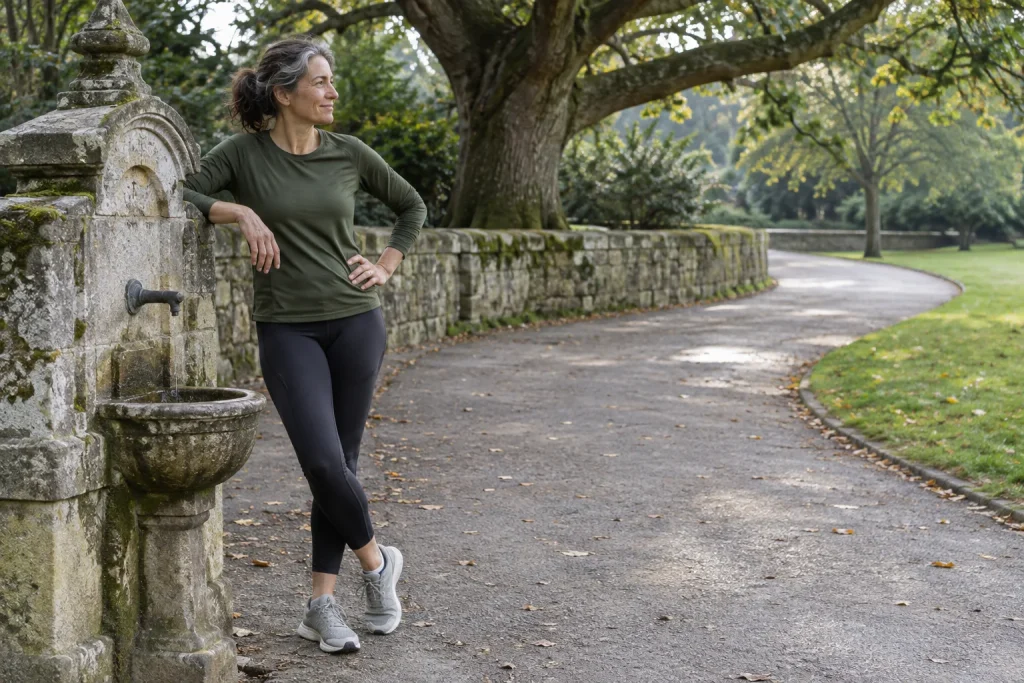
Running the same easy loop several times may initially seem less exciting than collecting new routes. Repetition has its own informational value, however. Once you know where the path bends, where the walkway narrows and when you return to the entrance, you may have more attention for organising the outing and the decisions you make along the way.
A familiar loop is not a home laboratory that precisely assesses your condition every day. Your surroundings and your day change, and measurements can have limitations. Even so, you can learn many useful things if you choose a question beforehand and interpret the experience alongside the circumstances. The aim here is to understand an easy, familiar outing better, rather than turning every return into a time trial.
First say what you want to notice
Choose one observation question for a run. For example: how much earlier should you start getting ready to avoid rushing? Which gate makes arrival simpler? How is the park used at the time that suits you? Repeating a route can create a more comparable setting for these questions than starting somewhere different every time.
How progress feels on different parts of the route is another question. A familiar hill, long straight or busier section provides recognisable reference points. You can describe this in everyday language without immediately assigning a physiological explanation. Naming an experience and proving its cause are separate steps.
If you ask “am I a better runner today?”, you are giving a single loop too big a task. If you ask “did the calmer departure and equipment prepared beforehand work?”, you are observing specific details. These can support a useful decision for the next outing. Compared with judging yourself generally, this is more precise and more open to change.
Define a consistent default version
Have a starting point and route you can describe clearly. You do not need to mark every centimetre of pavement, but know which loop or section you mean. If you include the approach on one occasion but measure only the inside of the park on another, the times refer to different programmes. It is worth distinguishing them.
The default version can include departure circumstances too: where you usually arrive from, where you put your key and how you return home. Knowing these makes time planning easier. The NHS page for beginner runners also recommends planning the route beforehand. On a repeated loop, you can gradually develop this local knowledge in more detail.
If you use another gate, shortcut or additional loop for any reason, name it as a separate version. “Default loop”, “short loop” and “evening version” may be easy labels to find later. This does not make the system complicated; it simply avoids mixing different situations. Variety and comparability can then be managed together.
 Enlarge diagram
Text version of the diagram
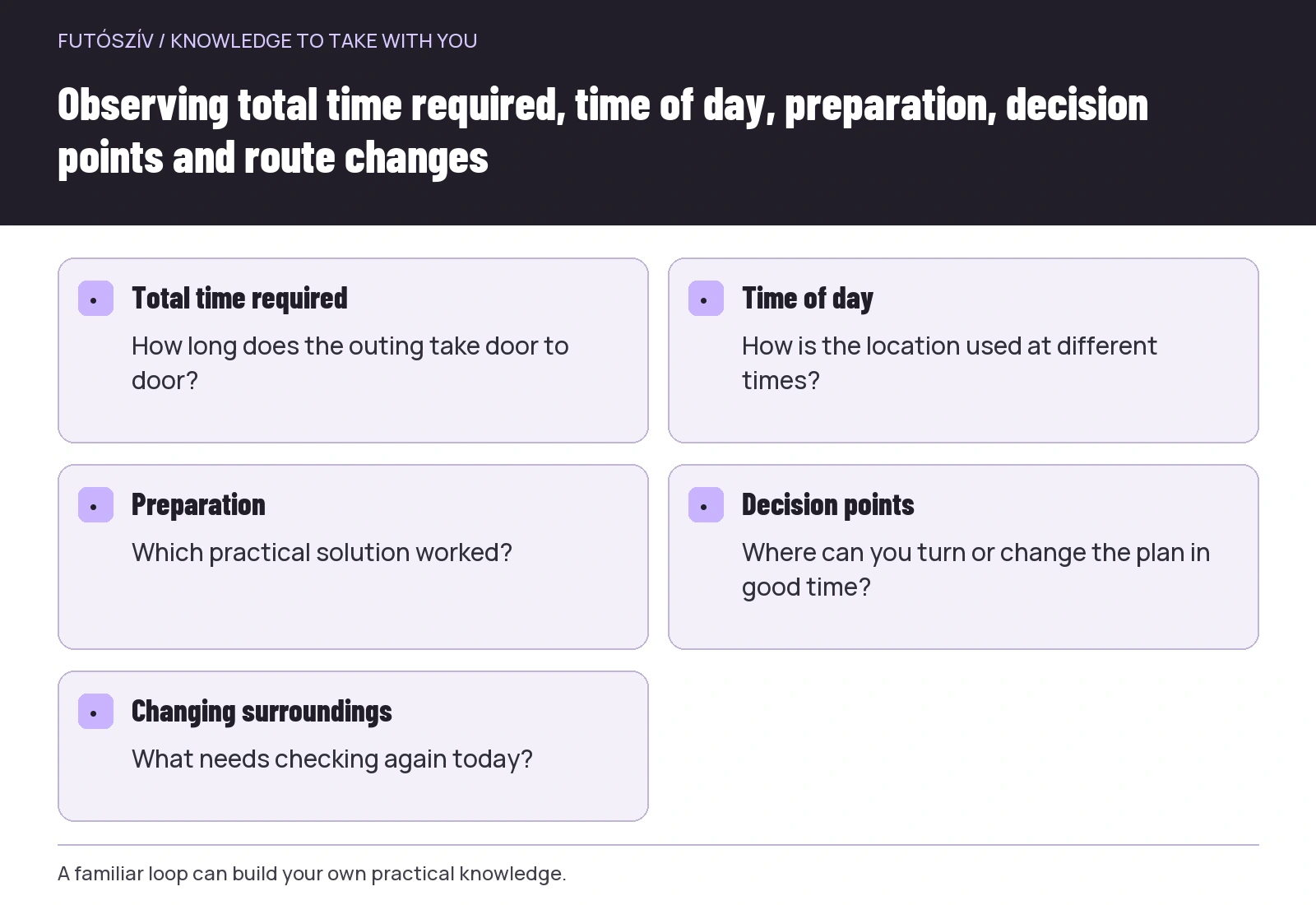
- Total time required
- How long does the outing take door to door?
- Time of day
- How is the location used at different times?
- Preparation
- Which practical solution worked?
- Decision points
- Where can you turn or change the plan in good time?
- Changing surroundings
- What needs checking again today?
Five things you can learn beyond your finishing time
The time needed for the complete outing. Repetition can show how much time a door-to-door outing requires. Preparation, getting there and returning home also become more predictable. This is particularly valuable for your everyday arrangements: you know more precisely which day has room for running.
Patterns of use at different times. You can observe when the path is busier, which entrance attracts groups and where you need to stop more often. Treat this as part of the location’s normal use. Experience can help you choose a time or version better suited to calm practice.
How your preparation works. On the same loop, it is easier to notice that the load is more stable, your phone more accessible or departure less rushed this time. You do not need to transform everything together. One small change can have a clear practical consequence.
Your decisions on the route. You recognise where you tend to turn back too late for your available time, or where to pay attention to your surroundings earlier. Knowing the route lets you prepare for those points. Learning such decision locations can later provide a useful outlook in other surroundings too.
Changes in the loop. On the same section, you may notice a new closure, damaged surface, seasonal change or out-of-service drinking fountain. Familiarity is therefore valuable together with fresh attention. Earlier experience is no reason to stop looking around.
Separate the fact from the explanation
“Today I stopped twice before the narrow bridge.” That can be recorded as a fact. “My condition must have deteriorated a lot.” That is an interpretation for which the statement provides too little information. There may have been more foot traffic, different weather, a different lead-up to the day or simply another decision. Recording the circumstances of the stop gives a more accurate picture.
The same applies to a more pleasant outing. If the loop felt easier this time, you can enjoy it without immediately naming a single cause. Perhaps you prepared better, the location was calmer or you chose your start differently. Another similar outing can add an observation. Acknowledging uncertainty about the cause does not take away the good experience.
Use three columns: observation, possible explanation and next decision to try. The third should contain only something you can actually change. You cannot rearrange every park user, but sometimes you can change departure time or avoid a crowded section. This keeps the note practical.
| Observation | Possible explanation | A decision to try |
|---|---|---|
| I waited a long time at the entrance | More groups arrived at the usual time | Use another familiar gate |
| The phone kept shifting | The pocket position is unsuitable | Try the pockets of another garment at home |
| I got home late | I did not include the approach in the total time | Plan the next outing door to door |
| Finding my way around the loop was easier | The decision points are now familiar | Keep the default version without a new task |
Even on the same route, data quality can vary
If you record with a watch or phone, displayed distance and pace may differ from the route’s exact real values. Garmin’s support page on GPS distance, speed and pace accuracy mentions several environmental factors, including tall buildings and dense tree cover. Map traces a few metres apart do not therefore necessarily mean you actually changed route.
First consider the data alongside the recording conditions. Did you start recording at the same place? Did you finish at the same point? Was there a long stop or an odd line suggesting signal loss? If you did not record the same part of the outing, the comparison is already about something different. The device instructions can help interpret your own settings.
You do not need to correct or explain every tiny difference. Learning from a familiar loop does not require a map accurate to the centimetre. For many everyday questions, knowing where you went, what the surroundings were like and whether the outing fitted your day is enough. Data can be a useful addition, but not the only evidence that the outing happened.
 Enlarge diagram
Text version of the diagram
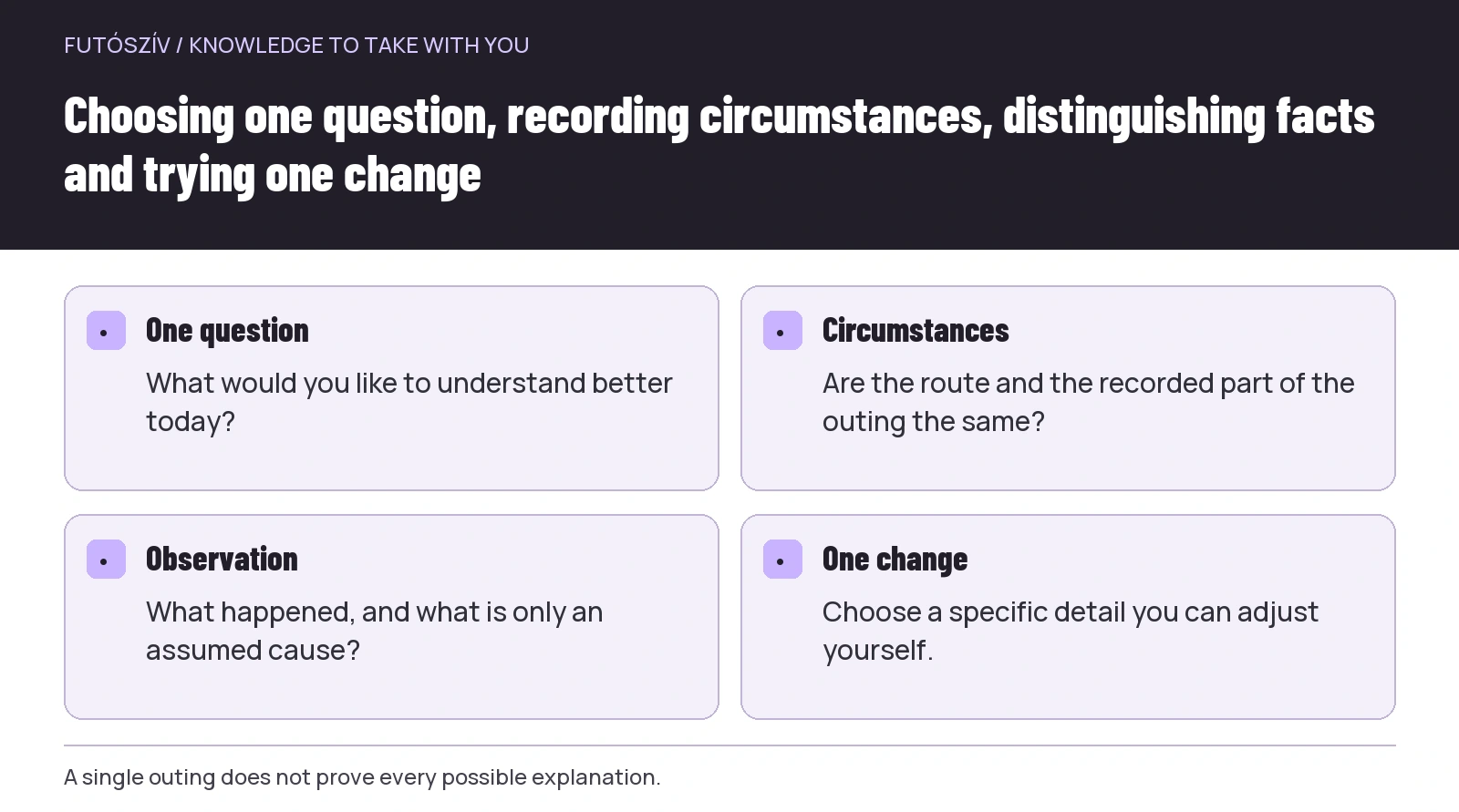
- One question
- What would you like to understand better today?
- Circumstances
- Are the route and the recorded part of the outing the same?
- Observation
- What happened, and what is only an assumed cause?
- One change
- Choose a specific detail you can adjust yourself.
Observe one change at a time
If you choose a new route, new equipment, a new departure time and a new companion at once, many things change. This can be a pleasant experience, but it is less clear why the outing felt different. One advantage of a familiar easy loop is being able to try a single practical detail separately.
For example, you can test phone placement while keeping the rest of the setting more or less familiar. Afterwards, you can say whether it was more accessible and whether it interfered with movement. This gives a specific conclusion about storage. You do not need to extend the result to your entire running performance.
You can similarly try preparation before departure or using another entrance. Give the change a named purpose. “This time I am observing whether starting here is simpler.” That is enough. The method helps you understand your own decisions; it is not a controlled scientific experiment and does not provide a medical diagnosis.
The easy loop can stay easy
Repetition can easily become competition if your previous fastest time becomes the goal every time. You are then no longer doing the same task for which you originally chose the route. If today’s programme is easy, fit the observation question to that too. Beating a time is a separate decision and a different goal.
You can choose a display or recording method beforehand that does not constantly draw attention to comparison. Use your device’s functions according to the current instructions. Another option is to note only the end of the outing and focus on the surroundings during it. Observation does not require analysing every second.
If you run the default loop with company, agree on today’s aim. Your familiarity with the route does not automatically make it easy or understandable for the other person. A shared outing may give the same loop a different framework. Treating it as a separate version also lets you relate it more accurately to earlier experience.
When should you choose another loop?
If the familiar route is currently closed, uncomfortably crowded or unsuitable because of the conditions, do not insist on it for comparability’s sake. The route is a tool for your programme. Accepting a change in the location may mean using another known section or another time. Continuity of a measurement series does not take priority.
The parkrun information on event cancellations also shows that a regularly used location can sometimes be unavailable because of weather or route problems. On your own loop, you need to notice current changes yourself. Habitual use does not guarantee suitability today.
You can choose another loop simply because you want to explore somewhere new too. There is no need to turn repetition into an exercise in enduring boredom. In your route library, the default loop and exploratory outings can serve different roles. The first simplifies decisions; the second expands local knowledge. Both can be useful if they fit today’s programme.
After three outings, make a useful summary
After a few repeats, review which practical questions you have answered. Perhaps the time needed to leave is clearer, you know which entrance is easier and you have found a more comfortable pocket. These are outcomes even if the displayed pace has not improved. They can make preparing the next outing simpler.
Include uncertainty in the summary too. “I have not used it in rain yet.” “I do not know its late-evening condition.” “One outing started from another gate.” This preserves the actual scope of the observations. Missing experience can be gained separately later if needed; you do not have to fill it with guesses.
Finally, choose one detail to keep and one to change. You might keep the nearby start but change the gate. Keep the short loop but make arrangements at home earlier. Repetition then builds your own practical knowledge. The same loop becomes valuable as you increasingly understand how to fit it into your day and make sound decisions on it that suit the situation.
How Futószív articles are prepared: our editorial guidelines.