What makes a run with a friend difficult is not different speeds, but different understandings of the shared outing. One person wants to chat; the other wants to complete their training plan. A short loop is a new challenge for one, while the other expects a longer programme. Friendship can remain a good foundation if you name these differences before setting off and choose a format to suit them.
There are several workable ways to run together at different paces. You can stay together throughout, share one section, move at your own rhythms around the same small loop, or meet after separate programmes. None of these formats is inferior to another. The choice depends on the purpose of today’s outing, the time available and what you can genuinely agree to happily.
Talk about the purpose first
Instead of “let us go running”, be a sentence more precise. “We would like to spend half an hour together in the park.” “Company would be nice at the start of my programme.” “I would like to show you the route, but I do not want to practise pace today.” Such sentences immediately show how much shared time you plan and what kind.
If either of you has a fixed training task that day, do not hide it inside a social invitation. You can meet before or after the task, or choose another day. Announcing an acceleration partway through a social run can easily put the other person in an awkward position, especially if they feel they should keep up for the sake of the friendship.
Community running has value in its own right. England Athletics’ RunTogether programme also supports friendly, inclusive shared movement in an organised form. For an outing arranged between two people, the important part of this approach is to shape your time together deliberately. Shared time counts even when you are not both doing the same training work.
“Slow for me” is not a shared unit of measurement
It is hard to build a mutual commitment from individual feelings. A conversational rhythm for one person may be demanding for the other. A well-intentioned “I will go slowly” from the faster friend therefore does not settle everything. It is more useful to clarify which format the other person knows and is happy to undertake: a short continuous run, alternating running and walking, or moving together for a set time.
The NHS beginner programme also uses running and walking sections. This is a useful reminder that walking can be included in the shared plan from the start. If it is one person’s familiar format and suits the other, there is no need to apologise or renegotiate the outing at every walk break.
If you agree a numerical pace, translate that into a shared language too. Minutes per kilometre and kilometres per hour are not the same display. Clarify the unit, but do not treat the figure as a promise independent of every condition. Hills, crossings and crowding can all affect progress. On site, the surroundings and participants’ feedback matter.
 Enlarge diagram
Text version of the diagram
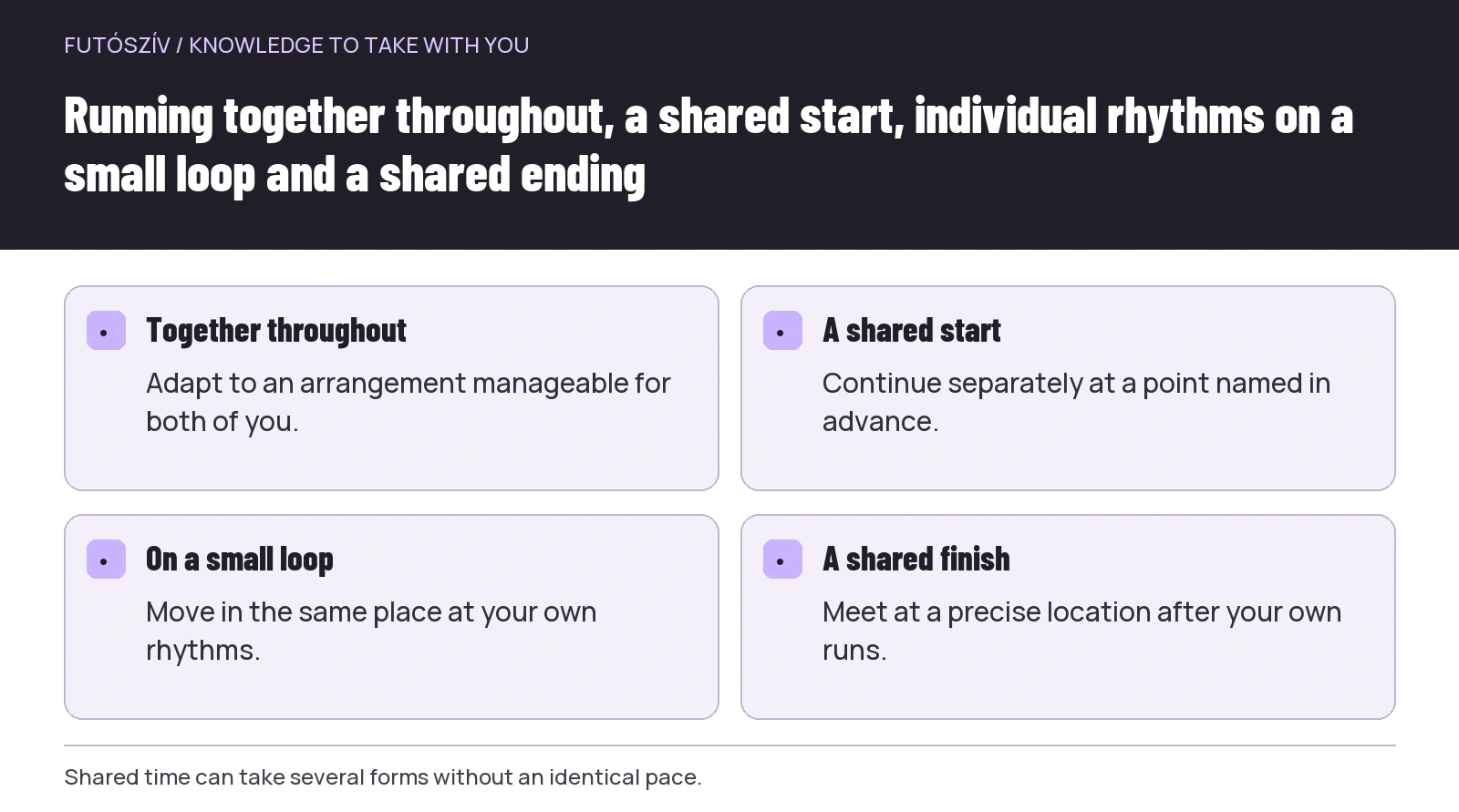
- Together throughout
- Adapt to an arrangement manageable for both of you.
- A shared start
- Continue separately at a point named in advance.
- On a small loop
- Move in the same place at your own rhythms.
- A shared finish
- Meet at a precise location after your own runs.
Four ways to share a running outing
| Format | What are you agreeing to? | What makes it clear? |
|---|---|---|
| An entirely shared outing | You move together on the same route | Adapt to the shorter, more manageable shared arrangement |
| A shared first section | Start together, then continue separately | A preselected separation point and onward plan |
| Your own rhythms on a small loop | Move in the same place and meet occasionally | A familiar loop, meeting point and finishing time |
| Separate runs, shared ending | Each person follows their own programme | A precise meeting arrangement and contact if delayed |
State your chosen format in everyday language. “I want to stay together throughout today, and the shorter version is what fits for me.” Or: “We go together from the park entrance to the first bridge, then you continue around the big loop and I head home.” A specific agreement gives both of you a programme you can follow.
An outing together throughout needs a shared boundary
If the aim is conversation and company, the route and time window should be manageable for both of you. The more experienced person needs to accept this as their own decision. If they constantly signal how much faster they would otherwise go, the other person may easily feel that keeping pace with them is a favour. A shared outing does not need constant comparison.
Staying together does not mean occupying the whole walkway side by side. In narrow places or near people approaching, you can move into single file. Consider both the opportunity to chat and the surroundings when choosing a route. A calmer, familiar loop may suit this better than a section with many crossings.
Have a simple signal for changing the plan. “Let us walk at the next point.” “Let us turn back.” “This is enough for me today.” These are complete statements, not opening bids. If you agreed beforehand to accept the signal, less explanation will be needed on the way. The decision does not need to depend on an external judgement of the other person’s fatigue.
Starting together, then continuing separately
This format is practical when one of you wants a longer programme but both enjoy a shared section. Choose an unambiguous separation point. It should be somewhere you both know your own onward route. An uncertain forest junction or an unfamiliar neighbourhood is a less suitable choice.
Do not leave hidden expectations after separating. If you agree that the person choosing the shorter distance goes straight home, the other should not later wait at the far end of the park. If you will meet again, set a precise place and time. “We will do laps and run into each other” can work on a very small, easy-to-oversee circuit, but over a larger area it can easily become a search for each other.
Saying goodbye does not mean the shared programme failed. The time together you agreed to has happened, and both of you then follow your own plans. This can be flexible, particularly with changing schedules. The person heading for a longer run should not expect the other to stay beyond their intentions merely because the outing started well.
Choose a looping-back method carefully
In organised groups, faster participants sometimes loop back to the rear of the group before continuing together. England Athletics’ report on Lawley Running Club presents this practice too. It is a specific community method, not a rule automatically suitable for every route.
Try it as a pair only if you both understand how it works, visibility is good and turning back does not interfere with other users. On a narrow path, busy crossing or among many junctions, sudden direction changes can add a new attention task. Staying together throughout or meeting at an agreed point may then be simpler.
The faster person’s extra movement should not become a conspicuous display of circling the other. The method aims to coordinate the group, not emphasise differences. The other person should be able to say that it feels uncomfortable or hard to follow. A workable format is a mutual choice, not a technique one person imposes.
 Enlarge diagram
Text version of the diagram
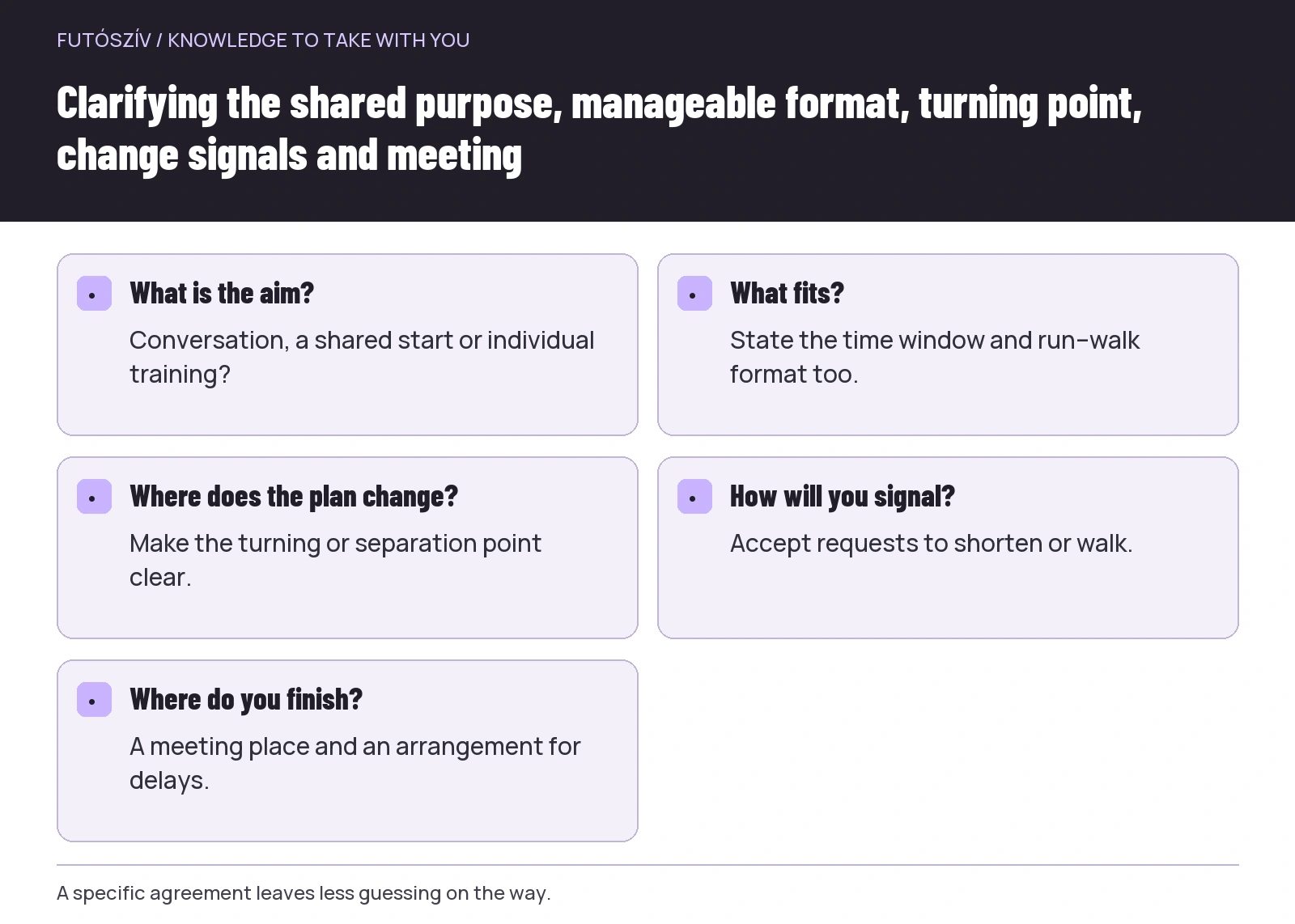
- What is the aim?
- Conversation, a shared start or individual training?
- What fits?
- State the time window and run–walk format too.
- Where does the plan change?
- Make the turning or separation point clear.
- How will you signal?
- Accept requests to shorten or walk.
- Where do you finish?
- A meeting place and an arrangement for delays.
When a small loop is better than a big shared outing
A well-known short loop allows you to move at different rhythms in the same surroundings. You can agree where to meet at the end and when to check whether a change is needed. This can help particularly when sharing a location matters more than continuous conversation.
Assess whether the loop really is easy to understand. In a large park with several gates, it is easy to return along a different branch. Make the meeting point unambiguous, such as a particular entrance or distinctive point with an official name. If one person finishes earlier, they should already know whether to wait or send a message and go home.
Even on the same loop, comparing results is not compulsory. The number of laps may differ, as may today’s aims. The social presence is still real: you arrive together, greet each other occasionally and discuss your experiences. A community format does not have to exist at only one speed.
Sentences that make arrangements easier
“I still alternate running and walking. I can enjoy coming if that fits the shared plan.” This shows the format you can manage. You do not need to apologise in advance for your current habit. The other person can then decide whether to join today using real information.
“I have a longer programme of my own today. I am happy to start with you, but I would continue separately at the bridge.” Here, the more experienced person also states their own aim clearly. They do not promise a fully shared outing they later regret. A specific separation point protects the other person from a surprise on the way.
“I want to chat today, so I am not looking at a pace target.” If you mean it, handle watch alerts accordingly. Reading out pace figures every minute during a social outing can send a different message from the stated aim. Equipment settings can support the intention of the outing too.
“This is faster than we agreed; let us ease back.” Feedback on the spot can be factual. You do not need to wait until a bad feeling becomes an argument. The other person should simply accept the signal rather than trying to decide from the outside whether the rhythm is genuinely difficult.
Distinguish unsolicited advice from help
Different experience does not automatically make someone a coach. A friend can be good company without analysing every step you take. If you want an opinion, ask specifically; if you would give advice, first ask whether the other person wants it. A social outing does not automatically become technical instruction.
Be especially careful with statements about pain, health conditions or individual training load. A faster friend’s personal experience does not replace appropriate professional help in these matters. Someone wanting to stop or finish is enough reason to modify the shared plan. There is no need to make a diagnosis on the spot.
Useful everyday help can be very simple: showing a familiar route, keeping an agreed time or waiting at a safe meeting point. These are specific tasks that can be requested and fulfilled. The value of support is not measured by the amount of advice.
Evaluate the format at the end
Ask each other whether the time window, shared section and route suited you. If a part did not work, change it for the next meeting. For example, choose a shorter shared start, find another loop or save the conversation until after the runs. The adjustment concerns the programme, not the value of the friendship.
If one of you adapted throughout, agree to do so next time only if you really want to. A repeated, unspoken favour can easily become resentment. A short shared outing chosen honestly can offer more than a long programme during which both of you wanted something else. At the end of a good shared run, you both know what you agreed and why meeting was worthwhile.
How Futószív articles are prepared: our editorial guidelines.