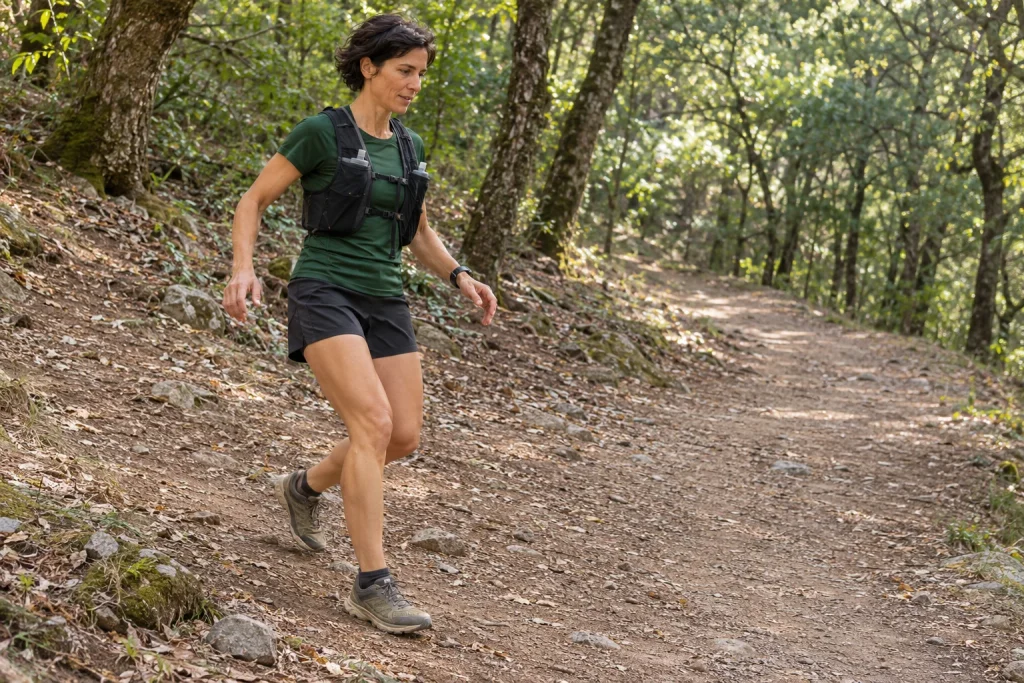
At the top of the climb, you feel relieved: now it is all downhill. Your breathing soon settles, your pace rises, and the descent can seem like free recovery. Yet climbing the stairs the next day may tell a different story. Downhill running requires particular muscular work and technical attention. Safer, more confident descending is therefore not simply a matter of courage, but a skill learned gradually.
The difficulty of a descent is not determined by gradient alone. Surface, visibility, weather, bends and fatigue all matter together. A smooth park path and a rocky mountain trail can be very different tasks despite the same elevation loss.
Why do your muscles work downhill too?
On a descent, you have to control and partly brake the body’s movement. Muscles can produce force while lengthening; this is called eccentric work. The sensation of breathing and the load on your muscles may therefore differ from what you experience uphill.
The review by Bontemps and colleagues also discusses downhill running as an important model in research on eccentric loading and exercise-induced muscle damage. However, differences in protocols and participants mean that findings need to be generalised cautiously.
The practical message is not that you should fear descents. Rather, easier breathing should not automatically lead you to assume a low overall load. Include descending time and elevation loss when interpreting your run.
Make control your first goal
Choose a speed that still leaves time to notice the surface for your next few steps. If you are constantly braking hard, scrambling or being surprised before bends, your pace does not suit the situation. Slowing down or walking can be a deliberate technical decision.
Do not use the speed of a runner passing you as your benchmark. They may have different experience, equipment and aims. Your own route choice and capacity do not follow from someone else moving quickly in the same place.
Control also means being able to let go of a fast descent. Wet rock, poor visibility or fatigue may call for a different decision on the same section than on a previous good day. Recognising the situation is part of the skill.
Where should you learn?
For your first practice, choose a familiar surface with good visibility and a modest gradient. There should be enough room to slow down, and the descent should not lead straight into a busy junction. Inspect the location on foot first.
Technical terrain compresses many decisions into a short space. While you are still learning a downhill rhythm, you do not also need to contend with roots, loose rocks and tight bends. Simplifying the task helps you focus on movement itself.
For repeated sections, the return journey matters too. Walking or running uphill is part of the whole session. Do not log only the minutes spent descending if the rest of the loop also added load.
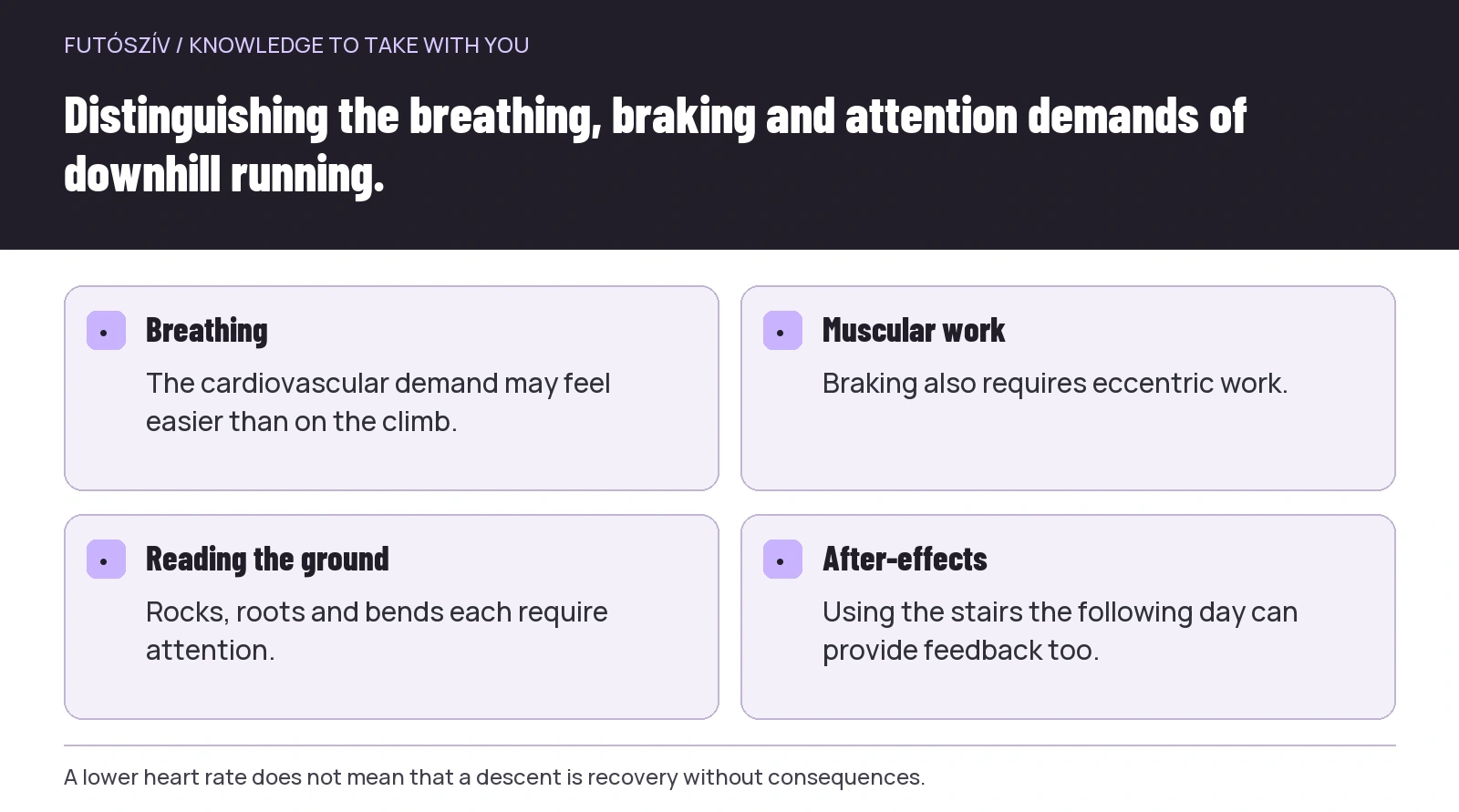 Enlarge diagram
Text version of the diagram
- Breathing
- The cardiovascular demand may feel easier than on the climb.
- Muscular work
- Braking also requires eccentric work.
- Reading the ground
- Rocks, roots and bends each require attention.
- After-effects
- Using the stairs the following day can provide feedback too.
Changing stride length is not a universal remedy
A common piece of downhill advice is to move with shorter, quicker steps. This can help control in some situations, but it is not a precise prescription for everyone. Speed, surface and individual movement shape the stride together.
A study that modified stride length examined signs of muscle damage after downhill running. Such an experiment does not establish that a single deliberate technique change can prevent every consequence of loading. Changing your movement is itself a new task.
Do not try to land on your toes at all costs or force one foot-strike pattern. If an instruction causes pain or unusual tension, stop and reassess. Persistent symptoms may require an individual movement assessment.
Gaze, arms and upper body: leave room to move
Do not look exclusively at the ground immediately in front of your shoes. Look far enough ahead to identify the next safe steps and changes of direction. This does not mean one fixed distance: a smooth road and a rocky trail require different viewing distances.
Your arms can help with balance as they adapt to the terrain. You do not have to preserve the narrow arm action learned for flat running at all costs. Look for freedom of movement and control rather than rigidly fixing your upper body.
Do not treat online instructions about leaning forwards or backwards as a complete technique on their own. The appropriate degree depends on the particular descent and the person’s movement. If you are uncertain, observation by a qualified trail-running coach may offer more than several conflicting short videos.
Line choice: the shortest route is not always best
On technical terrain, read ahead to identify more stable footing. A slightly longer but more predictable line can be a better choice than an uncertain section heading straight downhill. The aim is to avoid deciding every step at the last moment.
Reduce your speed before a bend so that you do not have to scramble to stop halfway through the turn. Leave more margin on wet or loose ground. A line that worked previously can change after rain.
If you reach an unfamiliar section too quickly, do not try to solve the situation with a sudden large jump. Slow down under control and continue on foot if necessary. Speed without knowledge of the terrain is not a compulsory part of training.
Progress gradually: do not change everything at once
With new downhill loading, gradient, duration, repetitions, speed and surface difficulty are separate variables. Increasing all of them at once makes your response hard to interpret. Choose steps you can track.
Research examining repeated downhill runs found adaptations in neuromuscular and mechanical responses. These are also discussed as the repeated-bout effect. The phenomenon does not justify deliberately making your first session very demanding.
The aim is not to “insure yourself in advance” by producing as much muscle soreness as possible. Research protocols had specific purposes and do not necessarily suit a recreational runner’s first practice. Your own programme needs to fit your background and the days ahead.
Less soreness does not prove complete recovery
A more recent study found that changes in muscle soreness and neuromuscular fatigue did not necessarily go together with repeated downhill sessions. Feeling better the next day therefore does not describe every performance or loading response.
In practice, do not plan another hard day solely on the basis of muscle soreness. Consider everyday movement, control while running and general fatigue too. Taken together, these observations provide a more meaningful picture.
At the same time, every small sensation does not have to be interpreted as an injury. Symptoms that worsen, are sharp, involve swelling or alter your walking deserve particular attention. This article does not provide personal clearance to train through pain.
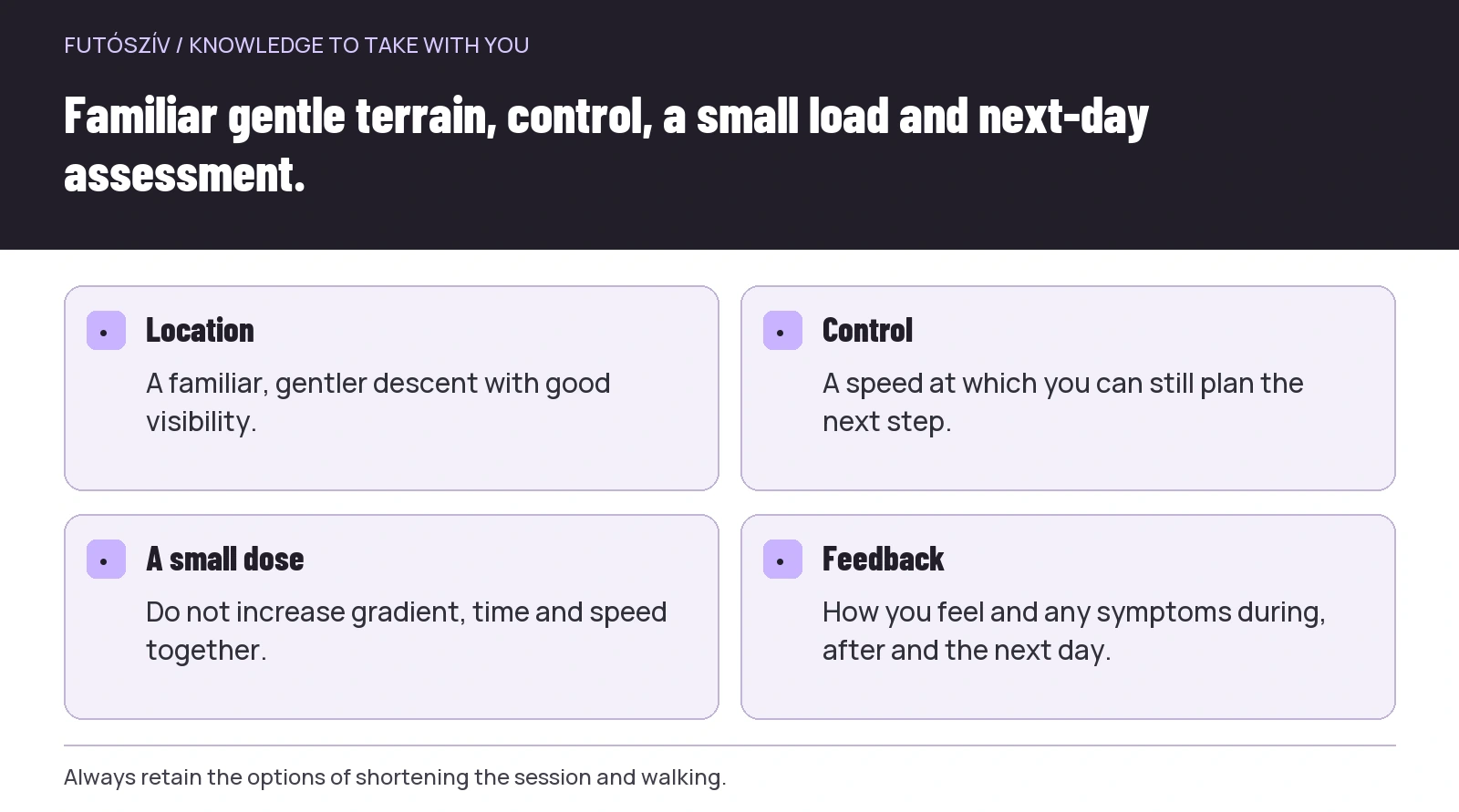 Enlarge diagram
Text version of the diagram
- Location
- A familiar, gentler descent with good visibility.
- Control
- A speed at which you can still plan the next step.
- A small dose
- Do not increase gradient, time and speed together.
- Feedback
- How you feel and any symptoms during, after and the next day.
An early-race descent can be a particular trap
When fresh, it is easy to descend faster than planned. Your breathing is still calm and the surroundings may draw you along with the group. Consider the demands of the later race and how much control you want to retain.
A preselected effort range can help, but on technical terrain safe progress matters more than meeting a rigid pace target. Gaining a few seconds does not justify a risky overtake or an uncertain jump.
During preparation, getting to know a similar descent can be useful, but you do not need to test it at full race effort every time. Familiarity with the line and its more difficult points is useful experience in itself.
Overtaking and shared trails
On narrow terrain, signal your intention in good time and wait for a place where both of you can move predictably. The other runner is not obliged to step suddenly onto a dangerous side. Walkers, hikers and other route users are also part of the situation.
If someone overtakes you, choose a place according to your own stability. Do not jump off the safe line simply because someone is approaching faster. Brief communication and patience help both people.
Leave enough following distance during group practice. Someone stopping at the front should not trigger a chain reaction. Discuss the technical task while stationary first, and be clear about where you will regroup.
If you film movement, do so from a safe position outside the line of travel. A short video can help you discuss rhythm and line choice, but it cannot by itself diagnose the cause of pain. Do not choose a faster or more difficult section for the sake of the recording.
Equipment: grip and manageability
Interpret shoe grip in relation to the particular surface. Mud, wet rock and tarmac may make different demands. An aggressive tread does not make every descent safe, and the toughest race section is not the best place to try new shoes for the first time.
Your bag and bottle should not bounce distractingly with every step. Test whether your belongings stay stable when you run downhill too. If you use poles, you need to learn how to handle them and check the event’s current rules separately.
In rain, darkness or poor visibility, adjust your speed and route as well as your equipment. Technology does not replace sound assessment of the situation.
What should you observe after the session?
Log the time spent descending, approximate elevation loss and surface. Note whether the descent was new or you moved faster than usual. A summary of climbing alone does not describe this part.
The next day, observe comfortable walking and stair use, and how well you can control your next run. Evaluate the experience alongside the full weekly plan. If downhill practice regularly disrupts other sessions, the amount or timing may need to change.
Do not regard the greatest muscle soreness as success. Learning can also show in calmer line choice, earlier recognition of the need to slow down, and reaching the bottom with more in reserve.
Sources and editorial note
This article cites a review of downhill running, experiments analysing repeated bouts and a stride-length study. The research findings have not been turned into promises of injury-free running. Technical and organisational suggestions are general; individual symptoms require personal professional help. Sources checked: 18 November 2026.
How Futószív articles are prepared: our editorial guidelines.