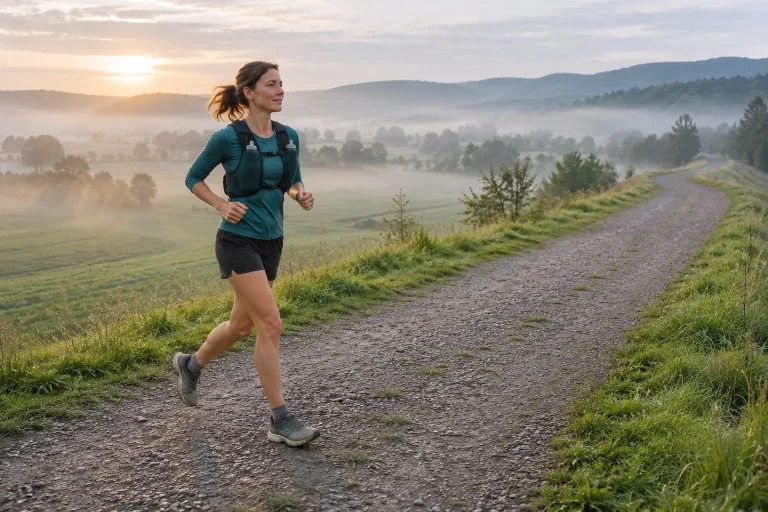
When you run uphill, the pace display can easily answer the wrong question. A kilometre pace that feels comfortable on the flat may demand a very different effort uphill, while walking may be the better way to progress on a steep trail. A good hilly run is not about avoiding any slowdown. It is about adjusting your rhythm to the gradient, the surface and the purpose of the day.
A hill can serve as an endurance challenge, a setting for a short, intense session or an environment for learning technical skills. Those roles are not interchangeable. First establish what you want from the session, then choose the gradient, duration and speed.
What changes when you head uphill?
Uphill, you are not only moving forwards but also raising your body’s centre of mass. That takes energy. Breathing, muscular work and your chosen way of moving may therefore differ from running on the flat. A slower kilometre pace is not, by itself, a sign of poorer fitness.
Research by Minetti and colleagues measured the energy cost of walking and running at different gradients. The findings clearly illustrate how fundamentally slope affects the task. However, laboratory curves cannot define a single switching point for every trail runner.
The review of the physiology and biomechanics of hill running also emphasises adaptations associated with gradient. Interpret your own running in the terrain you are actually on, rather than as a rigid copy of a movement familiar from a flat course.
Percentage and degrees are not the same
Gradient expressed as a percentage is the ratio of elevation change to horizontal distance. A ten per cent gradient means ten metres of ascent for every hundred metres travelled horizontally. A ten per cent climb is not a ten-degree climb: these are different units.
This also matters when interpreting a treadmill setting, route description or map. If someone talks about a “ten incline”, ask exactly what they mean. Imprecise wording can easily create a mistaken impression of the task.
Total elevation gain is also different from the steepest section. A long, gently undulating loop and a short, very steep climb may produce similar total ascent, while requiring different movements and distributions of effort.
Let effort guide an easy day
If the aim is a comfortable run, allow your speed to change. It is easy to carry your flat-ground rhythm into the bottom of a hill, only to find your breathing much harder a few minutes later. A gradual change of rhythm can help preserve the original purpose of the day.
Do not try to recover your lost average pace at the top of the hill. If every climb is followed by a hard acceleration, the easy loop becomes a different task. Pay attention to effort across the whole session, rather than just the flattering display on a downhill section.
Heart rate can provide useful additional information, but on a short hill it may lag behind changes in effort. Consider your own sensations, breathing and the difficulty of the terrain too. If you have health-related restrictions, your agreed personal plan remains the guide.
Shorter strides without forced shuffling
Stride length and rhythm often change uphill. The research examining running mechanics at different gradients analysed several such mechanical differences. These changes do not mean that everyone must reach the same fixed cadence.
In practice, look for a stride that avoids reaching far forwards at all costs and lets you retain control of your movement. Do not try to compensate for lost pace with enormous strides. At the same time, deliberately taking excessively tiny steps can also make your movement tense.
First observe your rhythm on a gentler, familiar surface. If the gradient, speed and technical instruction are all new at once, it will be difficult to tell what helps. One simple observation is often enough for a single session.
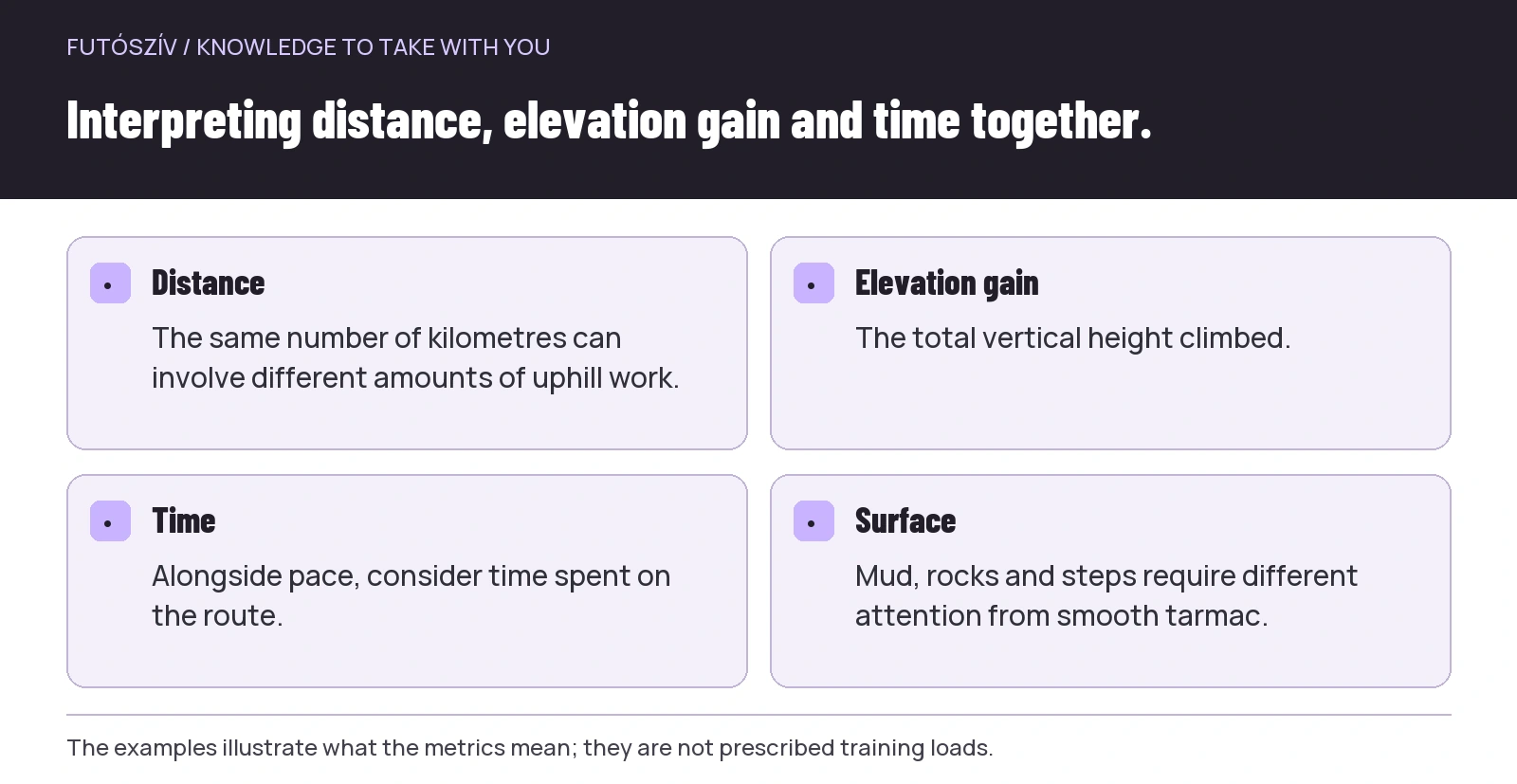 Enlarge diagram
Text version of the diagram
- Distance
- The same number of kilometres can involve different amounts of uphill work.
- Elevation gain
- The total vertical height climbed.
- Time
- Alongside pace, consider time spent on the route.
- Surface
- Mud, rocks and steps require different attention from smooth tarmac.
Let your posture adapt to the terrain
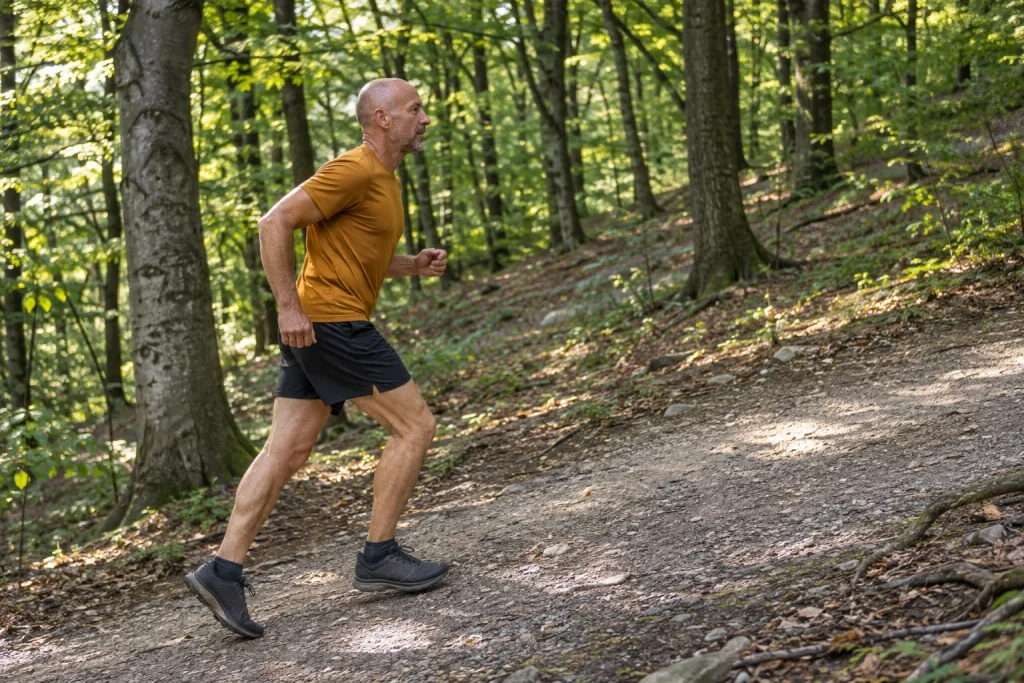
Some forward lean can be natural uphill, but folding at the waist is not a goal to pursue. Keep your gaze where it allows you to see the next safe steps. The precise position also depends on the gradient and your individual movement.
Shoulder and arm movement can support your rhythm, but you do not need to clench your fists tightly with every step. If your upper body becomes rigid, ease the pace and observe whether more comfortable movement returns.
Technical advice should not turn into many simultaneous instructions. “Look ahead, shorten, lift, lean, breathe” can be too much together. Choose one clear aim, such as a controlled rhythm, then assess what else is needed.
Walking can be a deliberate strategy
On steep terrain, choosing between running and strong walking is not a matter of pride. Economy of movement, speed of progress, the rest of the route and individual skill all matter. There is no percentage at which every runner must switch.
It is worth trying walking in an environment where you may need it. The aim is not merely to keep moving without stopping, but to maintain a controlled rhythm and manageable effort. Practising the transition beforehand can make it less unfamiliar during a longer trail event.
Resting your hands on your thighs or using poles raises separate questions of technique and rules. Use poles only if you know how to handle them, the location and event allow them, and you do not endanger others. Do not try a new piece of equipment halfway up the toughest climb.
A short hill and a long climb are different sessions
A short, brisk uphill section may serve a different purpose from sustained climbing. Quality of movement and appropriate recovery may be central to the short task; managing sustained effort may matter more in the long one. The specific dose depends on training history.
Do not automatically treat every hill as an intense repetition. On a trail route, a climb is part of the loop, not necessarily a separate race. If you run every incline flat out, the overall load of the session may differ substantially from what you planned.
Clarify with your coach which role the hill is serving. The phrase “hill session” alone does not specify repetition length, effort, recovery or the return journey. Together, these make up the task.
The descent does not disappear from a hill session
If you repeatedly run up a hill, you usually have to get back down. Descending demands its own effort and attention, even when breathing feels easier. Do not describe a hill session solely in terms of minutes spent climbing.
You can choose a comfortable walking return or another route if it fits the task. Fast downhill running is not necessarily recovery. On unfamiliar terrain, check the condition of the return route beforehand, particularly when there is mud, rock or poor visibility.
How you feel the next day may reflect the combined effects of the climb and descent. If hill work is new to you, do not judge how much work you have done solely by the immediate difficulty of breathing.
Treadmill incline also needs its own interpretation
A treadmill can provide an adjustable gradient, but it does not reproduce every outdoor condition. Rocks, mud, route choices and wind are not present in the same form. The displayed incline and speed are useful data, but not a complete race simulation.
Holding the rails continuously can change the task. Follow the machine’s safety instructions and adjust settings gradually. If you can only move unsteadily at the selected gradient, do not insist on maintaining it for the sake of the display.
New hill work can place unfamiliar demands on your calves, feet and other areas. A treadmill does not automatically make an increase risk-free. If symptoms occur, seek individual professional help as needed.
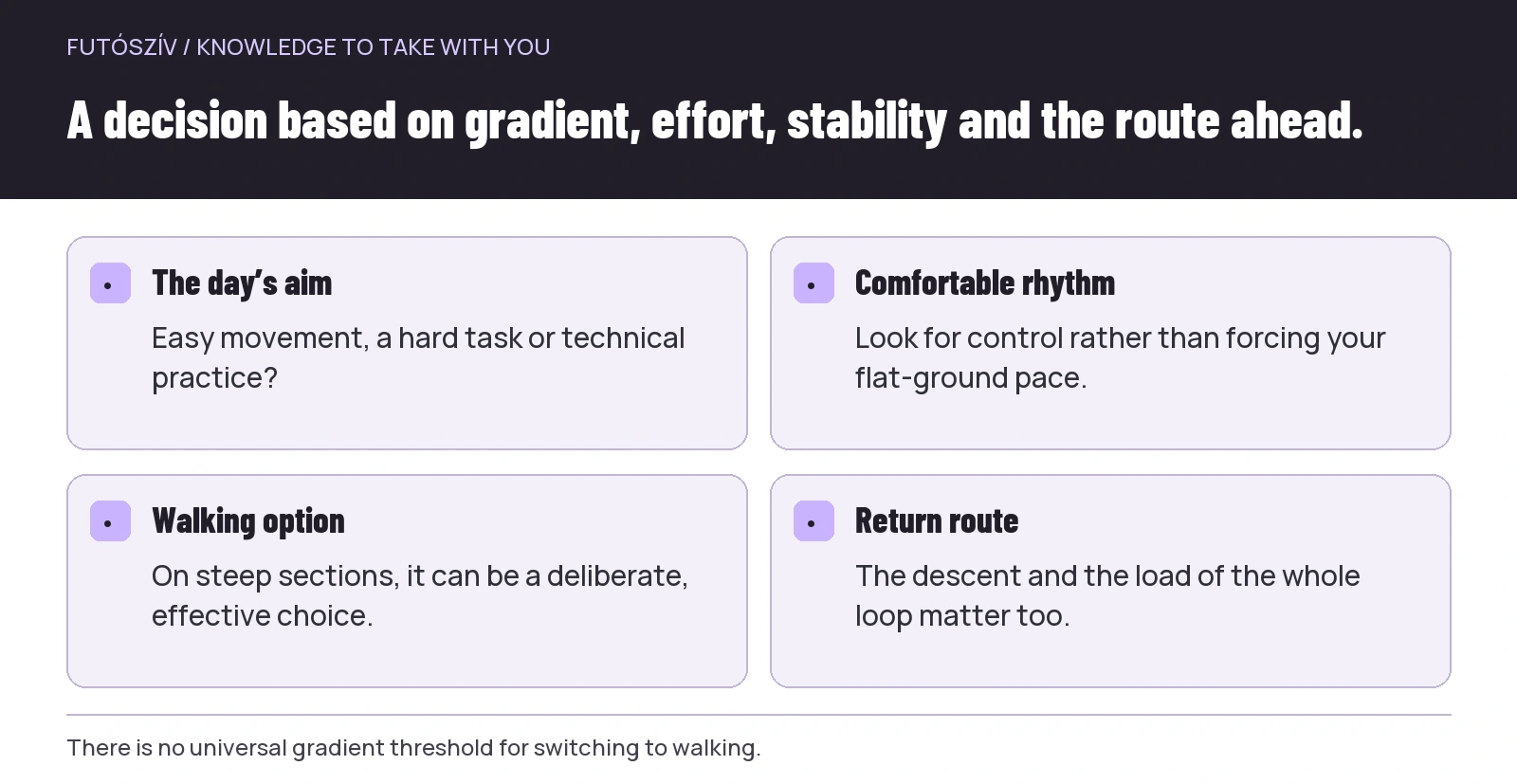 Enlarge diagram
Text version of the diagram
- The day’s aim
- Easy movement, a hard task or technical practice?
- Comfortable rhythm
- Look for control rather than forcing your flat-ground pace.
- Walking option
- On steep sections, it can be a deliberate, effective choice.
- Return route
- The descent and the load of the whole loop matter too.
What should you log alongside kilometres?
Total time, approximate elevation gain and a brief description of the surface are very helpful. Note whether you alternated running and walking, and whether the descent was technical. Later, you will be comparing more than two bare distances.
Vertical speed can also be a metric: for example, climbing a hundred metres in ten minutes is six hundred metres per hour. This is a simple illustrative calculation, not a recommended target. Without knowing the route and mode of movement, this figure is not a performance rating either.
Because GPS and elevation measurements can be inaccurate, avoid drawing major conclusions from small differences. Similar conditions and experience across several sessions can provide a better picture. Your own sensations and next-day response remain important.
Net elevation change and total ascent
If you return to the same place, the net elevation difference between start and finish may be zero, even though you have climbed a lot along the way. Going a hundred metres uphill and a hundred metres downhill on a loop gives you a hundred metres of total ascent, not zero. Check which figure your mapping app is displaying.
Many short hills and one long climb can produce different rhythms even with the same total elevation gain. The former may involve many transitions, while the latter may require more sustained effort management. When getting to know a task similar to your target race, that difference may matter more than an exact match in elevation figures.
Three goals, three different emphases
When preparing for a flat road event, a hilly session can be a supplementary task, but you do not need to turn every training week into a mountain programme. For a longer trail goal, however, practising the switch to walking and handling your equipment can also be important. If you simply want more varied outdoor movement, a familiar park hill and flexible walk–run approach may serve your purpose.
The same hill can feature in all three situations, yet pace, attention and the role of the return route will differ. Write down that purpose beforehand and judge the success of the session against it, rather than against the speed of a runner passing you.
Planning a good day on the hills
Choose a clear aim, a familiar route and a load you can easily modify. Decide in advance where you will switch to walking if necessary and how you will get back. Gradient should not matter more than control.
If climbs are part of your eventual target race, gradually become familiar with similar demands. You do not need to complete the toughest version every week. Rhythm and decision-making built through experience are at least as valuable as a quickly completed climb.
Sources and editorial note
This article refers to research measuring the energy cost at different gradients, a sports physiology review and a biomechanical study. Technical observations and planning examples offer points for your own understanding, not an individual movement assessment or an injury treatment plan. Sources checked: 18 November 2026.
How Futószív articles are prepared: our editorial guidelines.