
An empty diary week can look larger than a calendar week. Monday’s outing is missed, something intervenes Wednesday and by Sunday the whole former routine seems broken. Many runners add missed sessions beside next week’s usual programme. The calendar fills while the obstacle often remains: little time, too many commitments or an unsuitable time of day.
This guide concerns scheduling after time constraints, travel and everyday disruption. Returning after illness or injury involves individual health considerations to discuss with your treating professional. No general online table can say when or how much to run with particular symptoms. Separating these cases prevents misunderstandings from the first step.
First, name what was missed
“I have not run for a week” tells little. One outing may be missing, or three. Perhaps you hiked all day while travelling, or sat every afternoon. Was the week exceptional or the beginning of a lasting work pattern? Choose the answer for those circumstances.
Write three facts: last actual run, what blocked the next and which obstacle has now changed. For example: “I ran in the park last Tuesday. Work then filled three evenings. Only Wednesday evening is free this week.” A useful decision follows immediately. “I was lazy” does not reveal when to leave next.
Name obstacles precisely even when your choices contributed: later bedtime, an overlong loop or a group start nobody confirmed. These details can change. Whole-person judgements are too large to fix in Monday morning’s calendar entry.
Give the next outing its own place
Choose a next time and treat it as new. Add departure location and intended return. With thirty-five door-to-door minutes, the whole outing must fit. Changing and getting home belong as much as running. A paper-short commitment taking an hour in reality can cause another miss.
Beginner programmes allow scheduling flexibility. The NHS Couch to 5K information explicitly allows longer than nine weeks. An app’s next number does not oblige a harder step. Repeating a familiar manageable outing can be considered planning, particularly while establishing routine.
Do not combine the returning outing with a new route, shoe trial, pace test and social introduction. Each demands attention. A familiar loop makes scheduling easier to assess. This can teach more for the next days than a dramatic but unrepeatable effort.
 Enlarge diagram
Text version of the illustration
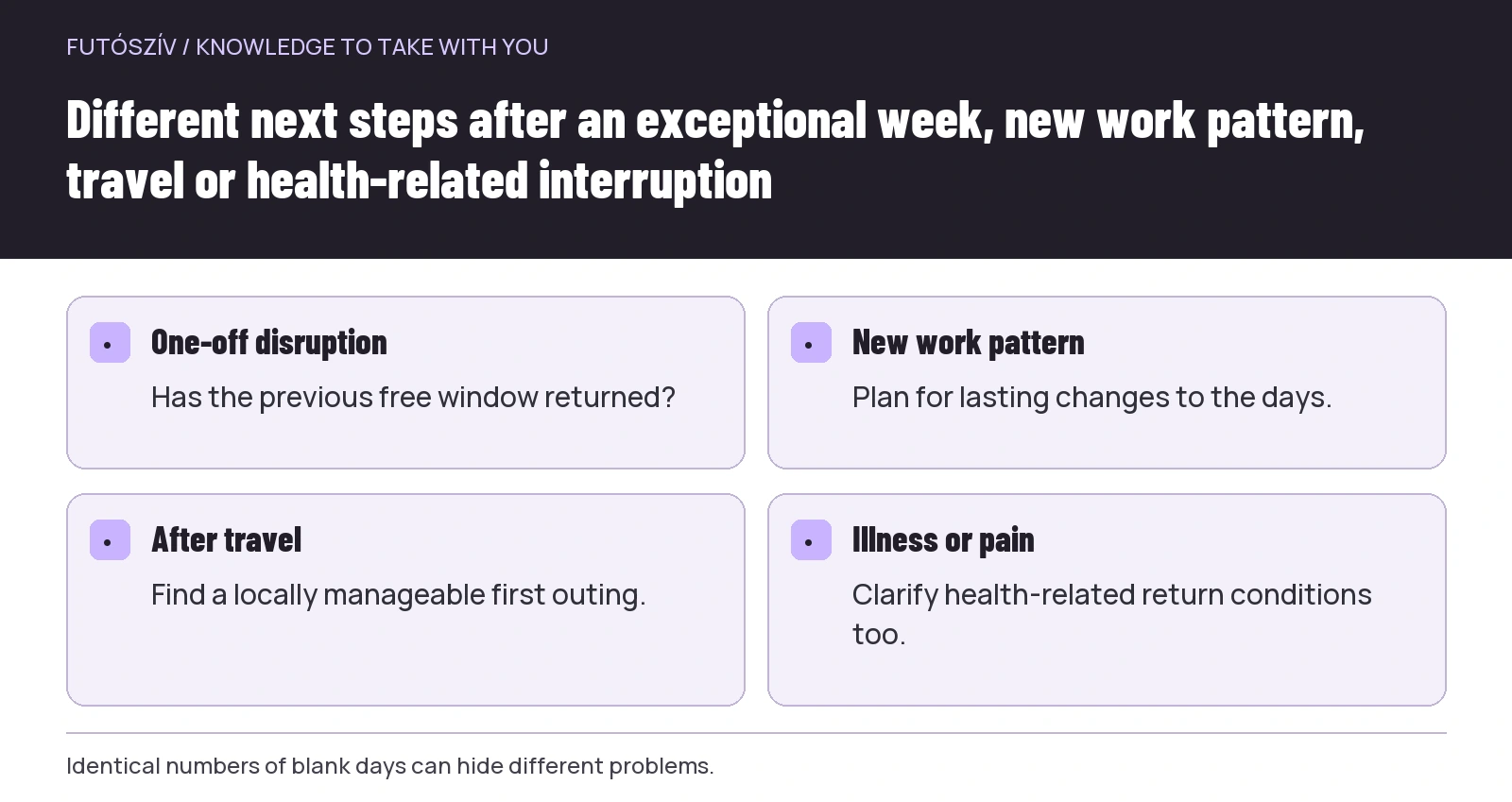
- One-off disruption
- Has the previous free window returned?
- New work pattern
- Plan for lasting changes to the days.
- After travel
- Find a locally manageable first outing.
- Illness or pain
- Clarify health-related return conditions too.
Why the training-debt image misleads
A missed appointment often moves to tomorrow, making the same approach to running understandable. Yet next week already contains work, family and rest. Compressed sessions create a different week while the missed one’s history remains unchanged.
The London Marathon organiser’s medical information specifically advises avoiding later catch-up mileage after illness and injury. For everyday planning, do not automatically turn last week’s figures into extra commitments. Build the next programme from the present.
Give your coach actual completed sessions. “More or less done” hides the information needed for the next plan. Mention less available time ahead too. Honest reporting is cooperation, not an examination. A personal plan follows reality.
Four types of missed week, four next questions
| What happened? | What needs clarification? | Useful planning step |
|---|---|---|
| An exceptional working week disrupted everything | Has the previous schedule returned? | Reclaim a known free window |
| A new work pattern began | Which days have changed permanently? | Redesign the week |
| Travel caused missed outings | When will home routines settle? | A short locally manageable first outing |
| Illness or pain was involved | What are individual return conditions? | Healthcare discussion considering symptoms |
This table separates organisational questions, granting no medical clearance. Three evenings away may be answered by a morning slot. Illness is not resolved through the same calendar trick. Match the precise cause with the appropriate kind of help.
Plan one week, not a whole supposedly lost month
Returning invites overwhelming promises: “three times weekly now, whatever happens”. One actual week is clearer: free day, shoes, collecting children and a route allowing timely return. A short planning horizon is not less commitment, but an assessable one.
Do not fill every gap. Empty space often provides the week’s only reserve. With every evening allocated, a late bus or shopping delay disrupts everything. Leave room for daily variability alongside running, especially when coordinating several people.
Choose a primary and genuine backup time. A backup must actually work. “Sometime Sunday” is easily only intention; “Sunday morning before shopping on the nearby loop” is a decision. If both fail, redesign next week rather than complete it at any cost that night.
Five small decisions the evening before returning
Prepare equipment you have already run in. Simplify departure. If weather needs other clothing, decide beforehand rather than search cupboards at the door. Missing socks seem minor but can consume a rushed morning’s whole allowance.
Check the full time window. Work start limits mornings, latest manageable return limits evenings. Choose accordingly. Travelling far to a favourite park may not be simplest now. A nearby familiar stretch can allow more movement within the same time.
Tell anyone affected. Sharing timing in a household is meaningful organisation. An agreed half-hour is easier to protect than rearranging others’ plans at departure. Be specific about leaving, returning and any task handover.
Choose a route you can shorten. Knowing the way home provides freedom. A large map loop need not be completed for value. The end of available time is enough reason to shorten; no exceptional justification is required.
Rewrite the success criterion. A tested manageable outing and timely return are achievements initially. Accepting only a former best pace creates an unannounced race. Performance data can be interpreted later.
 Enlarge diagram
Text version of the illustration
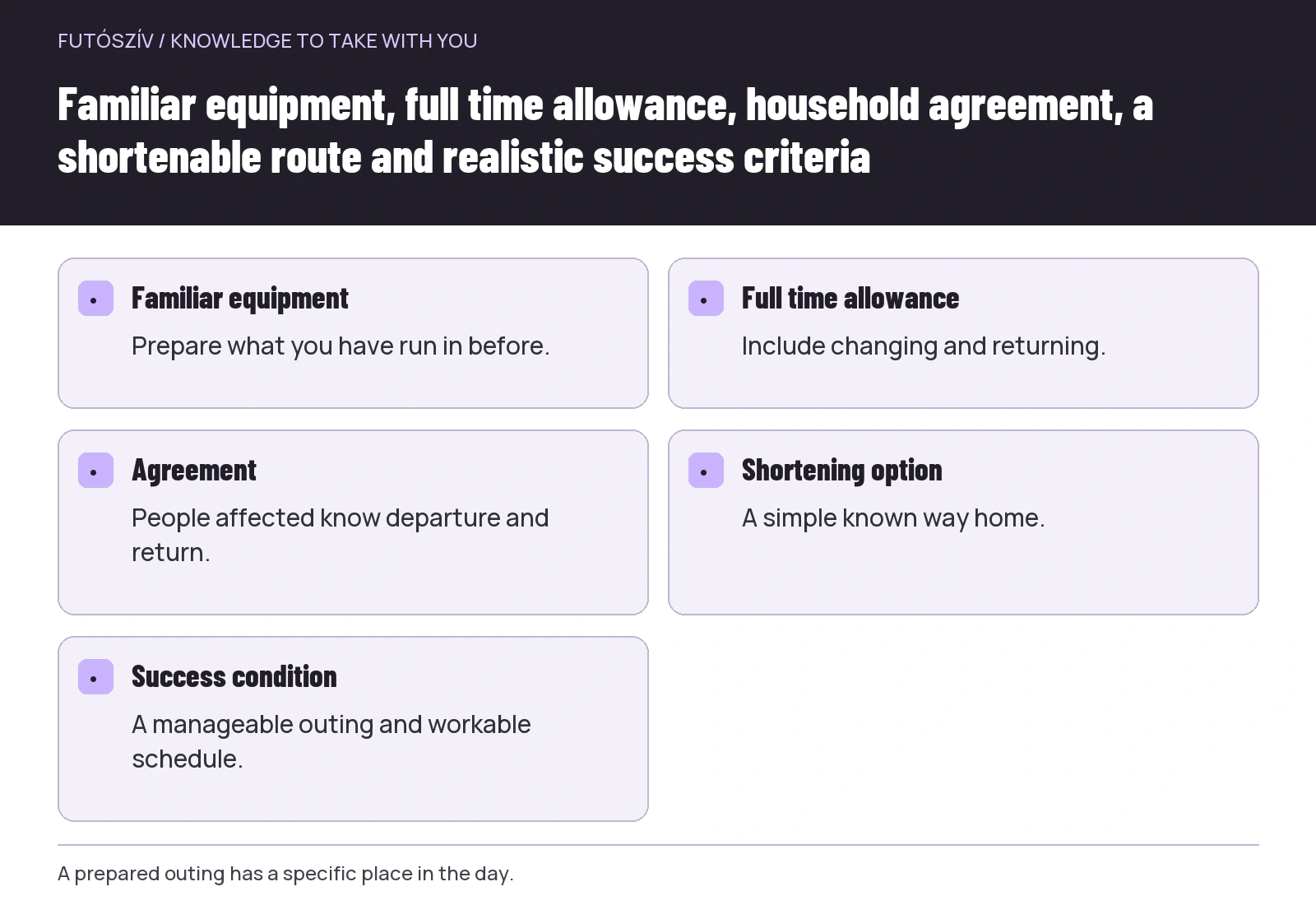
- Familiar equipment
- Prepare what you have run in before.
- Full time allowance
- Include changing and returning.
- Agreement
- People affected know departure and return.
- Shortening option
- A simple known way home.
- Success condition
- A manageable outing and workable schedule.
Three everyday scenes
Imagine a runner formerly going out Tuesdays and Thursdays, then working overtime every afternoon for a week. Tuesday evening is free again. Restoring that familiar outing makes more sense than hurried Monday–Tuesday–Wednesday catch-up. The value is recreating conditions that worked.
Another runner’s shifts changed permanently. Their old Tuesday no longer exists. Entering the same evening repeatedly produces repeated disappointment. They need two other predictable windows or temporarily fewer outings. Changing routine here adapts to a new setting.
A third returns from holiday to many tasks. Instead of immediately restoring the old programme, they find a calm local opportunity. The travel week needs no retrospective repair. The first home outing assesses current rhythm and room for another.
These are edited examples, not personal accounts. They show different next steps after the same apparent gap. Identical blank days can conceal different problems. Suitable decisions demonstrate planning quality.
What to say when someone questions your absence
A partner may show interest but sound like checking. Answer factually: “Last week did not fit; I restart Wednesday on the local loop.” This gives situation and next step without self-judgement. Every missing evening needs no detailed defence.
If cancelling a shared outing, focus on notice and rescheduling: “Sorry I told you late; next time I will confirm by the evening before.” This differs from your own volume. Clear communication improves reliability even with less running that week.
Ask a club beforehand how to rejoin after absence: different groups, registration and whom to tell about shorter participation. Community continuity need not mean every session. Clear joining arrangements also help variable work schedules.
Handle race deadlines separately
A booked race makes absence emotionally heavier. Catch-up calendar entries do not change its date. Check current distance-change, transfer or modification options and deadlines. Conditions differ by event; other races or years cannot supply certainty.
Tell a coach or appropriate professional the real history, missed work and present sensations. A paid entry is a sunk cost, not a health argument or readiness proof. Race decisions require more than days without running.
Guilt often merges two questions: does cancelling feel unpleasant, and is the same commitment wise now? The first can be yes while the second is no. Discomfort does not invalidate considered change. Telling travelling companions early lets them adapt too.
Review three things at the next week’s end
Which outing actually fitted, which preparation eased departure and what obstacle the calendar still ignores? These answers build a more accurate week without judging your personality or entire running history.
If the first chosen slot fails again, examine more than motivation. Timing may be consistently wrong, the route distant or the total process longer than estimated. A practical change can do more than another grand promise. Returning ultimately grows from repeatable outings with a place in present life.
How Futószív articles are prepared: our editorial guidelines.