
You hear that morning runs happen before anyone interferes, and evening runs come when work is finally over. Both may describe someone else’s life while your mornings or family evenings are busiest. A useful running time is not decided by a general slogan. Your own days reveal which window you can keep regularly with manageable organisation.
This two-week observation plan is not a new training programme. It asks for no more runs than your existing suitable routine and does not suggest abandoning rest days. Its purpose is learning scheduling. Why you did not leave is as valuable as a successful outing. At the end, seek the most repeatable time, not the highest-performing one.
Do not judge mornings and evenings in general
Name actual windows first. “Morning” might mean forty minutes before work or late weekend morning; “evening” immediately after work or late after family tasks. These are different situations. Broad categories can compare outings sharing only a time-of-day name.
Choose two realistic candidates, such as weekdays before work and just after arriving home. Both need not be tested every week if existing load prevents it. Observing windows, estimating preparation and walking a route also inform without running. The experiment must not become another obligation for its own sake.
Count the whole door-to-door time
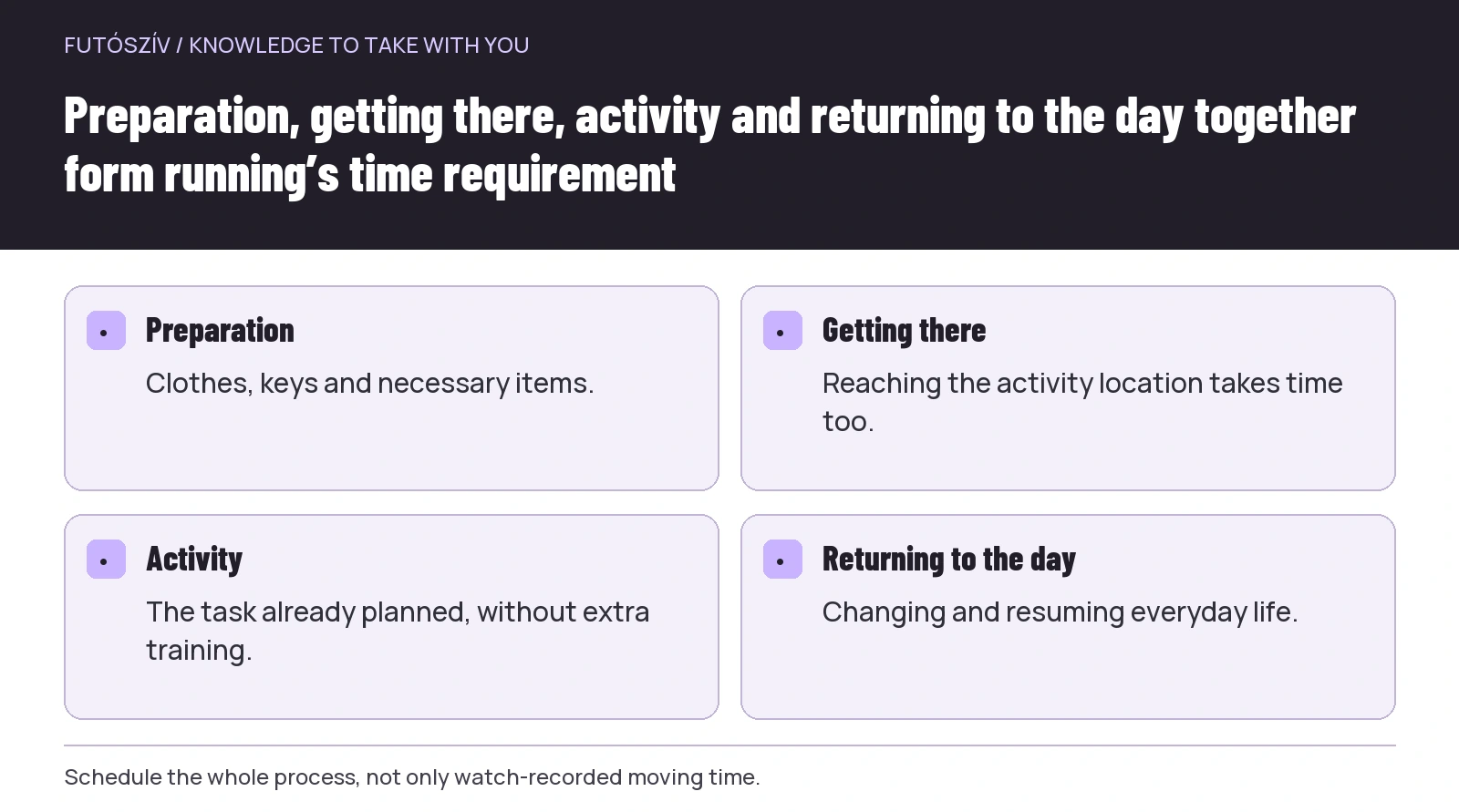
A watch may show thirty moving minutes, while preparation, reaching the route, changing and resuming the day also belong. Scheduling only running makes every outing overrun. The problem may be inaccurate estimation rather than discipline. First assess the real process.
The MedlinePlus time-planning guidance recommends scheduling activity deliberately and finding everyday opportunities too. For running, this does not mean filling every gap. Give a chosen outing visible space rather than relying on uncertain time left after everything else.
| Time component | What to observe | Why estimates often omit it |
|---|---|---|
| Preparation | Finding clothes, keys, phone and necessities | It feels like home time rather than part of running |
| Getting there | Stairs, walking or travel to the location | A short map distance contains several real steps |
| Activity | The actual chosen task | The watch usually makes this clearly visible |
| Returning to the day | Changing, washing and preparing for the next task | It often becomes visible only when you are late |
Use the first days for mapping
Before changing times, observe two or three ordinary days. Where is room genuine rather than only on paper? Twenty free morning minutes may be the family departure buffer. Lunch breaks vary. Commuting may regularly consume the after-work window. These are planning conditions, not excuses.
Separate recurring obstacles from one-off events. An unexpected visitor does not establish that evening running is unworkable. Daily responsibility at the same time is not unexpected but a fixed calendar element. Build windows around recurring conditions and preserve backups for exceptions.
 Enlarge diagram
Text version of the illustration
- Preparation
- Clothes, keys and necessary items.
- Getting there
- Reaching the activity location takes time too.
- Activity
- The task already planned, without extra training.
- Returning to the day
- Changing and resuming everyday life.
A two-week observation worksheet
These daily tasks do not mean daily runs. They offer an observation sequence to fit your calendar. Existing runs stay within your programme. On rest days, simply check preparation, timing or the route. Observation should simplify the next choice.
| Day | Observation task | What to note briefly |
|---|---|---|
| Day 1 | List fixed commitments for the next two weeks | Which windows are real and which only wished for? |
| Day 2 | Review the full morning-departure process | When could you open the door, and when must you be elsewhere? |
| Day 3 | Observe the transition after work | What happens between getting home and evening commitments? |
| Day 4 | Assess preparation for a planned run | What delayed you and what could have been arranged? |
| Day 5 | Inspect the route at the other time of day | Are lighting, traffic, opening hours and access the same? |
| Day 6 | Check weekend conditions | How much of the longer free window is truly yours? |
| Day 7 | Make a first brief review | Which obstacle repeated and which was exceptional? |
| Day 8 | Choose one improvement for next time | Prepared clothing, another meeting point or a more accurate allowance? |
| Day 9 | Observe willingness before a planned outing | Is it fatigue, rushing or organisational resistance? |
| Day 10 | Discuss with the family member or partner concerned | Is the time predictable and manageable for them too? |
| Day 11 | Try the chosen improvement within your existing programme | Was preparation shorter and leaving easier? |
| Day 12 | Observe returning to the day after running | Could the rest of the day continue without rushing? |
| Day 13 | Look for a backup window | What is genuinely realistic if the main outing falls through? |
| Day 14 | Choose the next basic rhythm from experience | What stays, what changes and when will you review? |
What to record without creating an administrative project
Four details can suffice: planned window, actual departure, main obstacle and how the day continued. Add one sentence about the activity. You need not score everything or invent bodily explanations for times. This two-week sample provides organisational experience, not biological proof of the hour at which you run best.
If you like scales, use a few consistent categories: easy to leave, some organising or unworkable that day. Add a reason for “unworkable”. A short window, dark route and unexpected work need different answers. Assessment helps when it produces a specific decision before the next outing.
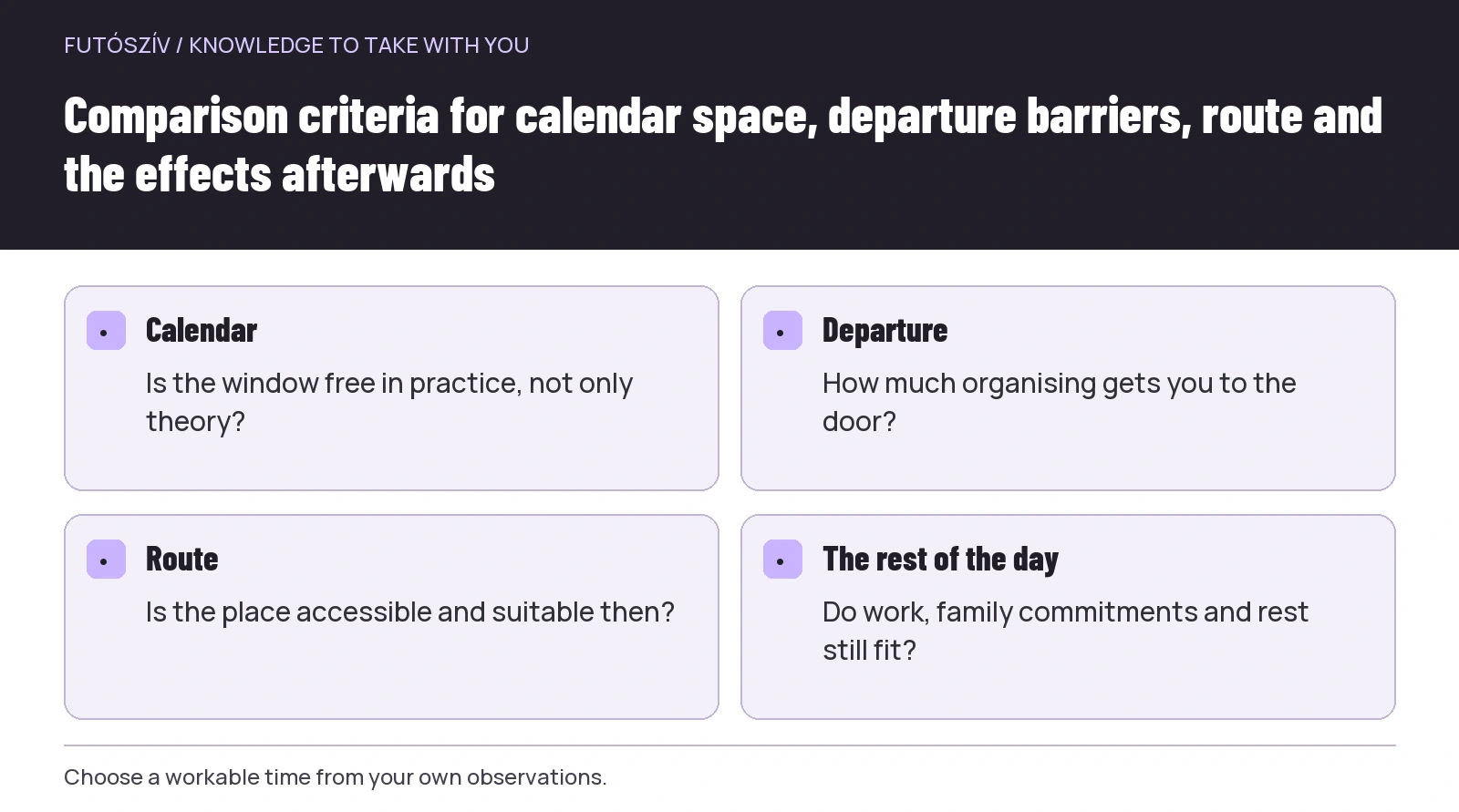
Morning running: examine the preparation chain
Small steps towards the door often create resistance: clothing, phone, school transport and work departure. Rebuilding the list every time turns starting into a puzzle. Prepared kit and a precise return deadline may help without automatically waking earlier.
Assess what follows a successful morning run too. Did work start hurriedly or with a calm transition? Did running regularly reduce rest? A good time works with the whole week rather than one heroic early start. If conditions are absent, another window is valid.
Evening running: clarify the transition
After work, where does the outing begin? Do you go home and leave again or count sport directly from work’s end? Organisation differs substantially. If restarting after sitting on the sofa is hard, more motivational phrases may not be the answer. Equipment location or route may need changing.
Check actual evening conditions: lighting, traffic, facility hours and return travel. Summer timing may change in winter. Leave room afterwards so running does not continually slide towards bedtime. A regularly late slot may need shorter access, another day or a different default.
 Enlarge diagram
Text version of the illustration
- Calendar
- Is the window free in practice, not only theory?
- Departure
- How much organising gets you to the door?
- Route
- Is the place accessible and suitable then?
- The rest of the day
- Do work, family commitments and rest still fit?
Lunch breaks differ between workplaces
Lunchtime running is realistic only with sufficient total time, changing and workplace conditions. A calendar’s empty half-hour is not automatically personal free time. Work arrangements, local rules and agreed availability matter. Clarified conditions bring more calm than secretly attempting a hurried escape each time.
If considering lunch, first understand access and returning. Is the loop suitable, storage available and resuming work realistic? The outing need not be running; another movement may fit better. Planning should find what works rather than prove a favoured idea.
Do not decide from one good or bad day
A first morning attempt may feel hard because preparation is unfamiliar, not because all mornings are unsuitable. An excellent Friday evening does not prove every weekday evening works either. Two weeks help separate recurring patterns from novelty and exceptional conditions.
Draw organisational conclusions from comparable situations. A short park run after rest and a longer session after busy work differ in more than clock time. When selecting timing, avoid entirely changing the task meanwhile. No rigid experiment is needed, but note differences before blaming the hour.
Three workable outcomes
One strong main time. Observations may show before-work slots repeat reliably while evenings remain uncertain. Organise main outings around the former and leave the latter occasional. You need not like both equally. Rhythm becomes stable through a reliable home rather than working at every imaginable time.
Two windows with different roles. Short weekday outings may fit early evenings and longer weekend ones late mornings. This is not inconsistency: different sessions need different allowances and arrangements. The NHS beginner running programme also illustrates rest between outings and progress at your own rhythm; timing need not follow one rigid scheme either.
No stable running slot yet. This is useful too. Coming weeks may support another activity or brief outings requiring less organisation. The CDC guidance emphasises choices suited to abilities and preferred activities. Observation does not prove that you must always do the same thing; it makes your choice realistic.
Choose one improvement for the next two weeks
Do not overhaul daily life at once after reviewing. Address the most common obstacle: prepare kit if getting ready took too long, try a nearer loop if access was lengthy or discuss conflicting family duties first. Match a specific cause to a specific answer.
Write when you will review the choice too. Seasons, work and family calendars change, so today’s window is not a permanent contract. A good rhythm does not require never changing it. It means recognising what works and adapting promptly when something no longer fits.
How Futószív articles are prepared: our editorial guidelines.