
Four runs were planned; two happened. At the next week’s start, the temptation is to move the missed long run to Monday, speed work to Tuesday and somehow fit everything else around them. The calendar apparently catches up, but your body meets a new, denser load. A missed session is not a debt to collect unchanged.
Plan continuation from present condition. First separate why activity was missed, the break’s length and what happened during it. Lack of time, illness, injury and motivational difficulties are different situations.
One missed day is different from several weeks off
One outing missed for work or family does not automatically rewrite preparation. The next day need not start with twice the work. Examine the missed session’s purpose and how the remaining week relates to it.
With a longer gap, assess the difference between former capacity and current routine too. Simply continuing the same row in an old spreadsheet is insufficient. Earlier experience is valuable, but present condition starts the return.
Do not merge these cases. One missed Tuesday need not imply total fitness loss; after weeks away, the former hardest week may no longer suit unchanged. Decisions need more than the count of missing ticks.
What does losing fitness mean?
Detraining means partial or complete reversal of training adaptations when stimulus is insufficient. The extent depends on break length, training history and remaining activity. It is not a switch flipping on a single day.
The short-term training-cessation review by Mujika and Padilla discusses several physiological changes, chiefly from trained-athlete studies. It does not say every runner loses equally after the same number of days. Participant and protocol differences matter.
Laboratory performance changes do not mean losing your running identity. Route knowledge, organisational experience and your relationship with sport survive a busy month. Those skills remain available on returning.
What do short-break studies show?
A study of two weeks without training found decreases in several circulatory and performance measures in endurance athletes, but not identical changes in every ability. “All fitness is gone” is too simple.
Four weeks of cessation have also been studied in high-level runners, using endurance and neuromuscular measurements. This offers information, not a return schedule for every recreational runner. A research break can differ from recovering after illness.
Do not read research as a punitive countdown. You need not immediately train hard to beat an imagined deadline. Current health and appropriate load determine safe continuation.
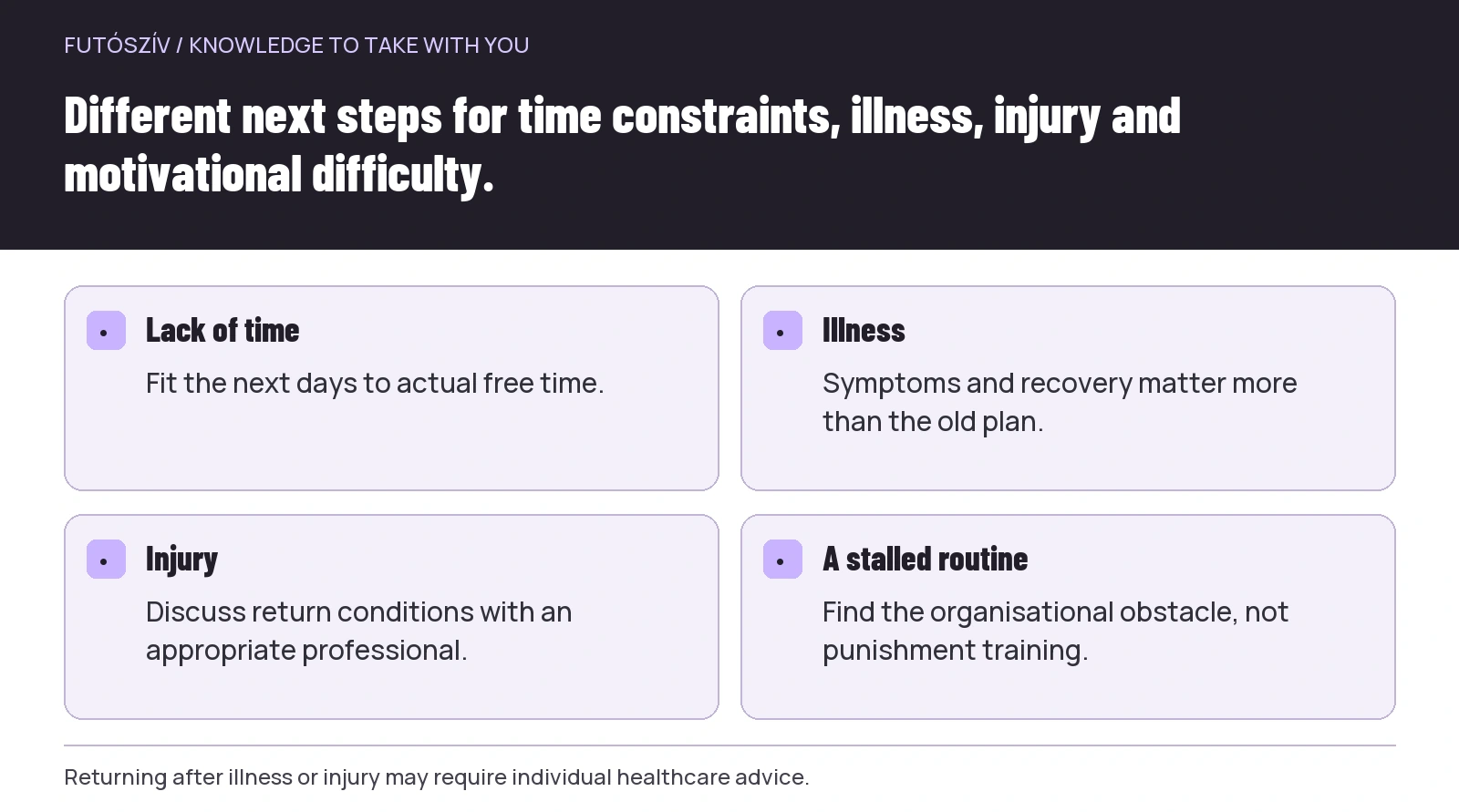 Enlarge diagram
Text version of the illustration
- Lack of time
- Fit the next days to actual free time.
- Illness
- Symptoms and recovery matter more than the old plan.
- Injury
- Discuss return conditions with an appropriate professional.
- A stalled routine
- Find the organisational obstacle, not punishment training.
Missed through lack of time: solve the organisational problem
If healthy but overwhelmed, review how realistic the former plan was. Sessions may be too long, travel excessive or every run allocated to the same uncertain evening slot.
Create a shorter, more accessible version. Compressing identical weekly distance into fewer days is not compulsory. The next phase may aim for a regular manageable rhythm. Another willpower test is not the best repair for a persistently overloaded calendar.
If the busy period is predictable, include it beforehand. Simpler programmes may suit travel or work peaks. Reassess the goal date in that light too.
Missed through illness: recovery comes first
Counting run-free days is insufficient after illness. Symptoms, remaining problems and everyday tolerance matter. Fever, general malaise or lingering symptoms may require medical advice.
Matching old pace is not a reliable independent health test. New chest symptoms, feeling faint or unusually severe breathlessness mean not continuing to test yourself by running. This article gives no post-illness clearance or personal return protocol.
Once health allows activity, make the next outing adaptable and easy to stop. Include responses during and afterwards in planning. The hardest task need not come first.
Missed through injury: a date alone is insufficient
Return conditions depend on symptom type and individual condition. Equal-length breaks may need very different next steps. An online weekly percentage cannot replace conditions from a physiotherapist or doctor.
Ask specifically which activity can start, what response to monitor and when to discuss again. Returning becomes observable steps rather than simply “running again”. Race urgency does not change injured tissue.
The missed-session list is particularly misleading here. Rehabilitation is not delayed execution of the same plan. Build the next phase from a new starting point and current condition.
For stalled motivation, find the specific barrier
If running repeatedly fails to happen, ask what occurs before leaving. Too late? A boring route? Constant performance pressure? No accessible company or location? “I became lazy” helps less than a specific organisational problem.
Try a simpler goal: a short familiar loop, fixed time or group outing where pace is not central. Rebuild the relationship with movement rather than punish missed days.
With persistent low mood, anxiety or difficulties affecting other areas, running should not become compulsory self-treatment. Appropriate professional support may be needed. Sport does not replace mental healthcare.
Connect the next week to actual history
Describe recent weeks’ activity. Include other movement without converting it all to running kilometres. Long hikes or substantial cycling matter, without fully replacing running-specific demands.
The longer-term detraining review also describes different maintenance activities and adaptations. A break does not always mean immobility, but alternative activity cannot automatically establish former running loads.
Choose a rhythm genuinely accessible now. A few manageable outings and precise feedback can be the goal. Proving the old maximum in week one is unnecessary.
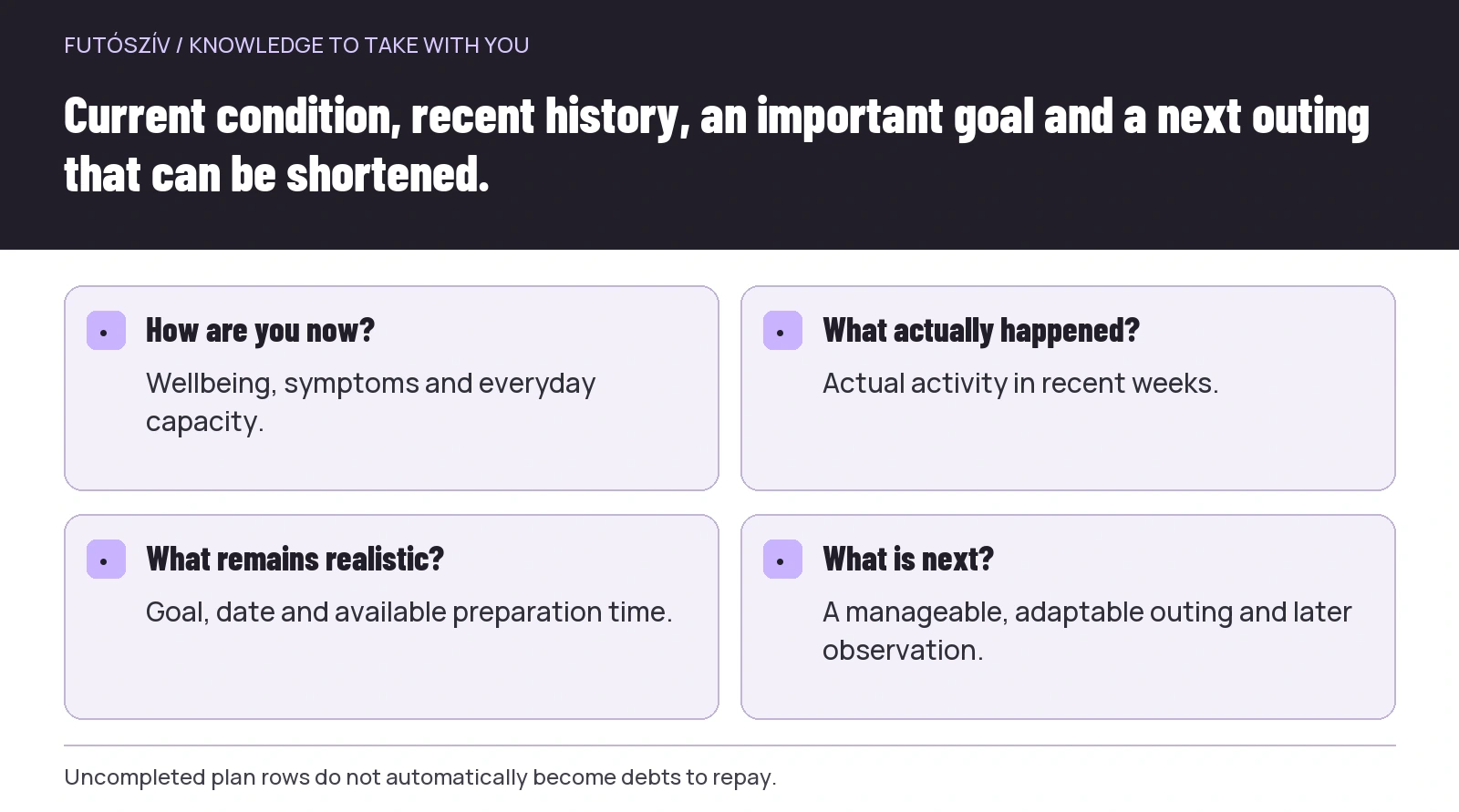 Enlarge diagram
Text version of the illustration
- How are you now?
- Wellbeing, symptoms and everyday capacity.
- What actually happened?
- Actual activity in recent weeks.
- What remains realistic?
- Goal, date and available preparation time.
- What is next?
- A manageable, adaptable outing and later observation.
What about the race goal?
Alongside the start date, assess genuine preparation time remaining. A minor interruption may need only plan adjustment. A major gap can justify changing pace targets, distance or participation.
Do not derive capacity from a paid entry. Cost and expectations understandably matter, but are not health arguments. Check current organiser transfer or distance-change options separately if needed.
With a coach, define several versions: realistic main goal, restrained option and situations in which you will not start. Advance decisions reduce start-line excitement overriding earlier judgement.
Prioritise instead of catching up
Not every missed session supplied a unique irreplaceable stimulus. Check which purpose appears again later. Sensible continuation may suffice without separate replacement.
If moving a task, adapt the full week. A long loop does more than occupy a free slot; it influences following sessions too. Preserving every original row unchanged often breaks the plan’s logic.
The priority can be one comfortably achievable week. It provides more real information than frantic overcrowded catching up.
Describe missed training precisely
Tell your coach or partner more than “a bad week”. Briefly state completed sessions, reasons for gaps and current wellbeing. Precision enables appropriate changes.
When self-planning, write the same summary. For example: two easy loops completed, long run missed for travel, no health symptoms and less time next week too. A manageable decision can follow.
Do not make the diary a collection of self-blame. A missing row is a useful fact, not a personal judgement. Build the next step from time available, present condition and the real goal.
An app streak is not the whole story
A broken daily counter can seem a greater loss than its training significance. Decide whether you track consecutive days at any cost or sustainable activity over time. These goals do not always align.
If a streak encourages running ill, in pain or exhausted, move it into the background. Your diary can recognise sound adjustments and deliberate rest alongside kilometres.
Sources and editorial note
This article cites literature on short and longer training cessation and studies involving endurance athletes and runners. These are not personal return programmes. Planning examples are our own editorial suggestions; illness or injury may require guidance from a healthcare professional. Sources checked: 18 November 2026.
How Futószív articles are prepared: our editorial guidelines.