
Two runners both cover thirty kilometres in a week. One divides it into six short, comfortable loops; the other runs two long, hard outings. The total matches, but the structure differs. Looking only at kilometres can miss the central planning questions: how often do you run, how much work falls on one day and how demanding is it?
A good week need not be a colourful spreadsheet. A simple structure of repeated sessions can work. Each day needs an understandable purpose, the whole week must fit your current background and modifications must remain possible.
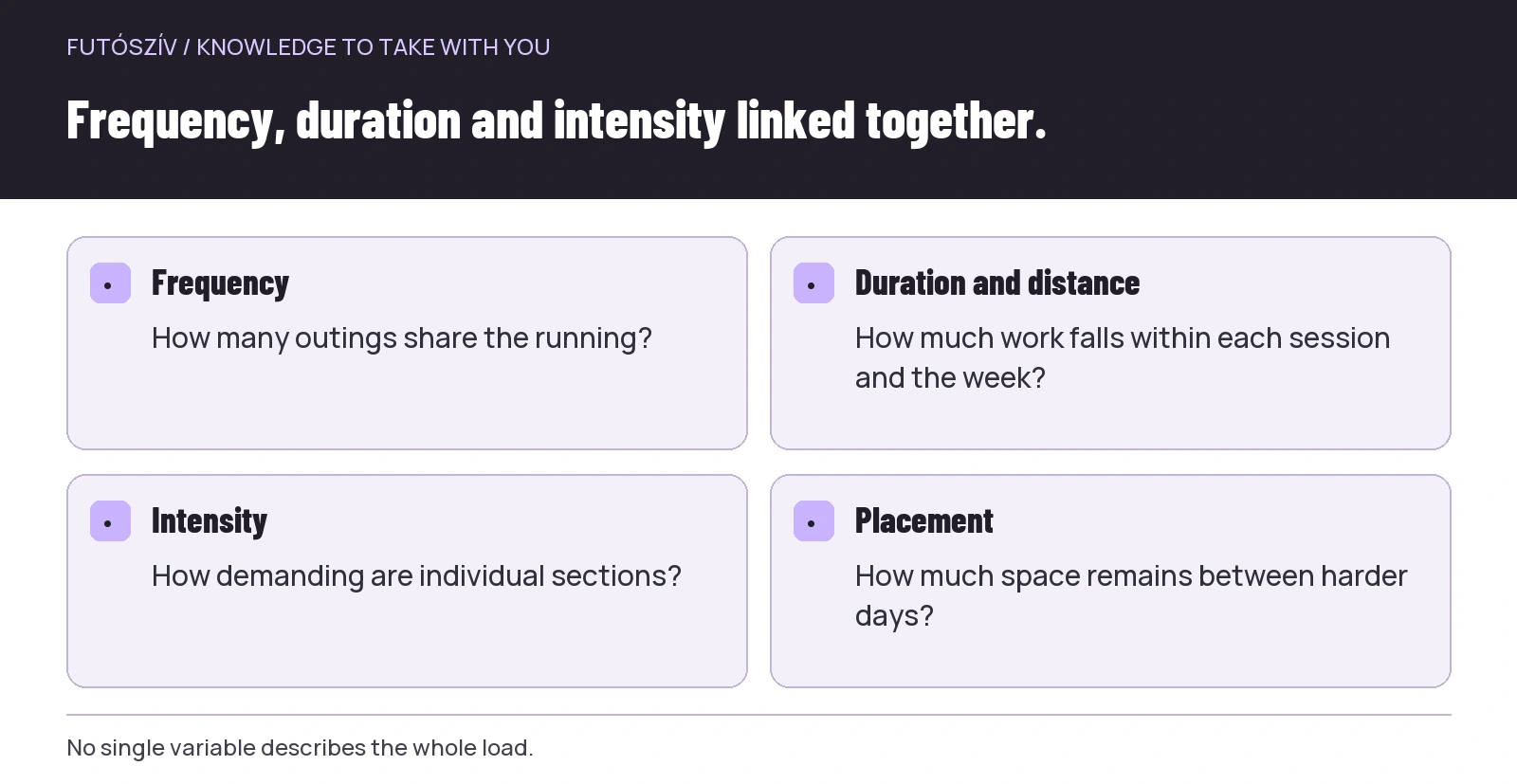
Frequency: how often do you encounter the load?
Run count is separate from weekly distance. Spreading the same volume over more outings can shorten sessions but requires more organisation and running days. Compressing it into fewer outings leaves more rest days but can lengthen each run.
Neither means more or fewer days are ideal for everyone. Beginners and long-established runners have different loading histories. Work, travel and family also make the same weekly time differently available.
When adding a running day, consider more than whether it is short. The rhythm changes too. If several days previously separated runs, a new short loop brings more frequent exposure. Treat this as a deliberate change.
Duration and distance: what does weekly volume summarise?
Distance can be useful on flat routes at similar pace. On hills, in run–walk programmes or changing conditions, time often tells more. Do not cling exclusively to a metric that fails to describe actual work.
The long outing deserves separate attention. A weekly total can contain one day far beyond your history. Always consider the longest run and its placement too. Omitting other days does not automatically make an enlarged weekend loop easy.
Add a brief ground description to time and distance. Ten kilometres on asphalt, sand or steep paths are different tasks. A diary is precise through visible circumstances, not numerous decimal places.
Intensity: fast-section duration is not the whole story
An interval session depends on speed, section length, repetition count and recovery. Two programmes can contain equal fast minutes yet require different effort. Do not judge a hard day solely by its title.
The load-monitoring consensus discusses combining external and internal information. Recreational diaries do not necessarily need elaborate instruments: time, task description and perceived effort already offer several perspectives.
A labelled easy day can drift towards moderately hard through faster company, hills or a regular long finishing push. Review actual execution rather than original labels.
 Enlarge diagram
Text version of the illustration
- Frequency
- How many outings share the running?
- Duration and distance
- How much work falls within each session and the week?
- Intensity
- How demanding are individual sections?
- Placement
- How much space remains between harder days?
Order is part of the week
Adjacent hard outings create a different week from ones separated by more space. Still, no fixed recovery-hour rule applies to every person and task. Individual response, history and session type matter together.
Working days differ too. An early fast run after a late shift can be harder organisationally and in how it feels. If little sleep repeatedly precedes the long loop, changing route or day may help.
Ask not only which day is free, but what fits that day. The best place for an easy loop and an important session may differ. Considered sequencing prevents much later pressure to catch up.
What can research teach us, and what can it not?
The older, small runner study by Lehmann and colleagues examined different effects of increasing volume and intensity. It shows why every loading change should not be replaced by one distance figure. The specific programme and result cannot transfer to all runners.
A study examining elite endurance coaches’ practice considered several planning levels from the year to individual sessions. Observed professional practice is interesting, not a personal prescription for a busy recreational runner.
Alongside research, personal observation is needed. Even a well-planned week can change through illness, travel or fatigue. A usable system must handle that too.
A three-day week: the temptation to compress
With only three days, making each important is tempting. A fast run, tempo session and long run look varied on paper but can leave little easier space. Do not value tasks by how exhausting they are.
As an editorial thought experiment, choose one weekly emphasis first and relate other sessions to it. It might be longer easy movement, one defined harder task or consistency. This is not a specific three-day programme, but a way to recognise too many goals.
If one run is missed, do not automatically compress the whole amount into the other two. Consider the reason and which aim remains realistic. Preserving the weekly figure alone does not justify an unusually large day.
A multi-day week: short outings add up too
Four, five or more running days can make each loop easier to keep short, but frequent departures also require organisation. Changing, washing and transport are real sport time. This is not everyone’s most sustainable arrangement.
Short easy outings are not automatically consequence-free extras. Adding kilometres at the end of every day changes volume and rest distribution. Record small portions in the actual diary too.
Before adding a day, decide why. Are you redistributing existing volume or increasing total load? These are different changes. Clarity helps interpret the following weeks’ responses.
Include strength work and other sports in the same picture
A low-running week can still be demanding through other sports. Heavy leg strength work, a long hike or intense cycling do not disappear because an app categorises them separately. The same person undertakes the next run.
You need not convert every sport to running kilometres. Duration, effort and unfamiliar demands can suffice. The purpose is understanding the whole week, not inventing an artificial unit for everything.
If separate coaches guide strength and running, support communication with a brief account of the other programme. This reduces two individually justified hard tasks landing where together they become difficult.
 Enlarge diagram
Text version of the illustration
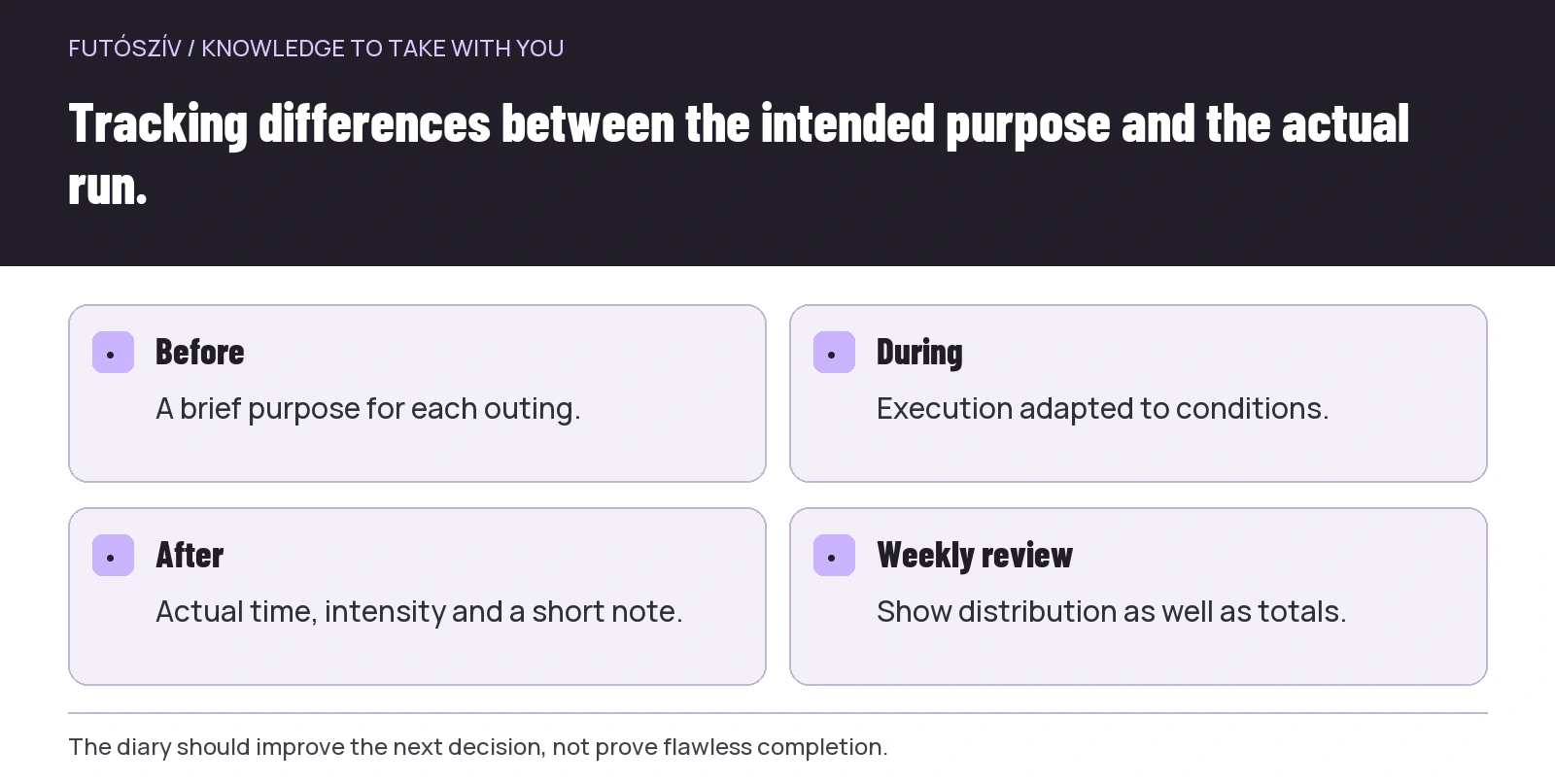
- Before
- A brief purpose for each outing.
- During
- Execution adapted to conditions.
- After
- Actual time, intensity and a short note.
- Weekly review
- Show distribution as well as totals.
Planned and actual: separate columns
Outline the week, then record reality. Every difference is not a mistake. Slowing for heat, shortening for time or stopping for symptoms can be appropriate decisions.
| What did you plan? | What happened? | Why does it matter? |
|---|---|---|
| A comfortable flat loop | A hilly group run | The actual task changed |
| A short intense session | A prolonged hard workout | Duration increased too |
| A long easy run | A shorter loop in heat | The change suited conditions |
| A rest day | A long hike | The day did not remain low-load |
Such a table can teach more than an overall percentage. Repeated differences suggest adapting the plan to life. You need not restart every week with the same unworkable schedule.
What makes an easy day easier?
Reduce duration, intensity or environmental difficulty. A short, familiar loop, comfortable effort and simple logistics can help together. For low load, removing only fast sections while everything else remains difficult is insufficient.
A rest day is an independent element, not an empty box. You need not fill it with running because time appeared. A free slot is an opportunity; the week’s purpose and current condition guide the choice.
If easy runs repeatedly feel hard, do more than prescribe slower pace next week. Review sleep, all sport and life circumstances. Persistent fatigue or symptoms may require appropriate professional advice.
A calendar boundary is not a physiological boundary
Sunday’s effects do not reset on Monday. A weekend long run followed by Monday’s hard session may sit in separate app weeks but remains adjacent in planning. Review the continuous sequence as well as weekly totals.
With variable work, a repeating structure longer or shorter than a week may be clearer. Use equal periods for comparison. The calendar should aid decisions rather than force every life into Monday-to-Sunday form.
A five-minute weekly review
Review total time and distance, session count, longest day and actually hard tasks. Then ask your condition at the week’s end. Start the next week from that real foundation.
Choose one change: another order, a shorter easy day or fewer tasks in a busy period. Moving every variable obscures what helped. Seek clear, achievable structure.
For sharp, worsening or gait-changing pain, do not seek a weekly scheduling trick to continue. Symptoms need separate attention and assessment where necessary. This is not a personal rehabilitation plan.
Sources
For multidimensional load interpretation, we used the cited consensus; for volume and intensity, research involving runners; and for planning levels, a study of elite coaches’ practice. Weekly scenarios illustrate concepts rather than recommend programmes for everyone. Sources checked: 18 November 2026.
How Futószív articles are prepared: our editorial guidelines.