At the start of a ten-kilometre race, strength often exceeds the judgement available to manage it. Music plays, the field moves, your legs feel light and the watch records a surprisingly fast first kilometre. The difficulty emerges later: did you choose a speed you can also manage in the second half? Your first 10 km therefore needs more than a target time. It needs a plan that accompanies you from the excitement of the start to decisions near the finish.
The examples below support race planning for healthy adults who run regularly. They do not establish an appropriate exercise load for you. Numerical examples explain the mathematics, not universally expected results. If ten kilometres still feels uncertain even in training, clarify how to complete it and prepare before setting a target to the exact minute.
What kind of 10 km are you preparing for?
The same distance can be a first completion, a friendly group outing, a flat road race or a park course with many turns. Elevation and surfaces make a ten-kilometre trail race another task again. Do not automatically copy a time from a different course. First read where you will run, the amount of climbing, whether there are narrow sections and how the start works. These determine how sensible it is to expect even kilometre splits.
During preparation, distinguish easy running, longer activity and race-like effort. The Boston Athletic Association 10 km resources use different session types and plans for different levels. The practical lesson is that race rhythm should not become the sole measure of every run. The weeks before a first 10 km should not consist of constant ten-kilometre examinations either.
Choose a target range before a target time
A single number can become a trap. If only a sub-sixty-minute result counts as success, a windy day or an awkward start can spoil the experience in the first kilometre. Three kinds of goal may be more useful: a result for favourable conditions, a realistic finishing range and a task independent of time. The last might be ensuring that your first two kilometres are not your hardest section.
Choose the range from training experience, ideally discussing it with a coach. A sports watch prediction or a friend’s result is insufficient alone. Recent runs, repeatability of the load, the course and your condition on race day together form a useful picture. Without a reliable basis for timing yet, running by effort and letting go of a finish-time target is a fully valid decision.
| Planning level | Example statement | When does it help? |
|---|---|---|
| A favourable day | In good conditions, I will try the chosen time | When supported by training experience and a backup plan |
| A realistic range | My current fitness suggests thinking within this range | When the course and weather may change expectations |
| An execution goal | I will start calmly and not speed up for every overtaking runner | Even if the eventual time is different |
| Adapting to your condition | If symptoms or illness occur, I will let go of the race goal | When race-day circumstances override the original plan |
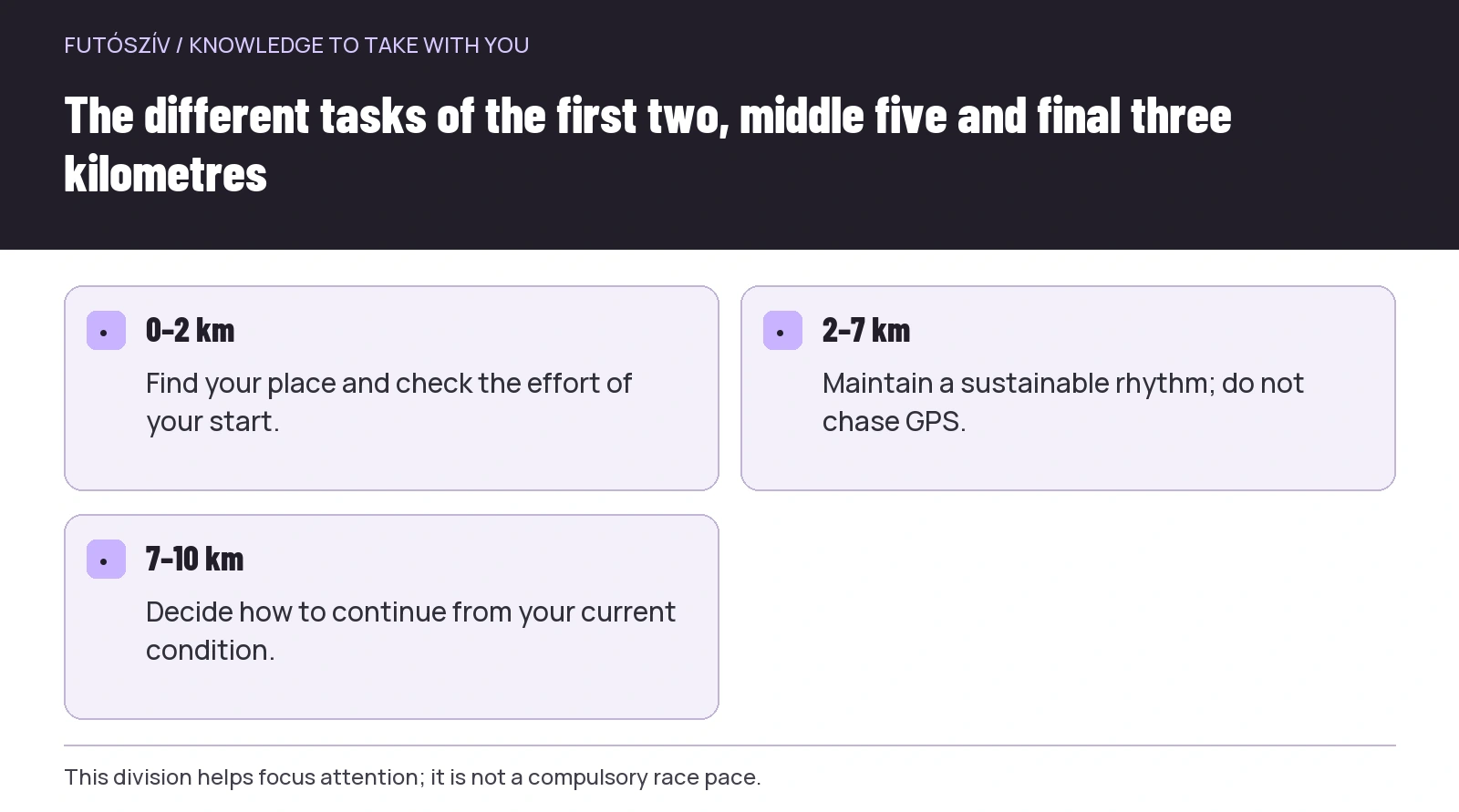 Enlarge diagram
Text version of the illustration
- 0–2 km
- Find your place and check the effort of your start.
- 2–7 km
- Maintain a sustainable rhythm; do not chase GPS.
- 7–10 km
- Decide how to continue from your current condition.
Pace calculation is simple; interpretation matters more
Average kilometre time is total time divided by ten. Fifty minutes over ten kilometres means five minutes per kilometre; sixty minutes means six; seventy means seven. Minutes, however, are not decimal: 5:30 is not five and three-tenths minutes but five and a half. When planning in an app, check whether you are entering pace, speed or total time; otherwise an attractive table can still produce a faulty plan.
| Example target time | Average pace | 2 km split | 5 km split | 8 km split |
|---|---|---|---|---|
| 50:00 | 5:00 min/km | 10:00 | 25:00 | 40:00 |
| 55:00 | 5:30 min/km | 11:00 | 27:30 | 44:00 |
| 60:00 | 6:00 min/km | 12:00 | 30:00 | 48:00 |
| 65:00 | 6:30 min/km | 13:00 | 32:30 | 52:00 |
| 70:00 | 7:00 min/km | 14:00 | 35:00 | 56:00 |
These calculations assume even progress. They do not mean forcing every kilometre equally. The same pace may require more work climbing a bridge than on flat ground; a headwind changes how movement feels. A target time is a reference, while regulating effort is an ongoing task. Especially at a first race, leave room to adapt the plan to what you learn on the course.
Use the first two kilometres to settle
You do not need to reclaim every second immediately after the start. If your starting area moves slowly, consider whether it is temporary congestion. Jumping onto kerbs, weaving between runners and sudden accelerations can create more uncertainty than the time they save. Let your position settle. Clarify net and gun time before the start too: events do not all use them in the same way.
Choose a short check-in question: “Would this effort still be manageable seven kilometres from now?” The answer is not a precise physiological measurement, but helps you step outside the crowd’s momentum. If the work already feels surprisingly hard at the end of the first kilometre, you need not wait until slowing becomes unavoidable. Easing off in good time is a deliberate race decision.
Do not respond to every overtaking runner in the middle section
Between two and seven kilometres, it is easy to fall into a rhythm dictated by those around you. Someone moves past and you instinctively accelerate; another person stops for refreshments and you immediately doubt your own pace. Decide in advance what information will prompt a change. How movement feels, the course profile and splits so far matter more together than who has just drawn alongside.
Even if you find a group travelling similarly, do not hand over control completely. They may be running a shorter distance, a relay leg or preparing for another goal. Race-number colours and route junctions can help you orient yourself, but you must represent your own plan. Shared rhythm helps when it does not obscure your own condition.
When the watch and course disagree
In cities, instantaneous GPS pace can jump around. Tall buildings, bridges, underpasses and sharp turns can make discrepancies especially noticeable. If the display suddenly shows an unusually slow number, your legs have not necessarily slowed suddenly. Consider lap average so far, course kilometre markers and how movement feels together rather than chasing a few seconds of data.
Marking a manual lap at an official kilometre marker can help, but practise it beforehand too. Race day is not the time to try a complicated new data screen. Use a few fields you understand: elapsed time, distance and perhaps lap average. If watch-checking disrupts you, check less often, perhaps only at particular markers. Measurement should help rather than continually examine you.
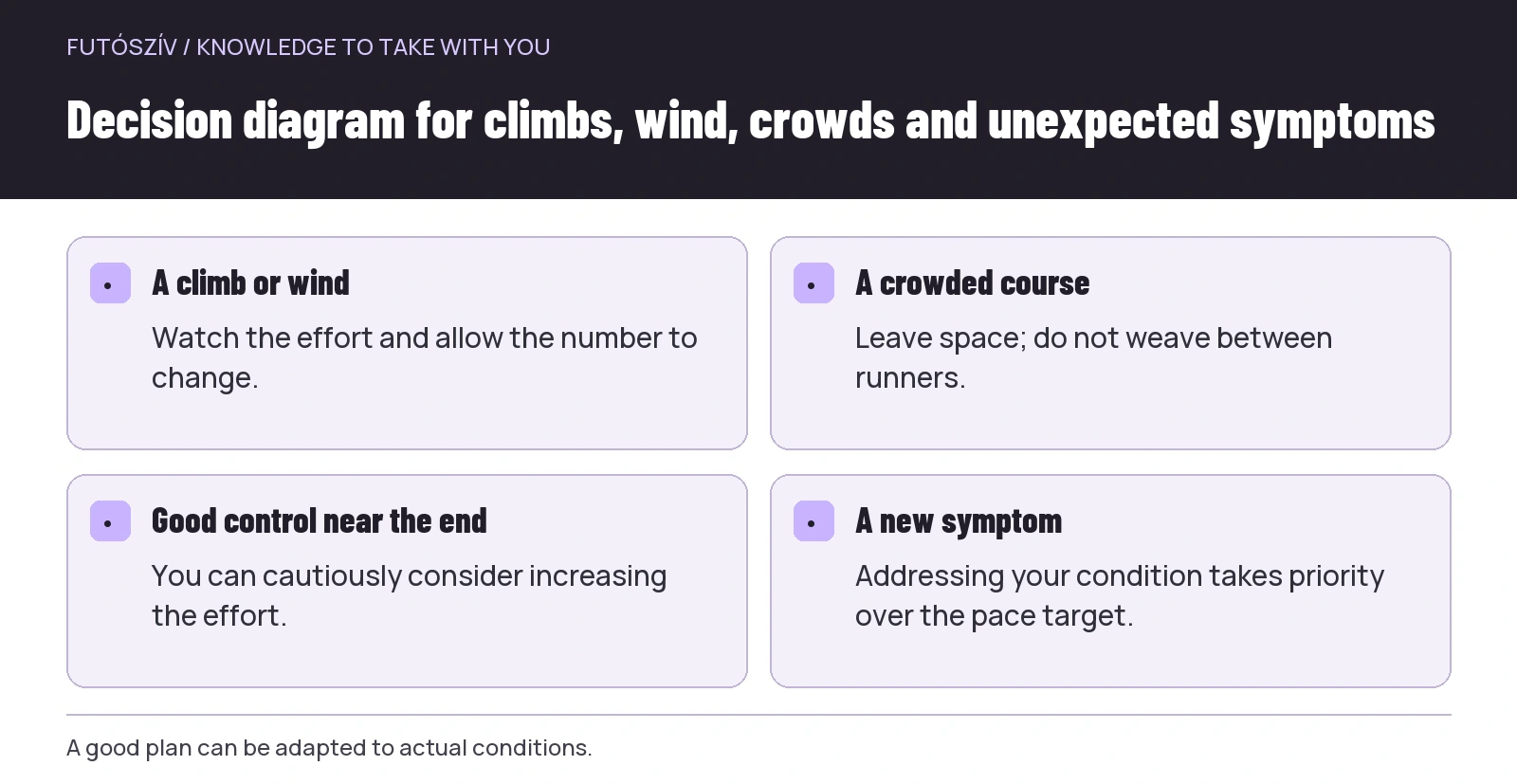 Enlarge diagram
Text version of the illustration
- A climb or wind
- Watch the effort and allow the number to change.
- A crowded course
- Leave space; do not weave between runners.
- Good control near the end
- You can cautiously consider increasing the effort.
- A new symptom
- Addressing your condition takes priority over the pace target.
Aid stations, climbs and turnarounds all count towards the time
Stopping or slowing to drink is part of completing the race. Do not treat every few seconds lost as a debt to repay. Accelerating suddenly on the next section solely to restore the average can upset your effort management. Check beforehand how many stations there are, how cups are handed out and whether any section makes safe drinking or overtaking harder.
Adapt fuelling to what you have practised; a 10 km does not come with a compulsory product list for everyone. Do not encounter a new gel or concentrated drink for the first time on race day. If uncertain about your needs, a sports dietitian can provide an individual answer. For the pacing plan, what matters is accepting a stop or slowdown in advance rather than treating it as a crisis.
| Course situation | A useful focus | A reflex to avoid |
|---|---|---|
| Climb | How movement feels and control of your steps | Holding average pace at any cost |
| Tight turnaround | Your line and distance from others | Cutting in at the last moment |
| Aid station | Signalling and choosing a side predictably | Stopping suddenly in the middle of the course |
| Headwind | Reassessing the planned effort | Speeding up because of the previous kilometre’s number |
| GPS jump | Comparing lap average and course markers | Reacting immediately to the display |
Leave yourself the right to decide in the final three kilometres
A good plan does not oblige you to accelerate simply because you have reached seven kilometres. First check whether control remains: is movement coordinated, is breathing manageable and can you attend to your surroundings? If so, consider a slight increase. If not, continuing steadily can be equally good execution. At a first 10 km, recognising the difference already teaches you a great deal.
Distinguish “I can hold on now” from unusual symptoms. Hard race effort and a new, concerning symptom are different. With chest pain, feeling faint or pronounced illness, seek on-site help rather than trying to save the split. This boundary is not about weakness; a result target cannot override every other piece of information.
Three scenarios for the same first 10 km
The plan proves too fast. The first few kilometres feel harder than expected, without congestion or hills explaining it. You can choose a new, more comfortable rhythm without making a final judgement on your preparation. One day reflects many factors. After finishing, you can review what planning missed; on the course, your task is to find a workable continuation.
The plan seems too cautious. Halfway through, you feel more comfortable than expected. You still do not need a large acceleration. Check the next part of the course and whether wind or hills remain. A gradual change later relies on more information than a dramatic finishing push begun at halfway. You do not have to extract every possible second from your first 10 km.
The watch fails. The race does not cease to exist because there is no display. Use course markers, elapsed time if still available and how movement feels. If you can no longer follow the time target reliably, switch to an execution goal. Frantic technical troubleshooting while running often produces a worse experience than accepting that today you will take home experience.
How to review your finish
Review the opening, middle and final sections separately. Where did you make deliberate decisions, and where were you swept along? The World Athletics introduction to the 10,000 metres also emphasises appropriate pacing, but you must add your road-course circumstances to the review. A track race and a crowded urban 10 km are not identical in every detail.
Do not record only whether you achieved the target time. Note the starting area, surface, wind, aid-station decision and when the run first felt too hard. If you want a change next time, these lead to specific tasks. A better 10 km can mean a faster result, but also a calmer start, a steadier second half and more decisions of your own on the course.
How Futószív articles are prepared: our editorial guidelines.