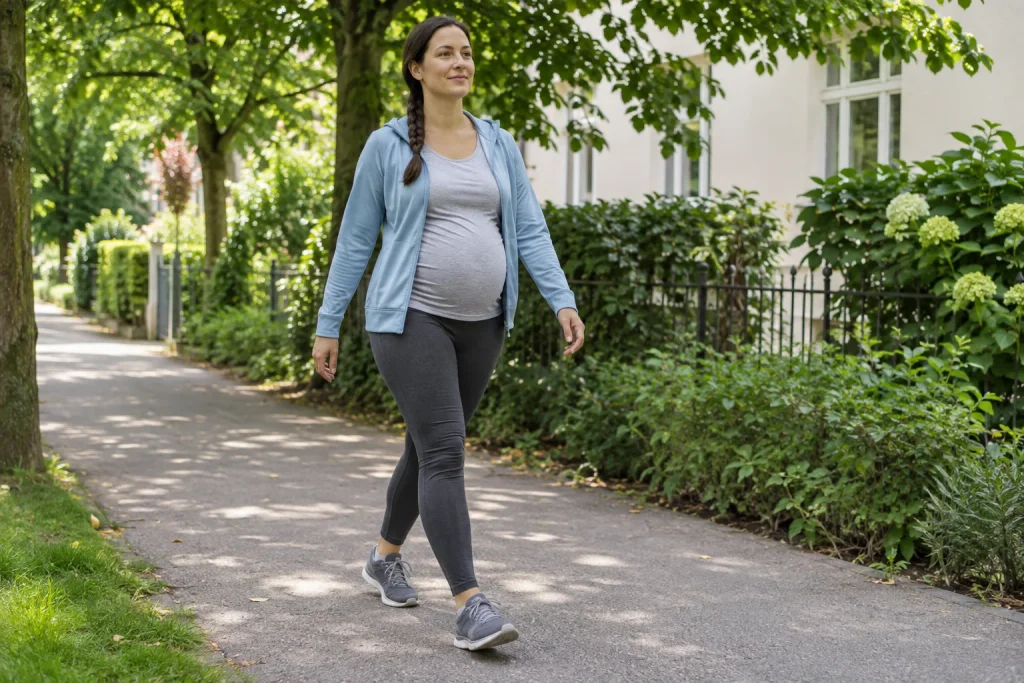
Pregnancy does not automatically make running shoes off limits, but an old training plan should not remain untouched either. The useful question is what activity is appropriate given your previous exercise, the course of your pregnancy and how you feel that day. A flexible plan agreed with your maternity care professional helps more than a general “allowed” or “forbidden” answer.
This article provides general information, not individual clearance for exercise. No personal assessment or medical review has taken place. With a high-risk pregnancy, known illness, new symptoms or uncertainty, follow advice from your obstetrician, midwife and, where appropriate, a suitably qualified physiotherapist.
Your running history matters, but does not override everything
Someone who ran regularly before pregnancy has a different starting point from someone wanting to begin now. According to the NHS information , familiar activity can often continue, but starting a new vigorous activity such as running during pregnancy is not recommended. Continuing an existing routine may also require changes.
Describe your running history specifically at maternity appointments. Rather than “I do a lot of sport”, explain how often you ran each week, for how long, on what terrain and whether you had pain or previous injuries. Racing, easy jogging and long mountain runs do not represent the same exercise demands.
If you have not run for a while, do not use your old race results as the starting point. Past experience is useful, but present capacity needs to be considered. Walking, swimming or another suitable, lower-impact activity can also be valuable options. The purpose of activity during pregnancy does not have to depend on one sport.
What do the general recommendations say?
The Canadian SOGC/CSEP guideline recommends at least 150 minutes of moderate-intensity activity per week, spread over several days, for pregnant people without contraindications. This is a framework for all suitable activity, not a weekly running prescription or a minimum to complete despite feeling unwell, medical restrictions or individual obstacles.
The ACOG professional summary also supports activity in most uncomplicated pregnancies, while recognising the need for modifications because of physiological and anatomical changes. This does not mean every run, distance or intensity is appropriate for every pregnant person.
Use numerical recommendations to start a conversation. Ask what an appropriate intensity means for you, whether you should avoid any activities and when the plan needs reassessment. Good guidance also needs to cover everyday implementation: what to do on a more tiring day and which symptoms mean seeking help.
Five questions worth taking with you
Write a brief note for your next maternity appointment. First, ask whether you have any health or pregnancy-related circumstances that change your activity options. Second, ask which parts of your current running routine you can continue. Third, ask which signs mean stopping immediately and whom to contact.
Make the fourth question about discomfort: whom can you approach for pelvic pressure, urine leakage, pain or uncertainty? The fifth should concern follow-up. One early conversation does not need to become an unchanging rule for the entire pregnancy. Ask when it would be useful to discuss the exercise load again.
The Irish HSE’s separate guidance lists several conditions requiring discussion in advance, including certain heart and lung conditions, inadequately controlled high blood pressure and pregnancy complications. Do not turn these into a self-diagnosis checklist; assessing personal risk is a professional task.
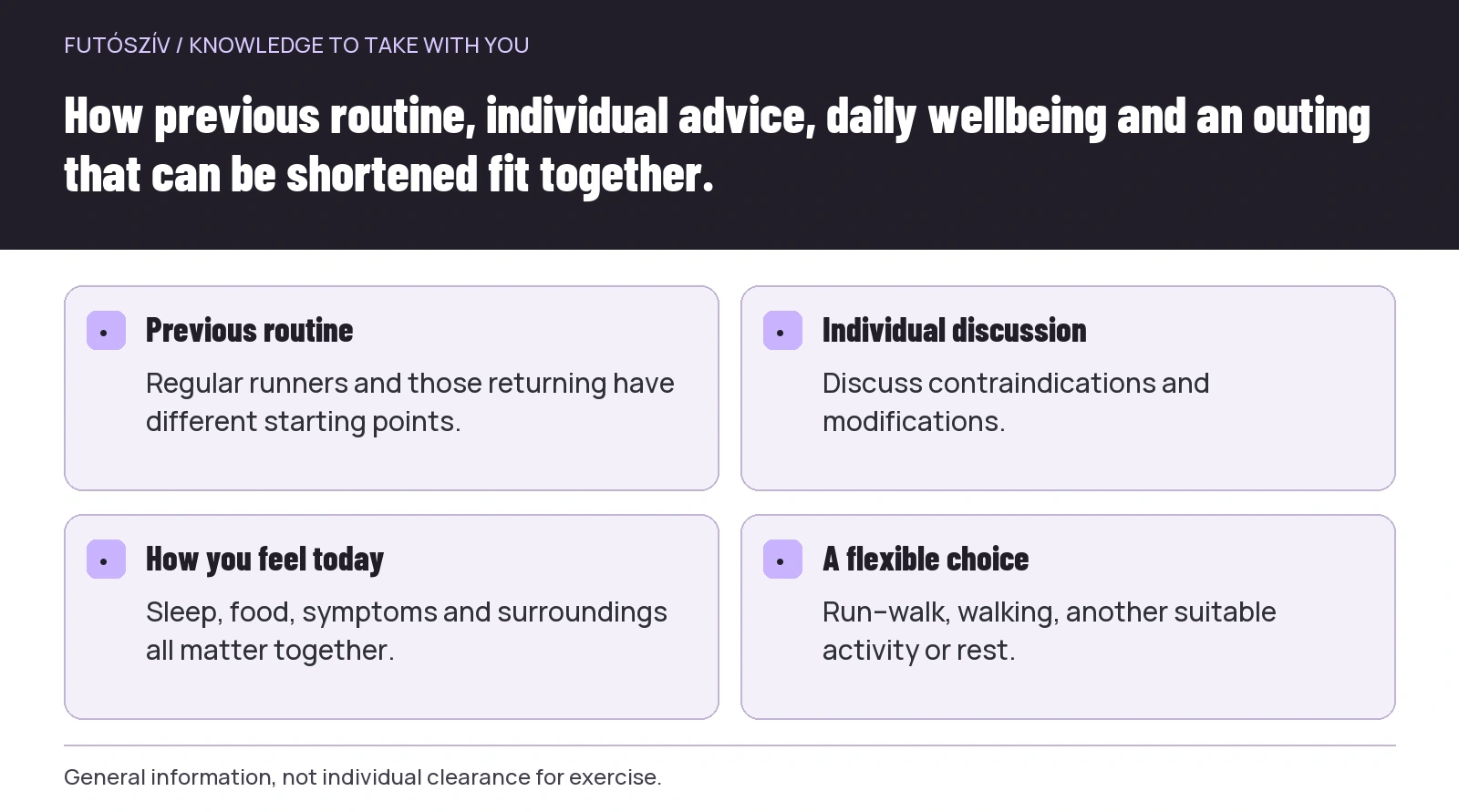 Enlarge diagram
Text version of the illustration
- Previous routine
- Regular runners and those returning have different starting points.
- Individual discussion
- Discuss contraindications and modifications.
- How you feel today
- Sleep, food, symptoms and surroundings all matter together.
- A flexible choice
- Run–walk, walking, another suitable activity or rest.
Circumstances are part of the daily decision
Before leaving, consider how much you slept, whether you have eaten, how you feel and how easily you can stop the outing. A short, flat loop gives you more options than a route where halfway round you can get home only with a long walk. Access to a toilet, drinking water and a phone provides practical support.
You do not need to make the same choice every day. It might be run–walk, walking alone, another activity agreed with your care team or rest. Adapting is not a lack of consistency: it is part of a routine fitted to changing circumstances. If exercise becomes a compulsion or missing it causes guilt, discuss that openly with your care team too.
Agree beforehand with a running partner that you can freely change the pace and turn back. You should not need to explain yourself halfway round if you want to walk. Choose someone who values the enjoyment of shared activity more than completing their own session unchanged.
Do not judge intensity by a single heart-rate number
A sports watch displays plenty of data, but the screen alone does not establish that an exercise load is appropriate. During pregnancy, perceived effort, comfortable conversation, your individual condition and professional advice all matter together. Another pregnant person’s heart-rate readings are not a useful personal upper limit to copy.
The HSE page on exercising safely emphasises comfortable intensity and slowing down when needed. The NHS also advises that you should be able to talk during activity. These are orientation tools; new or concerning symptoms still need separate attention.
Rather than the fast sections of an old training plan, a relaxed outing that is easy to stop can often make more sense. Discuss this individually, especially if you previously trained at high intensity or competitively. An athlete’s example on social media does not show their full health background and professional support.
Ground conditions, heat and the risk of falling
Your chosen loop should be easy in more than kilometres. Check the surface, lighting, descents and crowding too. A familiar woodland path can present a very different task in muddy weather. Technical terrain and fast downhill running do not become risk-free simply because you previously managed them without difficulty.
The Victorian government health information and ACOG both discuss overheating, adequate fluid intake and injury risk. A cooler time of day, shade, accessible water and a route you can shorten are straightforward planning options. A hot day does not need to become a test of determination.
In cold weather, slipping can affect your decision; in warm weather, heat strain can do so. If conditions take up most of your attention just to move safely, choose a different place or activity. Assess the particular outing in its present surroundings, rather than in the weather that existed when you wrote the plan.
More comfortable equipment, fewer experiments
Clothing should allow comfortable movement, while a bra should provide appropriate support without uncomfortable tightness. Try everything on a short outing close to home. A previously reliable size or cut may change; you do not have to keep using an old item throughout the whole period at any cost.
A belly support may feel more comfortable for some people, but it is not clearance for exercise and does not solve things for everyone. The ACOG patient information also mentions it in relation to comfort. Do not try to silence pain or pressure simply by tightening something more; seek advice about the cause and appropriate modifications.
Choose a pocket or belt that makes your phone and important contact details easy to reach. The aim is to avoid prolonged rummaging when you stop. Equipment should be straightforward to use, and your route should also be known to someone who can collect you if needed.
 Enlarge diagram
Text version of the illustration
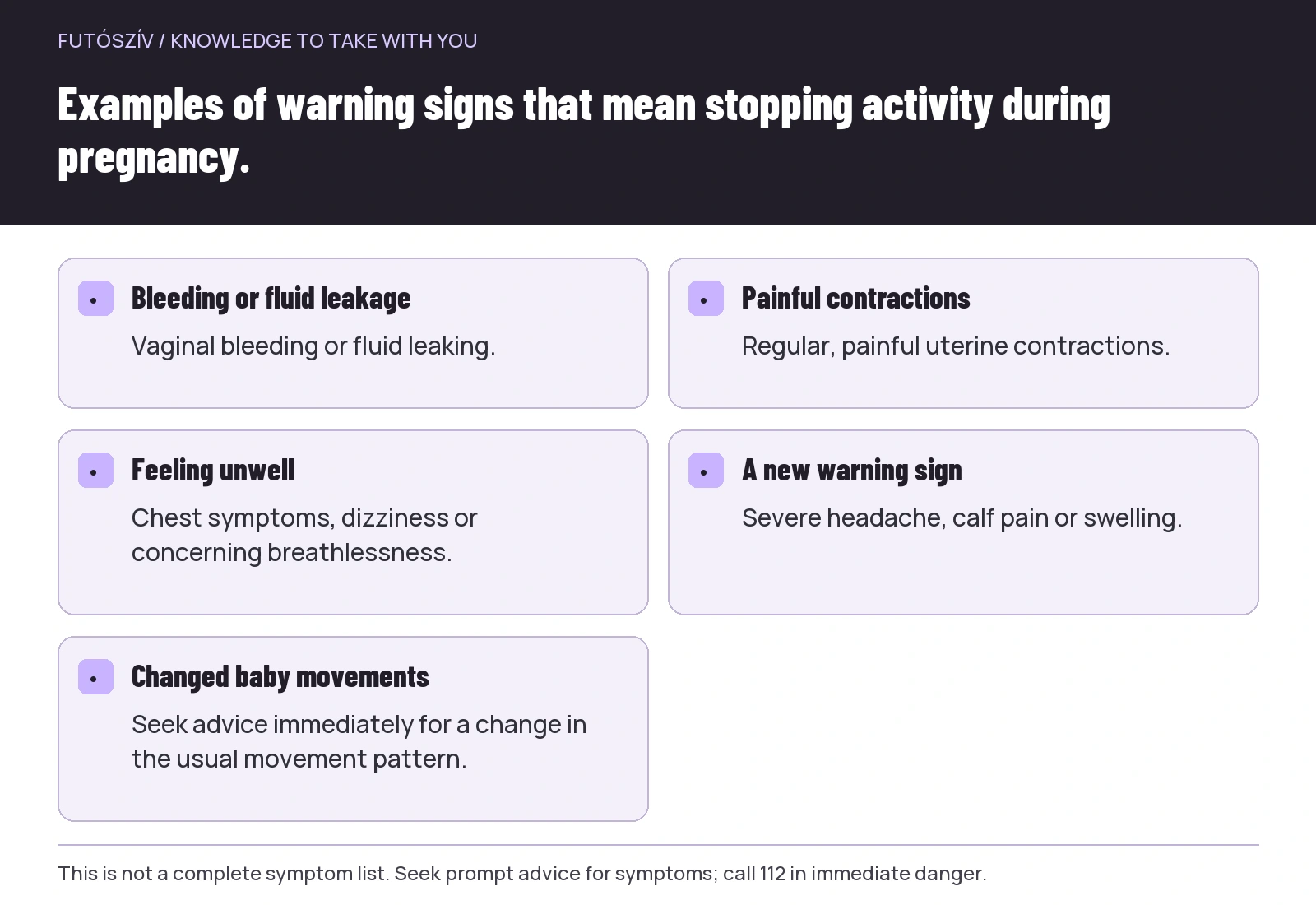
- Bleeding or fluid leakage
- Vaginal bleeding or fluid leaking.
- Painful contractions
- Regular, painful uterine contractions.
- Feeling unwell
- Chest symptoms, dizziness or concerning breathlessness.
- A new warning sign
- Severe headache, calf pain or swelling.
- Changed baby movements
- Seek advice immediately for a change in the usual movement pattern.
When should activity stop immediately?
The warning signs listed by ACOG include vaginal bleeding or fluid leakage, regular painful uterine contractions, chest pain, dizziness, headache, breathlessness before exertion and calf pain or swelling. Stop activity and seek healthcare help without delay if these occur.
The HSE page on pregnancy warning signs also treats a change in the baby’s usual movement pattern and severe abdominal pain as signs requiring urgent advice. Do not wait until the next run or try to decide whether things are all right from an app result. For severe illness or immediate danger in Hungary, call 112.
Discuss these actions with your maternity care professional while things are calm. Know which number to call outside working hours and where to turn with urgent symptoms. A warning list is not there to make you fear every bodily sensation, but to help you act quickly when an important symptom occurs.
The pelvic floor and the postnatal period need separate attention
Pelvic floor function cannot be fully assessed through a general instruction to squeeze. If you experience urine leakage, pressure, pain or an uncomfortable feeling of heaviness, seek suitable professional help. The Canadian guideline also emphasises learning correct technique for pelvic floor training. With individual symptoms, the type of exercise needs personal adjustment too.
Returning after birth is not an automatic continuation of running during pregnancy. Birth type, healing, symptoms, sleep and everyday demands all matter. During maternity care, you can already ask where you will be able to get an assessment and support. A calendar date alone does not replace discussing the conditions for returning.
A brief, useful record
At this time, how you feel may deserve more attention in a training diary than pace. Record what you chose, how long it lasted, how comfortable it felt and whether symptoms occurred during or afterwards. The aim is not another compulsory data-collection task, but specific examples for your next professional discussion.
Leave room for changes even on good days, and accept rest or a different activity on difficult ones. Your identity as a runner does not depend on the weekly distance of one particular period. Individual, flexible activity offers a way for sport to remain a supportive part of your life during pregnancy.
Sources and checking
For this article, we used the ACOG, NHS, Irish HSE, Canadian SOGC/CSEP guideline and Victorian government material linked above. Planning examples are editorial suggestions. Recommendations are general; assessing contraindications and personal exercise demands requires individual care. Sources checked: 18 November 2026.
How Futószív articles are prepared: our editorial guidelines.