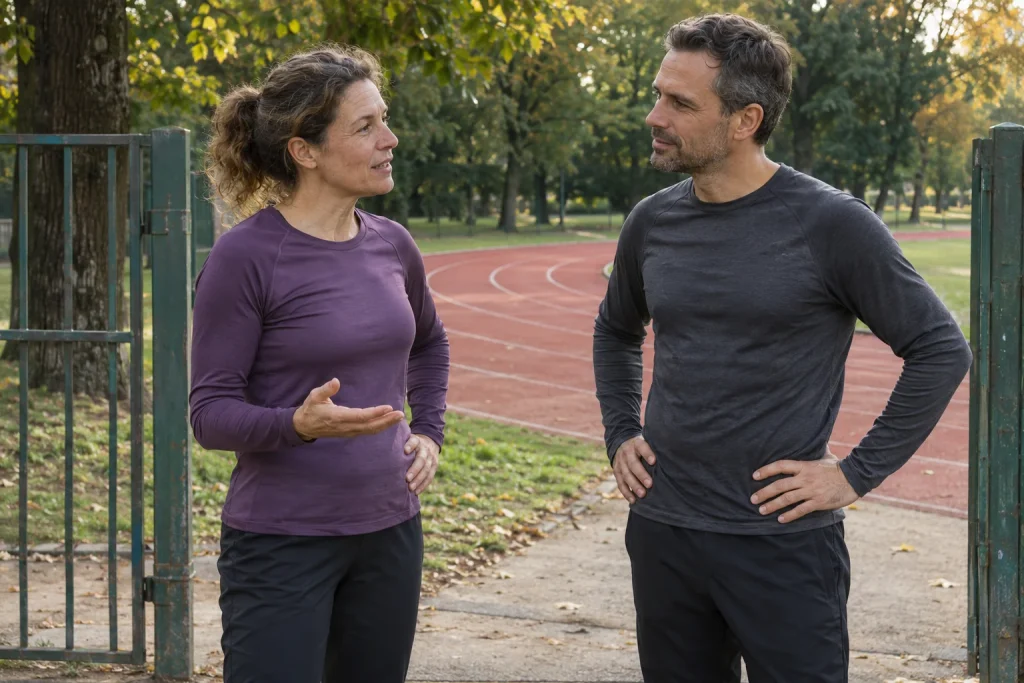
The same park section can seem a very different activity when you decide how to move along it compared with feeling you must constantly fit someone else’s idea. Running experience may involve not only route and movement but also how much say you have. In everyday language, ‘your own pace’ can therefore mean more than speed: choice, agreement and room for adjustment.
The question is not whether every prescribed workout is worse than independent activity. Some willingly entrust planning to a knowledgeable coach; others prefer freer decisions on a relaxed outing. Freedom of choice can coexist with a professionally considered framework. Understanding what researchers examined and what you want from a particular run is worthwhile.
What makes a pace your own?
At its simplest, someone else has not specified the speed beforehand. Everyday situations are more complex, though. You may freely choose a watch number while fearing the group will consider you slow. Elsewhere, you follow a coach’s prepared programme but understand its purpose, have discussed the framework and know how to give feedback. Actual involvement appears differently in these situations.
Separately ask who prepares the programme, who makes decisions on location and how freely feedback can be given. You need not decide everything alone for participation to be your choice. Whether genuine discussion is possible, or ‘everyone can go at their own pace’ exists only on paper, matters. A specific agreement makes choice’s content clear.
Your own pace need not mean the slowest, fastest or easiest option. You may want relaxed presence on one occasion and a previously accepted sporting task on another. Different goals can involve different wishes. Every run need not prove one fixed personal pace. Expressing which activity you currently seek can also be personal choice.
How were chosen and prescribed intensity studied?
In Rose and Parfitt’s original 2010 study, 17 less-active and 15 more-regularly-active women completed two thirty-minute treadmill sessions. They chose one intensity themselves; the other was prescribed relative to individual ventilatory threshold. At intervals, they spoke aloud about thoughts related to their feelings. Reports included appraisals of ability, expected consequences, attention and perceived control.
The full study presents a complex appraisal process, rather than one pleasant speed for everyone. No distinct themes emerged between less- and more-active participants. Reports help explain what participants may have thought; they do not experimentally isolate choice from every other circumstance. Choice allowed on a treadmill differs from complete freedom in every street-running situation.
Use the finding as a question in everyday life: over which part would you like more say? Perhaps prescribed numbers are not the problem; not understanding the task’s purpose is. Or you like the route but dislike constantly adapting to others. Naming details may help discussion more than deciding whether entirely free or wholly prescribed running is better in principle.
Self-selected sessions were not more pleasant in every study
In Parfitt, Rose and Markland’s 2000 research, twenty-minute prescribed and self-selected treadmill exercise were compared in trained participants. No difference in affective experience or enjoyment was found between conditions, while work output was greater with self-selection. This matters: independent choice did not produce greater pleasure in every study.
The everyday conclusion is not that choice is pointless, but that you need not expect a guaranteed feeling from it. Free activity can feel boring, mixed or unpleasant, while an agreed task can appeal to you. Consider the conditions for honest choice and feedback, rather than only who wrote the first programme version.
Preferences may change over time or by situation. Detailed guidance may suit new surroundings, while you prefer a freer session in a familiar park. Another day, someone else preparing the framework may feel helpful. This is not inconsistency. Deliberately selecting guided activity can be your choice while retaining room to ask questions and give feedback.
 Enlarge image
What should be clarified before a shared run?
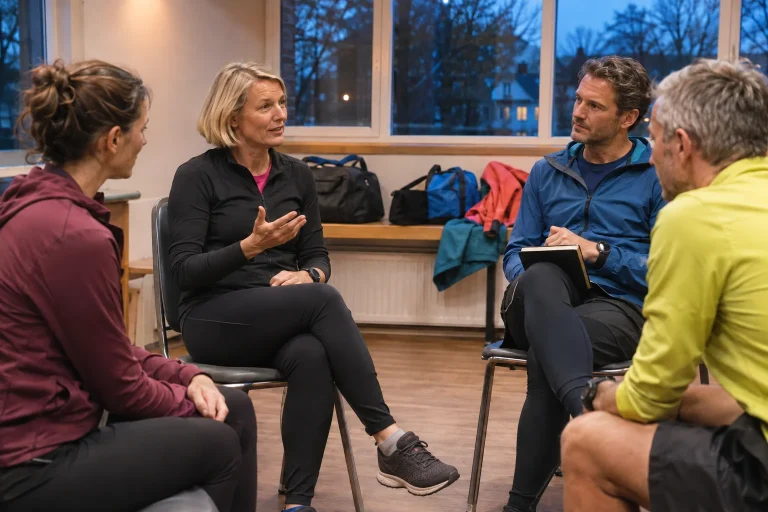
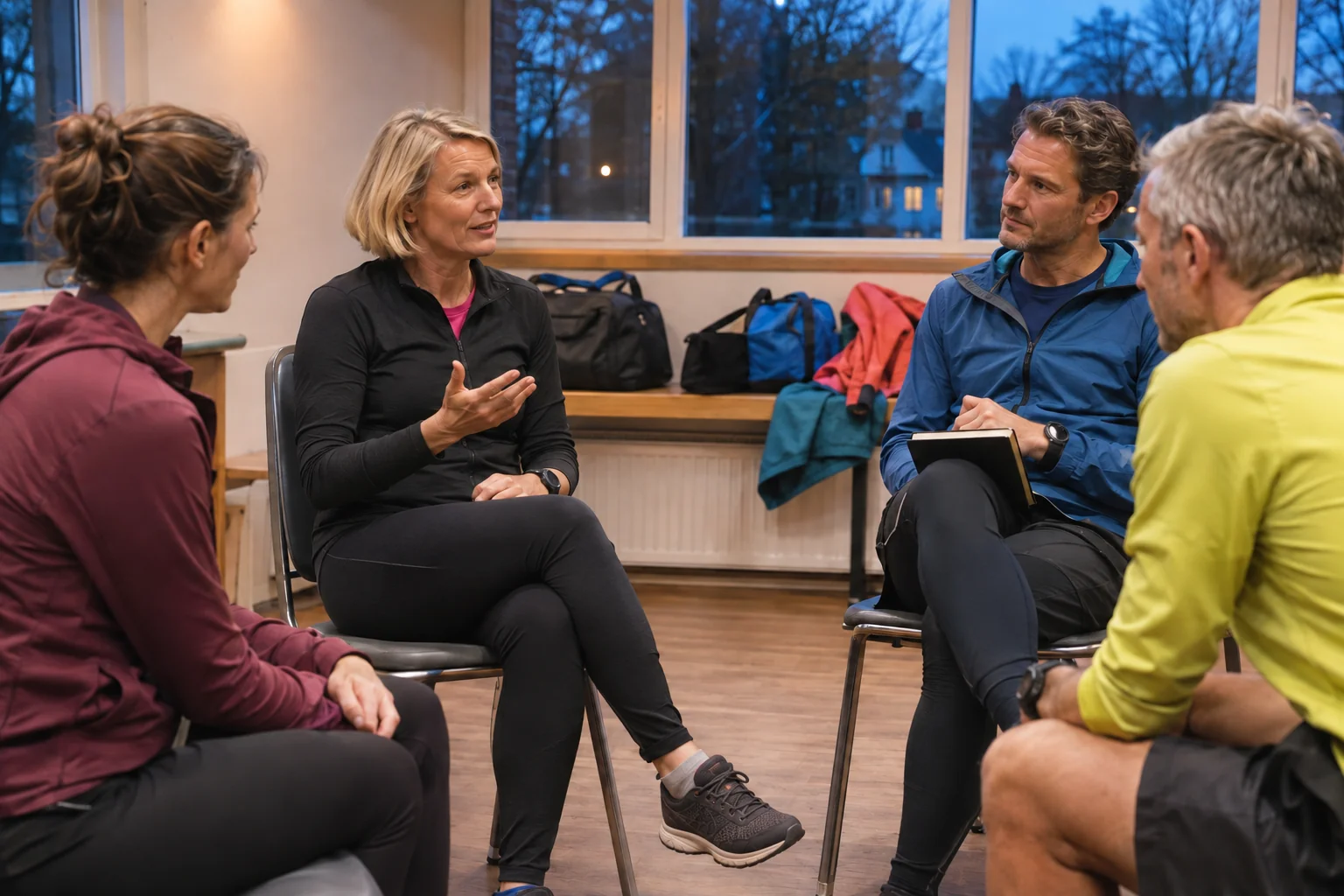
‘Everyone at their own pace’ sounds good but may cover several arrangements. Smaller groups may form, or everyone may start together and reunite at a designated point. Other sessions aim to stay together throughout. These are general examples, rather than one club’s rules. Find out which framework the invitation actually means before participating.
Agreement concerns more than pace. Route familiarity, meeting point, total time and conversation preferences may matter. If one person prepares for a sporting task and another seeks relaxed time together, you may not be planning the same occasion. Greater adaptation on location need not solve this. Separate or partly shared activities can be chosen during advance discussion.
In a fictional example, two friends meet on the same loop. They agree to begin together, follow their own plans later and meet again at the end. This is not general training advice or suitable organisation everywhere. What matters is that ‘your own pace’ represents a clear, mutually accepted agreement rather than a hidden expectation.
Feedback can say more than a number alone
If you do not want a pace, reasons may differ. You chose another goal, do not want to follow the group today or find adaptation uncomfortable. Specific words help a companion understand. You need not justify every personal decision in detail, however. A no deserves acceptance even without a complete explanation.
| Detail to discuss | An example in your own words | What does it clarify? |
|---|---|---|
| The session’s purpose | Today I would rather have a relaxed activity together. | We do not expect the same thing from every run. |
| Personal choice | I would like to decide how I move. | Having a say has specific content. |
| Shared arrangements | Let’s agree beforehand where and how we will meet again. | Different activities also need organisation. |
The table is a communication aid, rather than experimentally validated scripts. Its purpose is to avoid expecting someone to infer wishes from a watch reading or expression. You can likewise ask: do we want to stay together, or arrive at the same place for separate activities? Simple clarification can prevent misunderstandings without turning personal pace into an ideology.
Perceived control and actual opportunity do not always match
A group may call participation free while repeatedly commenting on anyone choosing differently. The theoretically permitted decision and experienced social situation then diverge. Ask yourself whether you can genuinely decline, ask questions or choose something separate. This concerns community experience, rather than running speed or determination.
Conversely, a prescribed framework can be clear and voluntary. With a well-discussed workout, you know its purpose, why it is arranged that way and whom to tell about your experience. A professional preparing some decisions can leave room for your perspective. Freedom of choice need not mean leaving professional collaboration, but participating meaningfully within it.
Distinguishing ‘I don’t know what I want’ from ‘I know but don’t dare say’ can help. The first may call for information and learning about possible formats; the second may make communication or social setting more important. These are personal considerations, rather than diagnoses. Adapting more is not the solution to every uncomfortable group situation.
Choice does not authorise unlimited exertion
Personal preference can be important to experience, but does not replace professional and health assessment of training demands. Choosing a pace does not automatically make it appropriate for every goal and condition. The studies provide no individual clearance either. How choice appears in experience is a psychological question, distinct from sports-medical suitability or symptom assessment.
If you have an individually agreed programme or restriction, choice can operate within it too. Discuss adaptable circumstances, necessary feedback and the next consultation question. Honest preference and careful organisation can coexist. ‘I would like a say’ can mean wanting clear, manageable collaboration, rather than rejecting every framework.
A physical complaint need not be recorded merely as an unpleasant experience, nor does good mood prove everything is fine. This distinction matters because freedom of choice can easily be described as though personal decision justified everything. Freedom also includes stopping, asking, choosing another activity or declining a session.
 Enlarge image
How can you find an appealing framework?
Instead of one ideal pace, name which sessions you like. Do you want every detail beforehand, or more freedom on a familiar route? Does company matter, or do you specifically want time alone now? These are not mutually exclusive personality types. Answers and chosen arrangements may change between days.
Keeping one detail may suffice: you appreciated not adapting to the group, or found the clarified task helpful. No freedom score is needed after every run. The named element may guide later consideration of a club, social programme or independent session. Consistency with your needs does not require organising everything identically.
If one setting does not appeal, you need not decide about all running. The particular social situation, time or mandatory goal may simply not fit. Nor must we assume a suitably repackaged running programme exists for everyone. Genuine personal choice includes both participation and selecting another activity as permitted possibilities.
Your own pace can also create shared language
Research on self-selected intensity highlights that speed alone cannot explain experience. In daily life, naming purpose, involvement and agreement makes this tangible. You need not expect guaranteed enjoyment from deciding yourself, but having the decision remain genuinely yours can matter.
Before the next shared session, clarify what ‘your own pace’ means among you: free speed, separate groups, an agreed task or other arrangements. A clear framework leaves less guessing and more room for actual-experience feedback. You need not find one universally pleasant pace, but discuss clearly which activity you choose.
Sources
- Rose and Parfitt: Pleasant for some and unpleasant for others, 2010 — original study.
- The full publisher text of the Rose–Parfitt study.
- Parfitt, Rose and Markland: The effect of prescribed and preferred intensity exercise on psychological affect, 2000.
How Futószív articles are prepared: our editorial guidelines.