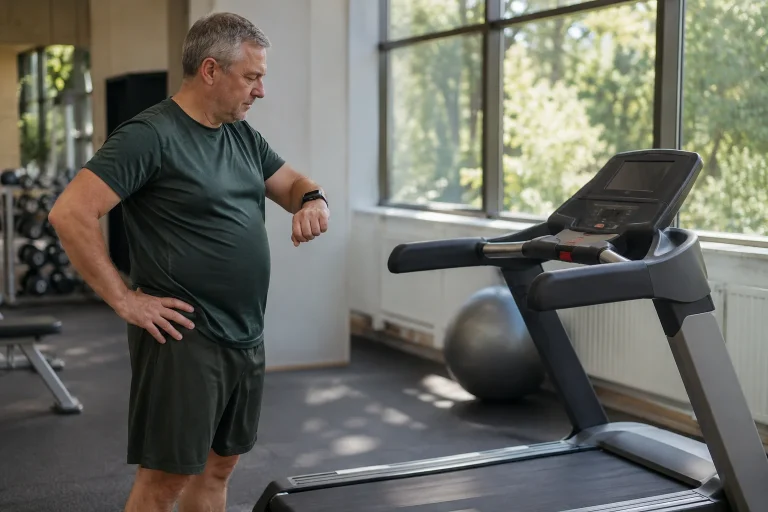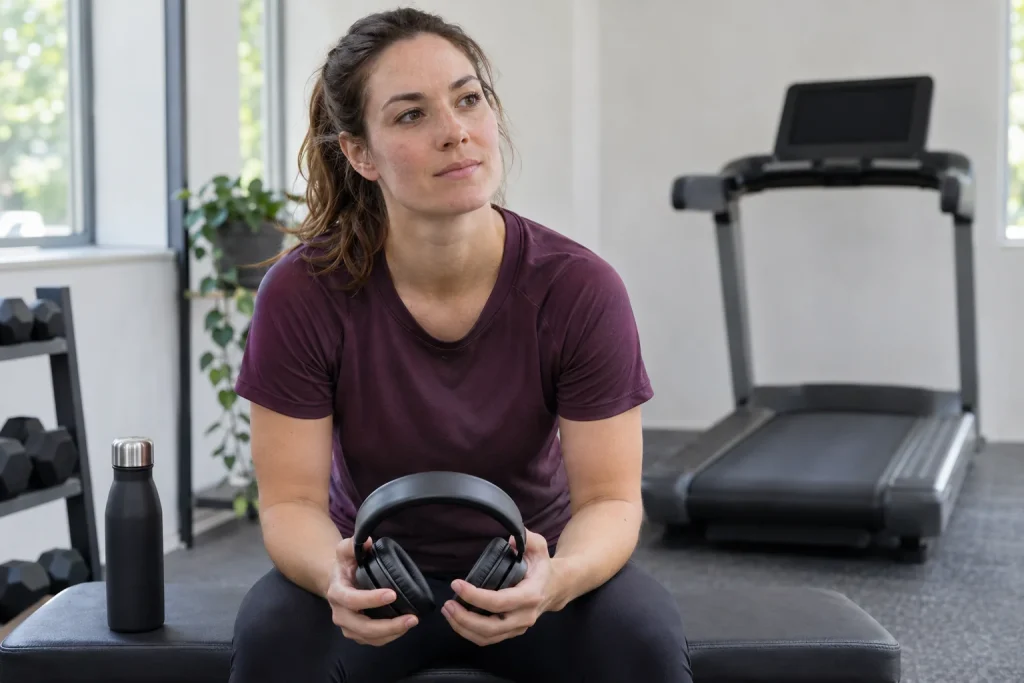
A run can feel easier with music without every measurable part of the body’s work decreasing. That may sound contradictory, but there are two different questions: how demanding movement feels and which physiological processes are measured during it. Favourite music can influence the experience without automatically meaning lower energy requirements or a more favourable movement pattern.
A 2026 treadmill experiment focused on precisely this difference. Participants reported less effort under the particular music condition, while some breathing and movement characteristics changed in another direction. You need not interpret this as meaning music is bad or your feelings unreliable. It is more useful for separating experience, the specific measured cost and conclusions about your own running.
What did the recent study compare?
Morrone and colleagues conducted a randomised-order crossover experiment with 32 recreationally active young adults. Participants ran on a treadmill for twenty minutes at a fixed 8 km/h, with and without music. The music condition used 128 beats per minute and a level of 85 dB SPL delivered through an in-ear device. This describes a specific research condition, not a recommended volume or instructions to try it at home.
With music, the researchers found lower perceived exertion, but a faster, shallower breathing pattern, less favourable ventilatory-efficiency indicators and a slightly greater oxygen cost of running. Some spatiotemporal movement characteristics also changed. The group was young, and the result was tied to a specific speed and sound condition. The study does not prove that every kind of music, at every volume and in every runner, changes movement in the same way.
The experiment’s value lies in placing different measurements alongside one another. It went beyond asking whether running felt better and observed other characteristics too. This made a difference between the subjective and instrument-measured sides visible. The everyday reader’s task is not to reproduce every measurement at home, but to recognise that ‘it felt easier’ does not always mean every other indicator changed in the same direction.
Perceived exertion answers its own question
When you say a run was hard, you are reporting the whole experienced task. That can include bodily sensations, attention, mood and your relationship with the task. A research scale asks about this in a defined way; it does not measure the same thing as oxygen cost calculated from breathing. The two accounts can therefore differ without either being inherently meaningless.
‘Subjective’ does not mean the account is false. Running experience matters precisely because you live it, and it may influence your relationship with the session. Yet experience is not a direct display of every internal process. If time feels less burdensome with music, that still does not tell you how much oxygen the movement required under those conditions.
Place the two types of information alongside one another rather than using either to discredit the other. You need not tell yourself you only imagined the relief, nor that a better feeling overrides every other consideration. An accurate statement can be simple: the music session seemed more pleasant or less difficult, while that alone does not tell you everything about the full physiological load.
 Enlarge image
What does breathing efficiency mean here?
Ratios used in breathing research are not direct measures of happiness. They can help describe the relationship between ventilation and gas exchange during a given task. If a study reports a change in such an indicator, that cannot simply be rewritten as participants feeling better or worse. Experience and respiratory function are separate measurement perspectives.
For the same reason, a particular difference in one study does not imply disease or lasting damage in every runner who listens to music. A short experiment examines a defined condition, not a whole life course. Distinguish a measured characteristic changing in a less favourable direction during the task from a person’s long-term health outcome. The latter would require different evidence.
You do not need to force your breathing into a prescribed rhythm on the basis of this article. Describing the study is not instruction in breathing technique. If an unusual or concerning symptom occurs during exercise, an explanation about music does not replace assessment. Do not continue an uncomfortable situation because you think the content merely makes you perceive it differently.
The direction of ‘running economy’ is easy to misunderstand
In everyday language, a bigger value often means better. In studies of running economy, however, the number must be read according to the specific measurement definition. If oxygen cost at a given speed increases, that does not mean economy has improved. A shortened label and the direction of a change can mislead if the measured quantity is not given alongside them.
It therefore matters when interpreting the recent result that the reported oxygen cost was slightly higher despite lower perceived exertion. This must not be summarised as music making running more economical in every respect. Consider the size of the difference together with the experimental conditions, without a general product or training promise.
Your sports watch’s estimate at home is also not the same measurement setting as laboratory gas-exchange testing. A workout summary cannot reliably confirm or refute this particular finding. Your own data may be interesting for another purpose, but you do not need to manufacture a laboratory conclusion from them after a run with music. The measurement tool and the question need to fit.
Not every study creates the same music situation
In an earlier treadmill study by Hutchinson, Karageorghis and Jones involving 24 participants, conditions included music, combined music and video, and a control. The combined sound-and-image condition was associated with more favourable perceived exertion and emotional responses at the specified intensities. That study used different stimuli and a different task, so it is not a direct test of the 2026 fixed-speed, in-ear music condition.
Differences between music studies do not necessarily make either worthless. Volume, tempo, content selection, exercise intensity and participants’ experience may differ. Leaving these out easily produces two overly simple claims: music improves things or makes them worse. Keeping the details reveals the narrow question each study answered.
A media setting may also carry personal meaning that a particular experiment does not investigate. Memories associated with a familiar song, a chosen programme or that day’s mood can be part of an everyday session. These are possible components, not proven causes of the physiological difference presented here. Separate explanations from what was actually measured.
A movement-pattern change is not an injury prediction
A treadmill study can record spatiotemporal characteristics: how movements follow one another in time or how a measured movement indicator differs. Such changes may help explain the task, but do not automatically create a personal injury-risk score. The relationship between a short-term measurement and later symptoms would require separate investigation.
This article therefore does not suggest consciously correcting a movement while listening to music for the sake of the research. A reported group average cannot tell you how you personally should step. Assess a specific movement complaint or technique question in your own situation. Study data do not replace individual observation and appropriate professional help when needed.
Nor should comparisons between groups become separate music rules for every woman or man. A particular comparison in a small sample is not a personal prediction. Participants’ age, activity and measurement conditions form part of the conclusion. The further a claim moves from these, the more cautious it needs to be.
 Enlarge image
What should you notice in your own session with music?
In your own experience, you can describe the content and the movement separately. Did the song feel good, did time seem easier to pass, or did it divert your attention? Whether the planned framework remained manageable is another question. A more pleasant experience does not oblige you to speed up or extend the session; a less enjoyable track does not require you to force more excitement into the exercise either.
If you want to change playback, do so from a suitable, stable position. Safe operation of a treadmill and awareness of your surroundings and other road users outdoors remain fundamental. Music should not become a task that makes you continually reach for your phone. A laboratory attentional effect is not a goal of excluding real signals as completely as possible.
Your own comparison can remain simple and low-stakes. There is no need to copy the study’s volume or speed, or organise an exercise test for a favourite song. For personal choice, noticing what is pleasant and usable may be enough. Scientific interpretation of the measurements remains a separate task.
An easier experience with realistic expectations
Running can remain a valuable experience even if you cannot name every bodily change behind a more pleasant state. You do not need to reject music because of one narrow experiment, or infer improved efficiency from every good feeling. More precise thinking lets you enjoy the content while considering other aspects of load and your body’s signals.
The paradox presented here is useful because it breaks a simple equivalence: if it feels easier, the work must be lower in every respect. The feeling can be real while physiological indicators differ from it. Together they offer a more nuanced picture than either alone. You need not prove this on your next run; it is enough for favourite music not to override a manageable task and safe awareness.
Sources
Morrone and colleagues: Moderate-to-loud in-ear music worsens ventilatory efficiency and running biomechanics during fixed-speed treadmill running, 2026. A fixed-speed crossover study of 32 young adults. Volume and speed are research conditions, not recommendations; increased oxygen cost is not improved economy.
Hutchinson, Karageorghis and Jones: See hear: psychological effects of music and music-video during treadmill running, 2015. Different sound and visual conditions and different measurement questions. This article is an educational interpretation, not our own laboratory study or the result of documented medical review.
How Futószív articles are prepared: our editorial guidelines.