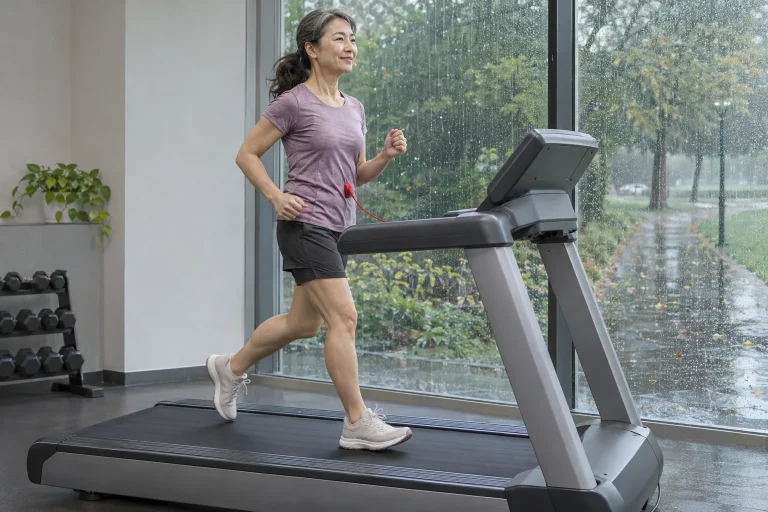
The clock records the same duration, yet thirty seconds feels different at rest and during movement. Some moments seem dense, while others pass almost unnoticed. Experienced time is therefore not a simple copy of the stopwatch display. A brief interval feeling long does not automatically mean the device is faulty, or that the exercise was necessarily too difficult or boring.
For runners, the relationship between experienced time, attention and effort is an interesting question. But the research method matters greatly: signalling during a task when you think thirty seconds have elapsed is different from estimating the duration of an entire session afterwards. This article starts with a cycling time-estimation experiment, then shows why retaining that distinction matters when interpreting findings about running too.
Time is not always measured with the same question
A researcher can record chronological time with a stopwatch. There are several ways to ask about a participant’s internal estimate, however. They can say in advance which interval the participant must signal, or ask only after the task how much time elapsed. These give the person different tasks. In one, you already know during the activity that you must pay attention to time; in the other, you assemble an estimate afterwards.
This difference easily disappears in everyday phrases. ‘Time passed slowly’ can mean you were impatient during a short section, or that you recall the whole session as longer. There is no need to translate every account into technical language. When reading research findings, though, check the question behind the claim; otherwise, we may compare different phenomena.
A runner’s own experience can be nuanced too. During one section, the remaining time may have seemed substantial, yet later you remember the whole run as having flown by. That is not necessarily inconsistent. You are discussing a different moment and a different kind of judgement. Such distinctions help avoid immediately explaining a changing sense of time through a device fault or a personal failure of attention.
The thirty-second task during cycling
In Edwards and colleagues’ 2024 study, 33 recreationally active adults completed three different four-kilometre cycle-ergometer time trials. The screen conditions involved riding alone, a passive companion avatar and an opponent accompanied by active instructions to compete. Participants had to say when they thought thirty seconds had elapsed while the researcher measured the actual time. The task was compared before, during and after exercise.
During cycling, participants signalled the time they thought had elapsed before thirty real seconds had passed, which the authors interpreted as a slowing of subjective time. They found no difference in time perception between the opponent conditions. Completion was faster with active competition instructions, however. This was not a running study, and the avatar was not without effect in every respect: performance and time estimation were different outcomes.
The methodological detail is particularly important: participants were not giving a retrospective number for an interval of unknown duration. They knew beforehand how much time they needed to signal. The measurement is therefore not a straightforward equivalent of remembering that an entire workout passed quickly or slowly. The research claim remains accurate when the task type stays visible alongside it.
 Enlarge image
How can an earlier signal indicate time feeling longer?
At first, it can seem backwards that someone speaks sooner while time is described as slower. In this task, however, they are not saying how many seconds a clock would show. They signal when the requested interval has passed for them. If that feeling arrives before the actual duration, the internal estimate reaches thirty before the stopwatch does. That is the logic of this measurement situation.
Similar to the everyday feeling that ‘this has been going on for ages’, internal expectation and external time may not match precisely. This does not establish a single internal clock or a particular neural mechanism. The experiment recorded a behavioural response. Possible explanations involving attention belong to a separate interpretative level, rather than being directly measured brain processes.
You do not need to launch an internal stopwatch competition during your own runs either. The time-perception task may be an interesting research tool, but it is not a compulsory part of training for someone curious about the phenomenon. Understanding the report only requires clarifying the question and direction of the response. You do not have to estimate every thirty-second period separately while exercising.
The opponent did not affect pace and time experience in the same way
It is easy to attach a general story to a virtual competitor: surely they distract you, so time must pass faster. The experiment presented here did not produce that simple result. Conditions differed in completion time, while the thirty-second estimate showed no corresponding difference. This cautions that several outcomes from one situation do not necessarily change together.
The result does not mean a competitor never shapes the running experience. The study used a screen avatar and a defined cycling task; an easy loop with a friend is quite a different situation. A negative finding needs to be described just as precisely as a favourable one. ‘No difference was found in this task’ is not equivalent to saying that social presence is generally irrelevant.
When choosing for yourself, ask separately what company offers: conversation, a shared outing, rhythm or competition? These do not need to be justified by claiming they certainly reset your internal sense of time. The value of a shared run can simply be personal and social, while its measurable effect on time estimation in that situation remains unknown.
Changing effort does not fully explain time
Perceived exertion increased during the cycling task, yet the time estimates measured during exercise did not show the same difference. In this particular design, that argues against a simple equivalence between time perception and effort. It does not prove they are completely independent at every intensity and in every form of movement. The limits of the research setting matter here too.
In everyday running, it can help to name separately whether the task was difficult, time felt long or both. Neither answer automatically implies the other. More precise self-description can help prevent you seeking only more entertainment for an excessively demanding situation, or increasing the load because a session seemed uninteresting.
Nor does the measurement imply that a symptom is merely distorted time perception. An unusual bodily signal or feeling unwell should not be dismissed with an attentional explanation. Research into the exercise experience does not replace assessment of the actual situation. A reasonable loading framework and appropriate professional help when needed serve different purposes.
A run estimated as short afterwards: another method
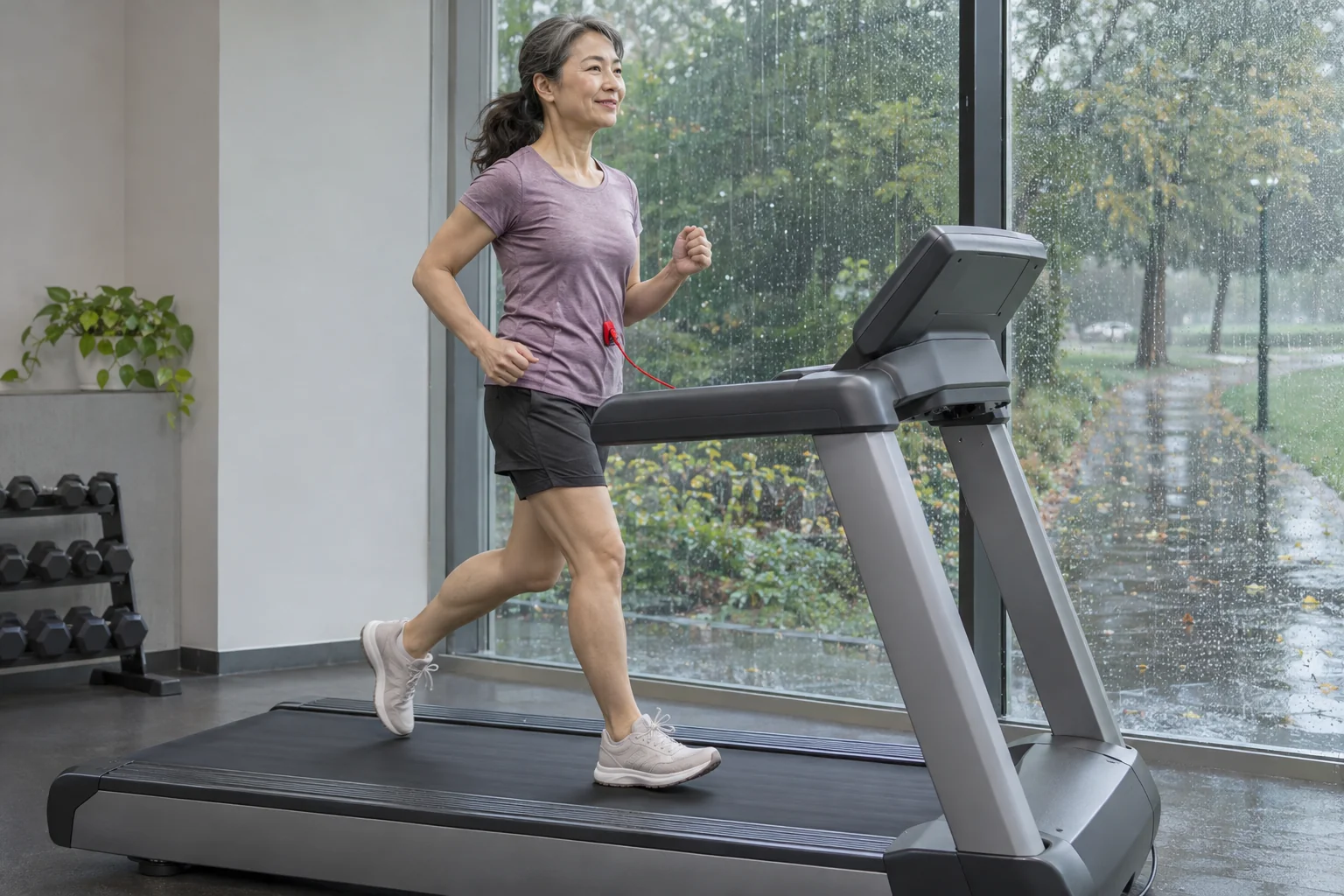
In Weippert and colleagues’ treadmill study of ten male endurance athletes, researchers changed the speed of a virtual landscape. In both conditions, participants retrospectively underestimated the total duration of a short run to exhaustion. The accelerated visual scene reduced this underestimation, while completion time and perceived fatigue did not change correspondingly. This is a different task from producing a requested thirty-second interval during activity.
The two findings should therefore not automatically be treated as contradictory. They involved different participants, different movement and a different time-estimation question. ‘Felt slow’ and ‘estimated as short afterwards’ can only be compared with knowledge of the methods. Recognising the distinction helps more than searching for one general claim about what all exercise does to time.
The exhausting treadmill study is not a personal task either. You do not need to try its exercise load on yourself to understand the methodological distinction in time experience. Your own movement can have a different purpose, time frame and manageable load. Curiosity about research does not oblige you to reproduce laboratory conditions.
 Enlarge image
Your internal sense of time is not a device test
If a section seems longer than the time displayed, the impression alone cannot establish the device’s accuracy. Time experience and the instrument’s operation are different questions. Investigating a device fault requires its actual operation, settings and appropriate checks, rather than only the fact that a minute felt tiring or uneventful.
Equally, instrument-measured time does not invalidate your experience. Little time may actually have passed while it felt like a lot to you. Both statements can be true. You do not need to discipline yourself by saying the watch shows you have barely done anything, so you have no right to find it difficult. The display provides information; experience describes another side of the same session.
Both can have a place in daily decisions. A time frame can help organise the activity, while your own feeling can indicate how manageable the situation is now. There is no need to use one to exclude the other. The aim is not to perfect an internal estimate, but to assess movement and circumstances reasonably from several perspectives.
Thirty seconds do not have to become a test
If a brief section feels long next time, it may be enough to notice that you are currently focusing on time. You do not need an immediate new explanation or technique. Variation in experienced time is a human experience whose particular context matters. One occasion does not need to become a judgement of your entire relationship with running or the quality of your attention.
The framework can change when there is a real opportunity: another task, simpler organisation or a different kind of movement that day may be options. These are everyday decisions, not proven methods for speeding up time. You do not need to conquer every unpleasantly long minute, or use distraction to exclude every bodily or environmental signal.
The research’s most useful contribution here is more precise questioning. Which time was estimated, when were participants asked, during what task and which result changed? Keeping these separate makes it easier to understand your own differing experiences too. The clock can measure the same thirty seconds while you are present in them differently; that is an interesting distinction that need not be erased by a single simple rule.
Sources
Edwards and colleagues: The perception of time is slowed in response to exercise, an effect not further compounded by competitors, 2024. Cycling time trials in 33 adults, with signalling of a thirty-second interval specified in advance; not a running study.
Weippert and colleagues: Optic flow speed during running in a virtual reality affects perceived time but not perceived fatigue, 2025. Ten male endurance athletes, with retrospective estimation of the complete run’s duration. The practical examples are our own editorial interpretations; this article is not based on our own experiment or documented medical review.
How Futószív articles are prepared: our editorial guidelines.