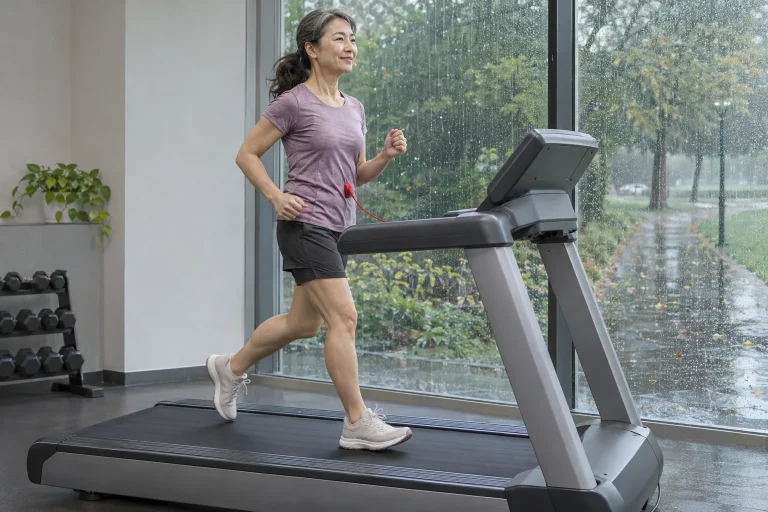
The first minutes of a run are not particularly difficult, yet time seems to pass endlessly slowly. On another occasion, moving demands considerable attention, but you are not bored. Boredom and unpleasant effort are therefore not two names for the same feeling. They can occur together, but can also appear separately. Calling every session that feels long a simple lack of motivation may lose precisely the detail that would help you understand the situation.
The question does not arise only on a treadmill. It can be hard to engage on a frequently repeated route, in an overcrowded schedule or with a task poorly suited to what you need that day. Here, we start with distinctions in describing exercise experiences and two primary studies. We are not offering a boredom diagnosis or a compulsory entertainment recipe, but more precise questions about what you experience and what might be worth changing.
Difficult and uninteresting are two separate dimensions
A task can be easy and interesting: you might move calmly through a place where you enjoy looking around. It can also be difficult and interesting when what you are doing absorbs you. An easy but uninteresting situation differs again from one that is both too demanding and difficult to face. These are illustrative everyday possibilities, not mutually exclusive personality types or research categories.
The practical value of distinguishing them is that every situation does not call for the same response. If the task is harder than planned, more stimulation may not be what you need. If the movement is manageable but nothing engages your attention, a different environment or kind of session may be interesting to consider. Naming the experience can help, but does not automatically prescribe the solution.
Do not rename a physical complaint as boredom either. ‘I do not feel like doing this’ and ‘I feel unusually unwell while exercising’ can be different situations. This article does not assess symptoms; a specific complaint needs appropriate attention and, when necessary, professional assessment. A psychological explanation must not become a way to dismiss an actual bodily signal.
Measures of boredom include several experiences
Fahlman and colleagues developed the Multidimensional State Boredom Scale to measure boredom experienced as a state. The original instrument distinguished five components, including disengagement, difficulty with attention, the experience of time and states involving different levels of arousal. Its development illustrates that boredom is not necessarily just sleepy disinterest: it can also involve a more restless experience.
The questionnaire is a research instrument, not a self-diagnosis to perform while reading. Even so, these dimensions may help refine your own language. Is your attention scattered, would you rather do something else, or are you continually checking the time? You do not need to calculate a score or infer a permanent trait from one occasion. Today’s experience may differ from what you usually enjoy about exercise.
The distinction between a state and a lasting characteristic matters too. Being bored on a loop today does not make you doomed to boredom or unsuited to sport. A description is useful when tied to the specific setting. A permanent label attached to yourself says less about details you could address than recognising that engagement was difficult with this task on this day.
 Enlarge image
Comparing a forest walk with an indoor walk
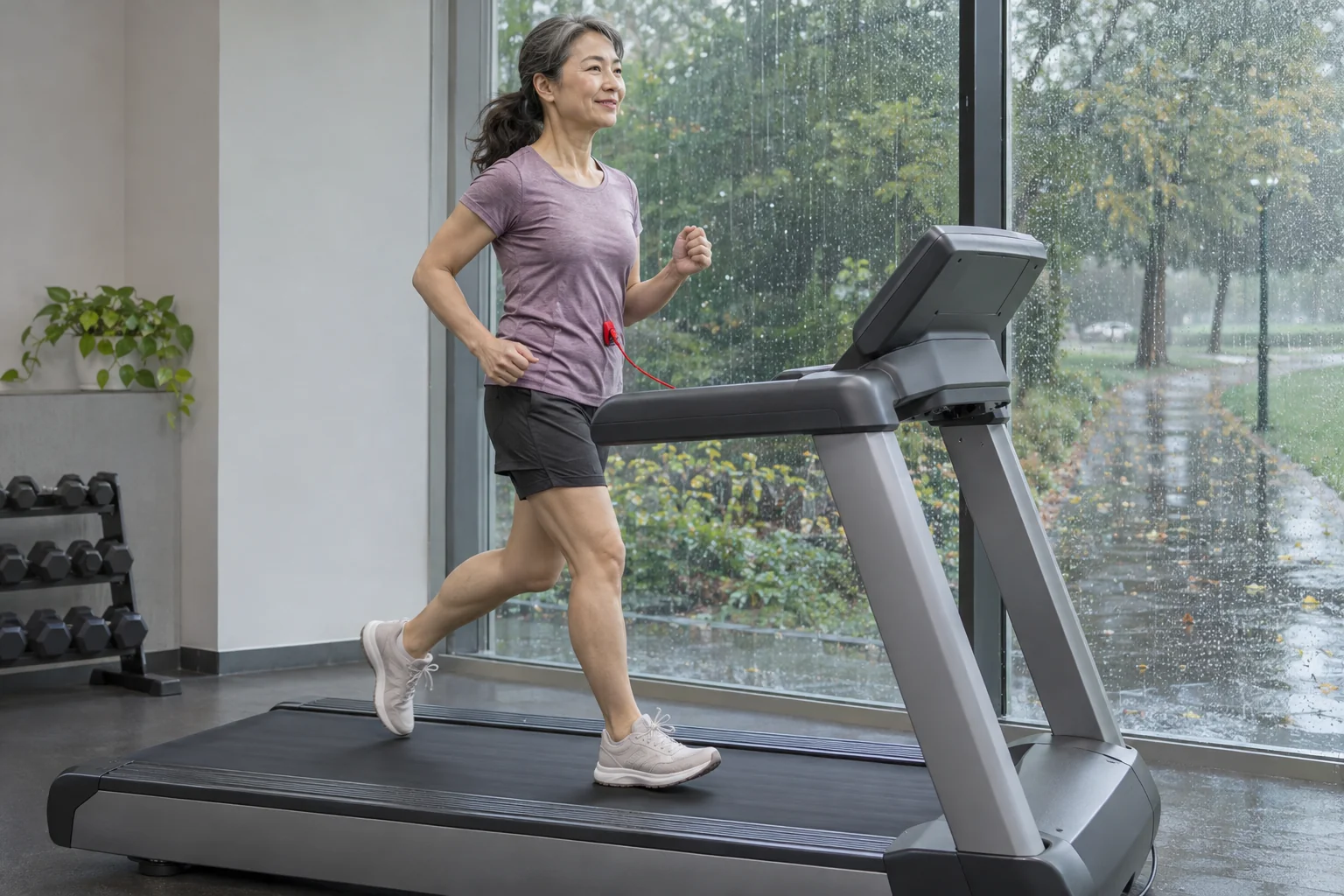
In a 2026 crossover study, 34 healthy Chinese university students completed 30-minute forest and treadmill walks. The indoor condition provided no music, video or other entertainment. Researchers used a boredom scale adapted to eight items. Immediately after exercise, they found lower boredom in the forest condition; in the adjusted comparison, the later measurement at thirty minutes did not show a significant difference. The separate measure of exercise enjoyment also showed no significant difference.
This detail matters because less boredom does not automatically mean greater enjoyment in every sense. Intention to continue was also more favourable after the forest session, but that did not represent regular exercise observed over the long term. A short walking experiment with a young sample does not prove every runner will prefer every forest outing.
The particularly restrained indoor condition limits everyday application. A windowless research setting without media may differ from your own familiar gym or a pleasant space at home. The shortened instrument required further independent validation. The study offers an interesting example of the relationship between environment and boredom, but no reason to downgrade every indoor option.
Why can time feel long even when the task is not too hard?
If nothing draws you into the session, the passage of time can easily become the focus of your attention. Each glance at the clock reminds you how much remains. This is an everyday description of experience, not a uniform process demonstrated in every runner. The same duration may not feel burdensome another time because the route or conversation interests you, or you simply enjoy the task.
A sense of time dragging can also accompany other states. The same session may feel like a lot when you are tired, doing something too difficult or thinking about an upcoming task. You do not need one explanation for every case. The more precise question is what was present this time and which detail could change while keeping exercise manageable.
Hiding the watch or switching off the screen is not a universal solution. Some people find clarity about the task reassuring; others find constant checking disruptive. In your own use, you can try a simpler display or a different framework, but there is no need to prescribe one attentional habit for everyone. Necessary orientation and safety must be preserved.
Variety should not automatically mean speeding up
It is easy to misinterpret boredom as proof that a task is too easy. This can lead to the premature idea that you should run faster or longer. The connection is not that simple. An experience can be uninteresting at a manageable load, and you can be bored during a difficult task. Increasing the load is therefore not an inevitable response to disengagement.
The setting can change without making exercise harder. A different, safely usable environment, a shared session or simpler organisation can bring a new element. These are possibilities, not universally proven boredom-management steps. If rest or another kind of movement suits you better that day, you need not interpret that as a lack of commitment to sport either.
Variety can also demand too much organisation. Seeking a new route, new content and a new task for every session may make getting started harder. Every minute does not have to offer novelty. A useful framework can be simple and repetitive while leaving room for change when you genuinely need it.
Media are not the answer to every kind of boredom
A favourite song or story can provide interesting accompaniment, but may not meet the need that is missing now. If you want company, another video is a different experience; if you want a change of surroundings, content at home does not take you out of your usual space. Recognising different needs can help you avoid expecting one tool to solve everything.
Content can also demand too much attention. You may try to follow a complex story while moving and find the session becomes tense instead. More stimulation does not always mean better engagement. Removing or simplifying media is just as valid a choice as adding favourite new content.
Adjusting a player should not create a new risk. Search in a suitable, stable position before moving or after stopping. Outdoors, keep your surroundings and signals from other users perceptible; indoors, preserve safe operation of the equipment. Reducing boredom is no reason to shut out the actual situation as completely as possible.
 Enlarge image
When the session lacks personal meaning
Sometimes the main question is not how much stimulation there is, but why you are doing this task now. A programme linked to an earlier goal may later matter less personally. The next song will not necessarily resolve that. Ask again what you want from exercise at your current stage of life, rather than automatically treating past commitments as lifelong obligations.
You do not need a grand purpose behind every session. It can simply be pleasant movement, time for yourself or travelling a familiar route. Personal meaning need not be a race, result or progress indicator. If the present task has drifted from what matters to you, reconsidering the framework can help without demanding greater performance from yourself.
Persistent disinterest affecting several areas of life, however, does not have to be dismissed as a running-route problem. If it is causing difficulty in everyday life too, discuss it with a professional. This does not contradict the possibility that a particular exercise situation was boring. The article is not a diagnostic guide, and a change of environment does not replace every other kind of support.
More precise words, less judgement
Instead of ‘I am a bad runner because I was bored’, you can say: the repeated loop did not engage me today, I kept checking the time, or I wanted company. These are more specific guides. They do not deny the unpleasant experience or turn it into a personal failing. A change in how exercise feels is not a final judgement on your entire relationship with sport.
The next decision can be small: another time, a different setting, a simpler task or rest. You do not need to replace your whole system after every boring session, but neither must you repeat the same thing unchanged simply to prove your willpower. The point is for your observation to help identify the real need, and for the response not to create another unnecessary burden.
Distinguishing boredom from effort therefore helps you understand your experience more accurately. Exercise can be difficult yet interesting, or easy yet feel long. Allowing this makes room for a wider range of human experiences in conversations about running. Every session need not feel enthusiastic, but neither does every discomfort need the same label and solution.
Sources and measurement limits
Li and colleagues: Effects of forest bathing versus indoor gym exercise on exercise-related boredom, 2026. A walking experiment with 34 young adults and no entertainment in the indoor condition; the later measurement was at thirty minutes, and intention to continue was not observed long-term behaviour.
Fahlman and colleagues: Development and validation of the multidimensional state boredom scale, online 2011, print 2013. Development of the original instrument, distinct from the later shortened adaptation and not a personal diagnosis. The practical examples are our own editorial interpretations; this article is not the result of documented medical review.
How Futószív articles are prepared: our editorial guidelines.