After an ultramarathon, even briefly making your legs feel less uncomfortable can matter. The massage question need not be reduced to two extremes: complete restoration or no value. Research treats immediate relief, pain days later and measured physical performance as separate outcomes. Benefit in one does not authorise promises about another.
Choosing sports massage also involves individual safety and consent. Finishing does not establish that every intervention suits you, and pain is not an automatic invitation for stronger pressure. Starting with a randomised trial at a real ultramarathon, this article translates findings into realistic expectations and precise provider questions. It gives no deep-massage technique or home treatment protocol.
What was asked of Western States finishers?
Hoffman and colleagues’ study published in 2016 followed participants in the 2015 Western States Endurance Run, covering 161 kilometres. Runners were randomly allocated one post-race massage, intermittent pneumatic compression or supine rest. Analysis included 72 finishers who completed the study. Researchers examined later running performance alongside subjective measures, rather than only the first impression after treatment.
Immediately afterwards, massage was associated with less muscle pain and soreness than rest; both massage and compression showed favourable fatigue ratings. From post-race day one through seven, however, no significant group differences appeared in investigated outcomes. Four-hundred-metre running tests also showed no demonstrated group advantage. The study therefore provided evidence of short-term subjective benefit alongside no detected lasting advantage.
Every part of that wording matters. A single intervention differs from repeated treatment, and a 161-kilometre event does not represent every workout. The findings cannot promise when you individually will be ready to train. Nor should immediate relief be dismissed because later test performance showed no benefit. These questions can be valued separately.
Less soreness and better function are different claims
A rating scale describes a person’s reported experience. A running test measures a specified task, while a muscle or blood laboratory measure supplies different information again. A favourable first outcome does not establish improvements in the rest. This does not devalue feeling; precise naming assigns a method the role actually supported by data.
Another randomised study of 74 Ironman triathletes compared massage with seated rest. Participants mainly reported pain at the front of the thigh after racing. Self-reported pain and fatigue improved more with massage, but pressure-pain threshold showed no group difference. Even soreness measurements differ when assessed in different ways.
The triathlon result need not be treated as identical to a running-only race. Its preceding demands and selection conditions differed. It shows why “pain decreased” needs a precise measurement method. A self-rating, pressure-provoked sensitivity and sporting task are separate questions. Realistic discussion avoids sliding between them.
As an everyday account, you can say you sat more comfortably in a waiting area afterwards. This is understandable personal experience without also claiming faster muscle healing or certain readiness the next day. Reporting experience and drawing physiological conclusions are different tasks, especially when advertising turns a pleasant moment into a performance guarantee.
 Enlarge image
Study methods determine which conclusions fit
An earlier pilot paper associated with the Tor des Géants ultramarathon described massage experiences in twenty-five athletes reporting muscle pain. A small preliminary study can help develop questions and understand a setting. Its design differs from random allocation with a comparison condition. Favourable feedback does not make those types of evidence interchangeable.
Random allocation’s strength is that group membership does not depend merely on runners’ choice. Asking only people who already want massage could mix preference and expectation with the method’s effect. A research design does not remove every uncertainty, but enables different questions from a customer-satisfaction account. Neither description requires claiming more than was measured.
The rest group matters too. Treated participants were not compared with an imaginary condition that never changes. Measures can change over post-exercise days without intervention. The question is the additional difference between conditions. Later improvement alone cannot establish the contribution of a single massage versus other circumstances or time.
| What does the result say? | What should be retained? | What would go too far? |
|---|---|---|
| Immediate subjective relief. | Personal comfort at the measured time matters. | Definitely faster complete tissue recovery. |
| No demonstrated later group advantage. | That study did not establish longer-term added benefit. | The method can never feel pleasant for anyone. |
| Preliminary pilot data. | It can generate questions and research directions. | Equivalent proof for every treatment and race. |
A non-significant difference does not mean methods have mathematically identical effects in every person. Sample, measurement precision and timing influence detection. Say the particular study did not establish the later benefit, rather than that it was excluded forever. This is more accurate than exaggerated advertising or total dismissal.
Name your goal when choosing a service
At the start, identify what you want. A calm, comfortable wind-down differs from assessment of new, uncertain pain. Do not use massage to bypass the latter. The NCCIH massage information also warns against delaying investigation of a health problem because of treatment. If suitability is unclear, clarify it with a healthcare provider first.
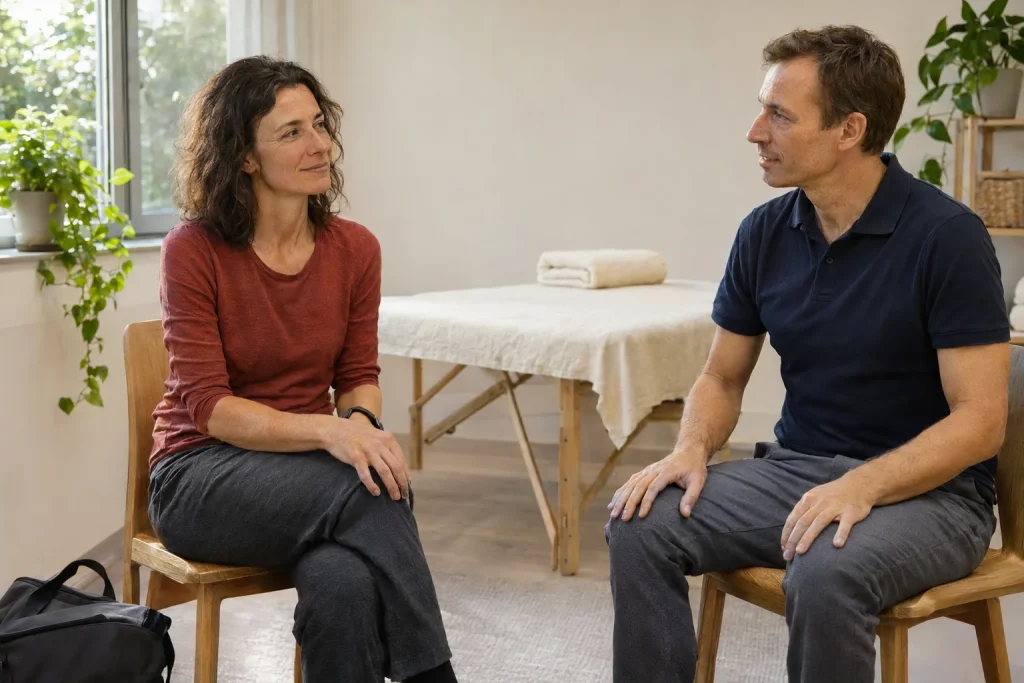
Ask about qualifications, experience and the provider’s role in this situation. Working with athletes alone is insufficient: explain the event, symptoms and uncertainty. “Therapeutic massage”, “sports massage” or another title does not itself establish the care aim and professional framework. A label is not individual clearance.
Clarify the expected process beforehand: which area would be treated, what consent is requested, how to request change or stopping and what happens if you report a new symptom. These are our practical discussion questions rather than method instructions. It can be a valid outcome to recommend assessment instead of performing massage. A service’s value is not measured only by beginning at all costs.
Pressure strength is not a measure of seriousness. You need not endure pain for it to “do something”, and “everything is normal after an ultra” is no adequate answer. Describe specific discomfort and request change or stopping. A study’s procedure does not imply ignoring every discomfort or guarantee stronger treatment works better.
Some symptoms require healthcare help
The NCCIH says serious harm from massage appears uncommon, but rare reports include nerve injury, fractures and clot-related complications. Some involved forceful methods or people with greater vulnerability. Report medicines, known conditions and new symptoms accurately to the appropriate professional. Mentioning rare risk is not a universal prohibition, but a reason to consider suitability beforehand.
New one-sided leg pain and swelling should not automatically be considered ordinary post-race muscle sensation. The NHS guide to deep vein thrombosis recommends urgent medical assessment for such symptoms. Breathlessness or chest pain also requires immediate emergency help; in Hungary call 112. This is not a home diagnostic checklist: certainty about the cause is not needed before seeking care.
Describe symptoms precisely after an ultra even among many tired people. Where did they begin, what changed, is function unusually difficult, and have you received care advice? “Everyone hurts somewhere” is a shared experience, not an individual assessment. Do not test severe or unexplained symptoms with strong massage. Keeping a service appointment should not take priority over appropriate care.
Do not narrow the post-race day around one intervention
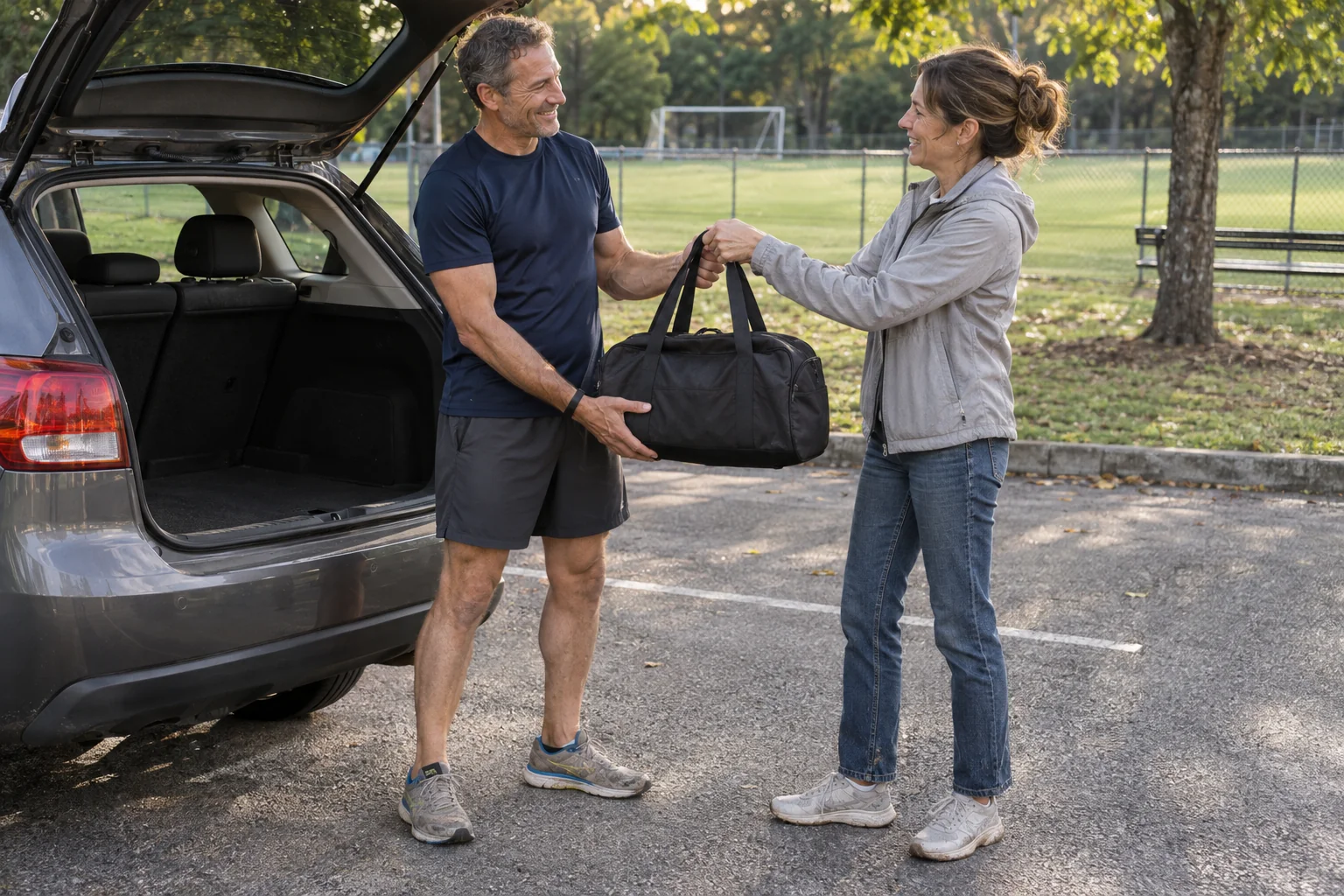
After finishing, you may need things massage cannot address: luggage, getting home, a quiet place or reaching a chosen companion. Plan these separately. If waiting for massage leaves everything uncertain, reconsider what you expect from it. A realistic decision includes comfort, availability, price and the rest of the day without a recovery guarantee.
An on-site service may be crowded while you want a quiet chance to ask questions. At a later appointment you may have more information about your condition and care advice. This does not prove later massage is more effective; the presented trial did not compare that. It illustrates choice. An arrangement that suits your needs does not require invented research justification.
Declining massage does not establish neglected recovery either. One method chosen or omitted does not describe the entire post-race period. Appropriate care, opportunities for rest and later considered return may be your goals. Do not replace them with a dramatic treatment scene. A well-chosen service has a clear task and acceptable boundaries in your situation.
 Enlarge image
A pleasant experience can be described precisely
When asked whether it helped, answer with time and outcome: “My muscles felt more comfortable immediately afterwards”, or “I cannot infer tomorrow’s function from that yet.” Personal accounts need not become scientific papers, but separating claims helps others. A good experience then avoids becoming unsolicited treatment instructions for a runner with different symptoms or history.
Post-ultramarathon massage research is interesting because it allows immediate comfort a place in the evidence while requiring later functional benefits to be established separately. Name your goal, clarify suitability and consent, and seek appropriate care for new symptoms. The task is not to declare massage compulsory or worthless for everyone, but to give it an understandable role in your own post-race day.
Sources
- Hoffman and colleagues: Massage and Pneumatic Compression for Ultramarathon Recovery, 2016
- Nunes and colleagues: Massage after long-distance Ironman triathlon, 2016
- Visconti and colleagues: Massage on DOMS in ultramarathon runners, pilot study
- NCCIH: Massage Therapy – What You Need To Know
- NHS: Deep vein thrombosis
How Futószív articles are prepared: our editorial guidelines.